Will digital currencies overtake the dollar? | Fintech guru explains
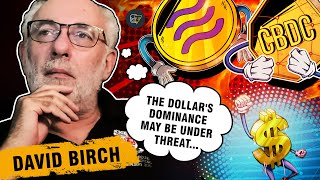
David Birch, author of Currency Cold War, argues the dollar's dominance could weaken if the US doesn't develop a digital currency strategy. He predicts multiple currencies will coexist: central bank, private, and community-linked. Bitcoin works as shared security infrastructure, not money.
Chapters
If there's a thousand different kinds of money and one kind of money goes bad, it's not the end of society.
The global dominance of the US dollar may soon face its deadliest threat. The coronavirus has weakened America's economy and eroded investors trust in the greenback. Data from the Commodity Futures Trading Commission reveal that hedge fund bets against the dollar are at the highest level in a decade. Some analysts believe this is an ideal opportunity for digital currencies to undermine the dollar's global hegemony. On one side, central bank digital currencies will transform international trade and cross border payments. On the other, privately owned digital currencies may disrupt nation states monopoly over money. In the struggle for dominance, which currency will get the upper hand?
The real competition comes from having currencies which are more closely linked to the values of the communities that they serve.
To get a glimpse into the future, I reached out to David Burch, fintech guru and author of the Currency Cold War.
In your latest book the Currency Cold War, you envision a future where the US dollar will lose its dominance. What makes you think that that will happen and what are the implications of that scenario?
Well, there are a number of scenarios, but I point out that if the US doesn't do anything, if the US doesn't have a strategy for digital currency, if the US doesn't have any kind of vision for what it wants to do, then actually the dollar's dominance is under threat. And that doesn't mean that the dollar is going to disappear or that nobody will start using dollars except Americans. But you have to remember because a very disproportionate amount of world trade is conducted in dollars. I can't remember the exact figure, but I think something like four bids of all international transactions have the dollar in at least one leg. That means the demand for US dollars is high and commensurately so is the demand for US denominated dollar denominated securities. And that keeps the value of the dollar high and it also importantly reduces America's borrowing costs. So if the demand for dollars falls a bit, not to zero, but if it just falls a bit, then the cost of borrowing to America goes up. And because America borrows so much, that means it takes quite a hit. But last year Mark Carney, who was at that point the governor of the bank of England, stood up and said perhaps it's time to start thinking about some form of synthetic hegemonic currency. By which of course he doesn't mean Libra. And one of the reasons for that is because of his words, not mine, the destabilizing dominance of the US Dollar. And why does he call it destabilizing? Well, because there are a great many countries around the world where because trade is denominated in dollars and the demand for dollars shapes the economy, they're not really in control of their own policies. You're not really in control of your own country if what you can or can't do depends on the dollar exchange rate.
In this future scenario that you described, private digital currencies such as Facebook Celebra, will be coexisting with central bank digital currencies. So how are these two types of private and state controlled going to coexist?
So earlier in the year, I think it was February or March, I don't have it in front of me, there was a paper from the Federal Reserve. The Federal Reserve did a very detailed numerical simulation of the impact of these new currencies. And their conclusion, I'm paraphrasing greatly, but their conclusion was there might not actually be that much demand for something like some private currency, whether it's Facebook money or Amazon money or anything else. There might not be very much demand for it, but actually that doesn't matter. The mere fact that it exists will have an impact on the fiscal, on the policies of states and what they can. So in other words, the fact that these currencies exist, even if nobody uses them, the mere fact that they could use them will constrain the policy options available to other states. So the first point to make is, in order to destabilize the dollar, do these currencies have to have mass widespread use? The answer to that is no, they don't. So in other words, if you're going to have currencies that sort of compete with the dollar for international trade, you'll probably lose. I mean, why would you? It's very hard to compete. But suppose there's other reasons for using these private currencies. I'll take an example, which hopefully will be a useful example for debate. But for example, suppose there was an Islamic digital currency which had certain characteristics, not interest bearing and this kind of thing. There might be a billion people that want to use that currency, and those reasons are to do with other values. So I sort of imagine the real competition comes from having currencies which are more closely linked to, to the values of the communities that they serve, rather than sort of different instances of the same generic money. So one of the reasons why I'm open to argument about this, I mean, who knows which way it will go. But the idea that you replace the dollar with another world currency or galactic currency or something, I don't quite see that. I think a more plausible vision of the future is that you'll have many more currencies.
So I wanted to ask you. This is a future where the monopoly on money that the government used to have is gone. And the government, the central banks, don't control money anymore because any company, any even personality, can issue its own currency and start exchanging the currency with a group more or less big of people. Why would governments allow something like that to grow at that extent?
That's a really interesting question, of course, because obviously one of the things a government wants to do, one of the things we want a government to do, is to control monetary policy. I mean, that's one of the things we elect a government to do, is to be in charge of money. But do they necessarily have to produce? I mean, the government doesn't run airlines anymore, but it's still in charge of the faa. You can't just start an airline and fly it around and crash it and say, oh, that's hard luck. It's caveat emptor, like defi kind of thing. It's not like that. The government doesn't run the airlines, but there's the faa. So the government can decide how many airlines there are and how many landing slots they get at the airports and this kind of thing. So the idea that the government couldn't control money if it wasn't making it itself, I think that's a different argument from an argument which I don't want to get into, about government debt and borrowing and financing your own. So if you're talking about currencies that would be viable in the future, I don't think the two things are in conflict. You could have lots more currencies, but the government could still be in charge of them.
What role will decentralized currency like, like a bitcoin play in such a scenario? Because bitcoin is considered kind of unique in the spectrum of all these different digital currencies that are arising because it's the only one without ownership. I mean, without a company that runs it, it's the only one which is decentralized, and it's the most likely to replace gold as a sort of digital gold. So what's your opinion about it? What role does bitcoin play in this kind of future scenario?
I mean, I know this will infuriate a lot of your readers, and I am always open to new arguments and new suggestions But I am just not convinced. Craig Wright, and I know we all love Craig and what he says, but years ago, I can't remember the exact. He said something like, don't think about Bitcoin as money and don't think about it as a payment system. Think about it as a shared security infrastructure. It's an infrastructure that we all share in to give us a secure platform to build on. And I kind of find that vision more interesting and more attractive. But if I had to guess, I would say that the world of digital assets is much more interesting. So in other words, if we assume that cryptocurrency is actually the security infrastructure, that we don't actually care about the value of those currencies, only insofar as it has to be high enough to maintain the security infrastructure. What people will actually trade are the digital assets that sit on top of that. And if you speak to people in the finance space, which I did for my book, they're pretty positive about that digital asset layer, like the money guys. They would prefer to trade money like digital asset instruments tokens, not for any kind of ideological reasons or because they're committed to Bitcoin, but because it's cheaper. Basically, if I want to sell you some IBM stock, we have to have brokers and settlement and clearing and delivery versus payment and all sorts of infrastructure which cost a lot of money to maintain back offices. But if I just sent you some IBM money, like from my wallet to your wallet, end of story, right? And it's the same thing with all kinds of digital assets. So when people talk about. And some of the stuff sounds crazy, of course you'll have digital assets which are 1 square meter of some office building or a digital asset which is, I don't know, 1/1,000th of a Picasso or something. That stuff sounds crazy, but actually, to me, that stuff sounds more interesting and more likely than the underlying cryptocurrencies whose value is determined essentially algorithmically or in some other way.
In a recent interview, you said that money should be under democratic control. What do you mean exactly by that?
Well, I mean, I want to live in a society. If money isn't under democratic control, then whose control is it under? To me, having money which is under the control of oligarchs or. I'm. I can't see why that's controversial. We're not cavemen, right? We want to live in a society. And if we're going to live in a society, then the money should be under democratic control. I don't think that's a particularly controversial statement.
But in the article where I saw that quote, you were somehow talking about this bitcoin maximalist who would disagree with this thesis? Why do you think the bitcoin maximalists would disagree with the fact that money should be under democratic control?
Next time you have one of those guys on your show, ask them. So suppose, suppose Bitcoin was the. Suppose we already had a bitcoin economy, right? Suppose Bitcoin was the only money in the world. So suppose nobody was using anything except bitcoin. We were saving bitcoin. We were buying everything with bitcoin. Suppose Bitcoin was the only money in the world, right? What would you do about the pandemic? What would you do? You know, you say, well, okay, you know, oh my God, the Federal Reserve is printing money. Well, good. I mean, that's sort of what it's for, you know, it's the idea that, you know, you have this, I mean, if you're an 18 year old computer science graduate undergraduate at MIT, this idea that it's caveat emptor and everybody should look after themselves and it's, you know, that sounds good when you're 18, you know, but it makes no sense as an actual, an actual manifesto for how to organize the economy or society downstream. I tease people by saying, you know, I mean, this all sounds good until your grandma presses the wrong button in an email and sends her life savings to Minsk and there's no way of getting them back. Then all of a sudden having some sort of order starts to sound a bit better. Bitcoin things. I mean, it's not fair to pick on people. I know people have more sophisticated views than this, but you do hear people say, oh, it's like the Wild West. That's an exciting thing and it's fun. Well, if the Wild west was all that, we'd still be in the Wild West. There's a reason we're not in the Wild west. Because it turns out not to be the best way to organize society. Just letting everybody fend for themselves. And I don't buy it. I think we should look to constructing better solutions for society as a whole. And a better solution for society as a whole might not be unaccountable money that's. Untraceable and blah, blah, blah.
In a recent interview with US founder of Electric Capital, Avish Al Ghar said that China is likely to gain huge influence on the global financial system if it gets to launch its own digital currency and a settlement system based on that currency.
And I worry that the US Government trying to compete on technology on equal footing against the China basically means that.
The only way the US can compete with China in this field, according to him, is by offering something that China cannot offer, which is privacy in transactions. Do you agree with this kind of analysis?
I mean, I would say that's. I mean, we might disagree on the details of how, but I would say I broadly agree with him if we're going to make a digital dollar or a digital sterling. So remember what I said earlier on about in this decentralized world, I can sort of see that currencies would be more closely linked to the communities that they support. And some of those communities might be things I was thinking about, but they might also be national. You could think about the US as one of these communities. So what will be the values of that community that a digital dollar should represent? And there are certain values, and I think privacy is one of them, which could distinguish it, which could mark it out. Now, where I will fall out with your bitcoin readers is privacy is not anonymity. Privacy is a function of that society we want to live in. So if you're going to argue that to compete with China we should have anonymous currency, then I would say you're completely wrong. If you're going to say we should compete with China by having private currency, I think you're very probably right. And what's the difference between the two? The difference is when I talk about anonymous currency, I mean unconditionally anonymous. I mean, no matter what you do, you can't find out who the parties to a transaction are. That would be a catastrophe. That would be a catastrophe on every level. When I say, for the obvious reason, which is if you do that, then the people that are already rich and powerful and unaccountable will become completely unaccountable. You would have no idea who was funding political campaigns and who was bribing politicians. I mean, that would be crazy. Unconditional anonymity is a recipe for chaos. But privacy is one of the values which I think we culturally would like to uphold. So the idea that transactions are private until such time as a law enforcement, a valid warrant provided by a judge for a limited purpose for a certain number of transactions, blah, blah, blah, whatever protections you want to build in.
Thanks a lot, David, to talk to us.
No problem. I shall sit back and I shall enjoy looking all the hate messages underneath the YouTube video from the bitcoin aficionados. Thank you for the opportunity.
That was fintech guru David Birch. I'm Giovanni, your host. If you enjoyed the interview, don't forget to smash the like button and subscribe to our channel.
Subscribe, Cointelegraph, like subscribe and hodl.










