Will RWA Tokenization Be the Next ETF? - Eric Piscini, CEO Hashgraph
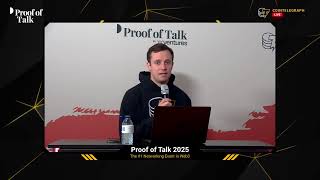
Eric Piscini, CEO of Hashgraph, discusses whether real-world asset tokenization could become as mainstream as ETFs. The conversation covers Hedera's technology, how DAG differs from blockchain, and the role of AI in decentralization.
Chapters
Hello and welcome back to Cointelegraph's live stream right here from Paris at Proof of Talk. We are talking to a number of big name speakers that have taken the stage here at this fantastic event. If you are watching the live stream on X or YouTube, please go ahead and drop your questions in the in the channel if you want to pose some questions to our guests throughout the day. We will continue to be live a few more times this afternoon, so keep it locked on Cointelegraph Socials as we go. I'm joined now by CEO of Hashgraph, Eric Pacini. We actually just sat on a panel this morning talking about AI and blockchain. But let's just set the scene for the viewers out there that aren't too familiar with Hedera and Hashgraph. What you guys do, what your real use case is and the majority of your users around the world.
Yeah, good, thank you for having me. It's been fun here right in Paris. I was born here, so I always love coming back here. So Hedera is a project that started in 2018. Dr. Leemon Baird and Mance Armand started the project. The co founders and the foundation was we're going to build a very efficient, high performing layer, one that is going to be able to activate any kind of use cases with very specific characteristics. One, the transaction fees are denominated in dollars, not in crypto, which means that if you're a business you can build an application and know exactly how much you're going to pay in the future. Very important. Second is the technology itself, which is technically if you're in technology is not a blockchain, it's a DAG with a gossip mechanism. You can look it up. There's a lot of interesting things that Dr. Ryman Baird invented and they are part of this very, very unique. And the third piece is Hedera as a council which actually is meeting today in D.C. so I'm missing the cancel meeting as we speak. But the cancel is 30 plus organizations running the network on behalf of Hedera. So Hedera is a public ledger, but permissioned because only those 30 organizations can run the network. And there are Google and IBM and Dell and many, many big, big firms doing this. And I'm the CEO of Hashgraph and Hashgraph is the team behind the Edera network. So the founders are with Hashgraph, everybody in marketing, communication, product engineering, security, blah blah, blah, blah blah. Everybody is working for Hashgraph pretty much except for the people giving grants to activate the ecosystems and they are working for the Hedera foundation.
When it comes to talking about hashgraph and Hedera not being a blockchain but a dag, maybe you can just explain that a little bit more and why that specific use case works in the industry and why it's very favorable for enterprises and people that want a sort of more permissioned network than they would get with using Ethereum or something else.
Yeah, so it's a little bit of a layer game, right? So which layer are you looking at? So if you look at blockchain today, one of the challenges of a traditional, let's call that traditional blockchain is performance because you have to wait for the blocks to be created to get finality of your transactions. And the second challenge is fair ordering, right? And with dag, and we are not the only DAG in the market by the way, but with dag, you actually avoid that. You don't have to think of those issues because you are providing by default fair ordering, which is extremely important in capital markets. Right. You don't want someone to front run you when you about to trade something, right. A token or anything. And then the second piece is, it's much more, the performance of the network is much faster. So for example, we can go to 20,000 transactions per second at the layer one, right? So typically you get that level of performance at layer two because they cannot achieve that on Ethereum or, you know, any other layer one. We are really, really efficient. That's the value of dag. Right? And then of course that translates into adoption by enterprise, adoption by the retail market, because they can benefit from those two things, fair ordering and high performance.
Yep. I've got a question coming in from the live stream and I'm just going to pose it to you from Biz Ben. You connected a SpaceX satellite project. Do you really expect IoT scale adoption from space or is this sci fi hype? I think that's quite an interesting question.
So it's hard to comment on rumors, right? So what I can say is that our blockchain would be really well positioned to support the use case, which is payments, right? Because we can do that very efficiently. So for example, a consensus transaction is a fraction of a cent dollar cent. So when you do payments and your transaction fees are, you know, 50 cents, that could limit you in what you can do from a payment point of view, because we are a fraction of a cent, in some cases hundreds of a cent. Right? So really, really cheap transaction fees. Then you can actually enable micro payments and payment streaming. Right. And so of course Those platforms that we binned for others can be used by major organizations to deliver their own payment solutions.
When it comes to the Hedera Council and all these big name household institutions being part of that council, some people in the ecosystem might say that this is never going to be as decentralized as you would want it to be. If only a handful of participants can be the network validators, as it were. What are your thoughts on that and the general approach?
So I'm going to create a storm on Twitter if I re answer. But that's okay. We did an analysis, right? You have the Nakamoto ratio, the decentralization ratio. And we looked at that against Ethereum, for example, and because of the Ethereum pools, we were actually on par with Ethereum when it comes to decentralization because we do have really independent organization that are running the nodes. But I would argue that quality in decentralization of the node is actually more important than the quantity. And let me explain. When IBM, Google and Dell are saying we are going to run a node on Hedera, right. They are not just committing to stake, they are also committing a brand, their brand to support a project. And they will never do something dramatic or nefarious against the network because they would damage their brands. Right. So there is an additional layer of another dimension of analysis when you think about decentralization, because it depends on who is actually enabling that decentralization. I think that's really important in our context.
It's interesting that you say that because I met the head of Web3 at Amazon earlier today at the breakfast that we were at. And look, I know this is a fact, but I don't think a lot of people do. More than 50% of you know, Ethereum's validator infrastructure is running on AWS servers. So when you think about it like that, it's like if we're going to be pointing fingers at people for centralization.
Exactly. So we pay a lot of attention to that too. So for example, I think we have 20 different cloud and infrastructure locations running nodes. So we are not centralized from a cloud infrastructure point of view either. Right. That's a really important topic. You're right.
I've got another question coming from the live stream and please do keep them, keep them coming through. This is your chance to ask some of the big names, the industry the hard questions that I might not be willing to ask.
Not too hard, not too hard.
You can always say no comment. Yeah. From Ola xt RWA Tokenization is sparking swell calls, brewing what's the play behind this trigger? Let's talk about RWA tokenization. I just spoke to Reeve Collins, who was one of the original founders of Tether, and I think that's the original RWA tokenization. You know, tokenizing dollars, that's. That's one. One flavor. It's now morphed into something way bigger. You can do property, you can be tokenized securities, you know, everything and anything. Do you see that as the real future, like core use for a lot of these different blockchain protocols that exist today?
Yes, but not the only one. Right. So I think, I think tokenization is. Was part of the foundation of blockchain. Right. I've been in blockchain for 12 years. We were talking about tokenization, maybe with different names, but we are talking about tokenizing assets, whether it's a physical asset, a digital asset, an identity, a right, legal right. We've been tokenizing from the beginning. So tokenization is just getting more traction today because now we finally are able to deliver those solutions around tokenization at scale. I think that's the. So it's not a new thing, but it's getting more traction today because we can actually deliver at scale. What's exciting to me is you create an environment with tokenization where you democratize access to a lot of things that people don't have access to. And yes, technology is one piece of the solution. The regulatory environment has to change as well. So if you're in the US and you want to invest into a real estate project, typically you have to have a lot of money and you have to be an accredited investor. With tokenization, you don't have to have a lot of money anymore because you can invest $100, but you still have to be an accredited investor.
Yes.
Right. So that is. The technology piece is fixed now. It's done. Now we have to fix the regulatory environment. But if you scale out and you say at the global level now, you can. You have people in other jurisdictions who can invest into assets in the US and vice versa at a very low cost with a secondary market. And that really change the nature of markets. And we're going to see that around real estate. We have a project on real estate, many projects, but one that's very, very well known by our community, called rights one.
Okay.
And we are tokenizing real estate and enabling people to invest and resell their participation into real estate projects on itra.
Okay. So that's a key use case. Right. I mean, and a very real one that exists.
It's Very real. It's on its lives. You can invest into those things right now. If you're in the U.S. you have limitations, as I said earlier. But we tokenized, you know, money market fund, we tokenized mature funds. We tokenize, you know, identity, which is usually not. We, we don't talk much about identity anymore. But that's one way to tokenize as well. You tokenize your own identity or you tokenize the identity of your AI agent, which is maybe the next topic, Right?
Yeah, definitely. Let's talk a little bit about AI. I mean, hashgraph is now integrating some, some AI functionality into what you can do. Tell us what that looks like and what the future sort of integration and use of AI for, for your organization and your layer one is in the future, I think.
And this morning we were talking about. It was great, by the way.
It was a great panel.
It was a really, really good discussion. Thank you for moderating and asking the right questions too.
You're welcome.
And we were talking about three different layers of AI and blockchain, right? So the first one is decentralized AI. So we cannot continue to run AI infrastructure and AI models just in centralized entities, right? Because they own everything. They own your input, they own your output, they own the models, they own the data. They're going to get better and better and better. And we don't want to recreate a world where they control everything because we are going to be interacting with AI a lot in the future. So we need to find a way to decentralize that infrastructure. So if one of the big AI company tomorrow for some reason stops to operate, we can still benefit from that model because it is a decentralized infrastructure. So that's number one. Number two is when those AI activities are taking place, we need a, a trust layer for the AI supply chain, right? So from the sourcing of the data to the running of the model, to the learning activities, to the output and the output turning into an input, all of those events must be reconnected on a ledger, on a public ledger or a private ledger, depending on the scenario, but on a trust layer. And the trust layer is a derived in our context, and we connect all of that here. So that's the partnership we did with Equity Lab, the partnership we did with Provai and other companies, they anchor an AI activity along the AI supply chain on the hedera, so that in the future, if we want to have an audit trail of what happened, we can, if we want to make sure that the right data was used to feed that model to create the outcome we can. Right. That's a very important part of AI and blockchain, that, the trust layer. And then there is the third layer which is coming now is those AI agents will need to have the ability to transact with humans, with others, with companies. And so they're going to need a wallet. Right. They're going to need a blockchain piece of infrastructure. And that's a third layer. And we are working on all three as Edera to make sure that we achieve that vision.
Yep. I just want to probe that, that second point that you made a little bit, in a little bit more detail when it comes to like all the centralized AI, you know, tools that exist, ChatGPT, you know, DeepSeek, Grok, decentralized and like you say, they probably have all that information on their servers. They can see who prompted the, the AI, what and give it a bit of an audit trail. But you would like, if you wanted the information, you would have to subpoena them or something like that. Whereas. Yeah, and probably they're going to say no. Right. Whereas this approach gives you a lot more transparency and a lot more accountability.
When it comes to using them and sustainability. Right. And Ben from Singular Singularity Net this morning was at a very important point. So Ben, back to you. The point was, yes, everything is open source, almost open source, or will be open source. But open source doesn't help in this context because you need so much processing power and storage to be able to run a model that even if I have access to the code and it's really good code, I don't have a billion dollars to run a data center. And so the decentralization through open source is not a good way to do it. It's not enough. It's good, but it's not enough.
Yeah, just looking forward, I think we'll probably wrap up the conversation here. What does the next five years look like for Hedera and Hashgraph? Do you still see your main sort of user base being institutions and enterprise grade sort of applications? And could it translate a bit more into sort of retail use cases, how people use Solana, Ethereum, Sui, Aptos and all these other.
So we do have retailers projects. Right. We have, you know, clarity Combat, I'm sure people know. But this one, that's a really cool one. Customer engagement will always be part of our DNA. We'd continue to do this. What's interesting when I have that question is to me those words are merging. So we don't have to actually say we're going to spend more time here or more time here. What I'm saying is those two words, retail and business, are merging into one world for different reasons, but the developers are moving from enterprise to retail to enterprise to retail. So it's not like the different people. It's the same people, but they move around. So they bring with them their expertise, their experience with Hedera and so on. So I don't see us focusing on one segment of the market. Not because we can. We could if we want to, but there's no need for that. There's no need to focus on one piece of the market. So we continue to do this. And if, if you guys have ideas on how to use Hedera and engage with us and make sure that we build something that you can benefit from, you know, come to us and we can talk and we can engage. I think that's a very important piece of the discussion.
That was actually one of the questions that came through on the live stream from hack. Hank, you're investing in hackathons with $360,000 prizes. Are these developer incentives working, or do you see it as a sort of a waste of money, as it were? Like, does it work?
We look at hackathon the same way we look at investment portfolio. If you're a VC or, you know, an investor, right, you say, I'm going to make a bunch of bets. Most of them are going to fail, but the one that are going to work are going to be amazing. Right? And today we have companies in our ecosystem who went through the hackathon originally and are now, you know, top projects for us, generating returns for themselves and for Hedera. So, yes, it does work, but you have to arrive at the right level of expectation. You cannot expect everybody to succeed at the end of the hackathon, or even the winner will not sometimes win anything because maybe they don't have the infrastructure, maybe they don't have the time. Maybe they were doing that for fun, maybe. So you have to have low expectations for hackathon, but I will not stop doing them because it's really, really important.
I've been to a lot of the Ethereum hackathons, and I think that they're hugely valuable for any of the different protocols that are doing it. Eric, thank you so much for your time.
Thank you.
It was good to catch up with you. If you guys enjoyed this conversation, please like and retweet it. If you're watching the live stream on X, if you're on YouTube, once again, give us a like. Subscribe to our channel. We bring you the best interviews right here from the ground. On Proof of Talk. We are going to be taking a short break and we'll be back with our next interview. I'm chatting to Austin Federe from Double Zero. A lot of you will know him from his previous role at the Solana foundation, someone we've spoken to a lot. Really looking forward to that conversation. So we'll be back in a few minutes time. Keep it locked here on Cointelegraph. Thank you very much.










