Inside the Carbon-Negative Bag Brand Disrupting Fashion
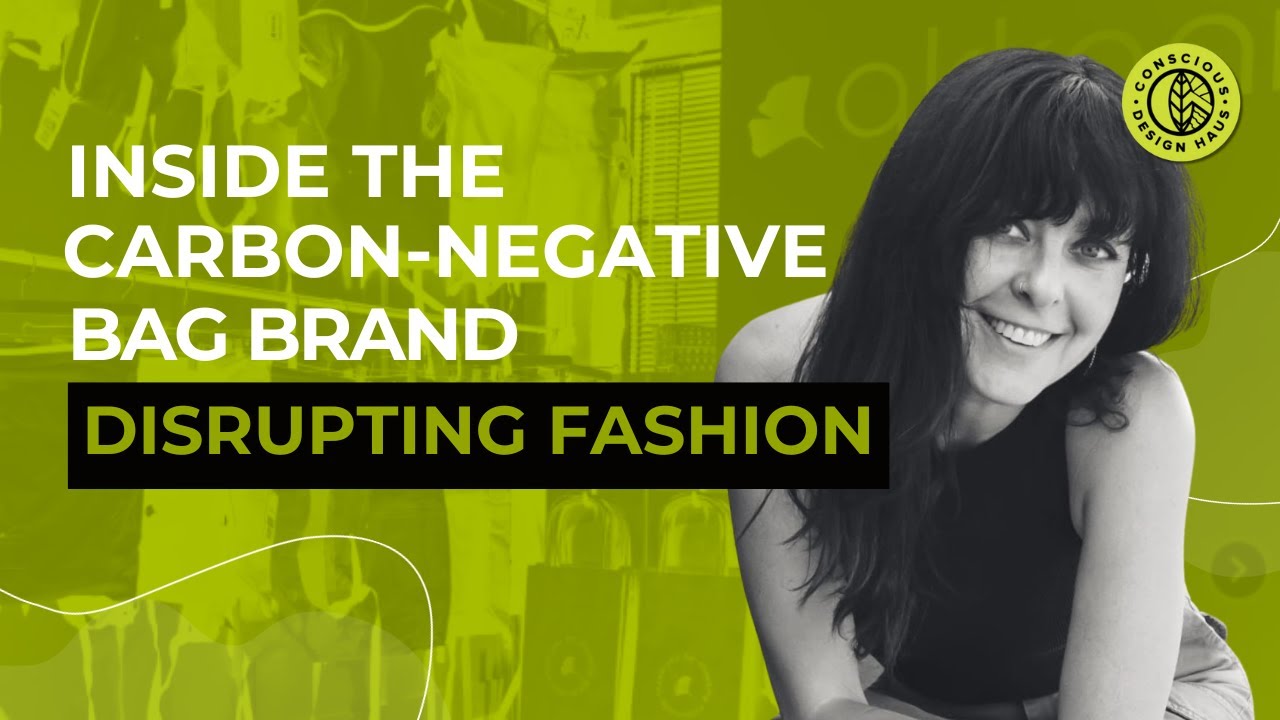
Alana Kumpski, co-founder of Econic, left two decades designing leather bags for major brands to start her own carbon-negative bag company. Each bag plants a tree, uses ultra-lightweight materials to cut shipping emissions, and employs 3D knitting to eliminate waste. She argues good design, not sustainability messaging, is what actually sells.
Chapters
Our planet is really bad shape. I think from now on, every product should be sustainable. Every action that you do should be—you know—you need to give a shit about this planet. I mean, we live here, so this is a must. It's not a trend; it's a base of every new product from now on. Not only for me, for everybody.
Hello and welcome to the Conscious Design Podcast. I'm your host, Ian Peterman, and I help turn product ideas into sustainable 7-figure businesses.
Join me for another episode where sustainability meets innovation and business savvy.
Today, I'm really excited to have Alana Kumpski. She's the designer and co-founder of Econic. They're a company that creates sustainable bags and related products. Welcome to the show.
Thank you. Thank you for having me. Nice to meet you.
Yeah.
And you did the— you did it with the names.
Perfect. Nailed the names. Well, let's start a little bit about how did you— and I know your, your co-founder is your brother. What got you guys to decide to launch this company and get into sustainable bags?
And so I design bags and I go 2 decades ago, 2 decades back. I'm designing bags since I finished my degree. I studied industrial design and I worked for big companies, very familiar companies, leading in the video and photo market, designing bags. I didn't study bags to design bags, but that's how it happens. So that's where I was. And, uh, after 2 decades of really impressive career and, and really I had it all. At some point I made a big change in my personal life. We both did. Me and my brother became vegan and I started to live a really sustainable, uh, lifestyle as much as we can. Right. I'm not a saint, but I'm trying. So like 10 years I was doing, uh, good in my personal life, but Still faking in my professional life because I was designing bags made of leather and the whole industry, the the real industry, the big shots. I mean, sustainability is not something that they really care about because it's usually not financial. It's not. It's a waste of money. Manufacturers doesn't like it. Suppliers doesn't like it. Of course, the owners and the shareholders. It's say something that they really just don't interrupt me with your sustainability. So I lived like fake life. I mean, I was believing in something and I was doing something else in my professional life. At, at some point, just couldn't do it anymore. I just decided that's enough. And well, I left with my profession, something, my desire, my passion, something that I love. I love designing bags. And it was either continue designing bags, but in according to my beliefs, according to my principles, or just stop designing because it is not a very pretty process. I mean, it does have its carbon footprint, even when it's sustainable. So either do it in a way that it should be from like 10 years ago on. We almost late. Or just don't do it at all. So I decided to, actually my brother was pushing me a long time ago to start my own company. He really believed in my, in me being a very talented designer. If he would be here, he would probably say something like this. So he pushed me a long time ago to start my own company, but I didn't see a purpose, you know, to have another brand of bags. What for? Another that will end up at the landfill, you know? So, but at some point when my personal life and my professional life just couldn't continue anymore as it, as it was, uh, for the last 2 decades, I realized that's what I need to do. I need to design sustainable products because I know how to design. I know how to design good, and I can actually democratize this sustainability to the people. You make a real impact. Yeah.
Amazing. Well, yeah, I feel like you're not the first person that I've talked to that has this, you know, they have a job and they make changes in their personal life. And then after a while they go, well, I can't, it doesn't make sense. Why am I doing a double life?
It's a double standard. I can't live by a double standard. It's really difficult. It's like 2 separate lives.
Right. It's, you can do it for a while, but after a certain point, like you said, it gets really hard to separate the two and be able to keep, keep doing that. Let's talk about the bags that you work on, right? Your bag collection now that you have, and there's a lot of ways to become more sustainable. How have you gone about making bags that are like, like you said, typically very not sustainable focused at all? How have you gone about doing that, making them more sustainable?
Okay. First of all, I haven't found the formula that says the bag design, the bag will design the product in this way and it'll be perfectly sustainable. There's no such thing.
Me either.
I'm still looking for it.
Let me know if you find it. I'll let you know.
And it's a trade-off, you know, if you go for recycled, recycled materials, there is a footprint, but then you use the waste, the plastic that we already produced, you give it a second life. If you use a biodegradable material, they're less durable. They're less, they're more expensive and they're less affordable to the mass market. Every decision, it does have its own impact on how it is being sustainable. And also it's a trade-off, but I decided that I will have these, you know, guidelines. First of all, I do a minimalistic design. This is something, this is who I am as a designer. I always, uh, been, uh, I was more excited about minimalistic Japanese design. Don't like, you know, features that doesn't have any function in them, that they're just only, only for fun or for marketing details, marketing features. And this is something when you work in a corporate and with corporate doesn't exist. You cannot do minimalistic because you need to do something that will sell. And when you do like 2 collections, 2 big collections every 4 months, you need to reinvent yourself over and over again. That's the way you just throw up all the features that they really don't need. The end user doesn't need, you put it on the, on the products so they will have something new to buy. So this one I decided to, to drop. this principle, so my bags are really minimalistic. I mean, every stitch and every line, every pattern is there with its own function and not just for, you know, for looks.
Mm-hmm.
I use sustainable materials. In this area, I really play from, I mean, sometimes it's biodegradable, sometimes it's recycled. It's never like a little green blanket that we cover ourselves to say that we are sustainable. It's always, full 360 degrees sustainability as much as we can. You know, we're also a small business, family business. I have less approach to the manufacturers that do actually more sustainable materials. And for me, they're much more expensive for us as a small business. So we do have like a million obstacles on our way, but— It's like, don't do sustainable. That's what the world trying to say to us. But for me, it's, it's, it's clear that this is the way. So sustainable materials, biodegradable, recyclable. Our bags are very lightweight. Lightweight, not only because it's not like outdoor backpacks that you really need to go with it, you know, to climb mountains or long treks. That's not the reason. Actually, I do functional fashion. It's Not even outdoor bags. It's just fashion, but it's a functional one. So they lied because eventually when you stop using your bag, it ends up at the landfill. Whether you put it in a recycle bin or just in a trash, it doesn't matter. So if they are, they're like 3 times less heavy or lighter than our competitors in each category. So it's like for every backpack that you buy, or bag, shoulder bag, messenger, whatever that you buy from a competitor, we can make 3 of them, 3 bags. So less sale, less waste. This is another principle. And I believe in honest design. I think design must be honest if it wants to be good. And honest design doesn't use the marketing features, doesn't use useless And, you know, extra pockets, extra padding, extra— for example, our shoulder straps, they're not padded because after 20 years of doing harness, professional harnesses, I realized that for your day-to-day use in urban environment, you don't really need this foam inside your shoulder straps. But it's still there because it sells.
Right.
Minimalistic materials. We also, we're carbon negative. This is important. Because we plant trees for every single bag we sell. We work with a company that plants trees, uh, and, uh, actually we're able to, to clean the air up to 250. I'm not sure about the number, by the way.
That's okay.
Don't get me on that. I think it's, yeah. So we also do that because as sane as we can be, it's still, uh, this process, production, manufacturing, uh, shipping. It takes energy. It's a footprint we cannot ignore.
Right. Well, and imagine having a, a lighter product. It's shipping less stuff. Just a less, less weight overall makes it, reduces a lot.
For example, this is a bag. This is a pouch. All the packaging is really compact. That's another reason. I mean, that's what I meant by saying 360 degrees. We are trying to be sustainable all over, production-wise, planning, patterns, graphics. Our packaging is not coated, it's recyclable, it's only one-color printing without harsh chemicals. Okay, there is a price for that too. For example, for gentle fabrics, for biodegradable fabrics, you can't wash it in a washing machine. From the other side, we don't suggest that to do it for any bag or shoes or because It shortens its life circle.
So, so a little bit of different care, I guess the care instructions also.
You need to care. You need to take care of the stuff you like, you know, the planet. Let's start with the planet, animals, why not? And also your bags, some that you buy, especially if you bought it for, you know, it's not like, I mean, the fast fashion, uh, really ruined us all. So people don't really care about the product they bought, the t-shirt they bought for $10. That's why. And it costs $10, not because it really costs that much. It costs $10 because someone else is paying the price, either the worker in Bangladesh or whatever, or the planet.
Or the planet.
The planet takes a lot of those.
The planet always pays the price.
Yeah, it always gets the price. It always pays it. So you mentioned you use different materials. I would love to get your thoughts on, cuz many people have different opinions as to what perfect material is, but you've worked with more biodegradable versus more recycled. Do you have a preference? Have you, like, what have you found in playing with all these materials that, that you think of as a designer and, and with these bags?
That's exactly what I found. I told you before, it's a trade-off. There is no perfect material. Some are more suitable, for example, for our European clients. There is a lot of rain, so we use more rainproof materials. For example, so it's more synthetic fiber. From the other hand, biodegradable, they also work. I have a client in Amsterdam that keeps on convincing me that it's waterproof, the biodegradable bag that made of a wooden pulp. It shouldn't be, but it keeps on convincing me that, listen, I was in heavy rain, it works.
Hey, it's your host Ian. I'm really glad you're enjoying this episode.
I absolutely love highlighting amazing brands and founders for the awesome things they are doing.
I've helped hundreds of entrepreneurs and businesses like yours turn their boldest ideas into powerful purpose-driven brands. So if you're serious about building a brand people love like our guests and clients do, and one that you're proud to stand behind, I invite you to dive a bit deeper with our book Conscious Design. Inside, you'll discover the exact framework and steps we use to help entrepreneurs like you turn purpose into a powerful impact-driven Brand, brand that stands out, attracts loyal customers, and drives sustainable growth with social and environmental responsibility woven into its DNA. Grab your copy today. You can find it on our website consciousdesignhouse.com, or just find the link below in the show notes. Enjoy the rest of the episode, and don't forget to like, subscribe, and share.
You're using 3 materials now. I would love your thoughts a little bit more on the 3D weaving, because I've heard, I've started to talk to a few different people that are starting to use that. And so you're now another person that I've run into that is using that. My main understanding is that it is a lot less waste in how it makes the bags, but I'm curious about what drew you. to that technology and what's making it useful and worthwhile for you?
It's the big idea. Actually, I started to work on such a project many years ago with the company I was working for. It was very successful, but it was very successful as an academic, more conceptual project because eventually it's very, very expensive, still very expensive to make the whole bag woven, knitted. Sorry. I decided to use knitted material, uh, out of 2 reasons, main reasons. First of all, it's 100% recycled, uh, which is, um, um, like reusing, uh, something, the trash that we already produced. And also once it's, um, knitted, it does get this 3D dimension, reduces the processes. Like I don't need to pad. Parts, and I don't need to reinforce some parts, uh, to be standalone because this knitting is making like very, uh, constructive fabric, very constructive textile. That's the idea. I'm not doing the whole bag made of, you know, like thread goes inside the machine and, uh, there is a bag coming out of the other side. Unfortunately, I wish, but this is not for small, uh, small companies yet. It's The process is very, very expensive. I'm sure we'll get there. We are going there. It's like the, the technology is already very, um, feasible, just a bit expensive.
Right. So you're using it just in part of your process because like what you're saying, you're able to combine some parts together basically and using this—
Using it instead of main, uh, main fabric. So the whole external material is really needed. As I said, it does reduce some processes, like instead of 20 rotations in the production, it goes only 10. So it's less energy, less time, less upfront. It's also very important.
It makes it easier, faster, lowers your— I mean, not necessarily a lot cheaper, but it does make your process a lot easier than in manufacturing.
No, no, it's not cheaper at all. It makes it much more expensive because I am One of those designers that the manufacturers doesn't like because they asked it to be recycled and asked it to be without chemicals. And, and, you know, uh, we are so used to, for shortcuts, to use, I don't know, petroleum for our creams, for our faces, and because it's easier and cheaper and it's very difficult to, to educate, uh, also the industry. Very difficult.
Right. That actually fits perfectly into what I wanted to talk to you about next, which is, you know, your customers and the feedback. I know you have your one in Amsterdam who's, who's very much working on getting you to see that it's waterproof and, and agree with them. But how overall, how have people reacted and how have you handled kind of, especially with the, with the material that requires a little more finesse and gentle care. That's a little bit of a change compared to, you know, what I, at least from what I've seen people treat their bags, and it's not as, you're not as gentle to them. So how has it been, you know, getting feedback from customers and helping educate them?
So first of all, not all of our materials, it's only the Tyvek, the white bags that are really lightweight, like 23, Liter, I don't know. Are you Canadian? You're Canadian, right? You use also American.
We use all of it. I'm based in the U.S., but I've used it all.
Liter she wants. So twenty-three liters. Twenty-three liters is like a day pack, a very nice day pack. Weights only three hundred fifty grams. Imagine that. So it is gentle, but. Not every material that we, that I design with is gentle. Some materials, my kid is using one of the bags made of, uh, wood, um, uh, pulp since the 3rd grade, like 4 years already. And he's a kid, you know, the bag is working hard.
Yes. Yes.
So, uh, I do, all the, um, products are durable, highly durable. There's one collection that needs to be treated. Better, but I think every product that you buy—that's what I try to educate my customers, especially those who I meet in person. Because we sell a lot online, and in some places, for example, we we sold the to drop principle. So might be not interested yet in sustainability, unfortunately. But they like the design, so it it works well there in Korea and Japan. So there I couldn't really educate. I can educate the seller person, the one who sells my product, but not in, for example, in my country, they really meet their customers and this is really nice. So every time when I explain, I do explain for everyone, all who asks me at the fashion shows or fairs that we sell our products, that we meet people actually face to face, I do educate and I do explain. That they need to take care of their bags, the products they buy, they need to love them and treat them well so they will last. But not everyone can do it. You know, there are some users that simply cannot, not gentle users, and it's okay because there is also a solution for them. And it's a long journey. It's like, I don't think I have the power to educate the whole, uh, system. But from the other hand, I do believe that every single step, I, I do see how it spreads. People know more and more about our brand, about the uniqueness and, and what we actually do, how we democratize the sustainability, because it's not very popular yet. And I think the design itself helps me a lot because They don't look like, you know, they don't look like bags you would buy in a nature store or something like, I don't, I simply don't compromise on design. It must be a good design, a perfect minimalistic, you know, fine design, even if it's sustainable.
Right. Well, that's something that I've, I've seen more and more and more people that I talk to, it's. You can't just be sustainable. Like, it's— yeah, yes, you should be sustainable, but you have to— and I love that you do this— you have to design a good product. It's got to do— it's got to be useful. It's got to accomplish what you want to accomplish and be sustainable rather than just, oh, it's, you know, like you said, it's, it's something that's, uh, burlap or something that looks Like it's a sustainable product and it doesn't look like something that you would want to wear in a fashion show. And so I think that's— I love that you brought up getting into Korea, Asia, Japan, is that those— you got into those areas which are not as much, you know, sustainability is not a selling point. You got in because of good design, good design. And now you are selling a sustainable product to them. But they're not buying it because it's, it's more sustainable. They're buying it because it, it actually looks good and it, and it works and they like, they like it.
Exactly. Exactly. This is the way, my way to push sustainability because first of all, I agree with you. Sustainability is, is not a trend. It's a must-have. I think we are almost a long time ago. I think we, we passed this, this point where our planet is really in a bad shape. And, uh, I think from now on, every product should be sustainable. Every action that you do should be, you know, you need to give a shit about this planet. I mean, we live here.
Yeah. Yeah. It's our home.
So this is a must. It's not a trend. It's not a, it's, it's a base of every new product from now on. Not only for me, for everybody. For those who don't care about sustainability or are not ready yet to accept the, you know, the change. I don't push it. I don't think it should be violent. And, you know, uh, veganism and, and we are vegan, but we don't push it in your face. The bags are vegan 100%, which is not easy. It's not just leather. There are many oils and, and different colors that are produced from animals in, during the production that you don't even know.
Yeah.
But we don't push it. We don't, it's not in your face. Just buy our bags because they look great. They're good design. They're functional, durable, chic, and, uh, it's a better product than the other. It's a great alternative for other products that are not sustainable. That's it. It's a functional fashion, just, uh, more gentle with this, uh, place we live.
I like that. Yeah, it's functional fashion. That's nice to where you live. Like, that's, that's the goal. And like you said, you know, as you play with different materials and you're, you're working through this 3D knitting, like there's always going to be new materials and new technologies. And I'm sure at some point we'll get a material that's far closer to being sustainable. And then you can change, you know, you can change to use that material. But you can retain the good design part. Where it's actually, you actually want to use it. You want to buy it, you want to use it, you want to wear it, you want to—
It is an object of desire. At least that's what my customer said to me. Yeah.
Well, I mean, that's, if you go, go to like, why do people buy things, right? It, you buy something because it either brings you joy or solves a problem. And if you're not meeting those two, like, yeah, you can sell something to someone. But if it's not bringing 'em joy or solving a problem, then you take a lot of effort to sell 'em on it and they're not gonna care about it as much. And you know, you end up with, like what you said, $10 shirt that no, you know, nobody cares about that. Just throw it away cuz it's not, you're not invested, you don't care. There was no—
Cuz it's easy, it's affordable, and it's there on your shelf in every store screaming, buy 3, get, uh, 10 for free. for free. And you don't need these 3 t-shirts. You need only one. But we're so, um, uh, we became such, uh, dumb consumers, all of us, that we just buy the, the, the sale. We go for the sales, we go for 3 for 10 and not, uh, only one that I really need. That's what I'm trying to change.
Yeah. And I think it's a, it's definitely a behavioral change too, right? It's We're, as you said, we, we are all used to, I'll just buy, buy 3, I'll buy 3 bags and yeah, they'll fall apart, but I'll have 3. So it'll, you know, that one purchase will last longer, but really you're just burning through 3 bags that aren't lasting very long. And so I think it's, I appreciate people like you are going, hey, here's how we can change that. Let's think about what we're buying, buy something that lasts longer. Take care of it, learn how to, you know, make sure you're taking care of it properly. And then you get a long, a long lifespan out of it. And even, you know, even if you're not perfectly sustainable in the material, if it lasts a long time, then you're going to get more sustainability out of it too.
I agree.
So, yeah. Well, this has been awesome talking with you about your products. I love what you guys are doing. I love that you're exploring new materials. Excited to see where, see where you are in a few years. See what new, new things you found and are playing with.
Yeah, absolutely.
My journey just, just started really. I, I am designing bags for 20 years, but for this baby, I mean, it's all new and different and I, I don't think I will ever, I mean, I keep on, keep looking and keep searching and then changing and improving. I think good design never ends. Needs to be, you know, constantly improved.
Yeah. Well, that's, and that's a really good point. Good design never, never stops. And I think that's something that some people get locked into where they go, well, we, it has to be 100% perfectly sustainable or, you know, don't do it. And I think it's okay. It's a process and being okay with constantly improving. Is better because then we actually get to move forward rather than kind of just being a stick in the mud and wait— waiting for it to change all the way. We're, we're taking the—
Accepting the, the, the reality, you know, and waiting for the end of the world to come.
Right.
No.
No, no, that, that's, that's not the best way to do it. I, I agree. I agree. Yeah. So for everybody who wants to find your guys' company, reach out, Maybe if they have cool material, want to show it to you and see what you think. What's the best way to reach out? Website or social media?
Um, we are everywhere. We, you can— perfect. There is a, through our website is very comfortable. Social media, Instagram is very active. We are available, available 24/7. Always open.
Always, always open.
Perfect. We're a real startup. We're a fashion startup.
Perfect. Well, for everyone listening and watching, there will be links in the description. So as she said, talk to her, reach out anywhere, all the time, and they'll, they'll be available. And yeah, I really appreciate you taking the time to record this and, and be on the show. Thanks for being here.
Thanks for having me. It was fun.
And that wraps up another episode of the Conscious Design Podcast. If today's episode inspired you to bring your product idea to life and turn it into to a sustainable 7-figure business, visit petermanfirm.com or click the link below. Your ideas have the power to change the world, and we're here to help make that happen. Thank you for joining us, and I'll see you on the next episode.
More from Ian


You Didn't Know a Shampoo Could Do This #Shorts #shampoo #ecofriendly #haircare





The Biggest Misunderstanding About Bioplastics - Sustainable Materials Consultant Joanna Pool

A Polymer Scientist Explains the Truth About Bioplastics #podcast #sustainability #science



NASA is testing this on Mars… why not Earth? #Shorts #GreenTech #NASA #science