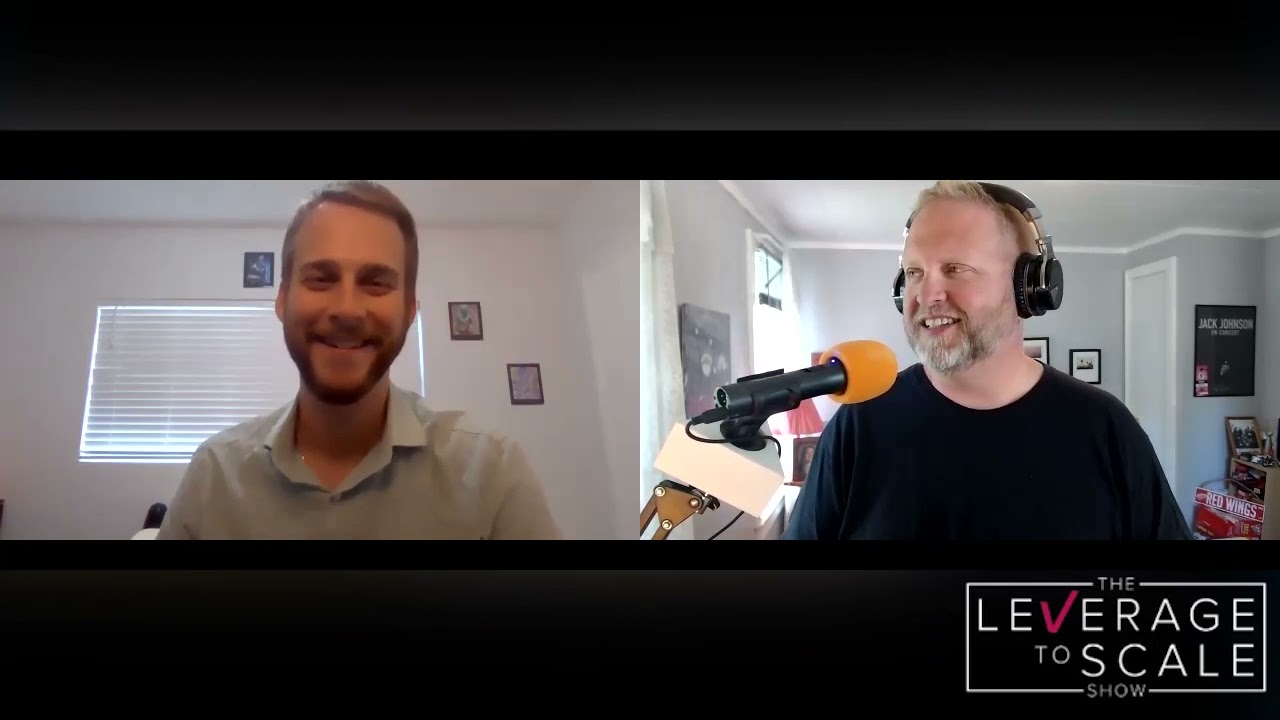
Product designer Ian Peterman started developing products at 12 and built his firm around a mission to improve the human condition and eventually enable humanity to leave Earth. He focuses on eco-friendly materials like mushroom-based substrates and 3D-printed food, and during COVID created a remote-work training program with his father.
Chapters
So welcome to Leverage to Scale. I'm your host, Dan Moyle, and joining me today is a visionary who helps visionaries. So I gotta believe that you're a visionary as well, Ian. Ian Peterman is joining me. Ian, welcome to the show.
Dan, thanks for having me. This is fun.
This will be, this will be a lot of fun. I love meeting people and learning things and just getting a ton of value and then bringing that value obviously to others. So So Ian, I called you a visionary. Um, I noticed in your LinkedIn profile that you help visionaries. So I assume that means you've got to be a visionary too. Um, so let's talk a little bit about you. Tell me about who you are, what you do, and kind of who is Ian Peterman?
Yeah. So my, my story is we go all the way back starting when I was about 12, I decided that I wanted to develop products. and make cool things. And that's turned into a journey to this point where I now, I started my design firm a few years ago and I now help, and I mean, I did it before too, but I help other people who have these big visions of wanting to put new products and help people in new ways out there. And so my whole mission and focus is to help people with visions actually Change it from just a vision and make it actually real. And so I, I worked in engineering for a long time. I did— I went to school after basically having a 10-year career for industrial design. So I kind of meld those 2 sides. And then the business aspect, I come from a long line of entrepreneurial-minded people. I can't say we've made it big yet, but we— but, you know, I've watched— I've learned a lot of lessons on how to start businesses for my family and how all of the roadblocks and issues that pop up. And so now I basically bring all of that experience to people that are wanting to start new things. And, you know, I work with bigger companies too that, you know, are started, but I have a— startup mentality of how to make things happen with very few resources sometimes.
So yeah, which just seems like in today's business is super important, whether it's, you know, 2020 or, you know, last year, next year. Like, it just seems like we're doing more with less, so that startup mentality is so important, huh?
Yeah, and it's all— it's, it's also eco-friendly to do more with less, so it's kind of an in mentality right now, which is It's good.
Yeah. So, uh, so Peterman Design Firm is your, is your business. So as an entrepreneur, you saw this need and you wanted to fill it. What was the other why behind starting your business? Like, what is Ian's why?
Oh, my why is, um, actually my why is pretty similar to Musk's. I, I actually want to push our technology to the point where we can Leave this planet comfortably. So my vision with that though is there's a lot of things that have to happen before then in helping the human condition. You know, if we have all the things, all the problems we have now, we should probably work on those. So a big drive is to help improve the human condition, just help everyone here have better lives, and products being my kind of the lens that I do that through. That is my focus and that's, that's my drive.
Yeah. So, so how do you take that big, beautiful why and get it to fit into this idea of a business and say, okay, I'm going to help these companies do this thing through, through products? How does that work for you on a day-to-day basis?
Um, it, it comes down to, you know, which, which projects I choose to work on. Um, you know, selecting ones that feel like they're really aiming us and the planet in the right direction. Um, you know, I'm, I'm definitely a fan of eco-friendly recyclable products. Um, there's some amazing things out there with, with like what you can do with mushrooms to grow new materials. Um, and so pushing, pushing those boundaries and what we can do with that tech is, is, is the focus on how, how I kind of pick Who do I work with? What's going to be a smart move? And put my effort into those ideas that I think are going to make the biggest impact.
So it's important to know that why and be able to use that as a barometer by which you choose your partners and this kind of thing.
Exactly. Yes. It makes it good for me because then I'm passionate about their project and that passion then goes into their project and it helps me create their vision when Their vision and my vision align, then we can become much more powerful than, than me just going, oh yeah, I'll design some stuff for you, but whatever.
Aligning those whys. Yeah, that's awesome, Ian. Yeah, so, so you're very entrepreneurial even before starting your business, it sounds like. But then as an entrepreneur now, you know, it seems like every entrepreneur has that, that moment where they hit rock bottom or they say to themselves Enough is enough. I got to do this thing. What was that enough is enough moment for you?
Um, I've had, I've had a couple of those actually, which I think, I think is pretty common. Um, and one of them was, was, uh, I worked at a design firm before this and it, I was a partner. Um, and it just, it didn't jive with everything that I wanted to be. And the success of the business showed it. we were not as successful as we should have been. So it kind of became one of those, all right, well, I have to shift something because this is not— it just isn't lining with what I want to be doing and the projects that I want to be involved in. And so that gave me the impetus to launch out on my own and solo this in a way on my mission. And So that's one, one big pivotal point. And I've kind of— it's been a flow. So there's been these ups and downs kind of through my entire career that have just bumped me and pushed me in the right directions. And so right now is actually— COVID, thanks for that.
Right, right.
It involves some shifts. And so now You know, there's been some pivots of like, okay, well, what, how do we make sure that I'm providing the most amount of value for companies? What, what can I do right now? And so I've done like, it's not completely related to product development, but I'm working with my dad actually to launch a program on how to train companies and employees how to work from anywhere because that's— I've actually been working from Anywhere. And we camped for— we've been road tripping for 3 months last year. And I worked from the road with family. So it's those experiences that I've had and just going, okay, well now people need that. How do I shift and how do I add the most value in the here and now? And so that's a program that's come up. It's like, well, now everybody's working from home and not everyone has a decade of experience doing it.
So— Right.
Help people with that because our businesses need to survive, especially small businesses.
Mm-hmm.
So it's just pivots like that that are just like, oh wow, there's value here that I can provide and I need to do something about it because if I'm just going to sit here and let it happen, then it's not— I should be providing the value if I have it. So I feel very strongly that when you get that little nudge of, hey, I know something about this, I should put it out there, just put it out there. It'll benefit somebody.
Yeah, that's great advice, Ian. That's really good advice. And through those adversities, you've obviously grown and you continue to do so. What's one of the biggest challenges that you faced with your own company?
Oh man. I think the biggest piece is... Learning which— early on, I had the idea that I would bring on some sales team and let them take over that. And I think the biggest learning curve there is that I am the company right now, and it's not something that I can really hand off.
Mm-hmm.
Because there's a certain level, you have to get to a certain point before you The company has its own momentum that'll just stay on a path. So there's a lot of guiding that needs to happen when your company is young and letting go of the reins, so to speak, for a little bit is not always a good idea. And so I did that. I tried it. Didn't work as I hoped. That was a bit of a learning process, but very valuable. It showed me kind of where my role needs to be in the company, in my own company actually, and where, what areas I can bring help in. Not sales right now.
Yeah, exactly. It's nice to be able to delegate and let go of those reins, but when you, like you said, when it doesn't work, what do you learn from that kind of thing? So that's a great lesson. Thanks for sharing that with listeners. So what other kind of teaching moments have you had in your business at this point where you're like, okay, I get that, I need to share that too with other people?
It's somewhat of a personal experience, but it's one that I see with clients a lot actually. The learning is that a lot of people wait. They try to wait for an idea. They think there's going to be a perfect opportune time. And I have the times where I haven't jumped on something that comes to mind, and I definitely see that it would have been better if I had listened to my gut. And so one of the challenges is I'm a very logical thinker. And so I can, I can put myself into analysis paralysis sometimes. And, and, you know, every time I look back, I'm like, oh man, that's— nope, I should have gone with my gut.
I should have done it.
And the times that I look back and go, wow, I just, I just did it. Um, I have some of the best results that I've gotten, and that's been, you know, in sales and like, oh, I should just contact these people. I should do this. I should try this. Works really well. And then when I sit there and Oh, how do I analyze this perfectly? Like, I need to make the perfect chess move. Life is not chess. There are not a small little board. You're dealing with so many variables. It's very much— I think following your gut is a lesson to be learned, and it takes experience. I mean, we all think, oh, well, we have it, we got it, don't worry. And then life goes, no, you No, actually, you should have listened.
Yes, life does that, doesn't it?
Yes, it does.
So if you think back over the last year, which of course includes this year, which you mentioned earlier, COVID.
Oh yeah.
But if there's, over the last year or so, if there's one thing that you could redo, what would that be?
I actually think what I would probably redo is Focusing more on making sure that my why and my focus and knowing who and what I'm doing, what I'm doing for is more clear. And it's not that I lost my vision, but that— I'm actually working with a couple of people right now on Focusing on the marketing side of focusing language and vision again. And it's something that you think just like, oh, once you've said it, you just let it sit there and it stays. And it's really actually something when you have a vision, you need to come back to it and re-solidify it and look at it because things change and the world changes. Look at COVID.
Right.
Great example, right? And I—
that—
so that would be something I'd change is making sure that I do that more often and checking in with that, that vision and goals. And, and that would help, you know, probably would have saved me a little bit of headache.
Sure, sure.
Kept me on, kept me on track more.
And so when you talk about that, that focus and that vision, how does that help you plan your next 3, 5, 10 years?
It's, you know, on a micro level, it's the language I use. It's how I talk. It's how I, you know, content on our website. It's how I interact with clients. And it's being very clear. When you're very clear about your vision, you use the right language that matches you and your vision, and people relate to that, right?
Yeah.
If you talk one way, people that talk that way and think that way are gonna be more attracted to you. They're gonna talk to you more, right? And, you know, on a big level, when we're talking about 5, 10 years, it's looking at, well, where do I want to be? What is that? What are the roadblocks I see coming up? You know, surprise ones pop up. But then it's adjusting for those, and it's really just an end goal, though how you get there can change. And really, that's what it is. It's not changing your end goal, it's changing the path to get there. And so it's really just that focus on, okay, well, here's, here's a road. We didn't think there was a mountain here, but apparently there's a mountain here. So, uh, surprise, are we climbing it? Are we climbing it? Are we going around it? Is there a helicopter nearby? Like, what are our options?
I'm all through it, whatever we gotta do.
Exactly. We still have to get to the other side. So what are we gonna do for that? And it's guiding the big moves of, okay, well, what— for me, it's like, how— what tech is emerging? How do I wanna be involved? Does that technology help my vision in the end? If yes, how do I become involved in it? And I've actually like really actively done that with some medical technology that I'm— I reached out to companies like, hey, I would like to help you with this type of technology. Like, this really interests me and it benefits things that I really care about. And so those guiding pieces just are how I look at how to roadmap any industries that I work in.
Yeah, that's good. Um, and so when you do that and you use that vision, where do you see, um, you, Ian, but also Peterman Design in, you know, 3 years, 5 years? Can, can you look that far out?
Oh yeah. Um, I mean, my, my goal is to really become a bit of a powerhouse of a design firm. Being a developer of not just products but new technology and working, working at the front of new tech, things like 3D printing food and medicine and things like that where I'm really adding value not just to a single product but to technology that's helping, you know, hundreds and thousands and millions of people. With, with the tech. And that's, that's where I want to be, is really just providing a ton of value with a team, large, larger team than I have now.
Build a team more than just you and your dad occasionally, right? Um, and again, that hearkens back into your why, which is changing the world for, for the better through technology. So that's pretty powerful. Um, so that's 3, 5, 10 years away. What about more immediately? What does success look like for you in 2021?
2021 is really probably about the goals I have set right now, which are like team of 20 people now instead of 5. It's being involved in 1 or 2 more bigger tech projects. I really getting into the R&D, early, early stage R&D work. Is a main focus. And also finding some, some ways to give back. You know, I want to, I want to grow my success and then I want to, you know, find some really potent philanthropical places that I can, I can actually give back and, and share my success and wealth with people that need it. So those are, those are the goals.
Sounds like good success in 2021. How can, how can our community jump on board and support you in developing that vision?
Right now, it's— I do things like share a newsletter with ideas out there, just communicating. I mean, it's— if you have an idea that you think is— even if you don't think it's a great idea, if you have an idea for something that solves a problem, reach out, talk to somebody. You know, it doesn't have to be me, but But don't let it, don't let it sit. I've talked to too many inventors 20 years after they invented it and it still doesn't exist. I'm like, well, this would have been helpful 20 years ago. Why, why have you waited this long to put this out? So, Yeah. I mean, to really be involved is just get your ideas out there, get them going. And, you know, if it's really a really good idea and it's picked up by people, people will find your idea. They will be interested and people like myself can help push those things out there. So that would be my advice.
That's good advice. And I think that what's great about it is that you mentioned, Ian, even if it's not you, talk to somebody, which is such a generous way to look at it because of course you want more business, but you also just want this world to be better. So that's a great Encouragement. But if people do want to reach out to you, where's the best place for people to connect with, with Ian Peterman?
Yeah, you can find us on our website, petermanfirm.com, and you can find me on Twitter, Ian Peterman, LinkedIn. I'm pretty easy to find on there as well. And yeah, those are, those would be the 3 best ways to get a hold of us.
All right, sounds great. Thanks for being a part of Leverage to Scale, man.
All right, thanks, Dan.
More from Ian


You Didn't Know a Shampoo Could Do This #Shorts #shampoo #ecofriendly #haircare





The Biggest Misunderstanding About Bioplastics - Sustainable Materials Consultant Joanna Pool

A Polymer Scientist Explains the Truth About Bioplastics #podcast #sustainability #science



NASA is testing this on Mars… why not Earth? #Shorts #GreenTech #NASA #science