The Future of Sustainable Packaging: Woodly’s Wood-based Plastic
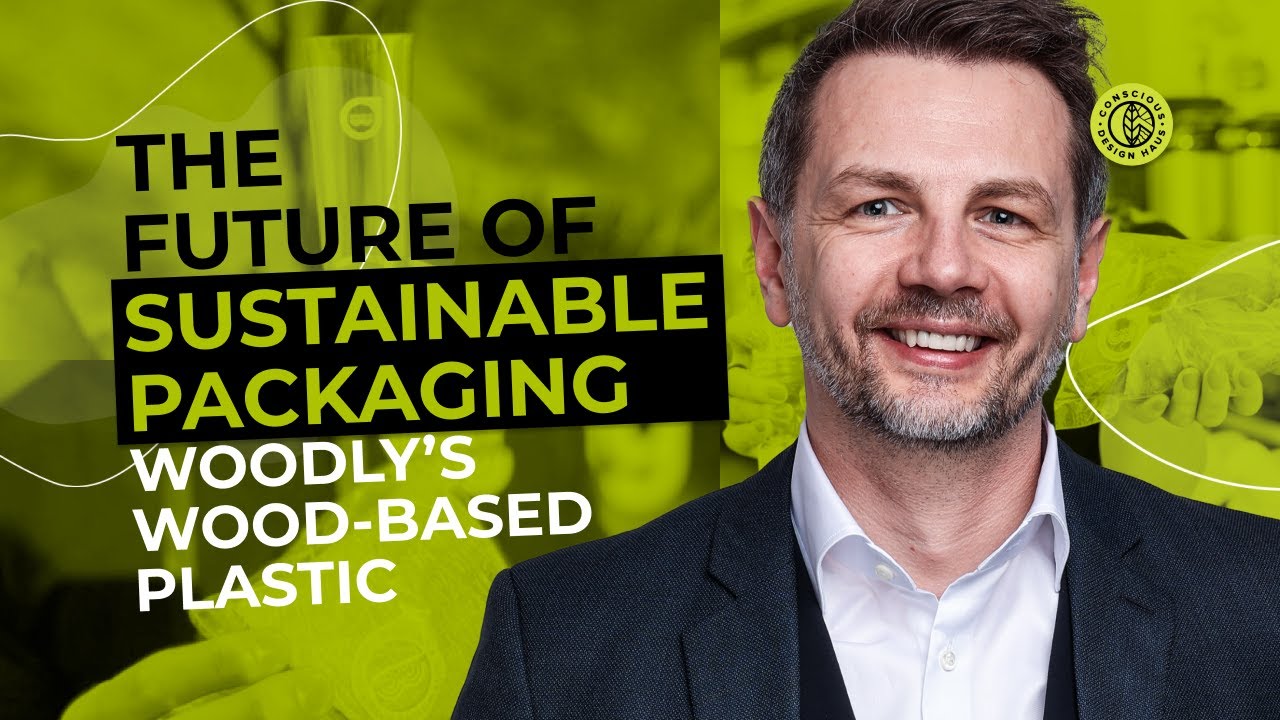
In this episode of the Conscious Design podcast, host Ian Peterman interviews Christoph Schiller, VP of Sales & Marketing at Woodly, a Finnish company developing a wood‑based, cellulose‑derived bioplastic. The conversation traces Woodly’s origin back to 2011, its mission to create a carbon‑neutral alternative to fossil plastics, and its first commercial launch aimed at the food‑to‑go market. Schiller explains how the material’s breathable, transparent film reduces food waste and addresses Scope 3 emissions for brand owners, giving Woodly a foothold in Finland (≈15% market share) and expansion into Norway and the UK. The discussion covers the material’s technical attributes—softwood cellulose backbone, dyeability, recyclability up to five cycles, and a reusable dishwasher‑safe cup—while emphasizing a circular‑economy approach that avoids biodegradability in favor of recycling and waste‑to‑energy with 33% lower CO2 emissions than fossil plastics. Woodly positions itself against polypropylene and PET rather than other bioplastics, highlighting superior barrier properties for fresh foods. Schiller outlines ongoing R&D to increase biocontent, explore new applications (cosmetics, toys, medical devices), and pursue US FDA approval. The interview underscores collaborative product development with customers, the importance of addressing both CO2 and food‑waste challenges, and Woodly’s broader vision of scaling sustainable packaging worldwide.
Chapters
Hello and welcome to this episode of Conscious Design. I'm your host, Ian Peterman, author of The Conscious Design Book. And today I'm excited to have Christoph Schiller. He's the VP of Sales and Marketing at Woodley, where they're creating a new generation of bioplastics. Welcome to the show.
Thank you for having me.
Absolutely. So give us a little bit of a background for people who aren't aware at all. Let's jump back a little bit. How's the origin story of Woodly and when did you come on board?
The whole idea of Woodly goes all the way back to 2011. So that's when the idea has started and we were thinking, or the founding fathers were thinking, if we cannot defeat the plastic, because Despite all of the actions that you can see all over the world, the forecast of the consumption for plastic says that by the next 5, 10 years, the consumption for plastic will be like triple. So you cannot defeat it. So let's try to make it more sustainable, something where we're actually not detrimental for the planet. And this is how it started. The first employee came on board like 2017. That was our former CEO, Jaco Kamion. Who started to work together with people at the Technical University of, uh, of Tampere in Finland on the product itself. And roughly 2 years ago, we brought on the, on the market very first, uh, very first commercial product which was dedicated for the food-to-go industry. And this is when I came to the game because I, I spent, well, I think it's over 15 years already in the packaging industry working on the both sides. I've spent like a decade with the paper industry working for the guys like International Paper, but then I work over 5 years with the companies like Amcor, who is also one of the biggest in the packaging, but on the flexible side, on the plastic side. So I'm always laughing that Woodly is like a natural landing for myself because it's a perfect hybrid between paper and plastic world.
Right. And you guys, you are approaching, I noticed that you guys do a lot of things with food, kind of your primary market, at least, at least where you're getting into now. Is there a reason behind that, or is that just the group of people that caught on the quickest or has the biggest need for this?
It's a little bit both. So basically Woodly is a new kind of the plastic, so it has all of the plastic, um, let's say capabilities or opportunities. You can replace everything what is today made out of the fossil plastic with Woodly. And that's one of the biggest threats for the startups that you start to do all the things at the same time and then you lose focus. But we, with Woodly, we decided to go after 2, one of the most challenging aspects of our lives these days. One of them is a CO2 emission or basically global warming. And the second is the food waste. Because it's such multidimensional problem, and we want to tackle that. And we figured that with Woodly, we can actually address both of these issues because Woodly as a carbon-neutral product on the cradle-to-grave level is addressing the global warming potential— global warming problem, sorry. And at the same time, if we will go after the food-to-go industry, we have figured out together actually with our customers that we can help them to reduce the food waste. So that's why we are focusing on the food-to-go industry.
I think you said you guys went to market with the first product a couple years ago. How has that journey been, Mark, on the marketing and sales side? Is it B2C, B2B blend? How has that changed over the last, you know, launching a new, a new product?
Actually, that, that was, that was pretty cool story. We are the company who owns the, the technology. We are a tech company. We have the recipe and the secret sauce, and we produce the granulate. So basically we are a raw material producer, but everything what is new on the market, what is bio, it comes with, with a tag. It's, it's more expensive than traditional fossil-based plastic. So when we went to the converters and say, hey, we, we have this amazing material, would you like to test it, buy it, sell it? They asked for the price and the reaction was like, no, you're crazy. You just go, no, we are never going to happen. We cannot sell it. So what we found out is that, okay, so if you don't understand the idea, let's go to the brand owners. Let's go to the people who are actually affected by the global warming, who are in frontline of the customers who are demanding because people, I mean, the consumers like you and myself, we are demanding that the companies are doing actually something for the planet, not just taking the profit. So we went to them. And we explain, listen, if you will switch to Woodly, you can actually contribute positively to scope 3 emission, which is super, super important and very difficult for the companies. I don't know how familiar you are with the ESG reporting, but basically scope 1 and scope 2 that you are reporting is something what you can easily, easily, you can impact on your own because it comes from your own operation. But scope 3 is something that comes from the supply chain. So most of the companies, they struggle with that because It's something what they cannot impact directly. We come with the solution because we come from the supply chain. We are impacting the Scope 3 and we help them to replace polypropylene or any other traditional plastic with Woodly and achieve their goals. And at the same time, they respond to the customer needs. They say, okay, we have a product that is environmentally friendly. They don't have to compromise or they don't need to jeopardize the product itself. Because if they're selling sandwiches, I mean, basically if you have a sandwich, you want to see what you are buying, if the sandwich is still fresh, if it's looking good and so on. So this is where the paper is not so great because it's in best case scenario translucent, not transparent. Woodley is even slightly better in terms of the global warming potential than a paper and still lets you present the sandwich in a nice way. So customers were happy, customers of the customers. So we consumers were happy. So once they said, okay, let's do it, we understand that it is important, we would like to do that. Then we came back to the same conversant and say, hey, now I have a customer for you. Would you like to buy our material? This is how it started. And, uh, that was quite a journey. Now we can proudly say that we have roughly 15% of the market share in Finland, which is absolutely amazing.
That's awesome. That's a, that was a great percentage after only a couple of years.
Yeah. And my responsibility is to introduce Woodly outside of Finland. So we are present in Norway already. And then we are starting right now in the UK, working with many international contract cutters. It's a fun job in one way, but in the other way, we are learning down the road a lot because we have started with sustainability and we were developing the product together with our customers who gave us actually the very first feedback saying, listen, did you know that if we will wrap Woodly, we will wrap sandwiches in Woodly material, Then we are extending the shelf life. So the sandwiches or the sandwiches at the end of the day, they look better than they were in polypropylene. So at the end of the day for them, they don't have to throw away the food. So it's absolutely amazing. And then, so it's in a way it's a cost saving for them, but it's also, it has massive impact on the environment because, you know, food waste, if you think about that, it has at least 3 problems in itself. So first of this is obviously the environmental, because if food waste were a country, it would be a 3rd biggest CO2 pollution. That's very powerful and massive. Then at the same time, it has a massive financial impact because we are living in post-pandemic world in something what you could say cost of living crisis. People are very cautious about everything what they are spending. So they cannot afford simply to throw away food at the end of the day. Only because the sandwich doesn't look nice and nobody wants to buy it because consumer buys with their eyes. If they don't like it, even if the best before date is, they will not pick it up from the shelf. And those 2 things, they lead to the social impact of the food waste. I mean, if we are thinking about being roughly 40% of global food production wasted every year, and at the same time, roughly 11% of the population goes hungry to bed every night. That's huge. And we are just throwing away the food. So companies who are aware of that, and there's so many of them and they come more and more, uh, who are aware of food waste problematic, they understand the value proposition of Woodly and that, and that's so great.
That's amazing. You know, when you set out with a new product, like what you guys did, you have an idea of, oh, I'm going to go to a certain person. I'm going to sell the, here's all the features, right? And then you find out Down the road, oh, well, it does these other things. And the person who really cares about this is actually over here. They're the customer of your customer, and they can drive a lot more. And not everybody thinks about those things. They kind of just go, oh, well, I don't know, nobody bought it, nobody gets it. And it's great that you guys track down, like, okay, where along the chain do we need to go till we find the person that cares about this, and this is valuable too.
Yeah, absolutely. And for myself coming from the packaging industry, I mean, I landed in the packaging industry by coincidence as it happens in life because I studied philosophy. I have a kind of different approach to that. But when I saw Woodly for the first time, I was absolutely amazed. It was a no-brainer for me to join Woodly when I got this offer. If you look at that, I don't know if you can see it through the background, but it's a very simple material that looks like a plastic. I mean, it looks like a plastic, it behaves like a plastic. but it's not as detrimental for the planet as plastic. And the funny thing about that, that it's a natural product. Because you ask also about this food to go. That's the thing. If you like to wrap a chocolate or crisp snacks in that, it wouldn't do the job as polypropylene is doing. Because polypropylene actually, despite of having a bad reputation and massive environmental impact, is a really good material. So if we only could use it in a more conscious way. If you are thinking about the polypropylene, it has an excellent barrier to protect the food. But not the fresh food. When you wrap fresh food in traditional plastic, fresh food is still breathing when you wrap it. So it's fighting against these barriers. So then you have this condensed water that is gathering inside of the packaging. This water is dropping on the sandwich or the baguette. Baguette gets soggy. Lettuce or, I don't know, tomato doesn't look appealing and nobody wants to buy it. Woodley is breathing because it's a natural product as the product itself in the packaging. That's like a perfect marriage.
Right. So Woodly is more, it's, uh, you're not sealing. The whole point is you're not sealing something in there. It's actually able to breathe when you put it in that material. That's awesome.
In this particular, yes. I love it because it's such a simple solution and it, and it works.
Now, is it, as far as like end of life cycle, right? There's all kinds of ways, recycling, biodegrading. How does Woodly fit in? Which? Which channel does it fit into?
Well, we deliberately go against biodegradability and it has something to do with responsible sourcing. Coming from Finland and knowing that like forestry is our national treasure, we just don't want to produce a very expensive soil. And that's it. If you go after, you know, biodegradability, you harvest your trees, you produce the material, you put it into the ground. Not the most sustainable thing. I mean, obviously you have the certification PEFC, FSC, and you know that it's sustainably managed forestry and that's all good, but We are a big advocate of being part of the circular economy. So Woodly can be recycled up to 5 times without losing its properties. And that's something what we strongly encouraging to be part of this circular loop. So you can actually collect it, detect it in, uh, in the streaming and recycle it again. That is the kind of the second generation of Woodly because we were discussing right now only the film for the food-to-go industry, but then we have also the injection molding grade. I don't know if you can see it. Hopefully yes. So that's something what we did with our partner in Poland, a company named Polena, who has specialized rising in cosmetic industry. And they have absolutely amazing know-how, how to use this kind of the granulate and produce really great stuff out of it. And now we are testing this, this cosmetic jar to replace traditional plastic or even glass because of its global warming potential and offer it to the luxury cosmetic brands. One of the biggest change cosmetic industry has is that, I don't know, people like the cosmetics or the fragrances to be nice and shiny. But the very moment that you start to metallize some material, you cannot recycle it. And it's not, not in Europe. I'm not sure how it is in the US, but in Europe, everything which is metallized cannot be detected by the near infrared in the recycling streaming. So it has to be sorted out and goes into the waste to energy. And that's the best part of Woodly. Woodly is not only a carbon neutral material by excellence from the production on the cradle to the gate level. But also, if it ends up in, in the waste-to-energy, it will generate 33% less CO2 versus fossil-based plastic. And that's a massive impact.
Hey, it's Ian here. So glad you're enjoying this episode of Conscious Design. If you want the full scoop on conscious design, what it is, how we do it, how you can do it, then check out our book. We wrote it so creative entrepreneurs like you can code social and environmental responsibility right into your brands DNA. You can download the first chapter for free. Link is in the description. Enjoy the rest of the episode. Don't forget to like, subscribe, and share.
When you're done with it, but then you said you can recycle it up to 5 times and still make something like that with it.
So we are almost as, as, as good as paper. Paper, you can recycle up to 7 times, I heard. So the wood leaves with, with 5. It's pretty good for a plastic.
Yeah, that's pretty good for a plastic. With that, so you showed the injection molded piece and then you also have that film. Is it exactly the same material or are you starting to split off into specialized materials within Woodly?
The backbone is, is the same. It's, it's also based on the softwood cellulose. There are some technical difference to make it more resistant in the process. You, you can tell I really love what we are doing. One more thing I wanted to show you, because we did one project in the US and that's a cup, actually, a very simple cup that we did together with the professional lodging contractors in state of Maine. That's a cup. You can put it into dishwasher, you can reuse it. So it's reusable. So it's like another level of end of life because you can wash it up to 130 times. Nothing will happen. And the good thing about that is that when you think about the events where you cannot use glass, you will use the plastic for the safety reason. Typically you will use something like polypropylene or polycarbonate. And those plastics, they work, they are functional. They are not so great in recycling, but definitely they use stuff like bisphenols or any other softeners. Woodly does not. You have this healthy aspect in case of Woodly, if you are using that. And that was actually the main reason why we have started to produce together with our partners, the cups to replace the traditional plastic cups. Because when you go to the pool or you go to the spa area, Yeah, typically you don't use glass, you use something reusable, preferably, but still a plastic.
So what plastics on the market today are you most closely, I'd say, competing or filling a similar role though?
Against polypropylene, definitely, in terms of the fossil-based plastic. And I like to say that I'm competing against the fossil-based plastic. I don't compete against other bioplastics. I would say that they are like worthy rivals. I like what they do. We all have the same goal and there's like 400 million tons of plastic produced every year. So if there will be like hundreds of companies like ours, great. I'm super fan of it. And I'm following many of our so-called competitors because they do great stuff, really. I'm super happy to see that what they are doing and they are inspiring me to do even more and better. So we are competing more against the fossil-based plastic. So polypropylene will be the one. That's the film application for the food-to-go industry. And also. Again, only in the section where it works actually, because polypropylene is really good if you are wrapping into chocolate, but let's not wrap a sandwich or baguette. It doesn't work as great. But also polyester, so-called PET, would have excellent thermoforming application. I don't know. Do you have this tradition on Christmas? Sorry, I'm not so familiar with the US to have this advent calendar. You know, you have these 24 windows opening and every day you open some window and get like a piece of chocolate. Traditionally, it used to be part of my business back in the days when I was in, in cartonboard business. So we were delivering that and you were producing a beautiful advent calendar with chocolate, but, and it was all made out of the paper or cartonboard, but the backbone of that, there was like a PET tray just to make it steady and to create these windows. So that's not so environmental because PET is not so great to be recycled. So Woodly can easily replace that. So it's as good as PET in terms of the properties. But if you will have to burn it, then it will generate so much less CO2.
That's awesome. There's all kinds of those here, different advents, and they're all, yeah, the plastic PET. You know, there's paper on it that makes it look nice, but there's, there's plastic as a tray behind it just to hold it together.
Yeah. I mean, I'm a strong advocate of saying that packaging must be done and made for purpose. So if it works and you can Do something good with that to make sure it works and you use it. But let's not try to cover it with the paper only because it has a nice appearance. It just doesn't work from the sustainability point of view.
Right. Looking ahead, right, you have this product, you have found a focus with this. Are you guys seeing, can you take this cellulose? Are you looking at adding more plastic-like materials? Is this something that we can, you can expand on? Or is this kind of the structural, is this where you're at in terms of, you know, what the material is and then it's just your job to go find more awesome applications for it?
We find more awesome applications because we are talking to so many companies. It's, there's an everyday business because I mean, I'm leading this sales and marketing team. So my responsibility towards our investors is to create the revenue and to make sure that we are running and doing our job. At the same time, we are exploring some other applications like the one for the cosmetic or some something for the toys. All of that is done on the side, like side projects, just to explore our future. And we know that it works. So that's, that's absolutely amazing. And our partners are doing that from our granulate. What we are doing at the R&D stage or R&D side is that we are increasing the biocontent of the material. And we are working towards that to have the 100% biocontent at some point. We could have it today, but right now the ligands, that's the chemical name for the binders in the structure, they are not bio for one particular reason, the availability, the commercial availability of those ligands. So if, if you would like to do it on a lab scale, absolutely no problem. But if you would like to commercialize it and go to the customers, even with our approach and really being passionate, I wouldn't be able to, I wouldn't be able to sell it and compete against the fossil-based plastic. So we are finding the balance between these two.
Right. So you're, you have ingredients basically that you have to Oh wait, is that, is that something that people are working on? Is that, or is that something you guys are working on as well?
It's both. Our Dr. Tommy, the mastermind behind the product, he's working relentlessly on that and trying to do this and do that to make sure that we are increasing in absolute speed and actually that we are answering to the demand of our customers because some of them, they come with a very clear expectation. We need you to do that. So we can report it in our ESG report because that's the demand of our customers. And he is doing it. And at the same time, he's looking for all of the novelties that we could use actually and replace something what we are using today. He's the brain behind that. And he's, you know, if you can imagine a guy in the lab trying this and trying that, and let's see what will happen at the end of the day. That's him. I know a lot, but if there are some more difficult questions, I always call for help.
Yeah, I'm not a chemist, so we, it's okay. We, that's, that's always above my head. All I know is it's cool material. We can use it. I know what to do with it. But as far as, you know, the chemical bonds that actually make it work, I leave, I leave that to those guys. Let them figure it all out.
Yeah, I'm always learning by doing and I, I learned pretty fast, but, but talking to him, it's, it's more like learning in a slide. It's his baby, so he's very passionate about this, what, what he's telling and, and explaining. And I, I really try to understand, so I need to think very fast. He has a, a great gift of, of explaining very complicated stuff in the way that even I understand.
Now, so the material's clear. Are you able to dye it? Have you been able to— I'm sure bio dyes is a whole other, other area of, of finding the right things. Is that something you guys can do or? See coming soon. How's that? How's that look? Because I'm sure you have customers asking for that.
Yeah, well, you can dye it. I mean, when you think about this simple cup, it is now bluish because of the pigment. Natural color would be less blue, but you can have it in any color you want, almost every color you want. So that's a great thing because there are so many bioproducts on the market that they cannot simply change the color because of the chemical properties. And Woodly is already transparent. But if you have something that is transparent, you can play the way you want.
That's awesome. That's an awesome— you guys have an amazing product. So it's great to see that you're out there and being able to injection mold it. I've worked in cosmetics. I know how much, how much plastic goes into cosmetics. So being able to swap it out for something like this would be a huge, huge impact for a brand.
Yeah, that was the reason for me to join Woodly because after so many years in the packaging, I think I can say that I saw a lot and really for both plastic and the paper side. And that was the very first time when I was really intrigued and I am not regretting. The product itself is amazing and that gives the, you know, the extra energy to wake up every morning and say, okay, so how about today this? The whole team thinks in the same way and we are trying to push it on the market. Because of the advantage of the product itself, you know, you have something with with the right cost.
Because you mentioned it's a little bit on the breathable side. Can you store liquids long term in it?
Yes and no. We can store liquids in the jars or in the bottles. Water is not a problem. We cannot store alcohol. Okay. We should not. I'm laughing because we have tested this this caps in Finland with our customers. Doors of variety of the customers. There was like a nightclub, the holiday clubs for the families. And basically they did absolutely everything what we told them not to do. So they tested it with the hot liquids, they tested it with the alcohols and they say, yeah, great. It works. Well, we didn't test it that before in the lab. So, uh, but okay. It's good to know that it works. So we know that if you do a mojito or some, uh, something like this, that's not a problem. I wouldn't put a pure vodka in that because of the content of the alcohol. But at the same time, exclude the fragrance, like, like perfumes. But you can definitely put the moisturizer inside of that. And that's, that's not a problem. Woodley has an excellent grease barrier, what is helping in a lot of applications.
Yeah.
Right now we have a very interesting project in actually Emirates for the bottles, for the water and the bottles. There is one sustainability company, to frame it in a very naive way, water out of the air. And they are looking for bottling in Woodley material because that just fits to the whole concept of being a very environmentally aware company, and we know that it works for water.
That's great. Yeah, alcohol and plastic does tend to eat away at some point anyway, so it's never, never your long-term, long-term option.
But yeah, good idea.
No, if you can pour a beer and it lasts long enough to drink it, that's good enough for that kind of use.
Oh, that works. That works.
Yeah, you're a customer.
Definitely.
Oh, perfect. Well, that's true.
So that's firsthand, you know, uh, feedback.
I mean, that's the journey though, right? Is you give it to a customer and they're gonna do all kinds of things to it that you either told them not to or you didn't ever thought of. And then you'll find out and they'll tell you, you know, as long as you communicate, you'll, you'll get that feedback. And then you, then you can take that and, uh, move forward with that information and use it. It's always fun when you do that.
Yeah, absolutely. That's the best part because we work as a team basically with our customers. It's not like, you know, typical sales. Okay. Hi, I have a product. Would you like to buy it? No, we all have the same goal. We would like to try it. We would like to test it. They come with some ideas. If we don't have any answer, then we work together with their R&D and try to figure it out. I mean, this jar is a perfect example because when I joined, we had already some jar. It looked a little bit cheesy. You could tell, okay, it's a plastic. Now with this partner in Poland, they have a know-how how to do it and you can replace easily something for a, you know, high-value cosmetic. So it's all about teaming up with the right people.
Yes, right people is very important every single time. This has been great. You guys have an amazing product, awesome company. I'm really excited to see this in more places. Hopefully, hopefully you'll start infiltrating the US and expanding over here more. It would be great for you guys to be over here.
Yeah, we go places. Yeah, we go places and US is on our roadmap, definitely. We are also in the process of applying for FDA, which is a part Because we have this, you know, European Food Safety Authority approval for the food contact. So we know that there will be no problem in getting FDA, but it's like a whole new process. So we follow all of the steps that we learned that we need to do and we apply for that. Because I think US is a very, very interesting, interesting market.
Yes, are a very interesting market.
But I'm a tourist in US. I will need definitely help.
Have you guys looked at medical as an application?
Good question. And a very simple answer is yes. We are thinking about that for one main reason, but there's some others. Because I don't know if you know, in medicals, if you are using something at the hospital for a safety reason, you are incinerating it afterwards. So that's all a lot of plastic that is being incinerated and the CO2 is being emitted. So that's where Woodly would be very, very helpful. And functionality of Woodly is definitely there, so we could use it. That's, uh, one of the applications that we have on our radar and we would like to try out. We don't have any, any partner in the medical or, uh, in, in, in the pharmaceutical business yet who would test it. But, uh, that's on my, uh, on my wishlist at the moment because I know it would work.
Yeah, I know. I've, I've worked in that space trying to develop different sustainable options and it's just, it's so hard because everything, like you said, everything has to get destroyed. Afterwards. It's not recycle, you don't really recycle it after it gets used. So it's a, it's a whole different level of getting rid of it. And so yeah, you're burn, you know, to burn cleaner if you're gonna burn it all anyway, that's a way better option.
Yeah.
I mean, some of the stuff you can put in, in disinfection and, and sterilize and, and try to reuse it, but some of them like, like a packaging, you cannot reuse or recycle it. You have to incinerate it. And in that aspect, we will come. I'm a super fan of reusing stuff because that's the best for the planet. If you can reuse, please do it. There are some limitations in that you cannot do it always. So if that's the case, let's try to recycle it. And if in the worst case scenario, it has to go into the waste-to-energy, then let's make sure that the CO2 emitted in this process is as low as possible.
Right, exactly. This has been a really great episode. This has been great chatting with you. You guys are doing well, it seems, and growing. Hopefully we'll see you in the US soon, maybe in medical products. I'll definitely have to keep you in mind.
Praise yourself.
Yeah, absolutely. So before we wrap up, I just want to make sure, is there, if there's anything you want to share and then obviously how to find you guys for all the companies that will see or hear this and reach out.
You can definitely find us on all the social media and I hope that you will just link it.
We will.
After the show, I'm available most of the time. I mean, we have a lot of fun with Woodly, not only because we are cool people and we understand each other very well and it's always fun to work with people who are like-minded, but also the product itself is great. So even though that you have the challenges to overcome the prices and, you know, if we would like to explore US, we will have to ask somebody local to tell us how to navigate in the US. We can only be, you know, tourists and asking for the guidance. But it's so much fun and we love to continue because we know that it's one of these ideas that can change the world.
Amazing. Well, thanks for being on the show. I really appreciate your time.
Thank you for having me.
And that wraps up another episode of the Conscious Design Podcast. If today's episode inspired you to bring your product idea to life and turn it into a sustainable 7-figure business, visit petermanfirm.com or click the link below. Your ideas have the power to change the world and we're here to help make that happen. Thank you for joining us, and I'll see you on the next episode.
More from Ian


You Didn't Know a Shampoo Could Do This #Shorts #shampoo #ecofriendly #haircare





The Biggest Misunderstanding About Bioplastics - Sustainable Materials Consultant Joanna Pool

A Polymer Scientist Explains the Truth About Bioplastics #podcast #sustainability #science



NASA is testing this on Mars… why not Earth? #Shorts #GreenTech #NASA #science