The Solar Solution: Harnessing Energy for a Greener Tomorrow with Bruce Dietzen
Bruce Dietzen, founder of Drawdown Hemp, discusses building a hemp-powered car and developing hemp and flax composites for an e-bike. He evaluated 17 hemp products for carbon sequestration and avoidance, and argues that high-biomass crops can restore soil while feeding a growing population without fossil fuels.
Chapters
Hello and welcome to this episode of Conscious Design. I'm your host, Ian Peterman, and author of the Conscious Design book. And I'm here today with Bruce. He's the founder of Drawdown Hemp, creator of the modern-day hemp car, an author, and all focused on saving our planet. Welcome to the show.
Thank you, Ian. It's good to be here. I'm honored.
Really great to be able to talk to you about all this. So let's start with everybody's favorite question. What's your origin story? How'd you get here? What brought you here? And we'll start there.
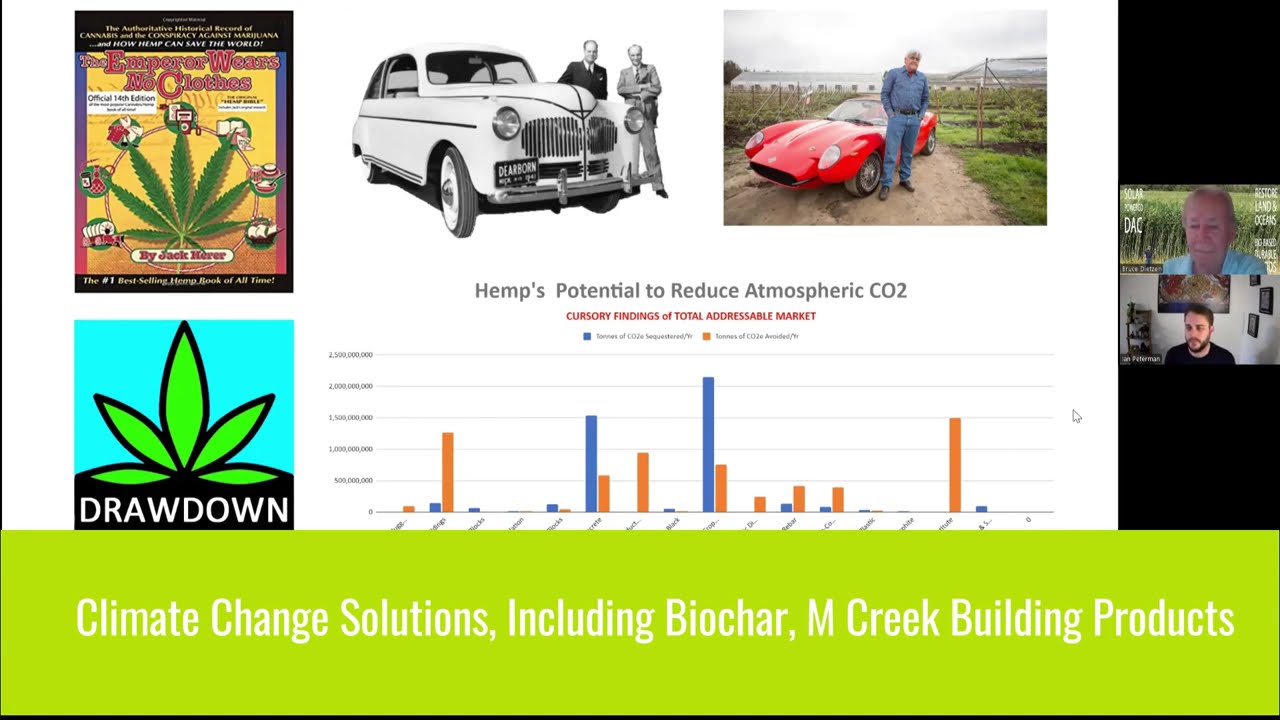
Well, I've got a slide that kind of summarizes that. So if I can, let me bring that up. Right. So about 13 years ago, I got a copy of this book you see on the left called The Emperor Wears No Clothes, written by Jack Herer, who was a big advocate of hemp. He started a whole movement back in the 1980s, and in fact, He actually proposed a way to address the global warming issue. They didn't call it climate crisis back then and brought it to the United States government and said, this is a great solution. And they said, well, it would be great, but unfortunately you're talking about using cannabis hemp and cannabis is illegal. So, Mr. Harry, you can't use that material. So it can't save, save us, etc. Even if— and his question was, even if it could help save the world, we can't do it. And he said, nope, can't do it because it's illegal. Well, we've come a long way since then. But anyway, that was the inspiration. And in the book, there's a whole story about Henry Ford creating a car that was about 50% of it was made from renewable materials, of which part of that was hemp, other was sisal and soybean oils for the resins, et cetera. To me, the most important contribution that Henry Ford ever made, much more important than the Model T, which obviously was very important, or the moving production line, which is very important because he showed the way that we could start making everything possible from plant materials and other renewable materials. So it was an inspiration to me. It led me to creating the modern-day hemp car that you see here on the right with Jay Leno. And Jay drove the car and we had a great time. And that was seen by many millions of people. So we got a lot of visibility on that. So following that, I started a small think tank amongst a bunch of primarily hemp advocates and entrepreneurs, and we called it Drawdown Hemp. And we set out to do at least a cursory analysis of 17 products that could be made from hemp. One of the things I think was really important about what we did, this is back in the day of the XPRIZE Carbon Challenge from Elon Musk, if you're familiar with that.
Yeah.
The XPRIZE had a competition, hosted a competition giving away $100 million. And those of your listeners that weren't familiar with that, but what they made one silly mistake, I think, but I don't know, maybe not, is they only asked for solutions that would sequester carbon that was already in the atmosphere. Very important to do. Absolutely, totally agree with that. But they didn't ask for solutions that not only did that, not only sequestered carbon, but also avoided carbon. So you can see in the chart down below that we have blue is carbon that's been being sequestered. In orange, you have carbon that's being avoided. So if you add those 2 together, that's really powerful. So we were looking for A solution. When XPRIZE came around, we were looking for a solution that would meet their requirements. So just sequestration was all that was being measured, not avoidance. And we can talk more about that if you'd like. We submitted one for concrete with hemp biochar in it. Bottom line is it wasn't the biggest impact area. What we discovered at Drawdown Hemp, and again, these are just cursory analyses, we didn't have the funds to do full Lifecycle analysis on all of these. This is really, we're just offering this out to anybody that wants to go and do all those. And there are some people that are now doing it. Happy to share this data with you so you can get a general idea. But we wanted to be within, you know, an order of magnitude of what the reality was. But the biggest one here, as you can see, is biochar made from hemp. You see, grow it right there at the field, and then you put half of the biomass You harvest the grain because it's a food crop, right? It's a high biomass food crop. And then you take half the residues, chop them up, put them back into the soil after they're composted, and take the other half of these stalks, the residue stalks, and pyrolyze them into biochar. So you add whatever nutrients you want onto it. And here's the bottom line, Ian. This is an inevitable solution. So it's not just a pie in the sky sort of thing. We have— Decades, only decades left where we are going to have to feed 70% more people on this planet with 30% less croplands. Croplands are failing all over the world. So it's inevitable. It's something that we have to do. Isn't it great if you can come up with a way to save the planet, an inhabitable planet, sequestering carbon, and it also happens to address the largest other problems in the world? You're onto something. So that's the number one, is to restore at least a billion hectares around the world. And each one can basically sequester at a minimum for over 1,000 years, by the way, this is biochar. At a minimum, they would be able to sequester about 2 gigatons per year. And they can continue doing that actually until the soil is several feet deep, just like Terra Preta. which we could talk next time we get together, but that was the biggest conclusion there. And then after that, we talk about hempcrete building products and engineered timber. As you can see on the left-hand side of the chart, we've got a lot of carbon avoidance as a result of that because we have better insulation for our buildings. They basically are a big chunk of the GHGs that are being produced right now. And then you also have some sequestration as well. But compared to using regular building materials today, It's just night and day. So there's actually even more carbon avoidance opportunity than shown on this chart.
Yeah, hempcrete is making big moves, which is great. It's great to see it's growing. I was actually just talking to someone in Costa Rica. There's a large movement there to build out of hempcrete to reduce. So it's not as carbon intensive, but survives all the bugs that would like to eat other materials.
Yeah. Yeah. And it insulates. That's— people think that it's called hempcrete, so it must replace concrete, and it doesn't, right? It's not a load-bearing material. It's an insulative material. And so the people that are doing it right are making buildings that have walls that are 12 inches thick, and they cut the heating and the air conditioning requirements for those buildings by as much as 80%, which is huge.
Yeah. Huge amount of power as it goes, gets saved.
Yep, exactly. So anyway, before we go into some of the other slides, I just kind of want to address, there's something that needs to be addressed out there. There's a lot of misinformation, disinformation, et cetera, primarily sponsored by the fossil fuel industry, right? And we need to get cut to the chase on this entire discussion. And bottom line, if there's a chance that tipping points tip and start cascading in a decade or maybe 2 decades at most, which I believe that a lot of people do, by the way, believe it's going to happen very soon, and they're actually happening now, then we must take massive, well-thought-out, highly effective action right now. Sorry, fossil fuel industry, but we can't wait around for direct air capture or carbon capture and utilization. The direct air capture model, requires that we double our renewable energy or electricity right away, and we don't have that yet. So we will have it in the coming decades. We're on track to do that, but it's not there today. And so we need to take action right now because we're looking at a potential, a small potential, but nonetheless a real potential for a runaway climate crisis due to these tipping points. Which is a whole nother discussion, as you know.
Yeah, yeah.
But it's just critical that we take action.
You've done a lot of research. So what in your mind, using hemp as a food, that's one solution, right? But we also know that not everybody is just going to eat hemp grain for the rest of their life. We're going to want to eat some variety to that. So what, what would be your next, looking at the technologies that you have looked into, You have buildings, building material, but like we said, it's not a load-bearing— hempcrete doesn't solve building concrete buildings, right? It's not structural.
Right.
So what in your research have you found would be the next kind of thing?
Is it the car?
I love the car. Always, it grabs people's attention with that. Is that on kind of your list of what what could be a highly effective now action, what's your top 3 that you think?
Top 3 is land restoration, cropland restoration, right? Something we, like I said, has to be done no matter what. And of course, you can go off and you can do something else. You can grow miscanthus or something like that and do the same thing, create the biochar with that. But do you get one of the most healthy grains on the planet? From miscanthus? No. You can do it with sunflower seeds. These are high biomass food crops. Sunflower seeds are very good for you. There was an article that came out just, I think, last week, and it ranked the top 10 grains for health and hemp. Hemp was right there at the top. It's the first time I've ever seen that. I'm going, thank goodness somebody probably figured it out. It's been a staple food crop and it was a staple food crop in ancient China. Poor people basically ate that all the time and the rich would look down on their nose and, you can't eat that. We're not going to eat that. But it turns out it was one of the most healthy foods you could possibly eat. So that's one is land restoration. And if you do it with something like hemp, then you get the added benefit of a really great food to go along with it. Also, if you do it with hemp, right, instead of some of these other high biomass food crops, you get farmers used to producing taking the stalks and using them for other applications, right? So you can take the stalks and you turn them into housing, right? And by the way, to your question about how effective is hempcrete, it will build any building, 98% of any building on the planet, because you can go at least 40 stories tall once you're using engineered timber to handle your loads, right? So it doesn't have to be— hemp does not have to be structural. Hempcrete does not have to be structural in order to be used across the board. You're not going to be making any hempcrete Empire State Buildings or anything like that.
Right, right, right.
But we don't build too many of those anyway. So that's the number one is the food crops. Number 2 is the built environment. I'll probably touch on some, some more of those. Using it to replace steel is a personal interest of mine. It doesn't have the biggest impact, But it was a personal interest of mine, and I still think it has some really good application.
Yeah, the steel industry is very carbon intensive for sure.
Yes, it is.
It's, you know, as far as like a material, it's not concrete, but it is, it isn't, it also isn't great that way. Yeah.
And there are a lot of solutions that are coming out in that area to decarbonize that industry with biocomposites like I've worked with. And same thing's happening in the cement industry, concrete industry as well. So these are disruptions that are happening right now. So it's pretty exciting. These are some of the things that I'm working on today. First current project that tell you a little bit about comes out of having created that hemp body car. That's a tough industry to break into making cars unless you're Elon Musk and you've got a couple hundred million laying around. So that's not something that I really expected to happen. I just don't have those kinds of resources. But one area that I can make a big contribution in is the electric, is the e-bike world. It's a lot easier to come up with something like that.
Yep. A lot smaller.
Yeah, it's a lot smaller and takes less capital. So on the bike, I'm not prepared to show you any pictures of it because it's still a little bit hard It's hard to comprehend how it's all going to come together. Not for me, it's fine. In my brain, I've got it figured out. But try to convey it to other people in the shape that it's right now, maybe in a month or two it'll be, it'll be something I could show. But here are the—
I was going to ask you kind of the, the benefits, right? Is it— so it's more replacing— you're able to replace the plastic components on it, but also the structural, correct?
Yes, some of the structural areas. If you look at today's EVs and how they're built, The entire battery for the car is the floor of a, say, brand new Tesla. And you take out a bunch of bolts and the whole floor drops down with the seats still attached. But that floor is a giant, effectively a beam from an architectural standpoint, right?
Right, right.
So you can hang anything off of that beam. It's a solid structural component. So grab any part that you want, you can start to put a load on it and that load will be distributed. So that hasn't been done to my knowledge with e-bikes and it will be done with this first hemp flax bike. That's a little teaser for people to think about, oh my God, how's he going to do that? The primary material that's going to be used will be hemp and flax. So yeah, so I'm really excited about that. I've got a couple of different types of hemp and flax reinforced plastic that are going in.
And what's People know about hemp. People talk about hemp a lot, but people don't talk too much about flax. What can you elaborate on that as a useful— we've used flax fiber for thousands of years, but it doesn't get the headlines right now. So for everybody else, what are kind of the properties that makes flax attractive as well as a fiber for this?
It's actually extremely similar in terms of the fiber that comes out of the long bast fiber, which is the outer layer of the stalk. If you look at it under a microscope, they look identical except flax twists this way and hemp twists this way. It's very strange.
Interesting.
But all those fibers are hydro— Right? In other words, they attract water and the actual fibers themselves are hollow inside. So that's how they transport nutrients and water up and down these tall stalks. But the difference between flax and hemp is how tall it gets and how fine the fiber can be. You can get hemp to grow over 20 feet if you want it to. Optimum time to harvest it is when it's really only about 6 feet, right? That's when the fibers are their finest. Flax, on the other hand, grows only to about 3 or 4 feet tall, right? So you can get longer fibers from hemp. Both of them are good from a grain perspective, by the way. Flaxseeds are great for you as well. So yeah, so that's, but other than that, they're very similar. And one of the reasons why I'm going to use the flax is for the exterior surface of the bike. What you see here on the left-hand side is actually an image of one company that produces unidirectional flax fibers, which look gorgeous, right? Look at that. I mean, it looks like a mahogany finish or something like that.
Right.
Okay. Yeah, so that one of the aspects of building this e-bike is art, right? You gotta make it pretty. Yeah, I gotta make it pretty. I want it to do the function that I want it to do, which is twice the range and twice the power. So we're not gonna, we're not gonna be making cheap, mass-produced, low-power e-bikes. I don't want to get into that business, at least not right now. I want to have a little bit more of a Discerning type of product that people with a little bit more cash would appreciate. So in general, the models that we'll be coming out with will in general have about, on average, about twice the range, which is the number one concern of most e-bike buyers, by the way, and have the power to be able to, if you live in downtown San Francisco as an example, and you'd like to go, you know, stay on the speed limit, do no more than 28 miles per hour on your e-bike. But you want to go 28 miles an hour up those hills in San Francisco as well as recharging the bike when you're going down, no problem. So in fact, this e-bike will actually have much more power than most e-bikes out there. We're not getting into the motorcycle area. That's big and bulky. Want to just stay in the e-bike right now.
Hey, it's Ian here. So glad you're enjoying this episode of Conscious Design. If you want the full scoop on Conscious Design, what it is, how we do it, how you can do it, then check out our book. We wrote it so creative entrepreneurs like you can code social and environmental responsibility right into your brand's DNA. You can download the first chapter for free. Link is in the description. Enjoy the rest of the episode. Don't forget to like, subscribe, and share.
And so the other aspect, which gets back to your question about the structural battery, is reliability. One of the things that Elon Musk had talked about recently With his structural batteries in the car, they're completely sealed up. It's impossible for the air to get in there or water to get in there, or somebody tinkering around and trying to screw with things to get in there. Its reliability is based upon that it's a completely sealed battery pack. So we're going to do a similar sort of thing. We'll do some removable battery packs later on, but the first one is just going to give you. As much freaking power than you could ever possibly want.
You got to get up those hills.
Got to get up those hills.
I've rented bikes and scooters, and it's always annoying when you're like, I want this to go up. This needs to go up the hill. If I have to push this up, why am I renting it? It's not worth it. I need to ditch it and be done. So, yeah, that would be a huge benefit, and probably a lot of people that, uh, there's no point, right? Too many hills. Yeah, not worth it right now.
Sure. And of course, you know, the— I think the police departments around the world will be interested in this too because they'll be able to unlock the additional power and go beyond what the, you know, speed limits would be. In certain countries like the UK, you can only go 15 miles an hour. In places in the United States on the streets, you can go 28 miles an hour. So that's the range right now. A police officer in pursuit mode may want to go 50 miles an hour on a bike, possibly. Yeah, realistically, in an urban environment or a beach town and that sort of thing. This is not going to be suitable for highway use, right? Don't want to—
Yeah, not right. Not, not for highway use. That's going to be right at your own risk.
You can get e-bikes or e-motorcycles that'll do that, but that's not the market we're going for initially. So The 3 core things here is we want to be a pioneer in carbon-negative materials. I've already done that with a car, so I have some credibility there. Again, we always want to be 2 times the power, 2 times the range, and then we want to take the functionality of that bike and then interpret that with art. So the actual design of the bike, we're able to redesign what the exterior of the bike looks like once a week. It's that easy. Very interesting, huh? Yeah.
I like that idea.
Yeah. So easily, we may even have competition. Who wants to design? Here's the blank slate. What design do you want? And we can pump out a design pretty quickly. So, and you're a design guy, so I thought you'd be turned on to that concept.
That's awesome. I love that idea.
Yeah. So the second project is One Sun, which is a book I've been working on for the last 2 years. It started out just talking about our conclusions at Drawdown Hemp, right? And talked about each one of the 17 different products that can be made from hemp. But then in, in actual working with other folks around the world that are, were competing with XPRIZE, et cetera, and doing some wonderful things. And I came to realize, especially in places like Africa, you know, hemp is still illegal. So you gotta have some other kind of high high biomass food crops. So you've got other things like canaff can be grown for similar sorts of things. I don't know if the grain is quite as good as hemp, but you have sunflower, you have sorghum, there's a few others. But you're talking about much more biomass than has ever been really appreciated, growing crops that have much more biomass. And that's actually, if you read the Vandana Shiva, she talks about oil, not soil, or soil, not oil. She talks about how years ago the green, the new green revolution, I guess it was called, introduced the idea that with a genetically modified seed, you're able to grow your crops so they have less biomass and more food, right? That has a high harvest index is what it's called. And that is considered great. Downside of it that she points out is that indigenous farmers, especially in India, no longer have wheat that they could grow, that they used to grow for generations because they don't have that seed anymore. Now they have just GMO and they need a whole lot more fertilizer to make them work. So if they can't get that fertilizer, then they can't get the results that they want and they starve. So the whole concept Right? Goes right back to the fossil fuel industries where they advocated using more fertilizer. More biomass was not good. What are you going to do with it? You got to burn it or something like that. It's bad stuff. It's not bad stuff. It's the key to saving an inhabitable planet.
There's a lot of companies that are finding a lot of uses for that. And even, how is it, Scotch-Brite uses agave plant Yeah. So, you know, after they use it to make tequila or whatever, everything else they use, and they pull off the leaves and they use it to make scrubbers. Right.
Yeah.
And there's, there's so many, so many uses. And I think it's, I think it's great that you mentioned the flax part of the e-bike is that we, there's a lot of focus, which is great. You know, it's, it's the hemp plant spotlight decade or however long it'll last, but the There's also so many other materials and other opportunities for us to really have more options, more materials. And so I think it's great that your book— when is it coming out?
I'm targeting for the fall.
Perfect. Fall 2024. Well, yeah, I think it's great. We're realizing these other materials that they also have good food or they can help revitalize soil and things like that. And it's Great to be highlighting that, that there's a variety, right?
Right.
There's so many, so many things to choose from. And so, you know, just looking at, you know, you have your book, you have your project.
Is there—
I know you, you did all that research, kind of what else are you working on?
Well, those are the two things I'm trying to constrain myself just to those, focus, quite frankly, trying to stay focused.
If you do well, is there any hope that the car will come back? Would you try that project again?
If, yeah, if there was somebody that had the capital to be able to tackle something like that, I would, right? If they were for real. I've been approached by a lot of people, a lot.
Well, I'm sure, I'm sure there's a lot of tire kickers going around.
Well, there's a lot of visionaries and, and, you know, success is 99% perspiration, right? So you really got to get with people that You know, they have the capital, they understand certain things have to happen. You don't just say— and I literally have been approached by way too many people that have pie-in-the-sky stuff and turned them down. So yeah, I would do it if I had the right— if someone with the right wherewithal and understanding came about, right? No problem.
Right.
But right now, just to finish up on the book discussion, we are We have this really interesting opportunity ahead of us. And this is, again, for the last couple years, I was just focused on hemp, but then I came to the conclusion, you know, it's more than hemp. It's basically the solutions that we need are all tied back to the free use of solar radiation. So give you an example, right? You're familiar with Tony Seba of— Rethink X, he talks about disruption. And he just recently pointed out in one of his presentations that the disruption is already well underway for electricity and transport. So those 2 sectors are really a big chunk of the GHG challenge that we have today. And they're already at that point right now. This disruption's gone up. The adoption rate is so fast, it's almost straight, straight up and down. So it's estimated by some that 100% of our electricity is going to be addressed by solar, wind, and battery by 2030. And what is solar and what is wind? It's the Earth's radiation that gives us those 2 technologies.
Mm-hmm.
And so why not start thinking along the same line? Well, if it's the sun that gave us, you know, solar panels that make them work, and it's the sun that causes The wind to circulate around the globe powers these wind turbines, right?
Right.
I'm getting pretty basic here, right? So kids in grade school can understand this. What else can the sun do? Well, there's this thing called photosynthesis, and we can grow high biomass crops, HPFCs, make biochar, we can do cropland restoration. In the case of agroforestry studies, we can eliminate up to 80% of the fertilizers that are being made out of fossil fuels again. And we can also at the same time yield a protein in the grains from these different high biomass crops that would eliminate, that has the potential. I know a lot of people don't like to talk about this, but it has the potential to avoid 1.5 gigatons a year that are generated by cows, right? Cow farts and burps and all that kind of stuff.
Right.
So that's all, these are just, these things add up. So the next thing It's going to happen. I think the next big disruption is going to happen agriculture, industry, and buildings, right? Those are the 3. So in industry, it's again the sun that's giving us the energy that we need to do this, right? So that we can make everything possible from plants. Gets right back to Henry Ford's concept from 1941. That's what he was advocating, my friend. He wasn't advocating, let's just make a car out of plants because I've got a bunch of plants laying around. He saw that from World War I and going into World War II, just before World War II, we were going to have another shortage of metal. And farmers were starving to death at the time as well. So that was his idea. He started up 28 different little village industries to make components from cars, from plant materials on various different— farms in northern Michigan primarily, and they floated down their parts down to Dearborn and they made cars. And if Henry Ford were 52 years old in 1941 instead of being something like 78 or 80 or 83, I can't remember, he— and he hadn't have had those strokes, et cetera, at that age, at the end of World War II when they start manufacturing automobiles again, he wasn't the same man that he was. If he had been 52, he would have put his foot down and said, "We're going to make these cars out of plant materials, and on top of that, we'll start making our buildings. We'll start making blah blah blah blah blah blah blah blah blah." It would have just—it would have taken off because he was the Steve Jobs of his day, right? Yeah, yeah.
He had a vision, and he had did more than what people give him credit for. Yep, absolutely.
So all those things, all these things on on the list here, all these large GHGs.
Well, let's talk about— I'm going to jump in on the ocean fertilization.
Yeah. Okay. That's the cherry on top. Ocean stuff.
Yeah. What is that?
Yeah. I follow a guy named Howard Dryden and he is just out there screaming that the oceans are right on the verge of dying. And I believe it's true. I used to be a big scuba diver when I was a young guy. I've watched, I lived in Key West for 20 years. I saw our coral reefs just decimated. But ocean fertilization, this is just an added bonus onto all these things we talked about here, right? We can sequester more carbon into the ocean. In fact, that's where most of the carbon goes right now. I don't know, we don't know when we're going to reach the point where it just burps it all back up and can't handle anymore. But right now, since the oceans are dying, ocean fertilization is the process of sprinkling iron ore into those parts of the world's oceans that are depleted from life. And what that does, along with solar energy, right? Free solar energy, free solar energy. It spawns massive amounts of plankton, and that's the bottom of the food chain, right?
Right.
And so from there, everything can start eating it. Yep. And when plankton die, right, they're 45% carbon. sinks to the bottom of the ocean. So then there's enhanced weathering. It's another one people probably don't know, but the idea of crushing up, I think it's mostly basalt rock, but there may be some other types of minerals, and then scattering them on croplands, et cetera. It's the solar energy that heats up those minerals, right? And causes them to bind with, guess what? Carbon dioxide. It's a beautiful thing. You're actually using free solar energy to do everything on this list, and I'm sure there's some others, but I just haven't discovered them.
There's a lot more.
Yeah. So it's a really exciting time. The real question is who's going to be the big disruptor in the future? Will it be Elon Musk? Will it be Jeff Bezos? But you can take a look at these guys that did great disruptions from Ford with his automobiles Steve Jobs with the smartphone, Musk with the EVs, and Bezos with e-commerce. I think the next big one is going to be using plants, high biomass feed crops. I know it sounds a little bit way out there. That's where new ideas come from. We can use this free energy that we get from the sun to create disruption in all these other industries. And I think it's a huge, huge opportunity. And I would suspect that really the forward-thinking people like these guys I have on this shortlist, they'll go like, oh my God, that is overreaching all these sectors in business, all of them, everything. It's not just transportation, it's everything. Everything we make, all the food we eat, it's all a function of avoiding carbon being put into the air and also taking carbon out of the air. It's an exciting time.
Yeah, there's a lot of people working in those areas. It's for sure. I, I see not as much in— I mean, I'm sure there are people in agriculture. I more work in the industrial and building space, so I see those people. But there's definitely— things are changing. It'll be fascinating to see what happens as things go.
The other thing I might add here, I see that we've got an opportunity right now, not just, you know, I mentioned that we have to reinvigorate regenerate our soils, right? But there's another opportunity here that's also huge. You have half the world is living in poverty, right? If you distribute these high biomass feed crops and you use them for all the things that I'm talking about, right? They're going to be in Sub-Saharan Africa, they're going to be in India, they're going to be in Central America, People are not doing well, right? They're not enjoying all of this benefit that us northerners have gained from the use of fossil fuels. And there's all sorts of folks running around in the UN saying, oh, we have to give them fossil fuels so they can live the great lives that we get. No, we can jump right over all that stuff. They don't need to have all these fossil fuels. We can avoid that whole situation. It's kind of like getting a telephone. Right. Who wires up their telephone in their house anymore? You just use your cell phone. So we can jump straight to the new technologies and bypass that. So we would have totally distributed energy. And that's what's key. That's the first thing you're looking at is where can you get really dirt cheap energy? Because that's what changes societies. And it is how we get it.
It is. Energy is such a core— well, it's core to everything we do. So it kind of decides everything, everything else in a way.
Yeah.
Big, big impact. Well, it's great. It's great to see, you know, your book that's coming out later this year. That's gonna be great to have that out. And I'm excited. I've been excited about your e-bike since you mentioned it. I'm waiting to see when you can share more and be able to show that off. We'll definitely, that'll be exciting to take a look at that and good to see more momentum in that space. It's, uh, I think it's populated with a lot of the low-end ones, but that only gets us so far. So launching a new one, I think it will be beneficial and interesting to see how you achieve that with the hemp and flax. And hopefully other people will see that and see it as a viable option and help bring back Ford's idea of plants in cars. It's been a while since that idea, so it'll be good to see it coming out in transportation finally.
Yeah. Funny story about Henry Ford. In 1927, he came back from an overseas trip.
Mm-hmm.
And his son, Edsel, who was then the president of Ford, in his absence, he had designed the Model A. It was a really popular car and it replaced the Model T. But Henry Ford was of the belief that Model T would last forever. It would never— they would never have to change the design, right? It's just so functional. So affordable, why do we need to change things? But General Motors was introducing cars that could be painted different colors and people liked that, right? And they could introduce new features every year. Today, right, you've got all this change that's constant.
It's a race every 12 months.
And we just expect it, right? It's just total consumer mindset. We expect all these bells and whistles. But poor old Henry, he was so upset about Seeing this prototype Model A, he smashed the car. He literally ripped the doors off the thing with his bare hands, right? He just was so opposed to it. As a result of that, I think, probably, I'm guessing here, but it was only a year and a half later after that episode that he took his best designers, sequestered them into a design studio, and gave them the edict. I want you to build a car that uses renewable resources from the farm. No restraints, do whatever you want to do, whatever. But if you have to use something other than renewable resources from the farm, you have to come to me and get them approved. So if he had continued on that path, it would exist. We might not have the climate crisis that we have today. We'd be thinking—
We might even not have the same cars. And that's a whole— right? That's one of those timeline branches, right? You're like, Yeah. Where it would be, it would've changed everything.
Yeah, it was, it would've split in the Matrix or something like that.
Yeah, exactly. Exactly.
It would've been kind of interesting. So.
Awesome. Well, I mean, this has been really great. I really appreciate you taking the time to chat, show what you're doing and some of that research you've done. Hopefully somebody's willing to take up and do more of that research as well. It's always—
Oh, there are people. Yeah. I talked to some here and there. Yeah. Fantastic. They're doing LCAs on some of these things.
So great.
It's all good. So hopefully we inspired a few people.
Yeah, we hopefully start to see those reports soon and get to see the results of that. Before we wrap up, for anybody that's wanting to connect with you, reach out to you, what's the best way to get ahold of you or, or reach out?
My email address is brucedietzen@yahoo.com. Okay. Or you can find me on LinkedIn as well.
All right. LinkedIn, always a good place to find people. Perfect.
Absolutely. Absolutely.
Thank you so much, Bruce. I really appreciate it. This has been informative and a great learning. So thanks for— thanks for being on the show.
Thank you, Ian. My pleasure. Hey there.
Thanks for joining us for this episode. I hope that you're enjoying the content we're putting out. If you're looking for more ways to learn about this, to get involved, create your own consciously designed products, there's a couple of ways that you can do that. First is our book Conscious Design, which you'll find a link to in the description of this episode. Please check that out. Go over quite a bit of information, what the process is, how I've applied it to product design, and some really great examples of companies out there that are doing really great work, some of whom you have seen on this podcast. The other way is our course, 4 Weeks to Launch, where I peel back the curtain on how to develop a product start to finish in a way that can create positive impact rather than any negative ones. So please check that out. That is a great resource that will also be linked in the description as well. And see you in the next one.
More from Ian


You Didn't Know a Shampoo Could Do This #Shorts #shampoo #ecofriendly #haircare





The Biggest Misunderstanding About Bioplastics - Sustainable Materials Consultant Joanna Pool

A Polymer Scientist Explains the Truth About Bioplastics #podcast #sustainability #science



NASA is testing this on Mars… why not Earth? #Shorts #GreenTech #NASA #science