These Upcycled Crayons Are Changing How Kids Experience Hospitals
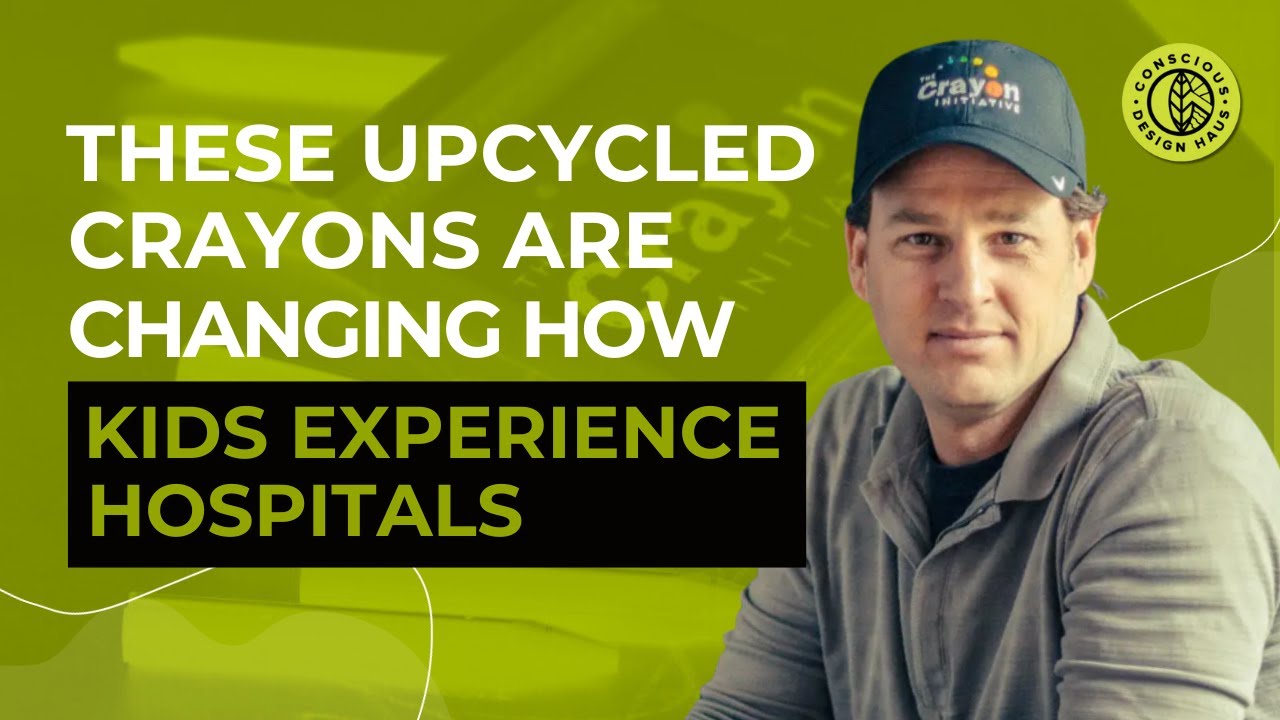
Brian Ware founded the Crayon Initiative to collect used crayons from schools and melt them into new ones for children's hospitals. The nonprofit has collected 450,000 to 500,000 pounds of crayons and designed a triangular shape that won't roll off hospital beds. Staples partners with them to collect crayons through their recycling program.
Chapters
This is what you're living. This is what normal is for you. So how do we make it not scary? How do we make it comfortable that it gives you an escape from what you're going through, as well as gives you the ability to possibly talk about what you're going through to the people within the hospital or even your family members that need to hear what's going on? It gives you that creative outlet.
Hello and welcome to the Conscious Design Podcast. I'm your host, Ian Peterman, and I help turn product ideas into sustainable 7-figure businesses. Join me for another episode where sustainability meets innovation and business savvy and design. Today, I'm really excited to have Brian Ware. He's the founder of the Crayon Initiative, which is a nonprofit helping kids, and Ware Works, a design consultancy. Welcome to the show.
Thank you. Appreciate you having me.
Absolutely. Well, good to have you on. I'd love to start where I usually do, the origin story. What, you know, design, you can see the trail into designing a product to help kids, but where did all this start?
Going back as a kid, I was always designing both from a fine arts perspective, but I mean, my real passion at the time was design work, a lot of architecture, a lot of that kind of design work. But art and design is what kept me in school all the way through, you know, college basically paid my way through college. So design was always, always a critical key.
Got it. And for people that don't know, what is the Crayon Initiative? We'll start with the nonprofit.
Sure. The Crayon Initiative is a nonprofit 501 that basically takes used and unwanted crayons from schools, restaurants, homes, wherever, come into us, we'll sort them by color, melt them down and make brand new crayons that we then donate to children's hospitals all across the country.
That's awesome. So, and this is, so you only sort, you don't use any new materials really, or do you have to blend in order to make that happen?
No, the short version is no, we don't really use any new materials in it. I won't lie about it. Like we do get some brand new crayons that come back to us. They missed the memo on the used. And unwanted crayons. But, um, so some of that gets mixed in, but it's not a— I mean, it's very small percentage, but we do not add anything to that that are new crayons.
Right. So you're not having to add something in to be able to— you're able to just melt it and reshape it, basically?
Correct.
Got it. These kinds of supply chains usually take a little bit more thought process than a nice raw brand new supply chain does. I would love to have you talk about how have you been able to first start it, but be able to continue and expand this kind of supply chain? Because I feel like, yeah, it's a, it's a challenge.
It is a challenge. Absolutely right. I mean, like if you go into a factory, I mean, whether it's crayons, candles, whatever you're making, it's more of a linear production versus a batch production in most cases. I'm not to say that we don't batch produce other things, but yeah, when you're taking used and unwanted crayons that are wrapped in paper and various other things, like you have to batch it. And so the question then becomes, how do you become very efficient at the batch engineering behind it, I guess, or the manufacturing behind it, as well as from a nonprofit perspective, you got to have the You know, working with factories and other things that I do in my other career, it's one of those, oh, well, if I had $10 million, I could just go buy this piece of equipment that's going to do X, Y, and Z. But the reality is, as a nonprofit, there is no $10 million. It's duct tape and, you know, baling wire of how we make this efficient. So definitely that batch comes into play versus just running, you know, virgin wax through Right.
And you said, so the partners you have are places like restaurants and schools, and you said even homes, so people can just— so you get all kinds of crayons in when you—
Absolutely. Yeah. We get everything from little nubs to, you know, full crayons. Some colors aren't even used out of the box, et cetera. But the fun story is that we get envelopes with 3 crayons in it from a kid that wants to help another child in a hospital to literally pallets from a You know, we've had dojos doing a whole community drive and they'll send us a pallet at a time. So you get that full range of everybody trying to help and be a part of it.
Right. Which I'm sure adds some more supply chain fun.
I never knew that I would own a forklift, but we own a forklift, you know?
Right. So Talking a little bit behind, you know, the crayon initiative, how did that come about as a thing?
The original spark or the idea came from back in 2011. Art was cut from the California school budget. It was one of those, I married a teacher, not, was not the plan, but I married a teacher. And when art was cut from the budget, it was like, how do we give back? Like, that's unacceptable. As I mentioned early on, art's what kept me in school. So from my aspect, art, the arts in general are a very important piece for many, many reasons. But when it was cut from that, that was kind of the spur of the moment. My kids were 6 and 8. We'd used plenty of crayons by then, you know, lots of art in the schools with my wife as a teacher. So there's a lot of that going on. But when that funding stopped, it was like, how do we give back? There's got to be a way to give back. And so we were at a restaurant coloring with crayons, asked the waitress what they did with these crayons, and they said they had to get rid of them. So again, from the supply chain side and all that other stuff, you're like, ooh, free materials. How hard could this be? We'll just take this free. We'll just make it over here and it'll be a win-win all the way around. But yeah, it's a little more complicated than that.
Right. I love that you found such a good use for this material. That would be otherwise just thrown away. You're able to have— bring some kid something cool and be able to use what would be considered trash, right?
Correct.
Do that.
Definitely. So that was a great benefit of everything. But yeah, I mean, it was going to trash. And so it was, hey, how do we get the free supplies? How do we get these free materials to turn them into something?
How much do you get? Maybe by pound would probably be the easy way to measure since it comes in all sizes.
Yeah, we do measure by pounds. I, we're in the somewhere around the 450,000, 500,000 pounds of crayons we've collected so far.
Wow. And when did this organization start?
The actual kickoff of the organization was in 2013. That's when we got our Official 501. So we're in our, coming up on our 12th year anniversary.
Oh, congrats. That is good to make it as a nonprofit to go that long and still be going, going strong. How do you, I guess on the supply chain, which is basically free, is it your own manufacturing or how have you?
Yeah, we do it here in Danville, California. All the manufacturing takes place here. We're run solely by volunteers. So that part's another great community thing coming out of the nonprofit.
Right. I guess, do you have much in the way of expense then? If you're—
Yes, we have a, we have a lot, a lot of expenses. Yes, the labor's free by using volunteers, but, you know, we have a warehouse, we have facility that we actually do the manufacturing in. That we, you know, have rent on all of these different things and we are in California. So it's not exactly a cheap rent location. You know, we got power bills, we got shipping. Our shipping expense is probably our 3rd biggest line item out of everything.
Pretty dense material for shipping.
Yeah, definitely. Each box that goes to the hospital weighs about 35 to 38 pounds. So yeah, it's a very small, dense box that goes to the hospitals and we don't charge the hospitals a dime for anything that we're supplying them. So we cover all those expenses.
Okay, so it's totally free for the people getting it. You're covering all of that, correct? Oh, that's awesome. Yeah, I hadn't thought about the shipping part, but it is just a pile of wax, basically.
It's very dense, very heavy. We spend between $40,000 and $60,000 a year on shipping, just to give you a ballpark. So yeah, it's a lot of money.
Have you run into issues with it like melting and things like that in some of the hotter I live in Arizona, so I'm thinking of, you know, yeah, truck.
No, we have— I mean, short version, no, not that I've heard anyways. Let's put it that way. So we definitely, uh, pack it. It's definitely, again, from the manufacturing perspective of my life, we have outer boxes, we have inserts, we have inner boxes and layers and stuff like that. So there's Some insulation just due to the cardboard boxes. I wouldn't expect it unless the truck got stuck somewhere, you know, on the highway in Arizona in the middle of summer. I wouldn't expect it to melt. The inside of the truck should be fine.
Yeah, I mentioned that because I was working with a candle company. We were running into some of their stuff was getting stuck while they were shipping it and it started to, started to pre-melt and nobody wants a partially melted candle when it arrives.
No, no. I've actually had the same issue that you're talking about, not for the nonprofit side of my world, but yeah, it was food related and it was one of those things. Well, yeah, a truck broke down on the side of the road in 120-degree weather in the middle of summer and blah, blah, blah. It's like, well, you can't plan for that. Like, that's scrap it and start over. So based off of our base, our main shipments going to the hospitals, no, we haven't had any. Issues so far.
Awesome. Well, I would like to dive a little bit into the design side. You've mentioned you've had to build some of your own machines, put things together. I would love to dive into kind of that, where it works and what you do there and how that's been able to help you in kind of creating a low-budget production line, I would say, as low budget as you can.
As low budget as we can. Yeah. So, I mean, going back to the initial design of the crayon itself, I knew that I wanted the, what I call the barrel of the crayon to be kind of triangular shape. If you remember going back to elementary school, you know, we had the little rubber doohickey that we were all given to put on our pencil that were triangle shape to kind of learn from a dexterity perspective how to hold it properly. So we worked with an occupational therapist. I knew what the shape ish was that I wanted. And then we actually made 3-dimensional models and we printed 3D models of the crayon shape and thin, long, short, and gave them to kids to use or hold. I shouldn't say use, it's a 3D model, but hold and figure out, you know, do we have the right size? So design went all the way down to that individual piece. Now jump ahead to the manufacturing side that you're talking about. You know, I use the example, the coolers that we use today to cool the molds down. So we're pouring hot wax into the molds. And just from an efficiency perspective, right, the faster we can cool this down, the faster we can do the next cycle and get that going. And the cooler showed up on pallets. No tubing, no pipes, no nothing. And I'm like, well, how do you hook these To molds? And they're like, we just supply the coolers. We have no idea because it's used for all different purposes. So it's, here you go, figure it out. So, I mean, that kind of design work goes all the way down to that. And it's like, okay, there's a half-inch threaded pipe coming out of a cooler. How do I connect to that to get to molds and disperse the cooling agent or the water through all these different molds? So it's not a 1-to-1, it's a 1-to-4. Oh, and each of the fours have 3 inlets and 3 outlets. So now there's 6 things on 4 molds. So yeah, it was pretty complicated, but that's just kind of how my mind works. And it's one of those, oh, I saw a little piece here, I saw a little piece there. What if I marry these things together? Would that work? Try it. Some things worked, some things not so much.
Hey, it's your host, Ian. I'm really glad you're enjoying this episode. I absolutely love highlighting amazing brands and for the awesome things they are doing. I've helped hundreds of entrepreneurs and businesses like yours turn their boldest ideas into powerful purpose-driven brands. So if you're serious about building a brand people love like our guests and clients do, and one that you're proud to stand behind, I invite you to dive a bit deeper with our book Conscious Design. Inside, you'll discover the exact framework and steps we use to help entrepreneurs like you turn purpose into a powerful impact-driven brand, brand that stands out, attracts loyal customers, and drives sustainable growth with social and environmental responsibility woven into its DNA. Grab your copy today. You can find it on our website, consciousdesignhouse.com, or just find the link below in the show notes. Enjoy the rest of the episode, and don't forget to like, subscribe, and share.
Well, I feel like that's the design trial and error. You're never gonna get 100%. You're gonna, you're gonna have some stuff not work out.
Absolutely.
Wow. In that process, have you— are you basically developed your own equipment in, in a way? Is it more like off-shelf things that you modify and stuff like that?
I would say most of it Is modifying to off-shelf equipment. The molds themselves, because it's R-shaped crayon, is a what I'll call a custom mold. But the concept—everybody's like, "How did you come up with this mold?" When they come into the facility to help, I mean, it's the same way your lipstick's made. It's the same way chapstick's made. It's the same way some candles are made. You know, so it's not that it's a ingenious design to want to sound like I. didn't create anything, but it's not that it's an ingenious design. Technically, how it's done is how it's done for lots of things. We're just adapting it to our shape, our style, and our purpose.
That's awesome. You've mentioned a few times that you have a lot of manufacturing experience. Can you talk a little bit about what you do with Wearworks, kind of what, what all that is involved in? You're involved in some Manufacturing and consulting?
Yeah, Wearworks is basically a consulting agency that it's mainly supply chain and manufacturing work. My background is both from the R&D perspective as well, mainly logistics, packaging, and that type of R&D side of things to the actual purchasing side. So I go into companies 99.9% of the time there was a problem, so I would be called in to come fix a problem. And then it got into, okay, we did that. How do we not make this mistake again with XYZ new product coming out? So then I get involved on the new product design side of things to make sure things are being put together properly so they don't run into these issues in the future.
Right. So very valuable in creating a whole, whole new product line of your own with the nonprofit.
Absolutely.
Very, very cool. What are the goals for the nonprofit? Kind of, I know it's been growing. Obviously you've been around for, for 12 years. Where is there like a goal or place you want it to be at a certain point? Kind of what's the future looking for it?
The future from my aspect for the Crayon Initiative is to go beyond the crayons. We've done some coloring books. We've done a few different activity guides and stuff like that. But I really want to be the go-to for the hospitals as the go-to creative arts nonprofit or organization to assist these hospitals to bring creative arts to the children.
As you've done some coloring books and things like that, is it, are you thinking of more kind of product things that could be used?
Yeah, more product, I would say, related. Stuff. Again, not necessarily developing a brand new product, but combining things to be. So I guess the underlying thing here is that the kids in the hospitals, their normal is not what a healthy child at home's normal is. So even our coloring books, they're very hospital-centric. We worked with the hospitals to create them. It's not a, oh, here's a Mickey Mouse coloring book or a you know, coloring book, et cetera. It's more of a, this is what you're living. This is what normal is for you. So how do we make it not scary? How do we make it comfortable that it gives you an escape from what you're going through, as well as gives you the ability to possibly talk about what you're going through to the people within the hospital or even your family members that need to hear what's going on? It gives you that creative outlet. Now, what's next? You know, I'd love to do like activity boxes, but again, it's activities that the child can do either in their hospital bed or in the, you know, playroom within the hospital versus doing something. I use the example of, you know, we made papier-mâché volcanoes and we put baking soda and we did all this type stuff. And it was a cool craft as a kid growing up. Well, guess what? You can't do that in a hospital. So what type of cool things can we do within the hospital 4 walls that a child is capable of doing, as well as capable of doing on their own or in a group setting? Because these children are stuck in their room. We talked a little bit about the shape of the crayons, but one of the side effects of that triangle shape that the hospitals came back to us with was It didn't roll off the hospital bed tables, which was a complete side effect from our design work. But I bring that up as a point of when the rounds are being done, either by child life or the nurses or the doctors, et cetera, they'll go spend the time with that child, but then they leave and that child could be alone in the room for 3 hours before the next round comes through. You know, as long as everything's going Fine. But if a crayon rolls off the table, that kid is down a crayon, that child's down a crayon or 2 crayons or 3 crayons, however many drop off. So by that, you know, so that was the design aspect. So when I come back to these activity kits, it's something that they can do by themselves. I hate using the word isolation, but in isolation and not have somebody over them saying, oh no, tab A goes into slot B and, you know, all this other stuff. They can figure it out on their own. So. We want to come up with those kinds of activity boxes at different age groups for these children to do.
Is this for mostly kids that are staying longer or short? Like, is there—
I would say that the activity boxes are more for the longer side of things. The creative arts, other pieces that go with it. Now our crayons themselves. I know for a fact they're used within emergency rooms. They're actually used with siblings of the kids that are in the hospital. So they have a way to communicate with each other. They're used long-term or what they call the frequent flyers, which are like cancer patients going through radiation where they'll be in for 2 days or 3 days, out for 2 weeks, back for 3 days. So they all have the opportunity to use the crayons, especially with the crayons. And even when we get to the activity boxes and other things, it's up to the hospital's discretion how they want to use them. They ask me like, can we use them in the hospital? I'm like, I've delivered to you. You're in charge of your hospital. You know, I'm not going to dictate how you use them within the hospital walls.
Right. That makes sense. I love that the design had the unintended but very beneficial thing of not rolling off. You've mentioned you've worked with some different specialists. Through this project. Who, I guess, is there anybody else you haven't mentioned that you consulted with or brought in? Because it sounds like there's, I mean, there's a lot to go into it. There's the hospital standpoint, it's making sure, because it's, you know, you design something normally for kids, you think of how they're probably at home playing or something like that. Hospital room, hospital bed, these are very, very different spaces. Compared to anything, you know, school, home, all of that, which takes a lot more. You got to think about, think about these things quite a bit differently.
You do. One of the first child life specialists that I worked with and was on our board, you know, gives the discussions when I go to child life conferences and various other things that it's in that hospital space world. And she's like, I don't know how he understands it, but because my kids, they were both preemies, but they weren't in the hospital from a using crayon kind of concept. They were right. So it was one of those, how did he know? And it's learn, just learn, use common sense in your design work. Don't be afraid to ask, as you say, you know, the experts in all these different areas because I don't know what I don't know. So you have to ask these questions and get the right parties involved. To you, it might be the life-saving question. To somebody else, it could be, that's a dumb question. Why would you ask that? But it's all learning. So bring it into whatever you're doing and, you know, the design work behind it.
I love it. And I love that you've, you know, you've brought in these experts, you've been able to create something that is unique and really specific for kids in this position. And I don't think there's very many people doing that. So thanks for—
Thank you.
Good. You're putting effort and brainpower toward, towards that. I've enjoyed talking to you. I think this has been, been really great. I wanted to ask for people that want to get involved, if they want to ship you, you know, 2 crayons or a palette. Where's the best way to reach out, connect? I know, hard for anybody not local to volunteer their time at working there, but for all the crayons and things like that.
Yeah, definitely. I mean, the stuff on the website. So there's 2 main ways for donating the crayons. They can either ship them directly to us. And if they go onto our website, there is a link, sign up to get your label. Basically, you'll be paying for it, but you get our nonprofit rate by going through. The link on there. The other way to do it, which is a partnership that started, I guess, a year ago, roughly a year ago now, with Staples. And basically any Staples office supply store you can walk into and under their recycling writing instrument program, they take crayons back, they sort them out from the pens and pencils and all that other stuff and send us the crayons. So if there is a Staples in your area, that's the easiest way to send crayons back to us because it's no cost to the donor.
That's awesome that Staples— I didn't even know they took pens and pencils back.
Yeah, that started, I want to say, early '24, late '23, early '24. Okay. They started that program.
That's awesome. Well, that's a— probably gives you a fairly good supply of crayons.
It took a little while and I kept asking like, are they getting them? Are they getting them? Because we did see a— I don't want to say a stop, but a significant slowdown once we announced that in the individual boxes coming into our facility. So I'm assuming they all went to, you know, Staples, and that's why we weren't receiving all these individual boxes. And once I got their supply chain understood of, oh, it goes from the store, then it gets trucked back to here, and then the DC brings them to this place and they do all the sorting and then it gets shipped. I'm like, oh, okay. Yeah, that makes a lot more sense why it's taken a while. So based off of that, once that happened and we got that pipeline filled, now they come. Yeah, we get, we just received 10 pallets last week from them. So lots of crayons, lots of crayons coming in that direction.
Amazing. Well, that's awesome. I will remember that now. And I will, when our kids get done with the crayons, know where to take them, which is absolutely. So, well, yeah, thanks for being on the show. I really appreciate it. And for everyone listening, there will be links and notes in the show notes on on all of that as well. So thanks for being on the show, Brian. I appreciate it.
I appreciate you having me. Thank you.
And that wraps up another episode of the Conscious Design Podcast. If today's episode inspired you to bring your product idea to life and turn it into a sustainable 7-figure business, visit petermanfirm.com or click the link below. Your ideas have the power to change the world, and we're here to help make that happen. Thank you for joining us, and I'll see you on the next episode.
More from Ian


You Didn't Know a Shampoo Could Do This #Shorts #shampoo #ecofriendly #haircare





The Biggest Misunderstanding About Bioplastics - Sustainable Materials Consultant Joanna Pool

A Polymer Scientist Explains the Truth About Bioplastics #podcast #sustainability #science



NASA is testing this on Mars… why not Earth? #Shorts #GreenTech #NASA #science