How I Booked 16 Sales Calls in 1 Week
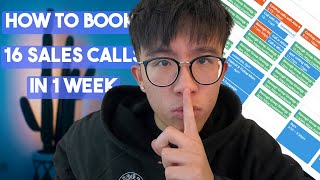
YouTube tutorial by Jimmy Fung (Borough Group) explaining how his appointment‑setting agency booked 16 sales calls during Jan 16–20, 2023. He presents a three‑part 'sales call booking formula' (irresistible offer × volume × timing), walks through campaign metrics from a cold‑email push, messaging structure, follow‑up importance, and advice to scale by outsourcing the outreach.
Hey, how's it going? My name is Jimmy Fung and thanks for watching this video. Pretty much as the title implies, I'll be going over exactly how my agency, how my business, how we booked 16 sales calls within a one week period, actually within a five day period because no one speaks and no one books calls on Saturdays and Sundays. So we book 16 sales calls between Monday through Friday. So just to give you some background on who I am and what I do, so I run an appointment setting agency called Borough Group. Pretty much in a nutshell, what we do is we help service based B2B businesses book qualified sales calls using cold outreach channels such as cold emails and cold LinkedIn. Right. So that's what we do. And what we did just to get into the video is we booked ourselves 16 sales calls dated January 16th to January 20th, 2023. So right now I'm filming this on the Sunday, January 22nd. So this happened. So this went, this happened just this week actually. And one of the things is, is the reason I wanted to share this video was to really highlight the fact that what we do for our clients, which is help them book meetings, we use that exact same process for ourselves and it very clearly works. Right, so this is a screenshot of my calendar, very packed. And just to show you that I am not lying, this is a Google Chrome profile. Let me refresh the calendar. So this is this week. I'm on the 22nd. We see for this upcoming week. It hasn't even started yet and I already have, I want to say around 10 sales calls here. But we're talking about last week, right? So this is the last week, January 16th to January 20th. And we booked 16 sales calls. So if you want, you could pause this video and count all of these, you know, light green, they're the sales calls. And we see that, you know, they're very real people, right? This isn't a fake screen grab where we just manually put in, you know, these, these calendar meetings for ourselves. These are real people, right? And we spoke with these people, right? These are very, these are very real people. And we spoke with a lot of them, right? And obviously not all of them were completely qualified. But that's fine. That's just the game, that's how it's played. And we were actually able to sign three clients just this last week alone using, you know, from these 16 sales calls. So what we're doing works. But I wanted to share exactly how we were able to do that and how you can replicate the same and get similar results. Inside of your own business, right? So pretty much just to jump right into it, what I realized, and we've been doing this for a very long time, right? I spent a lot of time learning how to book meetings, how to use cold emails, how to use LinkedIn to do so, and this is what I learned, right? There is a formula that you can follow. I call it the sales call booking formula. And pretty much here's the formula, right? Your irresistible offer times volume times timing equals booked meetings, right? So those are the three different variables that you have to pull on the three different variables that you must leverage in order to successfully book meetings. And there's no way that you're able to consistently book sales calls if you're missing one of those three variables. Maybe if you're missing one of them, you might be able to get one or two sales calls here and there, but there's no way you're consistently booking, you know, 10 plus meetings every single week the way that we are. If you're missing these, you know, one of these variables. So just to dive into the specifics, will start with the irresistible offer. So pretty much what that means is to start, it's very important for you to go ahead and craft your offer. So pretty much what that is is what are you offering and to who. So pretty much the overall idea is in a very quick sentence, one or two sentences you really want to summarize and explain. Why would someone want to work with you, you over your competitors? Remember, you're reaching out to business owners. These are very busy people and they probably get many similar messages of people, different people offering something very similar every single day. So you have to think of a way to really stand out and grab their attention, right? So pretty much what you want to do is identify a unique value proposition from your product or service. So what this means is clearly defining what sets you apart from your competition. And this is very important. What makes you unique and how, what your product or your service that you're selling, how that solves the specific needs of your target audience, right? So though, something that's very important as well is making sure that you're selling a product or a service to someone who actually wants, needs it, right? So for example, you could. So for example, let's take the newspaper industry, right? So obviously in the last couple years, just logically speaking about this, I don't have any concrete data or facts, but just thinking about it logically, the newspaper and journalism industry has changed a lot. You could be selling the highest quality, most up to Date newspaper. But there's no way you're going to be competing with online news outlets. They're not going to compete with the news outlets who are on social media, on Instagram, on Twitter, on YouTube, on Google, on Google News. You won't be able to compete with them even though your product is superior to them. Right? So what I'm saying is it's very important that you're selling a product or a solution to someone who needs it. So just to give you an example of what our own personal unique offer is, is we make it unreasonable for service based B2B businesses to not sign three to five additional clients every single month. And we do this by helping them build out their organic outreach channels. So that's our unique offer. What we do is the exact same process we use for ourselves to book ourselves meetings. So as you can see, right, this is a very quick sentence, very straight to the point, very direct, and anyone who reads this will know right away exactly what we do. What we do is we help our clients sign more clients. And the way we do so is by helping them get more sales calls. So anyone who reads that will be able to see and understand that very quickly. So what makes an irresistible offer, just to break it down more specifically. So found this illustration and I thought it was the perfect example for what the value equation is. So essentially what you do and why someone would buy from you, these are the different levers that you really have to pull on and together in combination, they make or break your offer. So what I mean by that is anytime you're selling something to someone else, whether this be a consumer or, or to another business, essentially what they're buying from you is the dream outcome, right? That is where the value is. And the way to increase your value and to increase the likelihood of someone being interested in what you have to sell is by pulling these three levers. The first one is increasing their perceived likelihood of achievement. So what this means is let's say for ourselves, right, we're selling appointment setting services. What our clients need to know and what our clients need to understand and truly believe before they decide to work with us is the chance of them achieving something similar, which in this case is booking high qualified sales calls, the likelihood of that happening is very high. They have to believe that if they believe the likelihood of that happening is very low, or it's next to none, they're obviously not going to work with us, right? And one of the reasons why I'm filming this video is to really just show you that the process we do for you and for our clients is what we use, right? So the likelihood of achievement is relatively high. Right. We're not implementing something that has not worked. We're showing you that we have results. We're doing this for ourselves, we're doing this for our clients. And we're booking, you know, 10 to 20 client calls, right? So increasing the perceived likelihood of achievement is very important. After that is lowering the time delay. So obviously this really depends on the specific product and service you sell. But generally speaking, people want to buy a service or a product which they could receive value in a relatively short period of time, right? If you're buying a car, there's two dealerships, exact same price, exact same car. The specs, the model, the color, everything is the same. The only difference is dealership A tells you if you spend $10,000, you can walk out with that car that you want today in 30 minutes, fill out the forms, make sure you qualify for financing, all that good stuff. You can walk out that car as soon as today. Dealership B says, no matter what happens, the earliest we could get you the car is next week, next Sunday. Who would you choose? Well, most people would choose dealership A. They're giving the exact same thing. All things considered, everything's the same. The only difference is the time delay. Obviously, you would want to receive that car a week earlier than dealership B, right? And it's the same, exact same idea, right? What you want to do is lower the time delay in your prospect and your lead's minds. And the first and the third step is, is to lower effort and sacrifice, right? So for ourselves, what we do and our sell, our offer is we build these cold outreach channels in house for you. We do it A to Z. So pretty much, we spent all the time, I spent all the time learning how to do this, practicing it, testing different angles, all of this good stuff. Now we're at a point where we know what we do works. It's highly. Is something that could be easily replicated into our clients, businesses. And a bunch of our clients have been booking meetings using a similar system, right? So we took all of that, we compressed that timeline, and essentially we're doing it for you as well. So you can go and do this, right? Your prospects can go and, you know, if, let's say you're selling recruitment services, your prospects can go make a job, post on Indeed or LinkedIn and, and interview 20 people and find a candidate, right? But the reason they're working with you, if you're a recruitment firm is because they don't want to do that entire process, right? So our clients work with us because they don't want to spend all that time and effort thinking about learning how to send cold emails, how to connect with people on LinkedIn. They just want a system that works and they don't want the headache of thinking about it. So that's what lowering effort and sacrifice is. The next part is. But that's all great. But how do we do these things, right? No, these points are important and they make sense logically. And if you really break down what makes someone buy something, you would think of these things, right? So how do we actually do these things? So what we do is, again, right, it really ties back to creating a compelling headline which grabs the attention of your recipient and your prospects. So your headline needs to be attention grabbing and entice the recipient to read on. So like I said, right, you want to keep this really brief. And a mistake that I see a lot of people make is they really make it very salesy or extremely high pressure. Remember, what we're doing here is we're reaching out to people who don't know who you are. So if you're coming off as really salesy, really high pressure, really spammy, right off the bat, you know what's gonna happen? That person who opens that email, who opens your message, they're just not gonna respond if they open your message at all, right? Because people get the notif on their phone and they see like the preview text and if you're writing something super salesy, they'll see that in the notif bar, right? So the idea here is to grab someone's attention in a non salesy way and to be very direct to the point with what you're selling so that they understand it. And one of the easiest ways to do so is to use social proof, right? So testimonials and content that builds trust. Again, remember these people, they don't know who you are. So anything that builds up trust is a must, right? When people are receiving a cold email from, even from me, you know what most people do? So inside my signature I actually have a link to my website. So what most people do is they actually go onto the website, they, they watch the quick video that goes over what we do and how we do it. And then what they probably do is they probably highlight my name, Jimmy, they copy it, they paste it into Google and they either look up my LinkedIn profile, my YouTube channel, and that's what people do, right? Because people don't know who you are and you need to do these things. And the easiest ways to do so is by either using testimonials, can you case studies, or creating content similar to what I'm doing right now as it builds a lot of trust. So that's the aspect of the resistible offer. So as part of the formula, the next one is volume. So remember, volume negates luck, right? So remember, you're in business, and as a business owner, it is your duty to get your business and what you do your offer in front of as many eyeballs as humanly possible. That's your duty. And if you're not doing that every single day, then chances are your business might not be doing very well. Right? So which is why paid ads is such an appealing option, right? Paid ads, Facebook ads, TikTok ads, YouTube ads, Google Ads, all of these things. Why they're so popular and why there's such a massive discussion about those things and why it works so effectively, right? Is because essentially what you're doing is you're creating an ad telling people what you do and it allows you to get in front of many eyeballs. However, the only problem is you need to pay for ad spend, right? So Facebook ads, they're not free. If you want to get in front of 5,000 eyeballs, you're paying a pretty good amount of change in order to do so, right? And that's what makes what we're doing here so effective, is we're able to in many cases, actually, because what we're doing is B2B. So other businesses, I think a lot of paid ads work really effectively for B2C especially, right? You're selling consumer products, but what we're doing works really well and in many cases is superior to paid ads. And one of the largest reasons is because this system, we're sending up cold emails, for example, it costs literally less than $200 USD to run, right? If you're spending $200 USD a month on Facebook ads, you know what's gonna happen? No one's going to see your ads, right? You're not going to get results. That's what's happening, right? So that's why what we're doing here works so effectively. We have a predictable system that pretty much does the same thing as ads, getting you in front of as many people. But in many cases it's actually better, right? Because we're getting the offer across much more direct, you're following up to people and we're able to scale the volume at I don't know, a tenth the price, maybe even 5% of that price. Really depends on how much people spend on ad spend. So. So, yeah, so volume is the key to success, right? That's one of the things that I realized very quickly in this business. Remember, I talked to many business owners, many agency owners, right? Last week I talked to 16 agency owners. And the ones that I noticed who are usually having problems in terms of signing clients are the ones, there's a very clear pattern. They are the ones who, who do not have a dependable way of getting clients and booking qualified sales calls, right? And they don't have a way of getting their business in front of enough people, right? Usually. And obviously just a generalization, but usually by the time they chat with us, the main channel for acquiring clients is through word of mouth referrals. And what I always tell them is, yes, referrals, word of mouth network, that's really great as a channel to get clients. In fact, some of the highest quality clients come from referrals. Because they already trust you, right? And that's quite literally what it is. But the problem with that is if you're trying to grow your business and you're trying to scale more aggressively, hit your, hit your growth targets, you can't depend on referrals, right? Because you can't control whether your client or your current client refers you to two people, three people, four people, five people, maybe none at all. You can't control that. So it's not a dependable and a consistent way to book meetings. Although they are really high quality clients when you do work with them, right? So what it is is those business owners don't need a new source of booking meetings, right? They'll need a new channel. And, and cold outreach is the best, right? But maybe they've tried cold outreach in the past, right? Maybe they've tried cold calling, they dabbled with cold emails, maybe sending cold linkedins, maybe sending DMS on Facebook or Instagram, but it just never got it to work, right? And one of the reasons I see again is they're just not sending enough volume, right? If you're getting your business in front of enough people, it's unreasonable to not get results. And that's kind of the mindset you have to adopt. What do I need to do to make it unreasonable to not get sales meetings? And when you think about it like that, the most logical answer is send so much outreach that you are booking sales costs. You send so much outreach that it becomes unreasonable to not book sales cost. And that's the overall idea. And the second aspect is testing, right? Testing different angles. What works with a certain industry might not work with a different industry. So if you're going to Google and you're searching up cold email templates and you're grabbing that, or you're watching a YouTube video and just blatantly copying someone, there's a very strong chance it's just not gonna work just because they're most likely not targeting the same types of people you are. And their offer is probably different from what you're selling as well. So what you need to do is take that, use it as a framework, and write different angles and test it. Test everything. Subject lines, your intro, your offer, your call to action, Test all of those things. And when you're sending enough volume, it's basically bound to work. It's basically guaranteed, essentially, Right? That's just what it is, right? And yeah, so just remember, I think one of the things that really changed my perspective on this and really it was like a light bulb moment for me, was just understand that your competitors, so whatever you're doing, right, whether you're running a marketing agency, a recruitment agency, a software development agency, PR firm, it doesn't matter, right? Just remember that your competitors, they're sending thousands of outreaches every single day. So how can you possibly compete by sending 50 cold emails a day, right. And cold calling 30 people, DMing 25 people on Facebook? How can you compete with your competitors who are sending thousands a day when you're only sending maybe 100 at best on a good day, right? And you're probably not even super consistent with it, or your team's not super consistent with it, right? So how can you compete with that? And the answer is you can't. Right? It's simple mathematics. You just can't. Right? The math doesn't. It doesn't work in your favor like that. So that's pretty much why volume is very important. In fact, it's one of the key ingredients. The next one is timing, right? You can't control this. It's very similar to business. There's an aspect of success in business which is luck, being at the right time, at the right place to meet the right people. And it's very similar here in terms of timing, right? You can't control this. But it's an important variable to think about and consider. So, for example, it's very important for you to understand your client's buying cycle and just the overall economic conditions, right? So, for example, everything works in cycles. Sometimes certain months Certain quarters, certain, they're just better for getting sales. Right. Because it's a period where people have more money. It's a period where people have more intentionality in terms of buying things, investing into their business. So you just have to be aware of these things. Plus the ever changing economic cycle, right. The conditions that applied six months ago are definitely completely different now. Right now we're hearing a bunch of companies doing hiring freezes. A lot of companies are doing layoffs. Microsoft, Google, Amazon, they're doing layoffs, right. So the economic cycles are changing very quickly every single day, every single week. And you need to be up to date and understand how that will impact what you're currently doing and adjust the strategy accordingly. Right. So again, you can't control this, but it's still important and you have to keep that in mind, right? Because you know, you have to increase your odds of success. And if you're just ignoring these things, you're just leaving that out to blind luck. And the odds of you succeeding is relatively low if it's not something that is measured and it's not something where you're aware of and you can plan for. So just to go over. So I wasn't going to include this, but since I was sharing exactly what I did, might as well, right? So how I booked these meetings was through cold emails. I'll be real, it was all through cold emails. All 16 were through cold emails. And pretty much this was the campaign that I launched. So I started this campaign on the last week of November and we were sending max volume starting December 1st. So really not that long ago. A little bit under 60 days really. But yeah. So this is what we're able to do, right. So in the last 60 days we reached out to 16,000 people, right. So the way it works is we were touch, we were sending 2,500 cold emails every single day. And after, after, I want to say five to six weeks, we were able to reach out to all 16,000 people. And then the follow ups and stuff like that, we got, you know, open rates really high, 82%. But open rates is not what gets meetings, right. So some people, I know they have a very heavy focus on open rates. But open rates is not going to get you meetings, right? So we have 8.8% reply rate. So we have 1400 people who replied back. Obviously a lot of these people were tire kickers or people who are just saying stuff like not interested, stop spamming me f off all these type of things. You encounter those people in sales, right? So Obviously not all of those, all 1400 people were interested. Right. But a good 300 of those people were. And out of these 300 people who were interested, I'm not going to lie and say I spoke to 300 people because I didn't. And that's just not how it works. But right before this, when I was just doing a rough estimate of how many people I spoke to from this cold email campaign, I think I spoke with somewhere between 100 and 120 people in the last 60 days. Booked somewhere between 100, 120 sales calls during that time. Just because. Right. On any given week we do average anywhere from 10 to 20 client calls. Sales calls, Right. Similar to in this video, it has 16. Right. But that's a pretty average week. It's not even like outlier week. Right. Like I showed you right now as a Sunday, the week just started and we already have 10 sales calls on our calendar from just Monday and Tuesday alone. So. So, you know, I'm pretty sure by the time, you know, it's Friday, end of day Friday, we'll have a lot more than 10. Right. But yeah, so that's what we were able to do, you know. And this is the overall message structure. Right. So I'm not going to share the specific message we use just because it's different towards every lead, but the overall idea is this, right. So. Hey John, their name intro and personalization. Intro as in where do you find them or why you're reaching out? So I stumbled across your LinkedIn profile. Noticed that you run a marketing agency, so thought I'd reach out. That's the intro. What you might want and this is something you have to test because it's different for every industry is personalization. So certain industries works better if you compliment something on their LinkedIn profile or their business. Saw that your business recently got another round of series funding. Congrats on the hard work. Right. Something personalized like that offer. We went over this. Your one to two sentence on what you do and how you do it for your clients. Case study. Right. Really to add social proof and trust. Examples of other companies, other clients you've done this for and the cta. Right. Call to action. Mind if I share more? Would you be free to chat? The call to action, very important. Right. And one of the things that I noticed if I was just to share a quick little bit on tips, is the money is definitely in the follow ups. Again, people are very busy so following up with them is very important. And the idea of connecting with the Leads and having a conversation that's not too salesy or high pressure and to really see if your service and product and what you sell can actually help them, you don't want to waste your time. At the end of the day, I'm in the service industry, Chances are you're in the service industry. And our businesses are very reliant on the type of clients work with. So even for me, right, if I'm working with a bunch of just really bad clients, right, the worst type of clients, the ones that micromanage you, the ones that are always looking over your shoulder, ask for many, many things that are actually very unreasonable, then my life is going to be miserable, right? My business is not going to be going as fluently as it possibly can, right? So making sure you work with the right clients is a very crucial part. And you don't want to come off as too salesy, but yeah, so that's pretty much how I booked 16 sales calls in one week. One important thing as well is the idea of scaling and completely taking yourself out of the process. So obviously doing that, this outreach, doing everything that leads to these booked calls. This is an extremely time consuming process, right? Just to give you some context, I don't even personally do this entire process myself anymore. In the beginning, when I was growing my business, yes, I was involved in every aspect, right? Lead scraping, writing the messages, setting up the cold emails, the LinkedIn, everything like that. But at the end of the day, that's not scalable. You only have so much time on your hands and realistically, you know, setting up cold emails, that's not a value added activity, right? Setting up your LinkedIn, that's not value added, right? Testing different offers, scraping leads, that's not value added. What's value added is talking to these people, right? Hopping on these calls, understanding what they do, seeing if you could be a good fit for them and potentially working with them, right? That's what's value added and that's what's gonna move the needle for your business. And focusing, spending all your time focusing on this is not gonna help you get there, right? So imagine trying to go ahead, building the lead list together, segmentating and personalizing your copy, and then spending the time to split test and book meetings on your calendar, right? It's just a poor use of time. That's quite literally what it is. There's no other way to put it, right? And realistically is you should be outsourcing these tasks to either a VA or agency, just like what we do. Who will Help you build out your lead generation, work with you to build these outreach systems in house for you so that you're not in the trenches spending seven, eight hours a day, you know, managing all of this stuff and figuring that stuff out, right? But you're still getting consistent sales calls and closing deals each and every single month, right? So that's the basic idea of what we do. And that's how we were able to book 16 sales calls in one week for our appointment setting agency. If you're interested in, if you know, if you even got to this point of the video, it's pretty long, 30 minutes longer than I thought. But if you're still here, there's a very strong chance that you're interested in figuring out how to book yourself more meetings, book more meetings for your business. So what we'll do is to be honest, like I said, right? Managing all this stuff, it takes a lot of time to learn and, and set it up and just a poor use of time. So if you agree with that, why don't we set up a call? We could figure out if this is something that could help you, if what we do is something that can help you, and if we can help you book more meetings and sign more deals, and if that's the case, set up a call and we'll see you on the call and we'll talk soon. Thank you. Bye bye.






