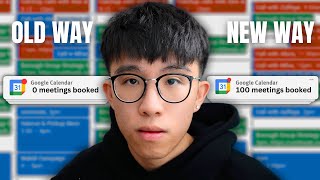
Jimmy Fung breaks down a three-step testing process for cold emails: first optimize messaging, then your hook question, then the call-to-action. He argues messaging accounts for roughly 80% of whether an email works, and that most people either test nothing or test everything at once.
The way most people test and write their cold emails is just completely wrong. I've sent over 1 million cold emails at this point. I've worked with hundreds of people helping them book sales calls with the cold emails. And they're either just making too massive mistakes, they're either testing too many things or they're just not testing at all. And in this video today, I'll be sharing with you a proven testing process for your own cold emails. And if you implement this inside of your own business, your cold emails will just print you money. Let me explain. All right, so what I see is a lot of people, when they're sending cold emails, they're actually doing it completely wrong. And here's what I mean by that. So what most people do is if they're trying to book sales calls for their business by using cold emails, what they're doing is they're doing two things. They're either running a cold email campaign and they're split testing like 50 different things. Or what's worse is maybe they launch one email campaign and they call it a day. They, they sit there for 30 minutes, an hour, whatever. They write one cold email copy and then they just send that to 5,000 leads or 10,000 leads or however many leads. That's what most people do when they're trying to use cold emails to actually book sales calls. And what I've learned after sending well over a million cold emails, booking thousands of sales calls is this is an extremely inefficient, ineffective way, really. And if you are doing any of these two things, to use cold emails to book sales costs, you, you are making a massive mistake. Because what a cold email should be fundamentally, and I'm not giving you like a template that you could copy or whatever, but I just want to help you explain why cold emails work and how cold emails actually produces a sales call is there's really three core fundamentals to any successful cold email. The first is the intro question where you're like, hey John, it's kind of like an icebreaker question. Hey John, you're just asking a problems probing question, right? To really get that conversation going. So it might be, hey John, is your company looking for more sales calls? If you're running a lead generation offer, right? Helping other businesses book sales costs, that's the intro question, icebreaker type of, type of thing, right? The second question is or the second thing in the cold emails fundamentally is the offer. So this is the part, the cold email where you're actually explaining what you actually do, who you Help what you do, what is your specific channel or mechanism that you're actually delivering these results? So it might be like reason for reaching out is because we help marketing agencies book five to 10 sales calls a month by using our automated cold email. Something along those lines. Very straightforward. It's an offer. The third aspect is your call to action. So kind of your next steps. So you're explaining what you do, who you help and how you help them. Where do they go from here, right? Is that booking a sales call? Are you sending them a vsl? Are you sending them a sales asset? What are you doing? That's the call to action. And every successful cold email fundamentally has each of these three things. So that's what you need to understand about how to make cold emails work. And what you want to do is as you are writing your cold emails, there's different things that you want to test. And this is all with the ultimate outcome of finding that winning cold email that you could just use and it will print you sales costs. But again, right, most people, they kind of mess this up because they're just testing a bunch of different things. Or again, worse, they're just writing this one cold email and they're calling a day. And it's very rarely that the one cold email, the first cold email you write will actually be your winner. It's very, very unlikely, even if you know what you're doing, right? And here's actually what you want to do to test your messaging for cold emails. The first is you need to see what message resonates best with who you're trying to sell to. What is the customer actually looking for? And then how do you actually maximize that? So what is the message that will convert customers the best? Think about what you are selling. It doesn't matter what you are selling. If you are selling lead generation, you're selling Facebook ads, you're selling website development. It doesn't matter what is the main thing that customers want, what is the thing that your specific service or solution that you sell, what does that solve for? And if the message is correct, it really doesn't matter how you say it. Like the specific words you say. Obviously certain phrases will convert better than others, but ultimately, ultimately it's the messaging, right? So what I mean by that is a lot of people kind of get really tripped up. And this is why people really love scripts, because they just want a very specific word for word copy of what is the best cold email template that kind of works. But you have to understand that it all comes down to the message. What is the overall idea that you're trying to convey in your cold emails? And if you get that correct, the specific words doesn't really matter, right? 80% of that success is what you're actually saying, not the specific way you're saying it. And what you want to do when you're testing the messaging is you want to find a message that just connects and resonates with the customer the most. And how you want to do that is you want to create three different emails with completely different messages. So think about what you sell. So for example, I sell lead generation as an offer. I help other businesses book sales calls by using cold emails. So what are kind of my three messages that I can use in order to do that? Well, the first is I could tell businesses that, that, hey, I will help you get new customers, acquire new customers. My second message is, hey, we can help you book five to ten sales calls. We can help you book 100 sales calls, whatever. The specific number doesn't really matter, right? But we're helping you book sales calls. And the third message is we can help you build sales pipeline value, right? We'll help you add $50,000 worth of deals into your sales pipeline within 90 days, whatever, right? Those are kind of the three overall messages. And when I am launching my own cold email campaigns, I create three variations where I'm testing messaging with each of those three. So if I was to plug it in to the cold emails, like fundamentally section, the main thing that would change is the offer, right? So reason why is we help marketing agencies acquire new customers, we help marketing agencies book more sales costs. And the third one is we help marketing agencies add XYZ dollar sales pipeline value to their business whatever within 90 days. Let's just say, right, that's what you want to do first. The very first thing is testing the message because the message is 80% of the success of of any cold email campaign is what are you actually saying? What's the ultimate outcome that businesses want to work with you for? That's what you want to do, right? So you want to create three different emails with completely different messages. You want to send each of these three and you want to look at which message got people just replying the most or booking sales calls. Because there will be three that stand out in the order of best, middle and worst, right? That's just how it works, right? There will always be that order. One is going to perform better, one's going to perform worse, and one's just going to be the middle Ground, Right. And that will tell you which message people are most interested in. So obviously for my business, I did all the research, I did all the testing, so I know which one works the best for me for what I sell. But you would want to go and create your own cold email testing each of these three messages. So once you have that down, the next thing you want to test is the intro question. So the intro question, which is, hey, John, is company looking for more sales calls? Looking for whatever, right? That's the question you want to test. And that's kind of like your overall hook. What do people read first when they click into your cold email? And what you want to do is once you tested the message, you want to take that winning message, and you want to test different intro questions or different icebreaker lines. That's essentially what you want to do. The message and your call to action. The initial call to action that you're testing is going to stay the same. And basically what you're doing with this test in step two is which intro question is is kind of the best hook and gets people to just respond the best. Right? And again, right, you're testing three different questions in relation to the message that works the best. That's what you want to do. And once you figure that out. So now you tested the intro and you tested the message, the final step is to test your call to action. So what is your next step? Right. And you have to understand that every single call to action works. Some works better, some works worse. But it all comes down to who you're selling to. That's the big differentiating factor. And what you're doing here by testing the call to action is you're taking the winning intro and message, the intro line and the messaging that you're saying. And what you're doing now is you're testing different call to action. So what is the call to action that is the best next step? And again, you want to come up with three call to actions. There's really only three, to be honest. The first is a direct, hard call to action, which is, hey, if you're open to it, why don't we put 30, 45 minutes on the calendar for Thursday or Friday. Let me know if you're free for that. You're booking a call right then and there. The second one is a video sales letter call to action. Hey, we put together a quick video walking you through exactly how this works. Mind if I share it with you? And the third call to action is what's called a soft call. To action, right? Just very open ended. Hey, are you interested in learning more? Are you open to seeing how this works? Something like that, right? That's a very soft call to action. And that's what you want to test. So what you want to do is whenever you're writing cold emails is you're testing it in this order. You're first testing the messaging. Once you find the winning message, you're testing the intro questions. So the hook, once you have that winning hook, you're testing the call to action. And this is how you find the best cold email that just resonates with your market and whoever it is that you're selling, whatever that you're selling. And this is a principle, a cold email principle that will work. And the reason I'm making this video today is because again, right, I see a lot of people that get stuck in the trap where they're always looking for the winning templates. What is the template that converted and booked sales for this guy? And that was me when I first started. I did a lot of research, I tried to find a lot of people's templates, you know, stuff like that. And what I realized is as I'm progressing in my own business's journey, as I'm booking sales calls using cold emails and getting better with cold emails, what I'm learning is the templates might change. But if you understand the fundamentals, the psychology behind why a cold email converts, you will be always able to book sales calls using cold emails. Right? The templates that worked so six months ago are not the same templates that work today. The templates that work today will not be the same converting cold emails that work six months from now because the strategies change, but the underlying psychology does not change. And if you're able to understand why people respond to cold emails psychologically, why people actually book sales calls off of cold emails, then you will never struggle with cold emails again. But that's what I wanted to talk about in today's video. If you like this video, make sure you drop me a like, make sure you drop me a subscribe and make sure you share this video with a buddy or someone you know, if you know this can help them. But see ya in the next video. See ya.






