This new cold email scripting trick that is taking over…
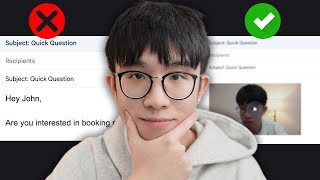
Jim Fung breaks down a cold email framework for agency sales: short curiosity subject lines, research-backed problem statements, and upfront value. He claims it generates 5-10% reply rates and hundreds of booked calls.
Hey, hope you're having an amazing day. My name is Jim Feng and in today's video, I'll be walking you through a new cold email scripting trick that I am personally using at my own lead generation agency that is consistently getting me somewhere between 5 and 10% reply rates and booking me hundreds of sales calls. So when I first started my YouTube channel and when I first started going really hard and posting a ton of content, I actually made it my mission to be as transparent as I can and share with people as much as I can for free. That's reasonable. Of course, what I'm currently doing at my own lead generation agency, some of the cold email scripts and tactics and strategies that I'm personally using. Because I know when I first started my business, my lead generation agency, one of the biggest things, one of the hardest things really was finding good information. And all the information required me to spend $1,000, $2,000, $3,000 on, on all of these random courses. And once I bought these courses, the information was just, quite frankly, you know, not that great. Nothing too crazy, not the best, right? Or it was some outdated information, or it just simply didn't work. So my mission when I first started my YouTube channel was to kind of just give away everything I know completely for free. And in today's video, I'll be sharing with you the exact code email script, the exact code email frameworks that I am using that is seeing great results. So I'm just going to jump into my iPad and I actually have a little bit of a flowchart that I'm going to walk you through as well. So jumping into the iPad, the very first thing I want to explain to you before we jump into the very specific code, email scripts and all of those things is you first have to understand what actually goes on inside the mind of Elite when you're cold emailing someone for the very first time. There's two things that are going on inside the mind of the receiver. The first thing is, do I know this person? Hey, Jim Fung, Jimmy just emailed me. Do I know who this person is? Who is this person? Do I know who John is? Now? The second thing that goes on inside someone's mind is are they trying to scam me? Because we live in a world where trust is at an all time low. I read in a survey, in a statistic the other day actually made a YouTube video about this, actually. But we are living in a trust recession where trust is literally at the lowest point in the last 40 years in the States, right, in the USA. So people are very hesitant to trust people. And those are the two things that are going on inside someone's mind. When they first open a cold email from you, do they know who you are and are you trying to scam them? Right, so those are the first two things. Now, moving on to the actual fundamentals. So when it comes to cold emails, there's really five key fundamentals. Now, the first one is going to be your subject line, right? So the first thing you want to understand is, before someone actually opens your cold email, why would they want to open your cold email? I know personally myself as a business owner, I get somewhere between 10 and 30 cold emails a day. So how do I select which cold emails to open and which ones do I ignore, assuming these are all coming from people that I just don't know and I have no prior working relationship with? Well, the answer is the subject line. So when you're coming up with your subject line, there's a couple of things you want to keep in mind. The first one is, does it actually create curiosity and does it make me want to open it? Does it or does it not? And this is a very simple answer. It's kind of like writing a headline for an ad. Now, the next one is you want to make sure your subject lines are between one and three words. Because if you write a whole sentence or, you know, 10 words, people just simply aren't going to read it yet to understand that people's time is very precious. People are kind of inherently lazy, and people will not be willing to put in more work than what is required. So when you're putting together a subject line, keep these two things in mind. Make sure it creates curiosity and make sure it is short between one and three words. Now, the next one is you need to have a relevant intro line, because back to that point of, does this person know who I am? Do I know this person? And if you have a relevant intro line, it kind of solves that overlying question of who is this person? And does this person know who I am? So you want to talk about where you found them. So if you found them on a YouTube channel, if you're, let's say, cold emailing an influencer, or if you're emailing someone who's really prominent and you found them on a podcast, make sure you call that out. Or if you just scrape your data off of Apollo or off of LinkedIn, which is completely fine because that's where I get most of my data, make sure you call that Out. Hey John, I saw you were the founder of this company, I saw you're the CEO of this company. So wanting to reach out, very simple intro line, don't overthink it. Or as an alternative, you want to ask them a thought provoking question. So don't overthink this very first part, which is a relevant intro line. This is where a lot of people get caught up into fancy gimmicks or personalized lines or all of these random little things that, that don't really move the needle and don't make a massive difference. But really all you need to do is just come up with a very short line or short question to segue the rest of your cold email in. Kind of like an icebreaker. Now the next aspect after you do that is call out a unique problem that someone will face. And obviously this specific aspect will require you to do research. And if you're not willing to do research, then your cold email simply won't work. Right? If you're not willing to even do that, then cold emails is probably not for you because this is not gonna work. This strategy will not work if you write a very generic email where it's just a copy and paste template that you copied off some other guy on the Internet. That's not what this strategy is about. You need to make sure you're doing your research. And when I say research, you need to understand who it is that you're cold emailing. You understand the specific types of problems that they face, what they've probably tried in the past, and you want to call those up. Because the main reason why, why someone will respond back to a cold email, why people respond back to me and not other people, is because my cold email gives people a reason to actually reply back. It's literally that simple. If you want more replies to your cold emails, make your cold emails something that is worth replying back to. So the worst cold emails that I get, they're just not worth replying back to. Even if I do open them, I just simply ignore it because for lack of better words, not to be disrespectful, but they're just pretty bad emails and they don't exactly add value into my life. So make sure you're doing research and that way you're able to to figure out the common problems that your ICP is trying to target and you're able to call out upon that. The next aspect is make sure once you talk about the problems, you figure out the problems they face. Make call out a hyper relevant issue that they might face. And this way it helps them feel like they're speaking directly to them. So the worst type of cold emails are the ones that are again just super broad, super templated and they're just not relevant at all. It looks like a message that was sent to 10,000 other people and the person just, it was just a low effort. Outreach, right? That's exactly what you don't want to do. And that's the point of calling out a unique problem that they face. Now the next aspect is you want to offer solutions or offer a new insight. So based on the problem, you're calling out a problem. Now what you want to provide value. Now again, your goal is to make your email valuable. Your goal is to make your email something that is just easy to reply back to. How do you do that? Well, the answer is, is by giving value upfront, giving solutions to the problems that you just called up. So for example, I keep on seeing this in this video, but make sure your email is worth replying back to. And all of that comes back to your research, right? Because you're researching, you're coming up with problems that people are facing and you're providing people with the solutions to their problems. That's kind of the over idea of what I'm using of this entire strategy. And that's exactly why I'm so successful with cold emails. Now finally, the next aspect is obviously the call to action. You're saying all of these things, you're talking about a problem, you're providing a solution, you're providing insights. But what do you do next? Now the next thing is you want to create a call to action. Now I talk about VSLs and sales assets on my YouTube channel. I'm not gonna talk about that in today's video. But essentially your entire goal is to have a low friction call to action. A low friction ask. You don't want to ask for something that's really, really massive. You want to try to refrain from asking for people to book a time on your calendar because that's kind of a. Instead you want to give people more value. And once people are ready to actually use 30 minutes or 45 minutes to chat with you to get sold on your service, that's when you want to make your ask. But what you want to do is come up with a low friction call to action that in a way is a no brainer to reply to. So these are kind of the fundamentals, the cold email fundamentals. And I know this kind of looks like chicken scratch, but hopefully you're following. So these are the five things you want to keep in mind when you're putting together your cold email scripts. And these are the five things that you're about to see right now as to why my cold email are generating so many replies and booking so many sales calls. So I actually put together example of a cold email script using all five of these principles. Now the first one is obviously the scenario that we're going to be talking about. It's going to be lead gen for marketing agencies. I'm just going to pretend that I am emailing a founder of a marketing agency and I'm going to try to sell them on my lead generation services, my cold email services. So the very first thing I'm going to do is my subject line, which is Quick Question. And a lot of people use the subject line, but I've actually tested this many times. I tested Quick Question with all of these other subject lines and almost always Quick Question just performs the best. It just does, right? And that's why I use it. Now the next part is I'm just going to call hi John. Pretty standard stuff. Quick question, does Apple Corp currently use cold emails to generate leads and acquire customers? So what am I trying to do with this line? This is an intro line, right? And what I decided to do as part of my intro line was, as you can see, it was a thought provoking question, right? So my thought provoking question is, does Apple Corp use cold emails? Do you guys currently use cold emails to get new customers? It's a very simple yes or a no. Whenever you're asking these thought provoking questions, you want to try to come up with yes or no questions. You don't want to have an open ended question where it kind of distracts people, right? So you want to use a very quick question. That's what I do. The next thing I do is reason why is because our team has brainstormed several ideas that can help educate your ideal customers on the importance of social media management, thus increasing your lead flow using cold emails. So there's actually a spelling error here using cold emails. So I'm tying it to a tangible thing. But what I'm trying to do here is I asked them a question, are you guys using cold emails? Reason why I asked that is because we have identified a few things that will increase the efficiency of your cold email system, right. Which leads to more lead flow. Right? So I'm always tying it to an end result. And then over here, these three points is the value that I am adding into people's lives. So I'm saying the first thing you want to do is want to use cold emails as a top funnel channel to increase traffic. The next one is you want to be providing unique insights about the specific service that you're selling to increase trust. And the third thing is to leverage a lead magnet to build credibility. Right, so these are the three points that I'm talking about. And anyone who's using cold emails, they will be able to relate back to these three points and and understand that I'm actually giving pretty good advice. I'm not just coming up with cookie cutter advice on how to write effective code emails. I'm actually giving unique insights and creating value. And then finally in my call to action, I say put together a quick video running over each of these points in detail. Mind if I share it with you? So that's my low friction call to action. And the reason this works so well is because all of those five things that I just talked about. So over here is the intro line or a thought provoking question over here. And over here I'm giving actual value and good unique insights that people just can't find from a quick Google search. And over here, finally I'm using a call to action. That's a low friction ask. And now obviously this is a cold email script that I just came up with for the purpose of today's video. But this is the exact framework that I'm currently using that again is consistently getting me anywhere between 5 and 10% reply rates, booking me hundreds of sales calls. I'm using this for my clients as well. If you're selling a different service using cold emails, you can still use this framework. Just think about what is valuable towards your ideal clients. Right, because it all comes back to making sure that you're actually doing your research. If you don't do your research correctly, this process will not work. You need to put in the new put in the work and you need to do the research. If you're not willing to do the research, then you're simply not going to get results. So that's basically it for today's video. If you made it to the end, drop me an apple emoji just so I can see who actually makes it to the end. If you like this video, make sure you drop me a like make sure you drop me a subscribe. And if you're interested.






