Do You Have A Toxic Disengaged Employee In The Workplace?
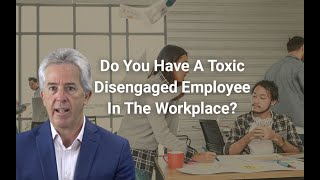
Peter Nadera explains the difference between toxic and constructive disengagement at work. Toxic disengagement spreads through teams, kills accountability, and can lead to sabotage. The fix often comes down to role fit and better communication.
Chapters
Have you been in an organization where you've noticed a person that has pulled away, they lack enthusiasm, they care less. Well, you might have come across a person that is displaying a toxic behaviour of disengaged. And with that, and to go further, we've got Peter Nadera.
Hello boys.
Greetings. So let's again we're gonna dissect it. Let's define what do we mean by disengaged?
Disengaged means there is no response. Like having a conversation with somebody and you say, so how was your day?
Good.
Disengaged.
Disengaged, yes. And then you see that with children actually, you know, they're very short and blunt. I know. So what is the root cause of someone who's sort of disengaged? Why are they disengaged?
Most of the time people are disengaged because they're disinterested. They're not invested in whatever it is that they're doing or talking about. And there's also a huge amount of avoidance as well too. I don't want to do this, I don't want to be here, I don't want to talk to you. So there's a lot of avoidance and it actually is a signal that says leave me alone.
Yeah. Are there certain situation events or trigger points that make it worse?
Absolutely. If you're forced to, as if you, you know, I think we've all had this a little bit. If we're forced to do something and we're begrudgingly doing it, we can become disengaged. Most of the time, most or most people will sort of say, okay, let's just suck it up and let's just do this because it's not going to last forever.
Yes.
Yeah.
And excuse me, how does it affect them personally? I mean from a well being or from a mental health point of view, someone who's disengaged, how do they see themselves?
Disengaged implies that they want to be somewhere else. So if they're spending their time thinking about where do I want to be elsewhere, they're actually building up a resentment factor that, you know, I should be on the, the beach of the Gold coast, for instance. What am I doing stuck here? So there is a resentment factor that can, that, that can set in that just increases the disengagement.
Yeah.
You know, you just interrupted my daydream about Gold Coast.
Yes.
Yeah.
And how can someone actually differentiate between what we, let's say call healthy disengagement and maybe a toxic form of disengagement.
Well, there are healthy forms of disengagement and they are proactive ones. So if, for instance, you're in the middle of a corporate bun fight and the boardroom has exploded, sometimes you have to disengage from that, look at the situation and go, ah, wait a minute, that's where the situation was, that's where the problem was. So this is a constructive disengagement where you actually don't get roped into the arguments or into the emotion of things, but you disengage from that and think, hang on, what's the purpose? Where are we going?
Yeah, good point. And how does it affect team collaboration dynamics, productivity?
You know, it definitely throws a damper on it. And team dynamics is interesting because if I'm sitting next to you and you're disengaged and I look at you and I think, well, you're just sitting there, you know, you're occupying the chair for how many hours a day and you're collecting the paycheck. Why should I do anything?
Correct.
What's my story?
Correct. Yeah, and that's a good point, because is it infectious? Yes, it is.
It's infectious to the point of people having the inner strength to be able to turn around and say, no, actually I'm going to focus on what I want to do.
So how does it hinder the sort of the organization's effective way of moving forwards?
Yeah. So obviously there is a function for the person who's toxically disengaged and by avoiding their de facto avoiding responsibility and accountability, which means that somebody else has to do it. Right. So in classic cartoon, it was those other kids.
Yes, exactly.
And you do that and you're going to create a situation where nobody takes accountability or responsibility and things fall over. Yeah, you know, and that comes down to the organization as well too. There are certain organizations that will tolerate that, that have the capacity or just tolerate that for what? And there are organisations that won't.
Yeah. So that brings me to the topic is how well are leaders and managers versed with understanding disengaged people? I mean, as you said, would they be proactive in terms of trying to do something about it or how do you see it from the experience that you've.
So it comes down to the criticality more than anything else. So if you have a toxic disengaged person in some critical environment, let's take air traffic control. That would not be tolerated.
Correct.
It would be out so darn fast. It's not funny, because everybody's basically Saying you're pushing responsibility on us. We've got enough as it is. There are also organizations on the other end of the spectrum that basically their KPI is to fill seats.
Yes.
So in that situation that's tolerated because we've got the required number of seats, we've got the required number of paychecks going out. So we've ticked that box and that's the other end of the spectrum.
So what are the risks, therefore, if the organization doesn't actually effectively mitigate or find some form of solution to diminish that behavior?
In essence, assuming that the organization is still producing in one way, shape or form that effectiveness, that production falls on a small number of people or a certain number of people, it's probably a better way of saying it, who are constantly there achieving the results. Everything else is just baggage.
Is it easy for an organization to unless to garner sort of the warning signs and say, okay, we've got one person or a few people that are exhibiting disengaged, what do we do about it? Is it easy to see?
It's less easy to see from the corner office than it is to see if you're sitting next to somebody. So I think there needs to be a chain of communication that happens. There also needs to be an organisational will or organisation desire to, to be able to fulfill everybody. Because at the end of the day, if somebody's just sitting there collecting a paycheck for the simple act of being there for X number of hours a day, they're not being fulfilled.
No, correct.
Perhaps. And we're getting, probably getting ahead of ourselves, but perhaps that person needs to be applying their talents within the organization in a different responsibility level, in a different environment, on a different project. I mean, the combinations are endless.
Correct. And so if we take the converse of it and look from a more of a high level, what makes someone disengaged to become highly disengaged from your perspective and then eventually potentially be disgruntled.
Yeah. So there's a lot of disaffection that happens inside of. If you start off in a role and let's just say that you're a project manager and you know your dream is that you want to project manager, project manage an amazing corporate infrastructure or corporate building or whatever it is and you're stuck there. Project managing childcare patterns.
Yes, yes.
Then the thoughts can start happening. Not to mention that childcare patterns aren't important. But what will happen in a lot of cases is that people will say, well, I've got more skills Than this. What am I doing sitting here?
Yeah.
And that's the slippery slope.
Correct. Correct. Because eventually what happens is when they start becoming highly disengaged, they're now looking for ways, maybe potentially causing challenges, issues, harm to the organization. So much so that when they become disgruntled, they can start sabotaging.
Correct. And look, that's when disgruntled turns into anger. Yes. And the anger can be around. I've just spent squillions of dollars to get my degree in X, Y and Z and I'm stuck here doing this.
Yes.
Now, the longer that persists, the longer the anger will build.
Correct. And especially if their voices is not even heard or if they seeking for alternative roles or something like that, and they're told no.
And also, you've just touched on a really interesting point. Perhaps right at the beginning they had a voice.
Yes.
Which was either toxically ignored.
Yes.
Passively ignored. Or was shot down in flames. And, you know, they were. They got the message of, you sit there, do what you do and be quiet. That that can be the seed for a lot of this stuff going on as well too.
Yeah. Cool. Let's wrap this up. What are sort of the key takeaways for of this toxic behavior? Disengaged.
I think it was you that quoted me that figures that there's a large number of people who are disengaged in the workforce, which kind of looks at that. People are not fulfilled in what they do.
Yeah. They're not happy.
They're mismatched.
Yeah, that's probably a better word.
Even though their CV may say, you're perfectly qualified for this job. Well, that's actually not where the passion lies.
Correct.
I mean, there are people that are toxically disengaged, but they would be like that in all of their life. So if you have a person who's disengaged at work but is an avid football fan and wears the colours and does the cheering, then there is a capacity in that person to actually get some emotional engagement going on. So obviously then that mismatch is sitting in the chair there rather than elsewhere.
Yeah. One last thing, and I know we spoke about it and I forgot to ask you about it. The idea behind what disengaged really means. Yep. And you mentioned it, that anyone who's disengaged is some level of toxic.
Correct.
Correct.
Absolutely. I mean, a disengagement, whether you're now looking in a corporate environment, especially in a relationship environment. I mean, if you're trying to create a relationship. Disengagement is an absolute.
Yes.
Poison.
Correct. There you have it. So thank you very much. Thanks for watching the series. I hope you really like it. We will certainly come up with some new videos down the track. Peter, much appreciated for your cooperation and your words of wisdom. I always appreciate that. Thanks for watching again and see you next time.
More from Boaz





The Cross Section Between Insider Threat Awareness And Disaster Recovery And Business Continuity


How Insider Threat Awareness Intersects With Key Areas: Fraud Prevention, Ethics, And Integrity



