AI Enhanced Cognitive Interventions: Dr. Izzy Kiver's Doctoral Dissertation
Dr. Izzy Kiver studied whether AI-generated focus music and a metacognitive training technique could boost workplace cognitive performance. Fifty knowledge workers improved by 31.2% on cognitive tests, but fatigue responses split three ways: some dropped 35%, others spiked 124%, and some stayed flat. The findings suggest cognitive gains work like athletic training, requiring short-term effort to build long-term capacity.
Chapters
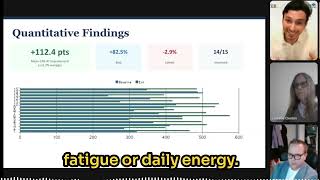
Here we go. So everyday knowledge workers face unprecedented cognitive demands, constant notifications, information overload, and an expectation of sustained focus over an 8-hour workday. My research examines whether AI-enhanced interventions can help. Good afternoon, everyone, or evening, depending on where you are. Thank you all for being here today. My name is Ibrahim Kiver, and I'm a doctoral candidate at William Howard Taft University. Today, I'll present my applied dissertation, Development of an AI-Enhanced Cognitive Rehabilitation Curriculum for Workloads Performance. Over the next 20 minutes, I'll share findings from a study of 15 knowledge workers who experienced a 31.2% improvement in cognitive performance, but with a surprising twist that challenged everything I expected to find. Possible? Most guess-reserving questions are still unanswered, for the end of the presentation. Let me give you a big picture before diving into the details. The study examined whether two AI-enhanced cognitive interventions to improve workplace cognitive performance. They worked with 50 knowledge workers over a 2-week intervention period. They used two tools, Brain.fm, which provides AI-generated Focus Music, and the Attention Training Technique, or ATP, which is a metacognitive training protocol, as a while in the flow of work curriculum program. The headline results were encouraging. Participants showed a mean improvement of 31.2% on cognitive assessments. 86.7% reported positive overall experiences. 57% intended to continue using interventions after the study, which as I'll explain later is actually quite strong. For workplace interventions. But here's where it gets interesting. When I examined fatigue data, I expected to see improvement with reduced burden. Instead, I found 3 completely distinct response patterns, which I call trimodal response later. One group experienced 25% less fatigue. Another experienced over 154%, or over 100% more fatigue. And a third remained essentially stable with just a 3% change. This paradox, cognitive improvement alongside different, dramatically different thinking experiences, led me to fundamentally reconceptualize how we should think about cognitive enhancement in the workplace. Let me begin with the problem this research addresses. So, We're living through what some researchers call the cognitive crisis in knowledge work. The modern workplace demands sustained attention across fragmented tasks, constant context switching, and always-on availability. Human cognitive capacity simply hasn't evolved to meet these demands. The research literature offers promising interventions. Functional music, particularly the iJury audio designed for neural entertainment, that has shown benefits for focus and concentration. May a content training protocol like the attention training technique have demonstrated effectiveness specifically in clinical settings for improving attention control? However, identify a significant gap. Existing studies examine these interventions in isolation under controlled laboratory conditions with limited attention to real-world workplace integration. No research has examined how knowledge workers actually adapt adopt and adapt these tools to their daily professional lives, or what happens when they use multiple interventions together. So to address this gap, I selected two interventions. First, Brain.fm is basically a subscription-based service that uses AI to generate functional music specifically designed to enhance focus through neural phase locking. And second, the Attention Training Technique, or ATT, an evidence-based metacognitive training protocol originally developed for anxiety treatment, which trains flexible attentional control through structured auditory exercises. This gap led to 3 research questions, and they were: first of all, to what extent do AI-enhanced cognitive interventions improve cognitive performance in knowledge workers? Say that again. To what extent do AI-enhanced cognitive interventions improve the cognitive performance in knowledge workers? This is an efficacy question. How effective is it? Those are really words, words. Second, how do knowledge workers experience and integrate these interventions into their daily work And that's an adoption question. The third, what factors influence the effectiveness and sustainability of these interventions? That's implementation question. So one, to understand efficacy, how effective are they if people are adopting and implementing? Second is adoption, assuming it's effective. How easy is it to actually onboard, adopt, and start using? And the third is what other factors can influence the effectiveness and sustainability for people to continuously use them, not just do it for a week or two and then drop off. And that's implementation, long-term. To answer these questions, I needed two theoretical frameworks specifically working together, not in isolation. The first was cognitive load theory, which explains the mechanics of how interventions Effect cognitive processing, it predicts that effective interventions should reduce extraneous cognitive load, freeing up mental resources for the primary task that you're working on. Whereas adult learner theory, or adult learning theory, specifically Knowles' andragogical principles, explains how adults adopt new practices in workplace settings. It emphasizes self-direction, relevance to immediate needs, and the importance of experience in learning. And I needed both. Why? Cognitive load theory told me what to measure, while adult learning theory told me how to understand adoption patterns. And to answer these questions, I designed a 3-phase methodology. So I employed a virgin mixed methods design, which again, basically means collecting quantitative and qualitative data. Simultaneously and integrating them during analysis. So the study proceeded in 3 phases. Phase 1 was a baseline assessment. It was conducted the first 3 days and participants completed the, what I call, it's a online exam called the Cognifit GAB AT or fully spelled out the Cognitive Assessment Battery for Attention. And that was to establish their baseline cognitive performance. And they also took an intake survey about their current cognitive challenges, work demands, and then something called the MFI, the Multiple Fatigue Inventory, based on a fatigue inventory test, see how fatigued you are coming in, created by University of Pennsylvania Medical School. Phase 2 was the 2-week intervention period. So participants integrated both Brain.fm ATT into their daily work routines. Through a timed curriculum. They did brief daily surveys twice a day, tracking their intervention usage, the key levels, perceived productivity, goal, self-assessment. And this gave both adherence data and longitudinal tracking of their experiences. Because we actually saw people who were some days not completing the surveys or the forms. They weren't actually performing or doing it in some days. But, and it actually came out pretty well. Everyone did the actual study. Phase 3 was post-assessment. So participants then repeated the ZBT, right, the cognitive potential, potential battery, assessment battery, to measure cognitive changes, to see if their score went up or down after doing the intervention. And then they participated in semi-structured exit interviews, and they're about 30 to 45 minutes each that were transcribed and captured. And I achieved 100% completion on these interviews. So everyone took the interview at the end. And for analysis, I compare the pre and post CBAT scores by using descriptive and differential statistics. And for the qualitative data, I use thematic analysis using NVivo, SurveyMonkey's AI thematic encoding tool. And I did this thematically until I felt it reached thematic saturation. That convergent design was essential because you'll see soon that the quantitative data showed what happened, while the pink area explained why it was happening, right? Why were some people also— why was there this trimodal effect? So talk about the sample will be the question. The IRP50 knowledge workers are professional networks and workplace wellness channels, and the sample was intentionally heterogeneous to increase generalizability, right? So they were between 21 to 46 years old for the participants. Mean need range of 34.2, and they represented diverse professional roles, including software developers, project managers, consultants, and administrative professionals. Importantly, I screened for baseline cognitive strain. We're looking for people who actually had some cognitive strain, not people who felt like everything is fine and dandy. The sample split almost evenly, so 58% reported moderate baseline fatigue and 42% reported high baseline fatigue. This wasn't a sample of people that were casually curious about productivity tools. These are workers generally experiencing cognitive strain in their daily work. And the data collection quickly streams, right? The CAVT assessments at baseline and post-intervention provide objective cognitive performance metrics. It's a method, third-party tool. The daily surveys throughout the 2 weeks captured adherence data and productivity levels over time, and the exit interviews provide rich qualitative data about participants' experience, adaptations, and perceptions. I want to note the 100% completion rate on exit interviews. Every participant completed the full study protocol, which suggested genuine engagement with interventions and the research process. Let me share what I found. The cognitive performance results were quite striking. Participants showed mean improvement of 112.4 points on the CAPI-T, which is, which is a representation of 31.2% if you divide over the, the 355 or so. So from baseline. So to put this into perspective, this effect size exceeds any typical pharmaceutical intervention for attention, which generally is 10 to 20% improvement. And it's comparable to to what we'll find later is, is a pivotal point here. I want to really focus is comparable to intensive cognitive training programs that require significantly more time investment, which we're able to start seeing in a shorter period. Looking at the chart, as you can see, individual participant trajectories can range with substantial from a high of 82%, 82.5% improvement to a low of actually negative 2.9%. But importantly, 4K F&B participants improved. And this isn't a case of a few outliers driving the mean. The improvements were consistent across the sample. And that single case of decline is actually informative because participant 14 had the highest baseline score in the sample, 501, suggesting a ceiling effect, right? So they're integrated, they start feeling the interventions were unnecessary given their already high cognitive function. So that, that was interesting, uh, qualitative data afterwards to inform on the quantitative. We— here's where the study got really interesting. When they analyzed daily fatigue data, I expected to see a simple pattern: improved cognition with reduced burden. And that's what I came in thinking will happen with a pilot group. And that's also what cognitive load theory would predict. Effective interventions should ease cognitive strain. Instead, we found 3 distinct responses. One, live participants increased experienced a 35% decrease in daily fatigue. Group 2, also participants, also 5 participants experienced 124% increase in fatigue. And Group 3, the remaining 5, showed more or less essentially stable fatigue at just a 3% average change. Same interventions that improved everyone's cognitive performance had dramatically different effects on their fatigue. Or daily energy. This paradox became the central puzzle of my analysis as we went into the primary study. The exit interviews helped me understand why three distinct fatigue patterns emerged. Six themes, six themes emerged from the qualitative analysis and they mapped directly onto the T-codes. The first theme was selective integration. Participants didn't use interventions exactly as prescribed. They adapt them to fit their existing workflows. Some use Breathe FM only during specific task types. Others practice HFE only when they felt particularly scattered versus, you know, once before lunch, once after lunch, for example. The second theme was energy awareness. Multiple participants reported becoming more metaconsciously aware of their energy patterns throughout the day. It's because the daily tracking itself became a tool for self-regulation. Third, I observed different music tool adoption, and that was also based on how much people actually enjoyed using different music that was selected for them using the questionnaire and AI. Brain.fm showed higher adoption rates because it integrated seamlessly into existing work patterns where they can run in the background. Participants simply start and let it play while working, whereas ADP required Dedicated practice time and face more adoption friction. For, for just clarity, what APT basically is, it's where you have someone giving you different prompts where it's maybe music, uh, or it's traffic playing and then a baby crying and then someone chewing. And it tells you to either focus on one of those noises, focus on all the noises at once, or try to ignore all the noises. And ATT essentially is a focus improvement technique or helps you train your cognition to be able to have selective hearing within the, within the exercise, just kind of for clarity, because I mentioned it, but may have not been explained earlier. Moving on. Fourth, participants reframed HP as training rather than a productivity tool. So those who succeeded with ATT described it as a mental gym. Something requiring dedicated investment that builds capacity over time. Almost like doing cardio or going to the gym or running on a treadmill. Over time, your capacity increases, but you get tired after doing it. Fifth, context dependence emerged strongly. Intervention effectiveness varied dramatically based on environment, workload, and stress levels on any given day. And sixth, secondary benefits appear unexpectedly. Participants reported improved sleep, reduced anxiety, and better work-life boundaries. Benefits beyond content measures I was targeting. Again, this only was able to come from the qualitative data we got in the exit interviews. These themes explain the tri-modal patterns. One's decreased fatigue came from interventions placing more taxing coping strategies, like maybe actual noise in the background or actual distractions happening, and it helped them more focus. Group 2 had increasing fatigue interventions adding load to already depleted resources. These people were overworked and to them these interventions felt like more work in an assignment that further depleted them, that increased their fatigue. And Group 3, the stability came from strategic selective use that balanced benefit against effort where they actually used it as intended. As a tool to help them increase, increase their focus capacity, et cetera. These findings led me to fundamentally rethink how we conceptualize cognitive enhancement. My findings directly challenge a core assumption of cognitive load theory. I want to just emphasize I'm not debunking cognitive load theory, I'm extending it. Cognitive load theory predicts effective cognitive interventions reduce load while improving performance. But I found the opposite. Interventions increase daily cognitive load evidenced by fatigue patterns while simultaneously improving cognitive capacity. This paradox required a new framework. I proposed reconceptualizing workplace cognitive enhancement to what I call an athletic training pattern. Consider physical fitness, right? When you train at the gym, you're deliberately depleting energy and creating fatigue. This short-term cost produces long-term capacity gains. No one expects to feel more energized immediately after a workout. The benefit comes from the adaptation that follows. Cognitive enhancement may operate the same way. The interventions in my study weren't reducing cognitive load. They were building cognitive capacity. Like physical training, this requires short-term energy investment for long-term gains. This reconceptualization has significant practical applications. First, organizations should deploy cognitive interventions strategically for high-stakes projects with skill-building periods rather than as always-on productivity tools. A good example is actuaries who need to pass actuarial exams once, uh, you know, in the beginning once a quarter maybe, then once a half, and then maybe annually. Throughout those training periods, they can use these tools in order to increase their chances of passing such exams. Second, implementation should follow a training model with dedicated practice time. Not expect seamless integration to existing workflows. That's not clear enough or effective enough at this given stage. Third, individual assessment is essential. The trimodal pattern shows that the same intervention leads to dramatically different responses. The size fits all deployment will fail for a significant portion of workers. Just like physical training depletes energy while building strength, cognitive enhancement may require short-term investment for long-term gains. This frames organizational expectations. Expectations entirely. So let me summarize the three contributions of this research. First, the empirical contribution is by demonstrating that AI-enhanced cognitive interventions can produce meaningful cognitive improvement, 31.2% average, in knowledge workers operating in real-world conditions. This extends beyond lab findings to practical workplace application. Second, theoretical contribution. Atlantic Dreaming paradigm reconceptualizes cognitive enhancement as capacity building rather than load reduction. This challenges and extends cognitive load theory for a new application domain. And you want to just clarify that long load theory is much better for instructional design where learners need to essentially gain a certain bit of information, whereas we're talking about increasing your capacity, for true intelligence, maybe increasing IQ or some other metric like that, it may not hold true in that scenario where you're increasing capacity. The practical contribution is the Trimodal Fatigue Patterns, which reveals that individual variation must be central, really central to the implementation strategy. Organizations can't deploy one-size-fits-all, and they can't deploy these interventions uniformly and expect consistent results across the board. So future research should include randomized controlled trials, RMCs, with larger samples. Again, that's for the true implementation, for conformity, not for the experiment, which succeeded at doing longitudinal studies examining long-term effects and investigation to baseline predictors of fatigue group membership. We identify who will benefit the most even for implementation. I want to close with this thought. This study demonstrates that AI-enhanced cognitive tools can meaningfully improve workplace performance, but not in the way we expected. The improvement came with real costs for some participants, losses CLV didn't predict. And by recognizing that cognitive enhancement operates like athletic training, we can design implementations that maximize benefits law-respecting individual variation. So we can set appropriate expectations and we can move from reactivity acting toward genuine capacity building. Thank you all, and we welcome your questions.
Are there any questions from the committee, please?
You know, I'll go ahead and just start with one where I Good work on the presentation. There's a lot of great information in there. But why did you choose this topic and why is it important to you?
Okay. Sorry, it's a little bit more of an emotional point. I mentioned in ball— give me a second to gather. I mentioned in the dedication of the thesis, my brother had attempted, made an attempt at taking his life over a decade ago. And after he came back, he had two traumatic brain injuries. And for those 10 years while he was still alive, I felt quite guilty that there was nothing I could do to help him. And I began to research different ways from a clinical perspective of how to help him adapt to society and work through the brain trauma and what he was going through. Eventually, in 2014, we lost him, and that still stays with me. So when, after doing the theoretical portion of the degree, it came time to choose a thesis, there really wasn't anything else that really struck at me, like specifically the topic of attention process training. Attention Training Technique, APT and APP. They're two different methods used in clinical settings. And I wanted to understand, is there some ways to work with these clinical tools to help some of the people that, um, the, the coworkers I had at Google, some of the burnout cases there, there were so many cases where people were suffering and struggling and no one really spoke about it. It was more of a go see your therapist, mental health professional, but no one was really addressing, you know, the root cause. Burnout in the workplace, people who were struggling from is, let's say, context switching. So, um, I wanted to research something that mattered to me and could actually provide benefit. And it was a bit humbling to realize that my intentions were good. I was enhancing the problem by increasing fatigue. And I thought this would actually reduce fatigue in the workplace. And then with a subsequent library study, I realized how this can be used in a positive way.
All right. Well, I'm sorry for your loss and thank you for that explanation. Dr. Gregory, I'll let you go ahead and take it from here.
No, I just want to also thank you for sharing that with us. I think it was very valuable. It's always interesting to learn people's backgrounds in terms of how they pursue their studies. Not related to my brother, but my own degree focused on something related to my mother. So I can definitely understand and empathize with the familiar obligations there. When it comes to the study here, I think if my research is correct, I think you started with a study of 5, right? And then expanded that to 15.
Yeah. So do you think— I started off with a pilot group and I came in with one set of expectations. I really thought that we're going to change the world and help people reduce their fatigue throughout the workplace by giving these attention training exercises and selecting the music for them and doing this Daily prime intervention. And the results were, were just all over the map. And many people actually, originally I thought it'll be 10 people, but only 5 actually did it because I didn't even understand how to deliver this in a way where it can be implemented. The adoption was off, the implementation was off. So when I came back to do the main study, I took all the lessons from the, from the pilot and I, I reframed how I did the adoption, the seriousness, the importance. And use while we're on vacation or going on vacation, really made sure that everything was dialed in. And the way I delivered it, I did, I used a full-blown LMS, learning management system. I invested the money just to make sure that's done correctly. So I was confident in the numbers I was seeing.
With any iterative process, like kind of like with your first iteration of it, you had lessons learned and takeaways and were able to pivot towards a second pass there. Having done that now and having learned the lessons that you've gotten from this past year, if you were to go into it again, how might you approach it even differently from this current one?
Thank you, Dr. Vitteri, for asking the question. I love that. So there are a couple of things that, that I would do, and I may have mentioned briefly in thesis. First of all, I would love to do an RCT, so randomized controlled trial, or randomized controlled trial. So maybe 60 to 90 sample size. If I was able to be on site where I'm actually able to maybe work directly with an HR manager or someone where there is a level of authority where it's done phased. If I'm able to integrate tools like Jira or task management where I have this more connected to their daily flow and workflow and have a much better segregation with this larger sample size where understand, okay, these are IT/admin, these are accounting or finance, and I had much better understanding of the data just to begin with. And then further, of course, if there was increased levels of internal tracking from the company, manager reviews, not just where, you know, where we had the conversation exit interview, but where I had a much deeper integration of these methods is essentially what I would do. But just like the first study informed on the fact this is athletic training, it's not one-size-fits-all or catch-all cognitive training. The further study would further explain, okay, now we understand this is cognitive enhancement and it's going to be difficult. We would probably even break up those two groups and understand we'll try timed interventions for one group. Group, and the other group, we're going to actually have this maybe as originally intended, once in the morning, once in the evening. Um, there won't be just-in-time. So those are some of the things I would love to experiment. And I can go further, it'll be a whole book of just all the things I'd love to try.
No, that, that's a great answer. Thank you, uh, it's, I, I love that you are already thinking of it in terms of like not just next steps, but even after that, what are the steps that I might want to further take it? So. That's all on my end here.
Thank you. Thank you very much.
Hey, just, just what do you, what do you think was your most unusual finding in the whole study?
I don't know if I'll call unusual, but definitely humbling. So many assumptions were made where, first of all, where I was convinced that cognitive load theory is just to be taken for face value. Understanding how to just read the literature. To understand that it could be any— there's, there needs to be an extension of it. How to actually understand cognitive load. Cognitive load means I'm trying to master the piano, for instance. And how do we break down those lessons, chunk them, and combine it with the learning theory understanding that for cognitive capacity building, it won't exactly work that way. Other unusual thing is, is these, the trimodal patterns. I, I did expect for some people to have way increased fatigue, some people have way decreased, some people to stay baseline. That was so unusual. I'm glad that we that I ended up going with the convergent methods with qualitative and quantitative because those really did work together. And I felt like everything married each other beautifully by the time the thesis came to the end, both CLT with adult learning theory, the qualitative with the quantitative data, and the thematic analysis really being informed where I felt there was data saturation by the 12th interview.
Okay. Also, maybe, uh, for a future study, might be interesting to use gender as a variable.
I only have anecdotal data on that. I, I, yeah, I didn't want to include in the study because I didn't want to include my own biases, but I definitely saw a difference in the way it was used. I don't know why. And that would just be very interesting to decide for sure, but men did adapt to it better than women. It just, that was the, that was my sentiment, or at least that just what I, I kind of felt as far as adherence and kind of just sticking through with it. It didn't seem to stick so well. Yeah.
Great. Any other further questions from anyone?
Yes. And the only thing I'll note, and, and I'm fine with the AI reading this, is that I see in your background there, Izzy, that it already said Dr. Izzy. Little presumptive, my friend. Little presumptive. But that's okay.
Yes, we are happy to announce that you're now Dr. Izzy Kiver or Igor Kiver or whatever. Izzy, I guess.
Izzy, I guess. Thank you very much.
Congratulations. Congratulations, Izzy.
Yes, congratulations. Well done on the presentation.
Congratulations.
Well done on the presentation.
Thank you for your hard work and it all paid off.
You can see that now. Thank you very much, everyone.
Okay, I guess this is the conclusion of the meeting. Thank you, committee, for standing by at all the time you've worked on this. Very much appreciated.
Not a problem. All right, well, hope to see you in the future, Dr. Izzy, and yes, again, Dr. Ningal. Take care, everyone.