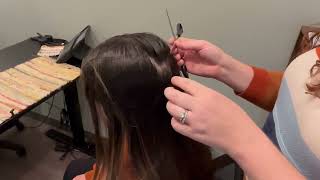
This is an instructional YouTube video by Jaban Moore explaining how to collect a hair sample for Hair Tissue Mineral Analysis (HTMA) using a physical kit that includes a paper scale. The video lists kit contents (instruction sheet, requisition form, envelope, paper scale), demonstrates folding and leveling the paper scale, shows how to take many small snips from the crown/back area cutting as close to the scalp as possible and keeping only the inch closest to the root, and emphasizes that hair must be freshly washed (no product), fully dry, and that chemically treated hair requires waiting at least two to three weeks and only collecting virgin root. It also covers packing the sample into the provided envelope, filling the highlighted (pink) sections of the requisition form, including the form with the sample, and using the pre-addressed stamped mailer.
Questions this video answers
Only the highlighted (pink) sections (personal information, shampoo type, up to five predominant symptoms).
Only the inch closest to the root (do not exceed one inch).
The box on the scale is 2 inches wide (sample should not exceed half the width).
A minimum of two to three weeks, and only the virgin untreated root may be included in the sample.
Freshly washed with no product residue and fully dry (skip heavy conditioner if it leaves residue).
Chapters
Hello. Today I'm going to demonstrate how to collect a sample for the htma, the hair tissue mineral analysis with the physical kit that includes a paper scale. So in the kit you're going to get an instruction sheet. This has all of the instructions and a linked guide. And then you're also going to receive a requisition form. On this form you only need to fill out the highlighted portion. So there's portions that are highlighted in pink. So you your personal information, your type of shampoo, and you can check off your 5 most predominant current symptoms. You do not need to complete any of this section at all, only the highlighted pink sections. You will also receive a small envelope to put your hair sample in and you will receive a paper scale. So the first step for collecting the sample is to fold this paper scale. It says fold here, there's some creases. So you're going to fold. Up to where this box is on the top. You need to make sure you have a level surface to place the scale. So I'm using this shelf here. So you're going to place this scale and you'll see that it naturally tilts one direction. So as we place the hair on here, it's going to tilt. You need to have clean stainless steel scissors. We have hair cutting scissors. They do not necessarily have to use hair cutting scissors as long as they are clean stainless steel scissors. If you have a comb, that's great. I don't have a comb to part her hair today. When you're collecting the sample, you technically can collect from any part of the head, but it's recommended to collect from the crown and kind of the back, upper to mid portion of the head down to the nape, but not too far because you don't want it to show. The hair is a little coarser and denser back here. So you tend to need fewer overall hairs to get the weight that's needed. So we're going to go ahead and take some samples here. We like to collect lots of little tiny samples so that you don't have a big bald spot. So you're just gonna. Take out a little section here. If you kind of tug on it a little easier, it's easier to get it down at the scalp. You're gonna cut it as close to the scalp as possible and then you are only going to keep the inch closest to the root. So on the instruction sheet, if I can get to it, there is a length guide. If you don't have a ruler handy. So you can use that to see about what an inch is, you do not want to exceed an inch. So I'm going to put this here. Make sure that I'm not going to go past an inch, and I'm going to collect this right onto that box. You want to put the sample within this border, ideally closer to the back of the box than the end. It tends to be a little less accurate when you put it there. I'm just gonna continue to collect a lot of little samples. I'll also note that the box on this scale is 2 inches wide, so you don't want it to exceed more than half the width of that box. If it's looking like it's more than half the width of that, then your sample is too long. It's okay if your sample is shorter than an inch. If you have shorter hair, that is okay. But you'll just have to collect more overall hairs. You also have to make sure that your hair is freshly washed and there's no product in it. So from the last time you washed your hair, you don't want there to be any product in your hair. If you use a really heavy conditioner that leaves a lot of residue, it would be best to skip your conditioner for that wash and just use shampoo. Make sure your hair is also fully dry when you're collecting your sample so that it doesn't affect the weight. Depending on how dense your hair is, it will make a difference on how much you have to collect. Some people have to collect more than others if their hair is a little less dense. You can do one big chunk if you want, but if you do it this way, it's a lot less noticeable. No one's going to notice that you've cut this out. The scale's starting to tip, so we're getting close. Now. It's tipped all the way down to the table. Now, believe it or not, paper scales are not super accurate. So we recommend taking another snip or two after it's tipped just to make sure there's enough hair. Because it's the lab doesn't have enough hair that will not be able to complete the testing. In that event, you just have to collect extra and mail it. But it delays the whole process. Okay, so that gives us a sufficient sample. It'll be about a heaping teaspoon worth of hair. Approximately is what it takes to get enough weight. I should also mention that I said to not have any product, but if you chemically treat your hair in any way, if you color it, permit any type of chemical treatment at all you need to wait a minimum of two to three weeks and then from that point. Any sample that you collect can only include the virgin untreated root. So you cannot include any of the chemically treated hair. You'll have to cut it down to wherever the new hair growth has been. So depending on how quickly your hair grows, you can collect it a little shorter than an inch and just collect more hair or just wait longer for it to grow out. Once you have your sample on the scale, you do need to write on the envelope your name, the type of shampoo that you use. We will have our account number written on here already for you. You can leave the lab number part blank. Just take this guy and just slide the sample in there. Make sure that you do see this envelope. We have had at least one sample where the envelope wasn't sealed and the hair was lost and they are going to have to completely recollect. Then we are going to provide you with a pre addressed and it will have a stamp on it too envelope to put the sample as well as the completed form. Please make sure you include the form and make sure that you actually fill it out and put your name on it. Because if they don't know who the sample is for, oftentimes we never figure out who it is for. Make sure you include that as well and then just drop it in the mail.