BUILT for Impact Ep. 19: Let go of the Past: Emotional Triggers and Nervous System Healing
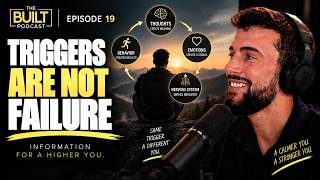
Jake Burhans explains why emotional triggers resurface even after inner work: your nervous system safely surfaces stored memories once you feel regulated enough. Memories are stored as both stories and embodied sensations, and suppressing them creates chronic stress. When a trigger hits, stay relaxed and let the feeling run its course to rewire your response.
Chapters
Have you ever caught yourself thinking, I've done so much work, I'm more aware, I'm more regulated, so why is this still happening? Why do old reactions still show up? And when they do, there's this quiet voice that says, I should be past this by now. I thought I healed this. What is wrong with me? Here's the truth most people never hear. That reaction isn't proof that you're failing. It's not proof you're regressing. It's none of that, right? And it's definitely not proof that the work isn't working. What's actually happening is much more precise and much more hopeful because the nervous system doesn't repeat things because you're broken. It brings them back when it's finally safe enough to let them surface. Today I want to reframe triggers in a way that removes urgency, dissolves self-blame, and turns those moments into information instead of problems. Welcome back to Built for Impact. I am Jake Burhans, and this is the podcast where inner peace meets high performance and where building your dream life starts from the inside out. Inside the BILT Framework, we are not trying to fix you or optimize you through pressure or pushing or discipline or willpower. We're reprogramming the subconscious patterns so that change feels so much less difficult, right? We've all been taught in the self-help place, you just need more discipline, you need more motivation. The interesting thing about our identity is it's what's called an attractor state. So it's always reverting back to its dominant state. So your identity really isn't, you know, it's not a noun. It's not like I'm a leader, I'm an entrepreneur. It's a familiar set of patterns, how you think, what you believe, your self-talk, your emotional tone, your emotional reactions, all those things are your identity, right? However you behave in those patterns, whatever is most familiar is what your identity is. So when we try to change, right? When we try to change and use our willpower to go against those conditioned patterns, our system triggers a threat, right? Our nervous system is designed to keep us in safety, right? Or keep us in the familiar because familiar equals safe. So when we try to grow and become this new person, the system is freaking out, "Hey, that's, it's life-threatening for you to do this." So it's trying to pull you back and that's really what self-sabotage is. But what we do with Built for Impact and what we do in the community, right, in the school community, is teach you how to reprogram those patterns so you can create real lasting change that doesn't feel like a freaking uphill battle. It's not about more discipline. When you shift your identity, you don't need discipline, right? Like, do you need discipline to brush your teeth in the morning? To tie your shoes? To be a good friend? To be a good spouse? No, you just see yourself as that person, so you don't need discipline to do it. It's just a natural, you know, expression of who you are. And that's what we want. Whoever the version is of ourselves that we want to be, we want to make that our baseline identity. So all of our actions flow naturally from there, right? Instead of trying to fight against that thermostat setting. But today we are talking about triggers and we are diving into the L pillar, let go of the past in the Built Framework. So this is phase number 4. Phase 1 is awareness, breaking our association with limiting beliefs. Phase 2 is regulation, really regulating the nervous system into a parasympathetic state because we know that our our physiology dictates how we perceive reality and how we experience reality. And if we really want to change as people, we need to be in a regulated state. So our prefrontal cortex is on, our thinking is online, basically, right? The, the creative center of our brain so we can problem solve and we can make good decisions. So awareness, regulation, and then we use identity rehearsal. So the past 3 episodes explain this, but the last episode is on imagining your future and how we need to familiarize our nervous system with this new version of ourselves so it stops self-sabotaging. So if you haven't checked that out, go check that out. But today we're talking about release. That's what phase 4 is really about, release. So as you become this new version of yourself, a lot of times these old triggers come up. And the reason that they're coming up and they feel so strong is because you've been doing the inner work. You know, you've started to condition a new baseline, whether it's more confident or more peace or more love or whatever the case may be. And the contrast between the triggers and your new state of being is so stark. And that's why it feels like this massive failure sometimes, because in your old state of being that was just anxious or worried or angry all the time, your triggers that were also those things kind of just blended in. You didn't really notice them. But now that you've done the work, you notice them. So triggers are stored memory. Okay, so we look at these things, and I think people can relate to the term trigger. This triggered me, that triggered me. What does that even mean? Well, we have to understand, we have to start with understanding how a memory is stored in our system. So a memory is stored in two places. It's stored in our mind as a story. You know, someone said something to me last week, and that made me angry. It's also stored in the body as an emotion. Okay. So what happens in life is that we're not taught how to deal with our emotions. Really, an emotion is a biological process, right? Energy comes in. In order to let that emotion dissolve and not get trapped in your system, you need to be present with the emotion, meaning you need to be relaxed, right? So you feel anger, you feel guilt. Instead of resisting that emotion, which stores it in the system, we need to be relaxed, right? And then let it go. But no one's taught us that. So. When someone cuts us off and we get angry last week, what do we do? We resist that emotion. We suppress it, right? Instead of kind of letting it just be there and linger. And when we suppress it, it tells the system, hey, this emotion is a threat, and it stores it in the body. It stops the biological process of completing that emotion. So what ends up happening is now every single time someone cuts you off or says something that, that makes you angry, that emotion is coming up and it's, it's getting triggered, right? 'Cause it's stored in the body. It hasn't released. It's trying to release now. And this happens quicker than your mind can think about what to do. And this is oftentimes why cognition alone isn't enough to create change, because you can know, you can understand the story in your head about why you reacted. Oh, I reacted because someone cut me off. I know I shouldn't do that. But if you haven't let the body heal, then every single time when you get flipped into that fight or flight mode, your body's reacting to that learned memory pattern in the body. And it's always going to be quicker because it's part of your survival circuitry. It's always going to be quicker than your mind. So it's like, I knew I needed to not react there, but I reacted. Why do I Dude, why did I do that? Right? And then we, and then we blame ourselves and all this stuff. But if we just understand how our physiology works, that's a stored emotional memory pattern and we need to relax our system. So the beautiful thing is that when these triggers come up, we can change them. So there's this area of research called memory reconsolidation, and basically we used to think that memories were happened and they're stored in a file cabinet, locked, can't do anything about it. But now through memory reconsolidation, we know that when a memory is triggered, it actually becomes labile, meaning it's editable. So that, that emotion or that situation, someone cuts you off, when that triggers you, if you respond to that situation by regulating yourself, by being at peace, by being present, you can start to re-encode that memory and how it's stored in the body. So over time you do that enough times. Now when someone cuts you off, your body's baseline default response is to be centered or to be aware and to let the emotion pass. So we can actually look at triggers as opportunities to free ourself, right? And to, and to gain more capacity, which is a beautiful thing. Instead of looking at them as some moral failure or character flaw, we can say, hey, this is just my system. It's an old emotion that I didn't let process and I need to let it go. Now, what does being present mean? Because I want to clarify that. Being present with emotion just means the ability to be aware of it, observe it, and not resist it. So all you're doing is just recognizing, okay, that person cut me off and made me angry. I am just going to sit in the feeling of anger. No one's ever taught you that. Have they ever told you that? That that's what you need to do. Relax your shoulders, relax your body, breathe, and just let the emotion be. Don't resist it. And if you do that, it might linger with you for 15 minutes, 30 minutes, 45 minutes, an hour, whatever it is, but then it'll go and that situation won't have power over you anymore. But if something makes you angry and you resist that feeling, you suppress it down, right? That situation's always gonna have power over you. Whenever that external event happens, it triggers that emotion. And then because you don't know how to free it, you keep suppressing, suppressing, suppressing. And then this is what happens in our life. We have all these external circumstances. That make us feel a way that we don't want to feel, and then we just go throughout life avoiding everything. It's like, that's no way to live, right? That's not freedom. So true freedom is being able to face these triggers head-on with presence and understand they're just part of our biology, our physiology. It's an emotion coming up to release, and we need to relax and be present with it, and it reduces the charge, right? So it's not enough just to know it in our mind. We need to release it through the body. Now, the beautiful thing— so we know that triggers are just stored memory. That's all it is. It's not like a present danger. It's a stored memory. And we know that presence is the release mechanism, right? That's what allows it to dissolve. The third thing is there was an interesting talk by, uh, Gabor Maté. You can look him up. He's a physician that talks about suppressing emotions and the detrimental health it has on our stress. Um, I actually watched a YouTube video the other day on it. You can look it up. I'll see if I can put it in the description here of this episode, or I'll comment it. But he's talking about how suppressing your emotions, like you feel an emotion instead of like feeling that emotion, suppressing it, it's causing diseases and cancers and autoimmune diseases and Multiple MS, right? Causing MS. We think this is like a noble thing. Like, I don't want to burden anyone with my emotions, so I suppress it. But it's so detrimental to our health. Like, we have to let these emotions move through us. The point I'm making here is that it takes an incredible amount of energy for your system to constantly suppress these emotions. It puts you into kind of like a low-grade survival state. You're always in this kind of survival mode and your system's got the shields up just like Star Trek, right? All the power from the ship, you know, the lights dim in a ship just so they can power the shields. The same thing with your nervous system. When you're fighting all these emotions, right? You're fighting all these emotions and you're not letting them pass through. It's like your system's in survival mode. It's got the shields up and it doesn't have energy to repair itself and for your immune system and to think and do these other things. So it's like you have 60 browser tabs open in the back of your head, right? And you're trying to open up a new one and you wonder why it won't work. You gotta close these browser tabs. You gotta let these, you know, Michael Singer calls them some scars, but you gotta let these emotions process. And it's just a completely freeing thing because you start to look at our emotions and these things that trigger us as opportunities for growth, as opportunities for freedom. Because if we can be present with these triggers and release them, you know, life becomes about— that's what Michael Singer talks about— life becomes about just letting go, letting go of all these triggers, experiencing them. And we look at these triggers not as bad things or regressions, but actually signs that we are healing, right? We're moving towards more freedom. And the other thing too is like why they come up after you start to do the inner work is because your system finally feels safe enough to let them up because they've been stored down there in the basement with a padlock on. But now that, you know, the house has been cleaned up a little bit, it's like, alright, let's crack open the basement and see what's down there. And those are all the triggers. But we gotta let them come up, meet them with presence, and then you'll have so much more energy on a day-to-day basis. Right, we're not like drained by 11 AM for no reason because we're just expressing, you know, or suppressing our emotions. So it's an incredibly powerful tool to be able to release these emotions, face them head on, and free up our energy and our capacity. You're gonna have so much more dang energy. It's not even funny. One thing that's really important is that we can't be blaming ourselves, okay? When we see a trigger. So part of, you know, in the Built Framework, in the program that's going to be released here, probably by the time this episode is out, it'll be complete, is 1.4 talks about responsibility without self-judgment. When we judge ourselves for these triggers, oh, why did I do that? I can't believe that, you know, this isn't working. I'm a failure. That is triggering a threat response in the system. That's putting you into further survival mode. So we think that that's how we're going to make ourselves change by shaming ourselves. But the nervous system just sees that as a threat. That's the opposite of what we need to do. We need to use our ability to be aware, right? Metacognition, to be aware of those triggers and to understand that, hey, that's just my physiology. It's just my past programming. It is what it is. Let's be aware of it. Let's release, let's be present, and let's let it go. That's why awareness is a fundamental skill here for all of this, cuz you can't be aware of these patterns and disassociate with them. Then it creates self-judgment and blame and all these things that put your system into a survival mode state, a sympathetic state, which prevents lasting change, right? Remember, we have to be in a regulated physiological state for our brains to be neuroplastic, for us to actually be able to change and learn things. In closing here. A simple reflection I want you to sit with this week is when something old shows up, can you let it be information instead of evidence, right? When something old shows up, can we just let this be information about what to do, be present and let it go rather as evidence of some failure? That's it, right? So next time we're feeling triggered, look at this as like, oh my God, this is an opportunity to be present and let this go. And the more that you can just sit with the feeling, right? Remember memory reconsolidation. We need the, we need the emotion to be triggered, but we need to meet it with a pattern interrupt. Meaning the system is used to responding in anger, but no. We're gonna go into anger, but we're gonna regulate back down to a regulated state. And then the system begins to link, oh, someone cutting me off with, oh, regulated state, right? I mean regulated and I figure out a solution instead of reacting. So we wanna begin to rewire ourselves in that way. If this episode helped reframe something for you, share it with someone who's been hard on themselves for still reacting. We are on a mission. I'm on a 365-day Built for Impact mission. As of this recording, I'm on day 33. I'm going live on TikTok every single day. The goal is to get 1,000 people into the Built for Impact community by the end of this year. Okay, or by the end of the challenge, and we want to normalize the inner work, normalize talking about nervous system health, normalize peace without pressure, building from peace without pressure, normalize being a multimillionaire, but doing it from a regulated, calm, peaceful state. That's what we're about. So if that's a mission that you can get behind and you want to be a part of that, and you want to be part of the global movement that redefines what it means to develop as a person and stop with all the force and the discipline and the pressure and the grind, hustle and hustle culture, and shift that to a culture of being regulated and then go having, going and having massive impact, then get in there. It's free to join the community. It's free to get in there and be in the community and be around people talking about this environment. So important. So get in there. I'll see you in there. Until next time, all the peace, all the power.










