BUILT for Impact Ep. 20: How To Create Sustainable Identity Change
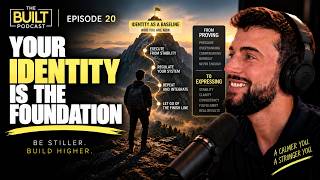
Jake Burhans explains how to make identity change stick by treating it as a baseline your nervous system returns to, not a destination. Neural retraining through visualization and repeated action rewires habits; pressure forces survival mode and kills precision, while calm execution delivers better results. Real success comes from internal sufficiency and values, not chasing external wins to feel enough.
Chapters
Most high performers think the goal is to become their 2.0 self, but that's really not the way that you want to go about it. If your identity is something you're trying to reach, you will always feel behind. You always feel like you're not there yet, and that really just creates more pressure and anxiety, right? You're monitoring yourself, you're judging yourself, you feel like you fell out of alignment the second you get triggered, and now your growth becomes this performance you have to meet every single day. Module 5, right, Transcend into Your 2.0 Identity, talks about this. This episode is about 3 things: identity as a baseline, not a goal, trusting calm while you're executing, and shifting from compensatory success to expression-based success. Because if your success is still trying to prove something, you're not free yet. Let's clean that up. Welcome back to Built for Impact. I'm Jake Burhans, and this is the podcast where inner peace meets high performance, and where building your dream life starts from the inside out. The BUILD Framework is, as we know, really about upgrading how you operate internally, not just what you do externally. And today we're talking about the final pillar— not becoming someone new, but stabilizing who you already are and really looking at identity as a baseline. I'm going to explain what that means, looking at this sense of calm as a prerequisite for high performance because it gives you precision rather than the distortion that force and pressure gives you. And then understanding that sufficiency is assumed, operating from an expressive model of success versus a compensatory one where you're constantly chasing external results to make yourself feel better on the inside. So let's get into it. So first thing I want to touch base on is identity is a baseline, it's not a destination. And to understand this, we have to understand what is the identity to the body. It's not a noun, it's not I'm a leader, I'm an entrepreneur, I'm a mother, I'm a father. It is really what's most familiar to your system. It's a familiar set of conditioned patterns, right? Your self-talk, how you think, your emotional responses, your behaviors, how you view the world, all those things. However you act most often becomes the most familiar to your system, and your system treats that as safe, and thus, who I am. So when we're trying to retrain our identity, we're trying to retrain all those patterns, right? Our thoughts, our emotions, our self-talk. Now, to our body, if we're constantly thinking negative thoughts or being guilty or being sad or playing victim, if those are the thoughts and thus the emotions in the self-talk that is most hardwired into our system, our nervous system— again, we know that our nervous system is designed to keep us in the familiar, and it associates familiarity with safety. So if those patterns are what's most familiar to your system, when we try to consciously change and be positive and be grateful, those are different patterns of thinking and feeling and behaving and talking to ourself. And our system treats that as a threat. It treats it as a threat to the baseline. It's unfamiliar. So it's gonna try to drag us back into the familiar, right? Self-sabotage. And that's why it's so hard to change. So training a new identity becomes about, obviously you have to be aware of those patterns. We gotta regulate ourself back into a regulated nervous system state. That's module 2. We have to visualize a different response and start to act out a different response as well. Both of those actions, visualization and real life responses, are hardwiring new connections into our neural network. And the more that we fire those, right, Hebb's law, neurons that fire together wire together, the more that we fire those pathways, the more ingrained they become, the more default they become. And over time, when those new ways of thinking and acting and responding become more familiar than the old ways, it then forms into our new identity. It's our new baseline. Now, the key thing to understand here is I talk about identity as a baseline. What does that mean? It means that you will get triggered, you will fall out. Say your baseline identity is someone who's confident, someone who's grateful, someone who is loving, right? Someone who is at peace. It doesn't mean that you are like this all the time. You get triggered, but you always return back to that baseline. And it's not hard to return to that baseline because if you've done the inner work and you've created those new neural connections and a new system that is familiar to your nervous system, your nervous system wants to bring you back there. So this is the beautiful part when our subconscious conditioning actually starts helping helping us. Because we think about our identity as a thermostat— all those conditioned patterns, what's most familiar, our system's trying to keep it, keep us there. Well, when we've done the inner work and we've raised up our thermostat temperature, right, to a different setting, or we've just changed it to a different setting, when we fall out of that setting, even if it's for the worst, right, like we react, we get angry, our system is going to naturally pull us back to that new internal baseline, which is one of peace, of calm, of regulation, of clarity. Isn't that such a beautiful thing? Now our subconscious conditioning is working for us. So identity is a baseline, not a destination. We're trying to retrain the baseline familiar patterns that we most often think. And we do that through the BUILD Framework. So if you haven't listened to the other 5 episodes before this, or the other 4 episodes before this, go check them out because we went through the B pillar, the U, the I, the L. Now we're at T. So you need to understand those other 4 things in order to really integrate this. A key point about training your baseline is that every time you return to the baseline, you are getting stronger. So it's actually a prerequisite for you to fall out of this baseline so you can do the proverbial bicep curl back to this identity, back to this new way of thinking, of behaving, of talking to yourself, of responding emotionally, whatever that is. Every time you return back, you're strengthening that neural connection. So you need to deviate in order to strengthen. Think about weights, like you need to put resistance when you're doing a bench in order to get stronger. You need to have that resistance, but you don't hold the resistance the whole time. But so look at triggers and falling out of this identity as part of the process of building the new identity. And then our identity becomes less about this performance, this ideal version of myself, and then when I'm not acting this way, I shame myself. For falling out. That's like this performative method of like, I have to be my 2.0 self. It's like, no, your 2.0 identity is just a baseline. It's a baseline. Yeah, you fall out, but you return to it all the time, and that's the work. And every time you return, you're getting stronger. So if you fall out and then you recognize it and then you return, you should get excited about that because you are aware about it and you returned, and you're getting stronger and stronger and stronger and making that baseline stronger every single time. So you fall out less, right? You can stay in it longer and you can return quicker. So the true metric for change isn't if you fell out or not, it's really how quickly do return. So that's what a training new identity as a baseline means, not a destination. Because when it's some destination to reach, it's again, it's like the same thing with vision. If your vision is a destination you need to reach, it creates a lot of pressure and anxiety because you're not there yet and you're trying to get there. It's like that identity gap. All right. Point number 2 here is that trusting calm during execution. So I think we're so used to using pressure and fear when we're working because early on in our career it worked, right? We felt the pressure of the sales call or the meeting, or we had to do something and we just pushed through it. Okay, and it worked. But when you're just getting started, it works because you don't need a lot of precision to execute. You can just, you know, use that blunt force. But your system made a very dangerous association when you did this early on. It associated you tensing up under pressure and forcing things with the only way to get things done. So now you're operating at a higher level, you have more responsibility, there's more nuance, there's more complexity to problems. You need to be able to think clear, right? It's less about doing and more about thinking about the best thing to do and then doing it. But as long as you're operating in pressure and fear and you know, that prefrontal cortex is shut off, that, that higher order thinking in your brain, and you're in survival mode. You can't even access that information to make the best decision for your team. So you need to understand that remaining regulated and calm is a prerequisite. It gives you the ability to operate with precision. And think about that— the highest performers in the world, they are operating with precision. They're not forcing things. A Super Bowl-winning quarterback, an F1 race car driver, a famous musician performing in an orchestra, anyone who's in a high-pressure situation, an Olympian— they're forcing and pressuring things, like they're relaxed, they're laser-focused, they're intense, but they need precision to execute. And that's what you need as you grow. You don't need force and pressure, you need precision. And being calm is going to give that to you. Because again, when we are in survival and pressure mode, we don't even have access to all of our brain. We can't even see all the options. We can't even see it. Our perception is literally distorted. So trusting calm during execution. So we got to start to familiarize our body. It might feel uncomfortable at first, like, like you're not doing enough. It's almost like this idea that you need that pressure to have your edge. You don't need the pressure to have your edge. You'll still have the drive, you'll still have the focus, but all the distortion will be gone. Pressure just gives you distortion. Remember, you want precision, not pressure or distortion, and being regulated gives that to you. Third point here is one of my favorite concepts in all of The Built Framework is compensatory success versus expression-based success. What does this mean? In Western society, we are taught, really taught, to go out and do things because we're not enough. You need to go to a good college and get good grades and get a job and manage people and have the highest position and get married and have kids and make a certain amount of money. Why? Because you're not enough yet. You need to become enough. So it becomes this endless hamster wheel of chasing these things that don't really even give you the fulfillment you want on the inside, right? And then one day you wake up when you're in your mid-40s, you've been chasing external things your whole life, and you know, you have a panic attack. Like, why? I still feel terrible on the inside. None of this external stuff made me feel any better. And that's because you're operating from a compensatory model. You are not enough, so you're trying to use external things to compensate for internal lack, and that will never work. I always say it takes people different amounts of time to realize that one truth, that nothing external— not any money, any accolade, any relationship— nothing will give you the feeling that you want on the inside. You have to choose to operate from that state of being, and everything is an expression of who you already are. So expression-based success is you are doing something because you genuinely like it, it aligns with your core values, and it's how you want to contribute to society. I understand you have to make money for your family, but I guarantee a lot of us are not in our career path just because we need to feed our family. We're there because we're trying to prove something, trying something to someone that we are enough or that we are significant or that we are worthy. That is not the way, folks. And I know that's what Western society has drilled into us. That's not the way. You are enough as you are. What you're doing in your work should be an expression of who you are, what you genuinely like to do. Do you like to teach? Do you like to coach? Do you like to be an artist? Do you like to help people overcome their challenges? Do you like to do therapy? Whatever that is, what do you like? What aligns with your values as a human being? And how do you want to contribute to society? That's going to give you real fulfillment following those 3 things. Because if you're just— if you're in this compensatory model of success, as soon as you get the thing, then it triggers loss aversion. Because what? You're scared to lose it. You're literally scared to lose it. Oh, I have this money, I have this accolade, I have this job title. Now I can't lose it because if I do, I'm nothing. My identity is wrapped up in something external, and you've now built your house on sand, not on rock. Because if that thing is stripped away from you, that relationship, that money, that possession, that job title, you're nothing. And then you crumble, you're weak, you're absolutely weak. So when you operate from an internal base of sufficiency, I am enough, I'm just doing this because I like it, because it aligns with my values, and because I want to contribute. If it goes away, you don't really care, you still know you're enough. And when we operate like this, we operate so much more effectively, right? Because we're able to make better decisions in work. Our ego isn't wrapped up in every decision. When you're operating from a compensatory model, it's like you're making decisions in meetings and about business decisions in your life just based on how people will perceive you. So you're not even coming to the best What's the best solution for the situation objectively? So when you operate from being enough, you're going to, you're going to provide more value and bring more impact to your teams and your communities and your companies and your families and your friends. So expression-based success over compensatory. Listen, I lived the compensatory model. It's like you make a bunch of money, right? It's like, okay, I got $50 grand, $60, $70, $80 grand in my bank account. Still worried about money. It's like, hey man, maybe the money's not the issue. Maybe it's not the issue, right? And then you, then you have the money, then you want to lose it because you're like, oh my gosh, what if I never get it again? It's like you just need to learn to operate from being enough. The best part about all this, right? Identity as a baseline, staying calm under pressure, operating from expressive-based success instead of compensatory. You get more external results, folks. I'm not telling you to do this stuff and you have to sacrifice some performance. It's going to increase your performance. It's literally, you can have your cake and eat it too. You can have the internal regulated state of being, go throughout life without running around like a chicken with your head cut off, and you can have all the external success even more than you're already having. Because you don't have all this distortion from this survival and pressure that you've been living in. You get better results. It's an absolutely beautiful thing. If you want to learn more about these modules, join the Built for Impact School community. It's live on school right now. The link is on all my social medias, TikTok, Instagram, Facebook, LinkedIn, YouTube, or you can search it on school, Built for Impact. Get in there. It's free to join. And then, you know, you can start to learn these models. I just completed the Built for Impact program. That's going to be available to the public soon. And it's going to, it's going to rock your world. It's the blueprint for your inner world. It's going to absolutely change your life. And it goes in depth into all of these pillars that we've been talking about in the last 5 episodes, in depth with integration exercises and hitting all the different things. I have like a video voiceover, I have an infographic, I have stories and all these things to help you start to learn these skills. Once you learn these skills, folks, you can go do anything. That's what it is. You become built for impact when you do these things, and the sky is really the limit for you. If you got any value out of this, please share it with someone else who you think could benefit. Again, it's not about me, it's about helping other people with this message of building from peace instead of pressure. And make entrepreneurship fun again and learning how to enjoy the journey and doing all that stuff. So if this is something you've struggled with, as I have, and you think someone else could benefit from it, please, please, please share it and get in the BUILD community. Would love to see you in there. We will all welcome you with, with open arms. And let's absolutely crush it. Until next time, all the peace, all the power.










