BUILT for Impact Ep. 24: How to Reduce Your Stress in 5 Steps
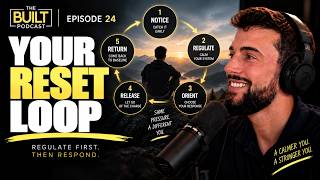
Jake Burhans walks through the BUILD Framework, a five-step tool to manage stress in real time: Notice dysregulation, Regulate your nervous system through breath or muscle relaxation, Orient to decide your next move, Release lingering emotion, and Return to baseline. He uses a sales scenario to show how regulation must happen before you can think clearly.
Chapters
Most people don't need more information. They need something they can actually use in real time when they're stressed, overwhelmed, or about to fly off the handles. Because that's where everything breaks down, right? You can understand all your patterns, you can know what to do, but the moment that pressure hits, it just goes away. And that's when you need it most. And then you're back in it, reacting, overthinking, feeling tight. So the question isn't, do I understand this? The question is, what do I do when I'm in the middle of it? That's what this episode is. I'm gonna walk you through the BUILD Framework as a simple, repeatable self-regulation loop you can use in everyday life. Welcome back to Built for Impact. I am Jake Burhans, and this is the podcast where inner peace meets high performance. And where building your dream life starts from the inside out. Today I want to simplify everything. So we've talked about beliefs, regulation, identity, the past, all of that. But if you can't apply it in real life, it doesn't even really matter. So this episode is about the BUILD Framework as a self-regulation loop. 5 words to explain how to use this in your day. Notice, regulate, orient, release, and return. So I'm going to go into all 5 of these. First up, break limiting beliefs is all about awareness, right? So the word I've associated with pillar 1 is notice. So we always have to notice. Awareness is the first key. We want to regulate ourselves, but if we can't be aware that we're in a dysregulated state, it doesn't even matter. There's no chance to regulate. You're caught in the tornado of a negative thought or negative emotion. You're completely dysregulated and you can't do anything. Now I want to explain to you that. Noticing allows you to regulate, which allows you to then orient, which then allows you to release and then return. It also works the opposite way. A lack of awareness leads to a lack of regulation, leads to a lack of an ability to orient yourself in the right direction. And when you're in all that chaos, you obviously can't be present and release, and then you're not able to return. So first is awareness. An example I'm gonna use is, you know, a sales rep and they're about to get on a call and they have a negative thought about what if I flub this call? Or maybe it's towards the end of the week. They haven't hit their quota and they're like, oh my gosh, if I don't hit my quota, I'm gonna go on a performance and action plan next week, which is basically a plan you go on when you don't hit your numbers. And if you can't get it back on track, you basically get fired. If I can't handle my PIP and get back on track, I'm gonna get fired. Oh my gosh, I can't do this. What's wrong with you? So all that happens because of their identification with their thoughts. They're not able to separate themselves from their thoughts and their emotions. So in that moment when that sales rep has that thought that I can't do this, or I can't do that. If they can understand that that is just a thought and they can let it go, they're going to be able to let that go and get back to the task at hand instead of getting wrapped up in that thought for the next 3, 4, 5, 6 hours or 30 minutes, an hour, whatever the case may be. If they can regulate in 5, 10 minutes and get back on track, they're going to be so much more effective, not only as employees, but they're going to be much more regulated and just enjoy their day-to-day so much more. But they can't do that unless they are aware of the thought and the emotion. So once they're aware of that thought, then they need to regulate themselves. So they notice that their body's in a survival state. And again, we talked about regulation. There's two ways to regulate. We can do top-down regulation, which is basically when you're aware of the dysregulated feelings in your body, you feel yourself in survival mode. Two is a bottom-up regulation. So you're already in survival mode. Thinking's not really gonna help, so you need to use your breath. Breath is the quickest way to do that, or relaxing your shoulders, relaxing your jaw, doing all the things that, that you need to do to, to relax and signal safety to your body. So two ways to regulate there. So the salesperson to have this negative thought, you know, end of the week, haven't hit their quota. Instead of going down this rabbit hole, they're aware of the negative thought. They're able to let it go. They regulate and then they orient. So many self-development frameworks miss. They just go right from awareness to trying to figure out a solution and orienting. But if your nervous system is not regulated, that's the foundation of being able to think. When you are dysregulated, your prefrontal cortex is offline. You can't think, you can't problem solve, you can't see all the options on the field. Your perception is narrowed. So it's absolutely imperative before you orient and choose your direction, you need to regulate. So they're aware of that pattern. They regulate, then they orient and decide which action that they want to take, because only then do they see all the options. Again, if they're dysregulated, they're not seeing all the options and they don't know the best way to act or the best decision to make. So the salesperson is aware, they regulate, they orient their action. What would my 2.0 self do in this situation? And then 4 is also not really talked about, but after you orient yourself, you're still going to feel the anxiety and the stress and the fear or whatever emotion was associated with that thought. That's okay. You need to relax in that moment. Relax and just get comfortable feeling the emotion. When you can relax and feel the emotion, you can then let it go, right? But when you try to suppress it, oh, I shouldn't feel angry, all these things, you're trapping it in the body. So that's very, very important. You could be aware of the pattern. You regulate yourself, you orient, you take the new action, right? What would my 2.0 self do? That's orientation. Then you release, right? You relax, you allow that feeling to be. And then you return the fifth pillar, T. You return to your regulated self, your 2.0 self. So that's the loop you can use in your day-to-day every single day, right? You're aware of a negative pattern, something that could get you out of regulation. You have to notice it. You're going to regulate yourself. After you're regulated, you're going to orient, how would my 2.0 self respond? Then you're going to release, okay? Or you're going to allow the feeling to be present until it dissolves. It's okay. Get comfortable feeling different emotions, and then you return. You return to your regulated baseline, and that's the loop every single day. That is the power of the Built for Impact framework. I had an example of this the other day. I was overwhelmed in the day and I was just feeling frustrated because a bunch of stuff had hit me all at once, but I was aware of it. I made sure to regulate myself. I relaxed my shoulders. I just kind of calmed myself down, slowed my breathing. I asked myself, hey, what does Jake 2.0 do in this situation? Oh, he doesn't care because it's not that big of a deal. Okay, boom. Let's take the correct action. And then I had to sit with that feeling of anger though, for at least probably like 10, 15 minutes. It just kind of lingered in my body, but I didn't fight it. I didn't resist it. I just allowed it to be and it eventually evaporated and I returned to my regulated state of being, right? My 2.0 self. So that is the self-regulation loop. So what I want you to do this week is be aware when you're in a survival state or a stressed out state, and I want you to use that 5-step process. Notice the pattern, regulate yourself. Orient your actions only after you're regulated. And then I want you to allow the feeling to be there, and then it'll eventually just dissipate. It'll go away. And then you can return to what you are doing, right? Return to your 2.0 identity. And every time you go through that loop, it's like a, a bicep curl for your inner world, right? This is a self-regulation loop. At the end of the day, this isn't about doing the framework perfectly. It's about having something you can come back to, right? When things get real. Again, notice, regulate, orient, release, return. That's the loop, and it's how you start building from peace instead of pressure. And keep in mind, you're gonna do this loop and the negative thought might come back 10 minutes later, 20 minutes later, an hour later, 2 hours later. You're gonna have to use it multiple times throughout the day, but every time that you use it, you're building your internal capacity to be able to deal with external stressors. That's the whole goal of Build for Impact. We're not trying to eliminate external stressors because that's impossible. We're building our internal capacity to deal with those external stressors. And every time that you do this loop, you're, you're increasing your capacity. Think about a circuit breaker. Okay. A circuit breaker in a house, it might be certified for 50 amps of voltage. So maybe it lights up a few rooms, but life might be requiring 200 amps outta you right now. So things are tripping you up. You don't have a lot of internal capacity. You have one, you know, one call that goes the wrong way and you're tripped into stress and survival mode. You wanna build that internal capacity so your system can handle like 500 watts, right? And then the, like, pretty much nothing in your external world can knock you out of your place of centeredness because you've done so much of the internal work. So that's what we're doing every time we do this loop. We're building our internal capacity to regulate ourselves. If this episode helped you, share it with someone who's been feeling stuck in that pressure cycle and make sure you're subscribed so you get new episodes every Monday. If you have not joined the Built for Impact community on Skool, S-K-O-O-L, go do that. We're going to put a link in the bio of this, uh, or link in the description of this episode. You can get in there. We have a lot of stuff in there. We have a Built Operating System assessment, which is gonna gauge you how your system handles pressure. We have a 7-day internal reset challenge. We have orientation videos. We have the Foundations course. And then if you're really feeling ready for it, you can get into the Built Core System along with our weekly calls. So put a lot of time and energy into that community to help you all. But until next time, all the peace, all the power.










