Built for Impact Ep. 29: How to Retrain Your Nervous System Out of Stress and Pressure
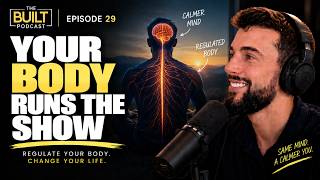
Jake Burhans explains how chronic stress becomes your nervous system's default setting, and introduces the BUILD framework to rewire it: Notice your stress patterns, Regulate through breath, Orient toward a new identity, and Release the old one. Repetition rewires neural pathways like inner bicep curls.
Chapters
Your mind actually isn't running the show. Think about the last time you told yourself to calm down, to stop worrying, to just let something go, and your body didn't listen. Your chest had stayed very tight, or your jaw was locked up, or your shoulders were tight. That racing feeling just didn't quit because you decided it should. Here's what I've come to understand. Your body is your subconscious mind, and if you've spent years operating in stress, pressure, and fear, That is not just a mood that is hardwired into your neurology. Okay. Into your biology. That's a pattern you've trained. Your cells know it and your nervous system defaults to it, right? It becomes home. It becomes the familiar baseline that you always revert to. So today I want to talk about why you keep ending up back in the same stressed out version of yourself, even when you know better and what it actually takes to build a new baseline. Welcome back to Built for Impact. I'm Jake Burhans, and this is the podcast where inner peace meets high performance and where building your dream life starts from the inside out. Everything we talk about on the show lives inside the BUILD Framework, the work of reprogramming your inner world so the life that you're building isn't running on all that pressure, anxiety, fear. In survival mode underneath. It's built from the steady, calm, regulated, focused, precise internal state of being. And today's episode is one core idea. Your body is the subconscious mind. It's been trained to be the way that you are, to be stressed, to be anxious, to doubt. But the beautiful part is it could be retrained. Your body has been trained to act in a certain way. So over time, you think act and behave in certain ways. Donald Hebb told us that in 1949, neurons that fire together wire together. So every time you think in a certain way, or you believe a certain belief, or you talk to yourself in a certain way, you behave in a certain way, you feel a certain emotion, you're firing certain neurons in certain ways. And over time, as you fire those neurons paired with a strong emotion, it begins to become hardwired into your system. Right? It's the most familiar ways of operating. And a funny thing about the nervous system is it is what they would call an attractor state. It's always trying to revert to its baseline. It's an incredibly efficient system at doing this. Think about it like a thermostat, like a thermostat is set to 65. If it gets to 74, what happens? It comes back to 65. But also if it gets set to, or it goes down to 55, it's gonna come back up to 65. Your conditioning and your patterning in your life is like thermostats. So you have a thermostat for how much money you should make. How much love you should get, how successful you should be, how fit you should be, and your system is going to keep you at that setting. So if you're only used to making $50,000 a year and you go make a million dollars a year, you could, you could sabotage, self-sabotage, start spending the money subconsciously, giving it away, making poor decisions because your system perceives that as a threat. It's a new way of being, a new, a new way of operating, a new way of thinking, a new way of behaving that your system's not familiar with. So our identity to our system is our most familiar ways of being, our most familiar patterns. So over time, if you have trained your body to just run around in pressure and anxiety and fear and all these different things, that is what's familiar to your body. And the nervous system only asks two questions. It asks, am I safe or am I not safe? And familiar equals safe, cuz we know it doesn't kill us. And unfamiliar equals potentially dangerous cuz it's unknown. It could kill us. And this makes sense in hunter-gatherer days, you could be in a village. And you know, it's not the best village, not the best resources, but if you're alive, your system would rather stay there than potentially venture into the unknown dangerous woods. Yes, there could be a better village, but you could also be killed. There could be an enemy, there could be a lion, there could be something. So no, let's just stay in the familiar. That's how our nervous system in our body has adapted to keep us safe. The problem is though, it doesn't know objectively what's good for you. It just knows what's safe or not safe. So if what's familiar is the stress and the anxiety and the fear, it wants to keep you there. Even if consciously you know that you want to live with peace or you want to live with more love or more confidence or whatever, your system's not used to it. So you self-sabotage, right? Those ways of thinking in the brain, those synaptic connections, you haven't fired those neurons together enough to make that your most default pattern. So changing who we are becomes about rewiring ourselves by thinking, acting, and behaving in new ways. Because right now how we're thinking, acting, behaving is a certain set of neural connections, right? Think about those like superhighways in your, in your body. If you want to go be more at peace, go be more confident, go be more successful. Right now, those are unfamiliar pathways in your body, and because it's unfamiliar, it's, there's more resistance to, to get into that version of ourself. So what we need to do is we need to be aware of the old patterns, be aware when we're acting as the 1.0 version of ourselves. Right? Regulate ourselves. So we're in a regulated nervous system state. We use the breath and other tools like we talk about in Built so that your body is open to change so that it's more neuroplastic, right? Neuroplasticity, the ability for the brain to rewire itself and learn new things. 'Cause you can't just go from awareness to trying to change if you're fundamentally on a dysregulated nervous system state. So we're aware of the old pattern, the 1.0 self. We make sure we're in a regulated nervous system state, and then we orient. How would the 2.0 self respond in a situation? How is the new version of me responding? There's a good book called The Alter Ego Effect, but you can come up with an alter ego for yourself, right? Kobe Bryant had the Black Mamba. Beyoncé had Sasha Fierce. LeBron James had King James. Have this 2.0 version of yourself so it's clear who you're becoming, right? Who is this new identity you're becoming? So it's clear as day when you're operating in the old version, you can be aware of it. You can let it go, regulate your nervous system, and then orient in the new way. And every time you do that, and then you release the old patterns, right? 'Cause you'll still kind of feel the stress and the anxiety or whatever it is. But relax the body and release. And that is the BUILD framework, right? B-U-I-L. Big Limiting Beliefs is the notice. Upgrade your operating system is regulate. Notice, regulate, orient is imagine your future. Let go of the past is release. So we want to notice, regulate, orient, release. Every single time we do that, it's like a bicep curl for our inner world. We're firing new neurons in new ways. And over time, we begin to do that more and more and more and more and more. That way of being, that new identity will become more familiar to our system than the old way of pressure and stress and anxiety. And soon that becomes your baseline, and then your system starts working for you. Like I said at the beginning, our system is an incredibly powerful attractor state. So if we're set to a baseline of peace and calm, when we get stressed, subconsciously now our body's gonna be working for us. It's gonna be working towards that new baseline. It's gonna wanna revert to those familiar patterns of peace and regulation. Right now our system's working against us cuz it's used to the familiar stress and pressure and fear. So when we try to be different, it reverts us back to that old baseline. So we need to train a new baseline. If there's anything you're gonna remember from this episode, it's that neurons that fire together wire together. And based on how you've been thinking, acting, and behaving, you have fired certain neurons in certain ways for a long time. That's become your baseline and your system wants to keep you there. So that's stress, anxiety, fear. You need to now think, act, and behave in new ways so that you can fire new neurons and train a new baseline. And once you train that new baseline, it takes time, repetition every single day. But over the course of 3 months, 6 months, 9 months, a year, 2 years, you are a completely new person. And now subconsciously, every time you get stressed out, your body just wants to return to that peaceful state. 'Cause it's your baseline. So that is how you retrain the body, which is the subconscious mind. And think about the body is trained to do a lot of things. Like think about driving in the car. You're driving in the car down the highway for 30 minutes. You're not even paying attention to where you're driving. Why? Because the body has learned how to do that. Your subconscious conditioning, your body is like this highly programmable machine and it runs 95% of your actions, right? That's a statistic you can look up is the subconscious mind, which is the body and a little bit of the mind, runs 95% of your daily actions and behaviors, right? Your conscious mind, only runs 5%. So you can say, yeah, I'm going to be at peace and all this stuff. But the second you stop consciously thinking about it, you're just reverting to your old patterns. So you have to change those ingrained patterns. And we do that through repetition. Okay. Rep-etition. We need to do those inner bicep curls, inner bicep curls, which is noticing the old pattern, regulating into a regulated nervous system state, orienting towards a 2.0 version of ourself. Come up with an alter ego for yourself, Magic Mike or something, whatever you want to call it. Savvy Susie. That's gonna help you get into this mode of the 2.0 identity, and that will help you do the, the inner work and do the bicep curl. So that is the inner work. The reflection I want you to take this week is what state has your body been practicing the most? And what state do you wanna actually live in? So what have you been operating in? What's the current version of, of yourself that you don't want to be in? How are you thinking, feeling, and behaving basically? And then write down on a piece of paper the 2.0 version of yourself. How do you want to behave? Who's the person you want to be? And then notice every time you're in that 1.0 self, right? And then correct and start acting like the 2.0 self. And then soon you just start living in the 2.0 self. Like, that's just who you are. You've done it enough times that your system is more familiar with that, and you just are that person. You don't even remember what the old person is like. But that is the practice. Your body is your subconscious mind. It's been trained by everything that you've lived through, and it could be trained toward the baseline of peace instead of pressure. And that's the mission of all of Built for Impact. Teaching entrepreneurs and high performers how to build their lives and businesses from peace instead of pressure. This is the way. If this episode resonated with you, you can learn more by joining the Built for Impact community. It is free to join. Get in there, take the orientation videos in the classroom section 1, and section 2 is the Built Operating System assessment. It's going to, it has a list of highly specific and targeted questions to better understand how your system is handling pressure and stress. And what your biggest limiter is. So all free, you can get in there, take that assessment, and learn more about why your system is operating the way it is and what to do about it. Till next time, thanks for being here, and all the peace, all the power.










