Direct to seller vs direct to agent. Which one is better? (SS #2)
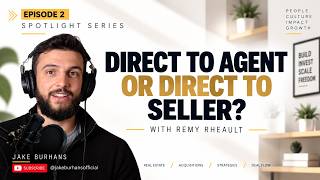
In this 30‑minute Spotlight Series interview, host Jake Burhans talks with fellow New Hampshire‑born wholesaler Remy, who operates out of Jacksonville, Florida. The conversation contrasts two wholesale models – direct‑to‑agent (on‑market) and direct‑to‑seller (off‑market) – covering how each is sourced, the tools and teams required, key performance metrics, revenue expectations, and the relational dynamics that drive repeat business. Remy shares his journey from joining Astro Flipping in 2022, learning to make 30 daily agent calls, closing his first two deals for $8K, and scaling to 105 deals with an average $10K fee per on‑market transaction. Jake outlines his own direct‑to‑seller operation, which relies on a high‑volume texting/calling system (≈2,000 texts per day, 7‑9 leads, ~52‑59 leads per contract) and a broader geographic footprint across Florida, North Carolina, and New Hampshire. Both discuss mindset hurdles – disbelief in earning potential, family skepticism, shiny‑object syndrome – and how community, consistent effort, and automation help overcome them. The interview also touches on lead‑generation methods (VA‑built Zillow/Redfin lists for agents; PropStream absentee‑owner and blanket‑pain lists for sellers), follow‑up tactics (weekly persistence for agents, timeline‑based cuts for sellers), CRM usage (GoHighLevel), and ancillary services such as transaction coordinators (EasyREI). The dialogue ends with practical advice for newcomers: squad up, focus on one model, automate, and leverage experienced peers.
Chapters
Welcome, welcome to Spotlight Series episode number 2. I just thought about this the other day, Spotlight Series. I thought it would be great to bring on people doing different things in the business. I honestly just want to have conversations with these people. I think there's a lot of good things that come from them. So I'm excited to have Remy on. He's another New Hampshire guy, uh, who relocated down here to, uh, you know, the Sunshine State. He's up in Jacksonville actually, absolutely crushing it. Um, and we got hooked up. We didn't know each other in New Hampshire, but We hooked up once we were down here, just saw each other at the Squad Up Summit. He does direct-to-agent, I do direct-to-seller. So I thought it'd be good for us to come on, keep it brief but value-packed, and kind of talk about the differences between those two. What's going on, Remy?
Nothing much, man. I appreciate you having me on. And yeah, man, it's pretty sweet that we're both from New Hampshire. Kind of cool. I haven't met too many people from New Hampshire in the business.
So yeah. For sure. It's good to be down here. It's like interesting too, being from New Hampshire, uh, definitely a competitive advantage up there because you don't have people really from other states trying to invest in New Hampshire like you do in Florida. Like in Florida, you know, especially from a wholesaling side, you have people from any state be like, hey, let's pull a list from Jacksonville today. So there's a lot more competition. However, there's a lot more deals. But in New Hampshire, you don't have anyone from Florida being like, all right, we're pulling a list from New Hampshire today, let's go.
Yeah, a lot of people don't even know where New Hampshire is on the map. I got, you know, when I tell people where I'm from, they don't really know most of the time, 9 times out of 10.
Yeah, it's crazy. Absolutely crazy. So real quick, tell us how you got to where you are today. I mean, I saw on your badge at Squad Up Summit, you had 50+ deals, you're a dual director agent. How the heck do you even get there?
Yeah, so right now, uh, today's sitting at about 105 deals. Um, started learning, uh, or joined Astro Flipping with Jamil in June of '22. Um, it really just took that time to learn and, and kind of develop my skills. Um, so I, I did 2 deals prior to joining Astro. I worked for somebody that was already in Astro, but I didn't know it at the time. I kind of just met them online. They're like, hey, come and work for me. Because I was asking them a million questions. I was still living in New Hampshire at the time. But yeah, did that, did a couple of deals with him. I started— he started me off with agent outreach. So he just told me, call 30 agents a day, every single day. And I did exactly that. And after about, you know, a month and a half, 2 months, Ended up getting 2 really good leads that converted to closed deals. So it was pretty sweet. Made about like $8K altogether on those 2, you know, getting my percent for just making the calls. And then took that money, invested in Astro, started learning. In that process, moved down to Palm Coast at the time. So I wasn't living in Jacksonville. Then yeah, kind of just broke off on my own, started learning, started doing the thing. Then I started agent outreach by myself using a tool, Astro Blaster from Andy, and then just started slanging deals, man.
And moved out here. Hey, I love it. Was that the most money you'd made up to that point in like one time?
Yeah. Like, like $8,000 in like one month. It was, it was pretty nuts.
It's great, dude. You see that come across and now your tolerance is built. Once you start to get, you know, $20,000, $30,000, $40,000, $50,000 deals, you're like, that's nothing. But dude, my first deal made $2,500. I was like, oh my God, this is great. I worked all summer for $2,500 digging holes when I was in high school, you know, in construction. So I was like, wow, this is phenomenal business. That shattered my, my mindset. But I think two key points there you brought up, which regardless of direct agent or direct to seller, you made 30 calls a day consistently for 1 to 2 months.
Mm-hmm.
Yeah, that's it. It's the consistency. It's the effort of putting in the dials. There's no shortcut. So, you know, I think people getting started, the biggest thing you can do is just be consistent with whatever you're doing and you, and you will find results real quick. What is Astro Flipping?
Astro Flipping is a wholesale community with Jamil Damji, and they provide, you know, of course, a community. They host events, and they pretty much teach you everything that you need to know to start wholesaling. It's primarily directed towards direct-to-agent stuff, so no marketing cost, anything like that. And I highly suggest it, you know, for somebody being newer to wholesale. Mainly because there's no marketing costs, right? Somebody joins the game and, and has to spend, you know, thousands of thousands of dollars and they don't see results up front, it can kind of, you know, scare you away if you don't have that proof of concept. Um, not saying everyone's like that, but I suggest it because I know how, you know, mindset is at the beginning. It's a little bit tough until you get that proof of concept. Um, but not, not just that too, like the, the community. I mean, you saw everyone at the event, you know, whether it's Sub 2 Community or Astro Flipping. Um, just having the community and having people to talk to every day and help guide you and just lean on and seeing their wins and everything, it was like a huge help in my journey. So I definitely recommend getting in some sort of community. Astro Flipping is what worked for me. But, you know, whatever community kind of lean towards, I would highly suggest.
I think that's great. I think you definitely need to be in a community. You got to be committed though at the end of the day, no matter what community you join, whatever you do, you got to put in the work. I mean, there's no really— there's no way around that of actually doing the dials, but it's going to help you get over those hurdles. And especially depending on what your environment is around you, parents if you're a little bit younger, or spouses or family or friends who don't understand the world of entrepreneurship might not be the most supportive. So being able to get around people who are in that space, right, and who are just a few steps ahead of you or even right with you, so they understand exactly what you're going through. I think that's absolutely huge.
Yeah, that's tough at the beginning, man. Everybody around you, especially a lot of people don't understand what wholesale is. You tell them, you know, I can make $10K, $20K, $30K in real estate with no license. People go bonkers and think it's crazy. So that was one of the things I kind of dealt with at the beginning, you know, telling— like, over-promising people and not delivering, having those people kind of chirping in my ears and bringing me down a little bit. But, um, the community is what brought me up and kept me focused on, you know, seeing them close deals and cashing checks. It's just like, wow, they could do it, I could do it too.
Yeah, yeah, man, you got to bring that confidence though, for sure. And it can be, it can be tough, but no one's, no one's laughing now except you. Uh, real quick, we're gonna get into direct agent versus direct to seller here. Um, I love mindset though. I'm like a mindset nerd. I love to talk about, you know, overcoming those things. What would you say your major limiting beliefs were getting into the business or starting in the business, and how have you, how did you overcome those? Or get past them?
Um, yeah, let's see here. I would say a few things kind of at the beginning was even understanding that you could make that amount of money, or that, that making that amount of money even be possible, because growing up I never really saw anyone that was making, you know, more than maximum $10K a month, um, off a really, really good high-end job. Um, so just understanding and being able to comprehend that you can make more than, say, $10K a month, because I never saw it. So like, seeing all this stuff online, it was kind of hard to believe, like, oh, it's real. Um, you know, people are out here making $50K, $100K, $200K a month. And it's like, that's, that's a lot of money. Um, especially when you don't know anyone that's making anywhere close to that. So I'll say kind of just believing, believing, you know, that that is possible. That was like one of the things that I had to overcome. But again, having the community and seeing people consistently do it and that they're just regular people, you know, going out and meeting those people at events or whatnot. Kind of just brought it to reality. Um, another thing that was a bit tough was the thing, uh, what I said earlier was, you know, over-promising to family and friends and stuff like that. You know, I told my dad, my mom, my brother, a couple friends what I was doing. And, uh, you know, when I was working for someone, I told them about it too, and they were like, hey, have you made any money yet? Have you made any money yet? 'Are you sure about this?' And then, you know, tell them the price of what Astro Flipping costs, and they're like, 'That's a scam, man. You're getting scammed.' And just having all those negative things in my ears, um, it was tough because it's like you don't know anybody that's having success in it personally, and you just have everybody, you know, yapping in your ear, all the negative stuff. It's kind of— that was something that, you know, I had to overcome as well, just the mindset on having a positive outlook on it and seeing that it is possible. And like I said, like, I leaned heavy on the community, um, and it wasn't always, you know, sunshine and rainbows. Like, I went 6 months— I closed the 2 deals with that guy and broke off, joined Astro, and in that period of time, moving to Florida and all that, I went 6 months without doing any deals. Zero money. Bank account was draining slowly. Got down to my last like $500 before I got another deal again. And yeah, just like the mindset of like believing in it and trusting in it and trusting the process and seeing that it works and just head down, grind, grind, grind. This is important, man. Like staying focused. Like you said, one of the things I messed up on and reflecting back was that period of 6 months where I didn't do any deals. And I was working for someone, you know, making 30 calls to agents every single day. I found success. After that, I was like, I got, you know, shiny object syndrome. I was like, let me do on-market stuff, let me do agent stuff, let me try to see what direct-to-sellers about, let me try, you know, this, that, the third. And I just got way too confused, and I was trying to do too many things at once, and it just didn't work out. So I had to kind of reel myself back in and sit and analyze what went wrong. So overcoming, you know, like shiny object syndrome, trying to do a million things at once instead of just honing in on the one thing that worked at the beginning. And once I started doing that again, I found success again. And it, you know, like you said, man, focus, keeping focused.
So good. So good. I mean, everyone's going to go through challenges. I mean, look at over 100 deals. I mean, no one just gets there overnight. It's not smooth sailing the whole way. So the first point you mentioned was believing it's possible to make this money, changing your environment. That's the biggest thing where that's the normal. So if you want to make more money, you want to make $100K a month, go get in a group where $100K a month is the normal. $1.2 million is the normal. We're around people, you know, that we follow. Now it's like our goal in the business is to get to $100K a month. We're like, that's nothing, $100K a month, you know. Whereas before it'd be like, oh my God, $10K a month, that's crazy. But now people are doing freaking $400,000 a month. $400,000 a month. So our temperature is— our, our thermostat has just raised. You hear about people like Rob Wensley doing a million bucks a month. That is possible. A million dollars a month, right? $12 million business. So just changing your environment, getting around those people who are doing, or who are at where you want to be, it'll become normal, and then you'll believe in it. So I think that's what you did by going into Astro, changing your environment. Second thing is kind of the family being like, oh, you're investing in Astro, that's a scam, how could you do that? People who, you know, I don't know, not, I don't know the right words for it, but, um, you see a lot of people that aren't wealthy, they don't understand the value of education and courses. Like now I'll pay, I'll pay $5K for a course or whatever. No problem. No problem. Wouldn't bat an eye at it if it was a good course. Right. Because I know that those skills that I learned from that could go— could have me go make hundreds of thousands of dollars, if not millions of dollars. So people don't understand that. Why would you spend, you know, $5K? That's an absolute scam. It's like, no, you're building your skills to go do that. And yeah, you could go do it for free if you want, if you want to go spend 6 months, 8 months, a year wasting time, which is money, trying to figure it out. Or you can just take the shortcut, someone who's already done it, and pay for it. Yep, 100%. Um, so I think those two points were, were super important you just said there. So, okay, cool. Direct to agent versus direct to seller. Let's get into a little fire round here. I want to go kind of head to head with these different things. So lead generation, what does it look like to generate leads direct to agent?
Direct to agent, uh, so there's two routes you go. Our main strategy is on-market stuff, so I'll talk on at first. So yeah, I mean, it's pretty much the low-hanging fruit. It's on Zillow, it's on the MLS. So every morning, you know, we have a VA go and make a list of ugly houses or things that in the description say investor or motivated seller or anything along those lines. So they'll make a list, they're already on Zillow, so you already know the leads that you're going to call, already warm leads. So yeah, VA will make a list of them and then our ad guy will call them, call them, you know, get the information on why they want to sell, you know, what price they're asking, which is on Zillow, about the majors, you know, roof, HVAC, plumbing, electrical, all that stuff. And then we're local to Jacksonville, so we only do on-market stuff in Jacksonville. So he'll pick a few. You know, that may qualify to go and walk the property, you know, shake a hand, meet the agent, meet the seller at the property too. Um, so he'll go walk some, and then after that, I mean, it's just about, you know, running your comps, running your numbers, estimating repairs, submitting an offer to them. Um, and a lot of it is follow-up, right? So one thing with on-market stuff is that you have a lot of competition, especially especially in Florida, especially, um, in Jacksonville, there's a lot of competition. So I'll say with on-market stuff, very, very competitive, and a lot of deals come from follow-up, right? Because there's a lot of newer wholesalers that will come in way too high and then cancel. And then, you know, you just got to stay on top of the agent, so follow up with them or make an automation to follow up or set a task. "Hey, follow up at the end of the inspection period." And usually that's where we get a lot of deals from. So the in-person stuff is highly important usually. And then on top of that is following up from failed contracts. That's a lot of where we get our deals from.
Perfect. So that was kind of the full gamut, which is great walking through that process. So actually generating the leads specifically, you have a virtual assistant doing that. So they're going on to Zillow scanning for as-is, or going into Redfin using the as-is filter, right? And that's how you're actually generating leads for your acquisition reps to call, is that right?
Yes, sir.
Yeah. Okay, so on market, and it's all free other than the VA. You gotta pay for the VA, whatever they are, 4 or 5 bucks an hour, but it's available to everyone.
Yep.
So with direct-to-seller, a little bit different. There's two ways to generate leads, two high-level ways with direct-to-seller, and it's either outbound, which is going to be PPC Um, things like that where they're, um, sorry, it's called inbound. Those are inbound. So those are the hottest leads, right? Because typically if someone's searching, you know, pay-per-click, I want to sell my house now for cash, um, their timeline is now. What we do right now is outbound, which is calling and texting. So this is a less hot lead, um, and that's because we're reaching out to them. It's a form of disruptive marketing. So we could be hitting them at 10 months, 8 months, 6 months, whatever. So when you do this calling and texting approach, you need a big team to handle all leads, right? Because it's such a sorting— such a sorting game. If you think about the analogy of you're trying to find the needle in the haystack, the motivated seller who's ready to go, when you're doing this calling and texting, it's a ton of sorting. That's why we have 6 callers. We have 2 lead managers. Lead managers are, are a cold calling expense because we need them to sort through all the leads, um, and we're trying to find that needle. When you do inbound marketing, which is much more expensive Pay-per-click, things like that. LeadZolo, which is YouTube ads. The needle is coming to you, right? They're, they're out there. They're a motivated seller searching online to sell their house. So, uh, typically those are more motivated sellers. You don't need to do nearly as much follow-up. Um, those are the two basic types of ways to generate leads. On our side, we do the calling and texting. So we use Batch Dialer to call and Launch Control to text. Um, and we're pulling our lists from PropStream. So basically, just PropStream, uh, we go very broad. There's two different types of lists we pull, data lists. So there's going to be what we call, um, just our absentee owner list. So it's going to be absentee owner, which means that they own the property but they don't live in it. Um, it's going to be individually owned, not owned by an LLC or a corp. It's going to be under $500K median value and not listed on the MLS. Those are the four things that we do for that. And then when we want to target owner-occupied data, because ideally an absentee house is easier to sell because they don't live in it, it's a rental, they don't have to move. And especially in this environment, interest rates are really high, people are less likely to move. So if it's like a rental for them or a vacant house, they'll be more likely to sell it. Now if we want to target owner-occupied data, we're going to go on PropStream and put together what we call a blanket pain list, which is just every pain point that's on there, which is, you know, pre-foreclosure, divorce, lien, tax default, bankruptcy, inherited the property, all that. So those are the two basic filters we use, and we just use them in all the towns, and we'll pull it and we call and text it. Lead comes into the CRM if they're interested in selling. And yeah, we pretty much have a team just generating leads that way. So a little bit more to it because you're on the direct agent, it's much more simple. You know, you're just getting the VA, you're going on there, you can probably create a standard operating procedure pretty easily, like a little manual. To figure that out. And then it's just getting those leads in there, whereas we have like a ton of leads coming in, a lot of sorting. So interesting, interesting approach. And you got to pay for the softwares with Direct to Seller. You got to pay for the—
a lot more tools. A couple of questions I had for you as you were going through that was, as far as like the area, are you hitting, you know, all 50 states or are you like, where are you targeting when you pull these lists?
Yeah, so in Florida, we're going to hit all the major cities. So, you know, we're doing St. Pete, Tampa, Orlando, Jacksonville, Miami. And then in each of those cities, we pull both of those types of lists. So we'll pull the absentee owner with those filters of individually owned, absentee owner, not on MLS, under $500K estimated value. And then we'll pull blanket pain for each of those cities. Super easy because then we can just have our VA go in there and be like, hey, pull blanket paying for Jacks, right? Pull absentee owner for Jacks. And that's pretty much as broad as you can go. So we're pretty much capturing all the data that we can there. Um, and then we'll recall those lists in like 6 months' time.
Okay, the same list.
Yeah, so we're in Florida, then we're in North Carolina, Raleigh and Charlotte, and we'll hit some of the other states, and then we're in New Hampshire. But those are our 3 main markets.
Gotcha. Heck yeah. And then you mentioned, you know, you do some calling, but you also do some texting. What does the texting process look like? Because cold calling is, you know, just cold calling. But as far as text goes, like, what's your— any KPIs for that? Or like, what does the texting look like specifically?
Yeah, so that's a good question. So we send out about 2,000 texts a day. I'd say, right, roughly 2,000 texts a day to 2,200, and we're getting anywhere from, on average, I'd say 7 to 9 leads. So it breaks down to like, um, did you say 2,000? Yeah, so that's a lot, but you could do less, right? But say we're sending out 2,000 a day divided by 8 leads, it's about 250 texts to a lead. You know, it's very high. Um, so that's typically what we're seeing. I think it's changed now because the texting regulations are so strict. You have to go in there. The biggest thing with texting is the templates. You have to adjust those. And like, the texting industry is hammering these software companies and saying, oh, you can't say this, or you can say this. So they're constantly having to adjust. Yes, you got to edit your template. Um, but we have one person, right? One person doing that, uh, 2,000 to 2,200 texts a day. We're getting 7 to 9 leads, whereas a cold caller, right, is going to bring in about, you know, 1 to 3 leads a day. Yeah, so one texter at that volume is going to be the same as, um, 3 callers. Now, if you want to know numbers like how many leads to a contract, Pretty, pretty even. Cold calling is a little bit ahead. Cold calling, cold calling for us is at 52 leads to a contract, and texting is 59 leads to a contract. And that makes sense because calling, you can vet them out a little bit better, right? You can actually talk to them. Texting, you're pretty much just, um, getting anyone to raise their hand. You have to do some more qualification on the calling side of it. But, um, I think it's good. It's been working well for us. We get deals from both pretty evenly.
Heck yeah, that's what's up, man.
Sweet. Yeah, sweet. So like ultimately PPC, all roads lead to PPC because it's like a very hot lead, but those leads are so expensive. Like we spend, you know, $11K on calling and texting right now for marketing, right? We could spend $11K on PPC, you know, have way less leads, but theoretically make more money. The only thing is you better have a sales process, have good sales guys, and respond to that lead quick. So if you can handle it and can talk to sellers and all that stuff, then it's good. But you want to make sure you have your systems in place because those leads are expensive, you know, they're like, um, whatever, a grand a lead. So, um, but yeah, I think it's good. I think it's good to have a mix of both though, ultimately.
Yeah, yeah, man. All right, I'm excited for that, that journey to, uh, Not quite yet. We kind of opened the door up a little bit to the cold calling stuff, did a couple deals as I told you, but a couple reps, you know, $40K, $50K, nothing much. Yeah, but that's why it's like, man, it wants me to hone in on that, but I know I had to build out the agent outreach stuff first and then, you know, kind of move over. I want to get everything perfect or as close as perfect as I can before I move on and get the shiny object syndrome on, on over. Yeah, that's seller stuff.
That's some experience talking right there, you know, staying focused, understanding that you need to build that bridge before you go to the next thing. Whereas someone just getting started might be trying to do both. But once you, once you try to do all of them, you understand, hey, it's most effective to focus on the one thing, really automate it, buy your time back so that direct agent is cranking without you working in it, and then you can go spend your time trying to build something else out. But You got to make sure that thing is automated. Same thing with us with direct-to-seller. Get it automated and then maybe add another arm of direct-to-agent or commercial wholesaling or whatever it is.
Exactly. Have to, man. Otherwise you're just going to keep spinning your wheels and been there, done that. So I don't want to go back.
Yeah. Um, so lead gen, lead gen is a big thing. There's a lot to it. So that's a broad category. Uh, lead follow-up, you kind of touched on it a little bit. Give us some tips on lead follow-up. You kind of already touched on it, but touch on it again, why it's important, how you do it.
Yeah. So lead follow-up, I mean, it's highly important, I think, in the wholesale game in general, but specifically for agents. Like I had mentioned before, there's a lot of newer wholesalers coming in and locking things up way too high., and we kind of had to come in and save the day. Um, and, and I guess the, the most important part as we're going through these leads, um, you know, if they say, if they respond to our offer and say, hey, we accepted another offer, or hey, uh, seller has declined, um, or hey, we're under contract now, make sure to, to ask that agent, you know, when the inspection period is up or how long they have for an inspection period. And we make sure a couple of days, maybe say 2 days before that inspection period ends, to follow up and hit on that agent again so that we're right there for them to fall right into if the contract ends up failing or if they come back retrading $30K, $40K. Want to be there as a safety net, just picking up that contract and then going and working it.
Yeah, that's huge. So I think the key difference is here because with direct-to-seller, um, you want to follow up really just kind of looking at their timeline, how, how soon are they, um, ready to sell. But a lot of times it'll be like, hey, when do you want me to follow up? It's a month, it's 2 months. I'll cut that time in half as a general rule of thumb. Hey, follow up with me in 2 months, I'm gonna follow up in 30 days, right? Hey, follow up with me in 6 months, I'm gonna follow up in 3 months. Because we've lost deals when they're like, yeah, follow up in 6 months. But 6 months is a long time. Like, think about 6 months ago, you didn't— you know, it's like, that's so far. These sellers have no idea when they're gonna sell. So always cutting that time in half. But it seems like with direct to agent, it's like you are like persistent. Like, you want to be on top of these people like every week because it could fall out whenever.
Big time. Yeah, I mean, inspection periods are usually, say, 5 business days or 7 days, like a week long. Usually at most maybe 10 days every now and again, but typically about a week. So we got to stay on top of it. And it happens all the time, man. They always come back. Not every time, but it's a pretty high rate that they do come back around. So yeah.
Okay, so lead follow-up, super important, direct to agent. You guys obviously use a CRM. What CRM do you use?
So right now we use GoHighLevel.
I hear that one a lot. So CRM, guys, if anyone doesn't know, customer relationship manager. It's gonna— it's where all your leads live. That's how you stay organized and follow up with everything. So if you want to get, um, organized, or if you want to run an actual operation, you need a CRM. Um, okay, perfect. So that's lead follow-up. So what about acquisitions, right? So kind of closing the deal, what does that look like with with direct-to-agent?
Um, I mean, it's pretty straightforward. I would say, um, it's pretty straightforward. Uh, I mean, closing though, we really just sell based off, you know, relationships. So going out and meeting them or walking the property to solidify the relationship, make them comfortable with us. I think that's mainly the, you know, it's like the main thing, like having them feel comfortable and confident in us, even if we're not the highest offer. Make sure that, you know, they know that we're here locally, that we perform, that we'll do whatever it takes to get it done. And, you know, sometimes we'll share our numbers with them. They don't agree with our offer. Hey, you know, we'll give them our calculator breakdown here. Go and share this with the seller so that they could see You know exactly how we're looking at it from our angle.
Yeah. So when you're working with an agent, seems like the— I mean, this is common with both sides, but the trust is a big component. Trust and credibility, that's a huge part of on-market, right? They're going to ask for proof of funds statements, all these things. They want to make sure you're a credible buyer because these agents obviously don't want you wasting their client's time. So building that trust and that reputation is probably a massive thing. You can get a lot of repeat business as well, which is interesting. Interesting on the direct-to-seller side, it's more— because on market, you already know they want to sell, you know, you already know they want to sell, you know their price, you know the condition. So there's a lot of already knowns there, and it's really just kind of vetting them out and making offers. Direct-to-seller side, it's much more of a discovery process, it's much more of sales. So you need a sales process to basically— basic sales process goes like this. Introduction, who are you, your company, what you do, because you're calling them out of the blue. Yeah. Discovery or fact find. So you want to get the 5 pillars in there, which is, uh, motivation, timeline, price, decision makers, and the conditions. You want to get that information, um, and then you also want to try to figure out— you're basically just calling them, say, hey, what are your needs? What are your goals? I want to see if I have a solution to provide you. If not, I'm going to point you in the right direction, move on to the next lead. So That's much more of what it is. We take a consulting sales approach versus like selling features and benefits and just jamming offers down people's throats. So we like to reach out and be like, hey, what's the situation? What are your goals? Do we even have a solution that we could provide to you? Um, we always go for no. Why don't you list it? Why don't you rent it? Why don't you keep it, fix it up? Um, and then if you can close those other doors and you have a solution for them, you're gonna try to take them to the finish line and get them to make that decision. So I think the biggest difference is there's less knowns off-market versus more knowns on-market. But on-market, you need much more credibility and all those things.
Yeah, man. Yeah. Terms, appealing terms, but credibility has been number one for us. So yeah, man.
Cool.
Pretty straightforward.
Nice. We're at the 30-minute mark.
I have to keep it.
I got a Few other things though, lastly. Okay, so revenue. What's your average deal size with the direct-to-agent approach? Because this is a key difference as well.
Yeah, big time. So yeah, right now we're averaging $10K for on-market stuff. So $10K, we will get every now and then like a banger on-market deals, like $20K, $25K. That's great. But you know, we hit $15K, $10K, $12K, you know, $20K every now and again. But you also get those $2,500 ones. You got the $5K, you got the $1Ks, $8K, $7K, all in between. But yeah, across the board, it's about $10K average.
Yeah. And I have a follow-up question to this too, which will shed some light on this. But so direct to sell, you're going to get bigger spreads, right? Usually higher motivation. You have to pay the agent and stuff. So We're on the low end, honestly. Like, I don't know what our average is now. We were at $20,000 average in 2023, but we're trying to get to $30,000 average fee. Um, but, uh, yeah, that's, that's the main difference there. You're going to get, uh, more deals but less smaller spreads. But the, the benefit though, it's flip-flopped here because what about recurring business? Do you get recurring business in direct agent?
Yep, all the time. Yeah, we actually just had an agent here. My partner was meeting with her about some upcoming opportunities. And yeah, man, it's like, you know, some of them aren't fans of the wholesaling stuff, but a lot of them just care about that they get paid. And anytime we do a deal with them that's successful, yeah, they bring oncoming, just anything that's upcoming, they'll bring to us. So it's, yeah, relationships. Are key for sure. So one deal can turn into a lifelong relationship with them. So it's pretty sweet.
100%. Yeah. And that's— in direct-to-sell, pretty much no referral business whatsoever. Everyone's a one-trick pony. We've had literally, I mean, out of the 50+ deals we've done, a couple sellers that have sold us another deal, which is great. It's always amazing when that happens, but super, super rare for that to ever happen. Yeah. And not only are you doing deals, you're building social capital with all these realtors, you know? So building a reputation, building a network. So there's a lot of benefits to the direct-to-agent side.
Yeah. Can be a bit tough sometimes too. You know, some agents are just control freaks as well. They like to make life difficult. So you have that factor as well where I felt, you know, when we touched on direct-to-seller stuff, it was a little more easier just talking to them and kind of going through the process. But yeah, yeah, it's overall, overall it's good, the relationships.
So yeah, that's great. Did you— what other— quite— did you have any other questions though about kind of direct-to-seller that you wanted to bring up? I wanted to get all those answered.
Yeah, I mean, you touched on, you know, what systems you use. That was a big role, uh, big question I had. You touched on, I mean, your KPIs or leads to contracts. That was one I had. Yeah, man, I'm sure some will come up, but for now, I guess— Oh, I did have one question today actually that popped up with a lead. So here's the situation. Got a verbal acceptance on a subject-to deal. Seller just wants to see the contract. So to be honest with you, I'm not sure how I could fill it out, but I heard that, you know, you pay TC to fill out those contracts. So have you ever been in that situation where they wanted to see, you know, the contract they've verbally agreed to, a subject-to deal or something along those lines? Are you drafting those contracts yourself? Do you pay TC, or how do you go about it where it's not fully solidified, but they give you some sort of verbal and they just want to look over the contract.
Yeah. Are you in Sub2?
No.
No. Yeah. Because they have an agreement in there. So we had an agreement and we just walked the seller through it. In terms of drafting the documents, I'm sure that I can give you a version of ours or something if you need a contract. But Yeah, if they want to look it over, which obviously completely understandable, look over the agreement. Got to get on the phone with them though to walk them through that because that's a long agreement and we do not want to leave that open for interpretation because that'd be like a, you know, that's going to be a nightmare. So if they need to look it over, great. They need to send it to their attorney, great. But before you send it over, I would say, hey, you can spend whatever the time you need to look it over, but just company policy, we got to hop on. I got to at least walk you through the agreement just so you understand everything. 'Cause you know, then they interpret things wrong. They're asking their neighbor, they're asking all these people, they don't even know what it means and it could just blow the deal up. But in terms of getting it filled out though, yeah, you could have a TC do it as well. I can send you our— we use EasyREI. I'm sure they could just have a document for you, you know, they're great. Do you know EasyREI?
Easy.
I don't know. You know David Olds?
No, it doesn't ring a bell.
Alright, well I'll send you their information. I'll send you Hannah's information. She's awesome for us. You can reach out to her and see because I'm sure she has a contract for you and they can walk you through it. And their structure, don't quote me on this, but I think you can pay like half of their fee upfront and they take half of the fee when the deal closes, which not a lot of TCs do, which is great. So, but overall you're going to want a TC taking that thing to the finish line with a sub-2 just because there's so many moving parts, you know?
Big time. Okay. Yeah. Yeah. That, that makes sense. Just jump on, walk them through it and then connect with the TC. Yeah. Other than that, I mean, I don't want to ask too many questions down the road when I'm ready to tackle this, I will, but for now. Good. You answered everything I needed, so I appreciate it.
Good stuff, bro. Yeah, no, I appreciate you coming on and doing this. I think this will be super valuable for people, just the direct agent versus seller and then getting in depth with that. But yeah, man, I'm excited to do some more deals, and I appreciate you coming on. Where can people find more about you? Where's the best place to reach out to you? And I guess what's the biggest thing you need right now that people could potentially help you with?
Um, more deals, man. More deals, baby. More deals, man. Um, but yeah, you can reach me, uh, on Instagram, uh, first name, last name, uh, underscore, or my, my cell phone, 603-858-9959. Um, but yeah, man, that's, that's my cell, Instagram, either or works. So yeah, man, I appreciate it.
Love it. Yeah, do more deals, guys. If you're getting started, and, and this is one of the biggest things I say, is squad up when you're getting started. You don't need to take it all the way to the finish line, but go out, take action, make calls, make offers. You know, if it's a direct estate, direct to agent, and you need a proof of fund statement and all this stuff, and you have no idea how to do that, reach out to Remy. He can hook you up. You guys can squad up, um, you guys can both make some money. You can learn a lot in the process. People are so hung up on trying to make all the money, it's like make a little bit less, but get the knowledge, right? So that you can go out and do more deals. And also, a little bit of one deal is better than nothing of the deal if you were to just mess it up because you were trying to do it yourself. So leverage other people's expertise, um, and, and understand that when you're getting started, you're in a season of learning, not earning, right? So you're there to build your skills. But the greatest thing about real estate is you can learn and earn, which is awesome.
So big time.
Overall, good stuff. Appreciate you, Remy. Um, we'll be in touch, man.
Yes, sir.










