How to Lock up More Wholesale Deals with Mike Gomes (SS #13)
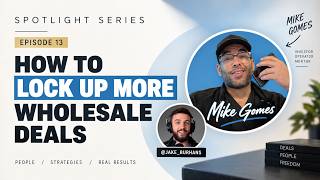
Mike Gomes, a wholesale real-estate veteran, explains how to close more deals by treating every lead like your last one and focusing on the seller's problem rather than price. He credits a structured 8-step sales process, authentic storytelling, obsessive practice, and surrounding yourself with active wholesalers as the keys to success.
Chapters
Welcome, Spotlight!
What's up, bro?
What's up?
I said that intro song turns up, dude.
It does, it does.
Welcome. Vibe to it.
Go ahead, bro. He's used to hosting his own podcast. He's trying to introduce himself on my thing. Um, podcast, uh, Spotlight Series number 13. He got me all jumbled now. Mike Gomes. Mike Gomes has been, man, I can't say enough good things about Mike Gomes. We initially connected through Sub2, I think. He was the first person that ever turned me on to even needing a sales process in wholesale. Absolutely changed our business from that front. He's just been a great friend and what we call an accomplished peer, a few steps ahead of me, crushing it, but not so far ahead that can't relate with me. He's been great mentor in that, in that sense. But I appreciate you, man. How you doing?
Doing good, bro. Doing good, man. Yeah, you got me excited, man. You got me in here like dancing and stuff before the, the pod, you know what I'm saying?
You gotta count it down a little bit.
That's like the legendary countdown, and every single time that thing goes, I gotta, I gotta give a little—
you know, they had it on, um, Wholesale Hotline for the longest time. They did that every time. Uh-huh, because I use it, man.
But anyways, yeah, StreamYard's great. So yeah, bro, um, thanks for having me here, dog. It's been a while.
Has been a while. I had you on before, uh, just on my YouTube before we talked about some sales stuff, but now I'm doing the Spotlight Series thing, so I was like, I haven't had anyone talk about sales, so I definitely got to have someone come in specifically talk about, you know, direct-to-seller sales. So I'm going to get right into it here. What would you say is the biggest part of the sales process that people who struggle to close deals miss?
The biggest part of the sales process that people miss, um, people miss that— here's where people miss. They don't treat every single lead like it is their last lead. That's where people miss. I'm, I'm a big fan of sales processes, right? Like, you know, you've came into Blueprint, you see the 8-step sales process. It's great, it's a framework, it, you know, gives you a lot of clarity, it helps out so that there's no gray areas in your calls. Like, it really gives you a framework. You actually, once you learn it, you go back and pull back the curtains and all your leads, and you're like, wait, what the heck, that's where this lead's supposed to be. That's how I'm supposed to be following up with this lead. That's when that lead is probably going to close. That's the information that I'm missing from the lead. Like, a sales process is great. However, without the energy, without the drive to, you know, get a deal done now, what's the sales process? It doesn't matter. You see what I mean? So like, if, if you bring the energy to the table, like, hey, I want to get a deal done right now. Now granted, we know maybe 9 out of 10 of the people that we end up talking to are follow-ups for specific reasons. Maybe they're You know, you got to wait on a total payoff, or maybe you got to— whatever, whatever they need to do in order to push the ball forward, right? You're setting up the follow-up for that next call. But it's that energy. It's treating every single lead like it is your absolutely last lead. Here, here's what I think. Even when I get a, a lead sent to me from a wholesaler that needs me to call their seller on a, on a Zoom or something like that, and they're like, hey Mike, you know, this guy's being tough. He says he wants retail price, and I don't even hear all that. I really don't. Like, like, all I heard was, hey, I have a guy interested in selling my property, and that is a gold nugget. I'm like, oh, I have a gold nugget here. I don't care about everything else. I don't care about, you know, they're, they're wanting retail, or, you know, their agent is about to list it. But I, I really do not care. I have somebody who is motivated to sell their property, and that's a golden nugget. So I'm just going to treat it like I am about to make $50,000 on the deal. So that's what I think a lot of people are missing. A lot of people are missing the, the drive to just make the deal happen, like, uh, in any and every way.
1,000%. That is one of the toughest things, especially when that lead comes into the CRM and you can see notes about it and you start cherry-picking. This one looks more motivated than that one. And if you have a surplus of leads, it's hard to do that because you have so many things in there. Like, I gotta rush on this one so I can get on to the next one. I think, what role do you think seller education— because I'm the same way, I hear price, I'm like, whatever, right? What role do you think seller education plays in that? And also, what role does, you know, just your relationship with the seller play in the price that they're asking?
Dude, I don't care about price at all. It doesn't matter. At the end of the day, it's the, it's the problem that is being solved. That's what matters. So the seller education can come with, hey, this is what your property is worth all fixed up. This is what would have to be put into it in order to get it to that number, right? There's a, there's a time for that. That's later on in the sales process where you're digging into, you know, helping the person solve their problem and everything like that. But the golden nugget is in the problem. The golden nugget is in this person is motivated to sell the property for some sort of reason, and all I got to do is get that reason and give the best advice possible to help them push that thing over to the table— push that thing over to the closing table, right? Whether that means referring them to an agent because simply a cash offer does not make sense for them, or that means buying their house for cash, right? Like, whatever that means. If I can get into the weeds of why this person is looking to sell their property and I can give them the best viable solution to do that, then I'm the guy. And if I could do that by doing two things, I always say it's cool, like one of the best things to, you know, one of the easiest ways to get a deal with somebody is through making a friend with them. That's true. But people do business with friends and people that feel that they can get the deal done, that are credible, that are confident, that are clear, that instills certainty. So it's like bringing those two things to the table. So here's my cheat code. My cheat code is making a friend as soon as possible so that the questions that I ask are much easier to ask. And all while doing that, I'm instilling certainty the whole entire time. I'm making sure that I'm planting little seeds of credibility here and there by telling stories. I'm making sure that through my, um, inflections in my tone, that I'm very clear and precise, and the person knows like, hey, this is the guy that I want to go with. And by the end of the day, when I hang up the phone, that person needs to feel like, yo, if I don't answer this guy's callback, or if I don't end up signing a deal with this guy, I might lose out on an opportunity. Or if I don't go with the advice that he gave me by maybe, you know, contacting the agent referral that he gave me or receiving the phone call from that agent referral, I might be missing an opportunity. So that's, that's the goal once the, once the call has ended.
Love it. So basically what you're saying is that it doesn't matter about the price if they have a motivation to sell, because if you can get on the phone with them, understand why they're selling it, and essentially come up with the solution to their problem. It becomes less about the price and more about you solving that problem. And hey, this is just the price we need to be at to get this problem solved for you, right? And maybe it's not an offer that you have, maybe it's an agent referral or whatnot. Um, but that's essentially kind of what you're saying there.
Yeah, I'm saying if you have somebody who is motivated to sell their property for any reason and they are looking to you for, for like advice on maybe buying their house directly, like you buying it directly from them, or maybe an agent referral or something like that, and you don't accomplish that exactly, then that's your fault. Now, that doesn't necessarily mean that right when you hop on the phone with a seller, that has to be the case. There's a timeline for every single seller. Right here is when they are looking to— when they are not looking to sell, maybe when they just bought the house. And right here is when they are looking to sell. You're going to catch them at some point of the timeline, but during this timeline If at any point they have looked to you as a person who can hold their hand to the closing table, whichever way that means, if they look to you at any point during that timeline and you do not convert that into some sort of deal, then that is your fault.
Absolutely, absolutely. And just to rewind, you had mentioned you tell stories to build credibility. What do you mean by that?
Um, this is— I, I do this already naturally, like when I'm just having a natural conversation anyway. I like telling stories. So if me and Jake are just kind of hanging out and I'm trying to explain something to him or I'm relating to him in some sort of way, I might explain a story of how I went through that same thing before. Me and Jake have had like hundreds of conversations probably at this point, and there's been points in Jake's business where He was going through something very similar that I went through in a previous season, maybe like a year or two ago, and I was explaining to him a story of how I got out of it and what happened and all that type of stuff. So Jake, as you might be looking to me for guidance, I tell you a legitimate story that legitimately happened. You can like picture it in your brain. Like, think about this, you were— when I'm telling you the story, you're literally envisioning this, this happening to me. Let's think of an example. I've told you before, right? Um, there was a season that you were going through where you're like, hey, you know, my business has been doing really well, I'm looking to figure out where I want to deploy the capital in my business. And I explained to you the season— the seasons that I've been in where I've been in the same boat as you, and I actually made the wrong decisions, right? And I, and I put the money in— I put the money and time into a place where I shouldn't have. Which didn't result into good results. And, and when I told you that story, you were thinking about it. You were literally— you probably thought in your brain, you saw me going through that season, and you were like, wow, that makes so much sense. And I can imagine that— and I don't know, we actually haven't had a follow-up conversation about this, but I can imagine just hearing that story resonated to a point and might have influenced you to make a decision. So it's the same thing while we're on the phone with the seller. It's like, hey, I just went through that. And, and the thing is, like, um, you have to do this in a way that's authentic to you. So I freak— I really can't stand when people just take other people's one-liners and all that type of stuff. Not, not because they're stealing— I don't care about that. I, I care about the authenticity of it because I'm like, dude, the seller feels you not being authentic to you through the phone. You see what I'm saying? Like, they, they can feel that. They can feel that it's some sort of BS story or a story that you just, um, that you just memorized in your head or something like that. No, just, just be yourself, bro. Like, that's it. Just be yourself and tell, tell stories from, you know, your experience that you've had. Or maybe you heard a story that I said before that I went through. Hey, my partner just went through that. It's just a story is going to help them envision what is really going on. And what that does, it doesn't, it doesn't only, uh, help them picture their problem getting solved, but it also helps them picture you solving their problem. Because now you're like, now they're like, oh wait, like, this guy has been through this before. I could see him solving their problem. That means I could see him solving my problem. And subconsciously, they already put that in the back of their minds, like, oh yeah, I'm able to I'm able to go with this guy, I should go with him.
Yeah, that makes a ton of sense. So stories do two things. One, I think just as human beings, we naturally are able to understand stories better. So if you use an analogy, I'll be able to understand what the point you're trying to convey. And secondly, it's a credibility thing because you can say, hey, you know, I dealt with a seller in your exact situation, Susan, blah blah blah blah blah. I'm like, oh wow, okay, so he's familiar with this. I feel confident that Mike can now do this transaction because he has dealt with it before with Susan. And I understand what he's pitching. So what we call third-party stories, right? Which obviously what you're alluding to there can be used in so many different ways. It can be used for pitching different things. If you're going to pitch a novation or a subject to or seller finance, you can use third-party stories of how this worked with other sellers and let the seller— one thing you taught me too is let the seller come to the conclusion on their own that, hey, this is a good fit for me rather than you trying to tell them like, hey, this is what you need, you know. Um, so I think that's, that's super important.
Yeah, 100%. And when it comes off authentic, that's when it really hits. Now I say that all with saying you have to start somewhere. So if you're in the beginning of your sales career and like you never even heard of telling stories during your sales processes or telling stories to influence people, start somewhere. If you got to take somebody's story and run with it, freaking take somebody's story and run with Like, do what you got to do to start getting some, um, to gain some momentum. And sometimes you got to put yourself in the fire, get told no, you get people that scream at you, do all the things, and that's how you learn. But you got to go out and get the thing done. So I, I always— a lot of the advice that I give, um, will also come with saying it doesn't have to be perfect. It's never going to be perfect. But you don't have to be the freaking— the elite closer when you're first starting out, and know that you're most likely not going to be. And you got to go through the fire, go through the things, intentionally work on the things that you are working on on a day-to-day basis, and intentionally work on getting better at those things by recording yourself and listening to your recordings. Um, literally physically record yourself while you're making calls, while you're on a Zoom, while you're doing whatever. Look at your facial expressions, look at everything, and intentionally work on that over time. And I promise, over a course of a year, if you do that, you'll come out a whole different person. Not only in your sales career, but just in your life. Because life, life to me, if you have a pulse, you are in sales, in my opinion.
I agree. I think the same thing. I think sales boiled down is you're really just getting someone to make a decision. You know, you're fact-finding, understanding their situation, figuring out what solution solves their problem. Then you've got to get them to make a decision on, on that route, you know. So in your day-to-day life, you're doing that all the time. Obviously, wives, spouses, partners, friends, always, always doing the sales thing. Um, so you talked about getting better at sales. You can listen to your calls. What are some other things you can do to really hone in? If I want to take the next, you know, 6 to 8 months to, uh to really hone in on my sales skills.
I'm going to tell you a story really quick. Um, when I first started my wholesaling business about 4.5, 5 years ago, I went about 7 months before I got my first deal, and I almost pretty much lost it all. I almost lost all my marketing dollars, just threw everything in the trash and said, screw real estate, I'm never going back. Everything on YouTube that I learned is fake. I'm never doing this again until I saw one of Pace Morby's ads about 6 months into me doing that, and I hopped into his mentorship. It's like when he first started out. I actually just put this on my Instagram the other day. I hop on a call with Pace like right when I get into his mentorship, and I'm explaining to him my business and what's going on and stuff, and he's, he's like pretty much scratching his head like, bro, you have like over 100 leads coming into your pipeline. Per month? Like, you're not closing deals? What the heck? I'm like, yeah, dog. He's like, bro, you gotta, you gotta, you know, convert. It's the conversion that's the problem. And I didn't even know what the heck that meant up to this. This is why I'm so passionate about it, because I truly did not know that there was a thing called conversion just in business in general. I thought It was you go out, you spend money on leads, the leads come into the door, you might have a conversation with them. Somebody's motivated to sell their property, or somebody's motivated to get their house painted, or somebody's motivated to get their lawn mowed, and simply that person books an appointment and you make money. That's really— I thought, I thought that, like, truly I thought it was that simple.
That would be wonderful if that happened.
If that would be wonderful, everybody would be doing it. And when Pace told me that, nah bro, like, conversion is the problem. Conversion is what makes you the most money. He actually told me this. He told me, Mike, what you should go do, since you have right now probably hundreds of leads in your pipeline, you need to go bring these leads to somebody who knows what the heck they're doing. Like somebody that's a certified closer that can close deals. Now, because Um, I have a hard head and I'm like, uh, nope, not doing that. In the beginning I was like, nah, not doing that. I'm just gonna go learn this on my own, bro. Which I'm pretty, uh, thankful that I did that because it kind of pushed me into purpose and it forced me to go do the hard things. So instead of me squatting up with somebody and giving all the leads to them, I'm like, nah, bro, I'm just gonna— I'm gonna learn this thing on my own. If I run into situations that I absolutely cannot fix, then I'll throw it over to another closer or something like that. But I'm taking the leads that are in my pipeline I'm calling every single one until I get nasty at sales, until I'm a beast. So I took the next 6 months of my life and did everything sales. Like, I was listening to, um, Pace's calls every single day, like seller calls. I was listening to people's seller calls on YouTube. Everything that I was listening to on a day-to-day basis had to do with sales, and I just got super obsessed, right? It was um, other people's calls. It was sales books. It was, um, sales trainings that I paid for. It was, it was all these different things, like anything that was teaching me sales that I resonated with. Because there was a lot of things that I would listen to back then, and I'd be like, I don't know about that guy, uh, or I don't know about that advice. I'm good. I'm gonna stay away from that. I stayed away from it, and I tripled down on the things that I was comfortable with that resonated with me. And ultimately, 6 months later, I came out a whole new person. And within 3 weeks of me doing that, I end up with my first deal. And ever since then, wholesaling has been the thing that has been feeding me. It's been the thing that has provided for me for the past 4 and a half years. So, um, that's why I'm so passionate of, you know, letting people know, dude, there's, there's gold in understanding conversion. And all conversion is, bro, is just learning how to effectively communicate with somebody. That's all that was like in my pipeline. There was thousands of dollars, but I just needed to learn how to communicate so I can grab that thousand— that those thousands of dollars out of my CRM. You see what I mean? But to answer your question, in order for people to get better, bro, it's just getting absolutely obsessed with it. Um, and that's, that's not easy to teach. That's not— actually, I don't even think that that's something that you teach. But people have to have the revelation, and people have to realize that so that they can go get obsessed with it. Because how are you obsessed with something? How, how are you so driven to get better at something if you don't even know that it's a thing? And I, and I really do not think the majority of people that are wholesaling and marketing and generating leads, I really do not think they understand how much power they have access to if they just learned how to effectively communicate.
Never worry about money again in your life. I mean, developing those sales skills, it's like, you know, and I, I made a note about it and I was like journaling, journaling the other day, but I was just like, You know, I think financial freedom— maybe I made a post about this, I don't know where I put it— but financial freedom in my mind is not any amount of money in the bank. It's not any amount of passive income. It's the confidence in your skill set that you could make money whenever you want, right? Say I need to go make money. I know with absolute certainty that if I was on the phones all day long for a week, I could lock up a deal, right? Just, just put property addresses and phone numbers in front of me and people who've raised their hand saying I want to sell And that's true financial freedom, because who cares if you have, you know, $100,000 in the bank if you're just— you're so concerned, you don't know if you'll ever be able to make it back, what happens if you lose it, all these things. But when you have confidence in your skill set, um, whether that's sales or any other income-earning ability, that you can go make money, that's what gives you the most confidence ever, you know, not only to close the deal but just in life and the comfort and all those things. So I think going out and developing that skill set, it takes a lot of courage. It takes courage because really the only way to get better is to put in the reps. That's it. You just got to go talk to 1,000 sellers, and I guarantee on the 1,000th seller you're going to be better than the first seller that you spoke with, right? Um, so do the trainings, do the readings, do all those things, but you need to do those in conjunction with actually doing the reps, you know what I mean? Um, and one thing I'll share real quick— did you see my story the other day about, uh, the 3 different types of salespeople? I think you'll enjoy this. No, let's see, Alex from OZ podcast, and he basically— I thought this was so good. But, uh, obviously you talked about the sales process, right? And that's really important, but it also comes down to the person, right? You got to have the hunger and you got to want to be a salesperson. You got to want to learn and get better. So there's 3 types of salespeople. You have dogs, right? Dogs, you got to feed them or they're going to roll over and die, right? You got to pat their head, rub their belly, or they're just gonna die, right? Then you have horses, right? And horses will be good as long as you're whipping them, as long as you're in there driving them, pushing and pushing and pushing them. They're, they're galloping. But the second you get off their case, they go down to a trot, right? And then you have tigers. Tigers will have just eaten a full meal and they'll see a bunny walk across their line of vision and they'll kill it for sport. And the best salespeople kill for sport. Meaning, say your expectations are to get one contract a week and you lock up two contracts for the week, but you see a lead come across your plate, you're gonna go close it for fun because you love sales and you're a killer salesperson, right? So I thought that was such a good analogy of the 3 types of salespeople. And you gotta be that tiger, right? You gotta want it. You gotta, no matter how many deals you've closed or how much success you've had, you're out there putting in the reps, wanting to get better. You're not worried about the quality of the lead, right? You're just like, hey, this is a chance for me to improve. Okay, it's a crappy lead, but I either improve or I close the deal and make money. So it's a win-win. Anyways, I thought that was just a phenomenal analogy.
And I'm like, nah, dude, that is, that is gold. And I think what's important for us to realize as leaders of sales floors and sales departments is we are the tigers. And when we're leading sales teams, we are most like, like the majority of the people that we are leading are the horses and the dogs. And they feed off of the tiger's energy. So like, we got to bring the energy to the table on a daily basis. Just is what it is. When you leave, uh, like imagine this, you leave for a 2-week vacation. I guarantee if you didn't hop in a meeting with your team at all, if you didn't have a conversation with none of your sales leaders or anything like that, I guarantee that the culture would be different from the day that you left to the day that you got back. It would. You, you would, you would come back 2 weeks later and you'd be like, yo, what the heck is going on here? Then all of a sudden you get back into the motions with things, and then, you know, 2 days into Jake being back in the office, like, getting the salespeople riled up, is back to the same culture that you had when you left. Bro, it is so important for us as leaders to bring that energy to the table because our teams feed off of that. And that's why sales is freaking tiring. If it— like, consistency. That's why, dude, I don't plan on leading sales teams my whole entire dang life. That is freaking tiring, bro. Like, you gotta be on it. Like, you gotta bring the energy to the table. I always plan on bringing the energy to the table wherever I go, but like, dude, it's a different vibe. You gotta be pushing and making it happen. And then here's what happens: you get the tigers that come onto your team, great. They start eating, eating stuff, like freaking, uh, making things happen, and they leave because that's what they're— that's what they do. That's what they're supposed to do, and that's completely fine. So you gotta keep that energy going, but just know—
or they go to sales manager and that's your exit.
But even then, bro, unless you set them up correctly with, you know, being a partner or something like that. Dude, a tiger is always going to be the— put it this way, um, let's not even call it a tiger, let's call it a freaking lion. The lion's goals are to be the king. Why? How are you gonna be the king if, if you ain't the top dog?
No, it's true. That's what I mean. Leaders lead by example, right? People respect you because you're in there doing the thing and they see that you have the capability to do it. That's why they follow you. Like, if you look back at like tribes and all those things, even back in wartime, the leader of the army or whatever is usually like the strongest guy, you know. He's— or the leader of the pack, the lion, he's the strongest one. No one can take him down, so he's just the leader.
And then a gangster comes over and, and wants to take over, and if they can't defeat them, then they'll go create their own tribe.
100%. If you defeat him, the leader—
but dude, I imagine that's completely fine. And you will find people that are the dogs and the horses and stuff like that, that, that will stay with you long term. And you need those people, and you need to keep on feeding those people the energy. And when you have a Tiger that comes onto your team, still feed them the energy and just know upfront that they are going to leave at some point. And it's like a revolving door. That's what sales is. You got to keep these people coming, coming through the door, and at the same time keep the, the energy coming through.
Yeah, it's a lot of energy required for sure. Like, it's— I mean, you just gotta, you gotta do it. That's just what it means to be the, be the leader though, you know. I always thought managing was like, you know, yeah, we'll be the leader, you know, put people in their position, they're just gonna slam deals, I'll just go, you know, for a walk, come back into the day. Sounds good.
I'm gonna tell y'all, that ain't it. You want to— you want somebody to tell you the truth? That ain't it. You want somebody to tell you like what is really— what it— what it's really going to take to make that $100,000 a month wholesale business is not sitting on a beach hanging out while your team's working. You're going to be working. Yeah, I think that's great.
One last question I did want to ask too before we— like to keep them short. I like to give people a little taste, you know, and if they want more, they can go check you out.
I like that because I can—
Mike's got his whole Blueprint REI thing, which I joined a while back. Phenomenal. Can't recommend it enough. Now talk about that a little bit real quick though, the Blueprint, because you now have— you have sales training, but you also have just like a monthly community, which is super underpriced, um, but they can get access like a Discord and things like that and Right, or fill me out.
Yeah, they can go to joinbp, as in Blueprint, joinbprei.com, uh, to go learn more about that. They could book a call and we'll get you in there. But pretty much it's an A to Z wholesaling mentorship, um, where we're holding your hand through the whole entire process. You get all the modules you need to learn wholesale, all that type of stuff. And I would say If I was you, I would connect with Jake and what he's got going on because he is really hand-holding people as well. So, um, if you have been watching Jake's stuff for a while at this point and you guys have not been— that you guys been like, ah, not really going to pull the trigger on anything that, you know, Jake's had going on, whether it's doing deals with him or whatever, trust Jake. He's been a leader of our community since pretty much day one. And, um, he's gonna take care of you.
I appreciate that. Yeah, you know, we're both out here to help people for sure. Um, but I mean, at the end of the day, like, you are not serious unless you got skin in the game. Unless you pay for mentorship, my opinion, you're not serious. You're not serious. You just want to do it on the side. You want to be a hobby. You don't want to be a professional real thing. Because the true top dogs, they pay for mentorship because they understand the value of time and they want to shortcut their thing. And I don't even have anything to sell you, but but I'm just saying, that's just the facts of, of everything. No, anyways, two things I wanted to touch on real quick. One, would you say the biggest misconception with sales in general is that we're slimy, uh, salespeople that just are looking to get over on people?
And I'm not saying that there aren't those people, there are people that are very manipulative. Um, here's what I would say, Jake. I say the— these, these three things. For somebody to be a freaking elite salesperson, in my opinion, it takes: one, never taking no for an answer, that type of energy, like, I'm gonna do whatever it takes to make this thing happen, okay? Two, doing this with great positive optimistic energy. And 3, doing 1 and 2 while keeping your integrity. So I think salespeople that do this at a high level, a lot of them are good at number 1, and some of them bring number 2 as well, but they lack number 3. Or people will come in and they'll have a lot of integrity, but they just don't bring the energy to the table. And maybe they're super optimistic, but they're not— they're not like— they're not like— they're not bringing that tiger energy, like, I'm doing whatever it takes in order to get this thing done. My thoughts are, why can't we just be all three? Why can't we bring all the energy to the table that is like, hey, I'm getting this deal done no matter what, I am your guy. All with the best energy as possible and keeping my integrity. Meaning I'm not telling little white lies, I'm not manipulating people, I'm not taking advantage of somebody's situation— in situation that they're in because they're about to get foreclosed on. No, like, I'm gonna do this business with integrity and I'm gonna make sure that we get a dang deal done and I'm gonna be optimistic and positive as hell while I do it. So I think the misconception is, um, a lot of salespeople lack one, or if not more than one, of these three. And then especially the first thing that I said, like the slimy, grimy salespeople— it's not that they're really bad people, right? Like the people that are very fast talkers. Like you go to a car lot, all of a sudden you walk off the car lot with a car that you really didn't want in the first place, but the guy really talked fast and he sweet talks you into getting the— get in the car. Like, dude, that dude isn't a bad person. He's just doing his job. And you might have buyer's remorse after that and be like, dang, I really— that— I didn't have the great— the greatest experience after the fact. Like, I, I really feel like I shouldn't have bought that car. Um, it's not that that salesperson was a bad person, in my opinion. He just might not even understand that you can do this business with doing— while keeping your integrity, doing it with positive energy and not taking no for an answer. So I think that's huge. People think that you have to— that you can't do all three at the same time, and I think that you can.
Yeah. And just for people who have that moral compass too, you know, it makes you feel better about just sleeping at night when you just know you, you're genuine. For me, it's like just being genuine. If I just get on the phone, be genuine, have a good conversation, that I don't feel weird, right? When I get too scripted or I get too this or that, it just feels disingenuous. But I think that's why it's important to have a sales structure, right? You have a sales script, but it's really just a structure like, hey, make sure you get this information, make sure you understand these things. You can go about it how you may, but that's phenomenal. Absolutely phenomenal. Where can people find more about you? What platforms are you most active on?
You can hit me up in the DMs, bro.
Right there.
On Instagram, that's the best way to reach out to me. I answer a lot via voice messages and stuff like that. So if you have any questions, feel free to reach out to me there.
I always forget to do that. I should be doing that every time. Jake_Burhans as my name, but I just—
Oh yeah.
Smart. Last question. What is the number one action item someone needs to take if they've never had any sales experience or sales training? And they're looking to get into wholesale real estate. So number one action step they need to take in order to get better at sales, they need to go find the people that are doing the thing.
And that could mean, um, one of two things or a combination of both. Either hire a mentor and get into that mentor's community where people are doing sales training live, they're doing role plays, they're doing live seller calls, they're doing all these things. There's a training there, all that stuff, that environment. Is going to get you going, um, and finding people that are, that are actively doing the thing that you were doing that you can go hang out with. So for me, in the beginning, I was doing the second thing that I just said. I was hanging out with people that were doing the business, but I was hanging out with like fix and flippers, people that weren't talking to sellers, people that weren't marketing, people that weren't doing the sales things. And I was learning real estate, I was learning flips, I was learning scope of works and all that type of stuff. I just was not learning wholesale. And that, that wholesale, um, that wholesale virus was not rubbing off on me because I wasn't around those people.
Yeah, those people aren't getting their teeth kicked in on the phone, right? Exactly.
It's completely different. Actually, the opposite. They would be bashing wholesalers as I was sitting there at their properties, right? Like, so, um, I would say like, get, get in the right rooms, get with the people that are doing the right things. That back in the beginning of the podcast when I told the story about the 7 months of me doing no deals in the beginning, I was not hanging out with the right people at all. I wasn't surrounding myself with— I literally, I was pretty much just surrounding myself with those people that were fixing and flipping and nobody else. I wasn't, I wasn't surrounding myself with anybody that was generating leads and closing deals. So surround yourself with the people that are actually doing the thing and get a mentor to pull back the curtains in your personal, like, like your personal business so that there can be direct, um, direct direction on where to go.
100%. 100%. Yeah, you got to be around the right people to push you because it's just, it's too difficult. It's too difficult to be an entrepreneur and do it on your own. You'll just on an island. You won't, won't last. At least I would never have lasted. But anyways, Mike, I appreciate you. Uh, until next time, I'm sure I'll have you back on at some time.
Peace, guys. Peace out, gang.










