Lessons in Leadership with James Lascara (SS #11)
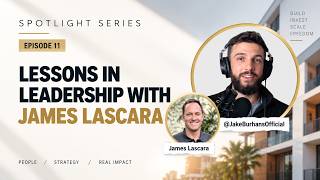
In Spotlight Series #11, host Jake Burhans interviews James Oskar, a former Navy officer turned real‑estate investor and founder of the Elite Investor Mastermind in Tampa. The conversation explores common misconceptions about leadership, emphasizing that leadership is a learnable skill rather than an innate trait. James discusses the importance of decision fatigue and how minimizing trivial choices (e.g., uniform clothing, meal prep) preserves mental energy for strategic problem‑solving. He outlines how different personality types require tailored motivational approaches and shares his own evolution from military leadership to real‑estate team management. Core leadership principles he highlights include leading by example, clear communication of expectations, and personal accountability. The dialogue also delves into the creation and growth of his investor mastermind, focusing on value exchange, social capital, and the role of disciplined self‑leadership. The interview concludes with James’s top actionable advice for aspiring leaders: develop personal discipline as the foundation for leading oneself and others.
Chapters
Welcome, Spotlight Series number 11. Very excited to have James Lascara on. Today. We're going to talk about some leadership. I first met James— I don't even know how I met, how I met you, but I think I had heard about you because you just have built such a big brand down here. Like, hey, you got to check out James's meetup in Hyde Park, it is the best one around. And I checked it out and it was indeed, uh, most people there. So most quality connections as well.
I appreciate that.
You're doing this—
I appreciate, I appreciate that.
Yeah, yeah. How you doing?
Good, good. Can you hear me all right?
I can hear you. All right, good. Good to go. Um, so yeah, just getting, getting right into it here. I like to kind of start off with a hot question, but what would you say is the biggest misconception that people have about leadership?
Um, okay, man, that's, that's a really good question. And I think, uh, for me, a lot of things— a lot of people think that leaders are just naturally, naturally occurring. They're born that way and they've always had those traits and that's just part of their personality. But, uh, I am very much a subscriber to the belief that leaders can be made, and leadership is something that you can practice on, you can improve. It's a set of skills that you can train to become better. I think that's a really big misconception. And then I think there's some truths that are not often talked about in leadership. And ultimately, those truths always point back to the fact that it's not easy. Leadership is not easy. Being a good leader won't feel sometimes like you're being a good leader. So I think those are common misconceptions with leadership.
Yeah, I would agree. Feeling like you're not a leader, you need to be born into it. I also feel like people put leadership on a pedestal. Like, you need to have a certain, a certain size business, you need to be in a certain position to consider yourself a leader.
Okay, right. So are you a leader because you accomplished a result, right? So were you a leader which then, um, well, sorry, let me go in the reverse order. Did you start to accomplish a result, and because of that result, that's evidence that you are a leader? Or did you start before and you are a leader and you were the kind of person that produced a process, produced a team, uh, led the team to a result, right? Two different ways of thinking about it, and, and it can go both ways for some people. But I think, you know, I always go back to like, these are trainable skills. I can, I can iterate on these skills. I can mess up with a, with an employee and, um, maybe in a moment of passion, like say something I don't mean, and then I can iterate that on, improve, and be better for the future, right? So these are all things that, that can be grown over time. It's not like some one day people just snap and they get it. Like, these are all things that can—
yeah, yeah, yeah. It's a process, just like anything. It's a journey. Yeah, interesting point you make. It's, it's to get to a desired result. Like, that is a point. Like, you are leading someone to get to a result. I guess I've never heard it laid out that way before.
Yeah, like if you have a goal in your company, let's say, um, throw any number, like, so if we raise $5 million in our capital business this year, that could be a result for the year that we might aim to achieve. Well, in order to achieve that, I need to make sure I'm implementing the right empowerment approach for my team so that we, we have the structure to get there.
Yeah. I agree. I think the big thing too is you're leading them to a certain result, and I feel like a lot of leadership is making decisions. That's what it is. People don't like to make decisions, so you're there to help, help guide them and push them in that direction, um, especially when there's forks in the road. So I do this, do I do that? You're kind of there.
Yeah. You ever heard of decision fatigue?
No.
Decision fatigue is a, is a real thing. So like Um, I'll give you, I'll give you a couple tidbits of my opinion on this. I wear basically the same thing every day. I love it. Like, for me, I don't— it's— I don't have to decide. Like, it's already done. I just go whatever color shirt that day, whatever pants I have, like, of this certain type of pant that I always get. I just— it's already done. I get meal prep and I just like get whatever's out of the fridge. It doesn't— it, you know, whatever. Like, eating stuff, people are super into that, but That allows me, and everybody's a little different, I'm not saying you have to be my way, but that allows me to focus all of my attention and energy that day on solving problems and leading my team versus if you have all of these decisions that you have to make, even little ones, it adds up and it leads to you getting decision fatigue.
So I try to avoid that. I have decision fatigue every day about 4:00 PM. I'm done. I can't even, someone texts me something, I'm just like, I got to respond tomorrow. I can't even think about it right now, even if it's a very simple thing. Uh, so that's why really I like 6 AM when I start working, you know, like 2 or 3 PM, that's like my most, uh, beneficial hours for me to like make decisions and do things because later in the afternoon, evening, I'm just like toast, you know. Yeah, real thing. Yeah, yeah. Um, but okay, great. So, and then what is your business right now, I guess? What does that look like? And you have a few different things going on. Um, Realty New Development. What does that oversight look like? Because I know you're talking about leadership, but I guess what are you kind of leading right now? Yep.
So I have different teams. So I have like, I have a team that when I say like my team, uh, my team is 3 full-time employees, um, and they work across the different— they work, I guess, across the enterprise, we could say. And so what that looks like is we have an urban infill development business in Tampa We have, uh, like a rental portfolio in Tampa. We have equity allocation across the country in larger commercial, usually multifamily, but some other commercial syndications. And then we have, uh, we have like the, the transaction side, like residential, mostly residential, some commercial, uh, the brokerage stuff. And I'm not a broker, I just have a team of agents that I also lead and mentor who Some of who you also know.
Yeah. Yeah. That makes sense. You got the new development, raising money for some deals, and then the brokerage. Have you seen, what have you seen in terms of leadership styles? Like, do you have to cater to different personalities or do you see like a common 2 or 3 avatar type of people that you have to kind of change your leadership style towards?
Yeah, I think you definitely, for me, like I definitely think you have to be a different type of person. You don't have to change your values or anything, but you have to have a different type of approach in your personality with different kinds of other personalities. So I'll give you a quick example. If somebody is super hard on themselves and they're very intrinsically motivated and they make a mistake, you probably don't need to be hard on that person. They're already hard enough on themselves. And in fact, what I just described is probably the ideal fit for my company culture. Like they already, you know, everyone messes up. It happens. I make mistakes, they make mistakes, but I don't need to bash them over the head with their mistake. We can have a conversation about it. We can make sure we put mechanisms in place that doesn't happen again. But you're not gonna have to like convey the significance of that in a manner that makes them feel a little bit dejected, I guess. Versus a person who, um, you know, sometimes they need a, they need a kick in the ass a little bit, right? They need a spark. Those are two different kinds of people. So you don't want to give a spark to somebody who's consistently a high performer and putting a lot of strain on themselves because, um, you risk burnout, and that might be your, that might be your top person. So I definitely think there are different approaches, and it comes down to, um, time with your people to understand who they are and what makes them tick.
Yeah, that is phenomenal. So understanding their motivators, there's certain things you need to understand so you can understand how to effectively manage them and motivate them. Like you said, someone who's already very hard on themselves, you know they know they messed up, so there's no need for you to come in guns blazing and just, you know, put them in the dirt, necessarily, essentially. All right, you got to be a little bit lighter and you recognize it, but maybe, um, you're, you're pointing in the next direction. Hey, let's move on, let's focus on the next thing, we'll learn from this, we'll make make the same mistake again. Versus someone who's maybe a little bit more on their high horse, you're not going to come in and be the same way. You got to kind of knock them down a little bit. Yeah, knock them down, but you got to just, you know, give them some tough love. Yeah, yeah, that is so good. So how did you, uh, I guess get to where you are now in, in real estate? I had a lot of, a lot of life experience before this. What are some things that I guess you've taken away from your previous um, life experiences that you've instilled into your company and your personal, personal life?
Yeah, yeah, absolutely, absolutely. So I went to the Naval Academy for college, uh, graduated there in 2010. I swam in college and, uh, went right into the Navy right after that and, um, spent 14 years in the Navy. I'm in the process of getting out now, and, um, that taught me a lot about leadership. You learned really quick really some really good values from people who you want to emulate. And I probably learned the most from people who were not good leaders and, uh, saw things I was like, I would never do that. So that was a, uh, a really effective real-world application of leadership that, um, that I could take during my time. And I mentioned iterating before, like, I definitely worked on different aspects of my leadership during that time. In 2019, I moved to Tampa through the military, and in the process, I had lived in Virginia. I had a house that I owned there that I sought to rent out. Didn't really do much preparation. It became a train wreck. I, you know, it sat vacant for 3 months, had to go through different property managers, uh, kind of cycle through them, and it was just, it was not a good situation. And, um, I like learning, I like being, I like education and kind of like being informed on things. And I realized that the negative result was the result of poor performance— or sorry, poor preparation. The negative result was the result of poor preparation. And so once I realized that, I started saying, well, what happened? Like, let me do what's necessary to fix the immediate problem. And so I started learning more about just like rentals, like long-term rentals. How do you know what a good deal is? How do you know what a bad deal is? How do you prepare for to risk mitigate. And so, um, once I realized that I, I now had knowledge that could be applied, I started looking in the Tampa market. And then I, I had some money I'd saved up from being in the military. I've always been very financially independent-minded. And so, um, so I started buying rentals. And then like once I did one, I was like, well, how do I improve that process? And I bought another. So I bought 7 rentals in 9 months, um, in that time. And I was like, Wow, this, like, this seems like the way, and, and it is. So, um, that's, that's kind of like my life, life conversion to real estate, uh, story.
Yeah, no, that's good. So getting into it coming out of the, out of the military there, I love how, how you think, right? You seem very process-oriented. Yeah, systems and breaking it down, which is how I think as well. So, uh, that's, that's definitely led to your success as well, just because you have a strategic, organized approach to everything you do. Especially as you're building your businesses and building your teams. Everything is very organized and structured, which, as you know, as you scale things up, is, is absolutely everything. Um, so in terms of, uh, I guess some of those principles you had learned, you know, before you got into real estate, what are some specific things that, that stuck out to you that you, that you've implemented in your business? That you're like, you know, this is a great principle and we generally follow this as a team, as a company, or personally?
Leadership-wise?
Yeah, leadership, or I guess other principles.
Yeah, uh, I mean, the first is you have to be leading by example. If you're expecting other people to work hard with you and for you and you are lazy, but you're expecting them to be driven and, and, um, stay on top of it It's like there's a huge mismatch and people can smell that from a mile away. So the first thing is definitely leading by example. I think the second thing I would say, this took me some time to improve on, is just communication. Like set clear expectation, talk to your team in a manner that helps them feel inspired. Even today, I sometimes get this wrong. I think sometimes I can tend to be too much on the side of being just like a literal robot versus like being very enthusiastic about the work that we're doing. So the way you can communicate with your team in a manner that they understand what's expected of them, but also the long-term vision is understood so they know what they're like working towards, they know that they're an integral part of that. I think those are two, two huge things right there.
Yeah, because, because in general, right, people are motivated by like the big why. Everyone talks about, oh, it's your big why. So when people are coming into a company, they need to understand the company's big why, the vision, because then they don't feel like they're just a cog in the wheel. They feel like they're contributing to this, this bigger vision. It motivates them more than just the paycheck, essentially. Yeah. And then leading by example, obviously, because It's just a classic hypocrite situation. I can respect hypocrite. I tell you to go be in shape and I'm out of shape. You're like, well, you're right. Yeah. So I think that's, that's absolutely huge. And it's interesting point as well, you bring up how you tend— you kind of contend to be more of a robot, very to the point. I think that's stereotypical of a lot of entrepreneurs, very type A, to the point. Do you think it's important to understand your own personality so that you can understand how you can effectively communicate with other personalities? Right? Because someone who's more driver is not going to jive as well as someone who wants to sit there and talk.
Yes. And in fact, I think leadership begins with leading yourself. Like, you got to be able to lead yourself. You have to be able to put yourself through— like, this is, this is pretty, um, this is pretty trite. This is like overused. It's very cliché, but in entrepreneurship, you're going to be hit with a thousand problems every single day, and they're not always going to go your way. It's gonna— and like, consistently, it's gonna feel bad, right? It's gonna feel bad. Um, and so if you can't lead yourself to do things in life— and again, this is my opinion— that take you out of your comfort zone, like things like fitness, or I don't know, just like even going off and like meditating for 5 minutes, or uh, even, even when you don't want to, probably especially when you don't want to. Or, um, waking up early if you know you have a lot to do and you need to stay on top of it. Like, if you can't lead yourself to get through those hardships, like, you're gonna have a really hard time, I think, in business.
Just my opinion. So, so good. I think it was you who— did I mention accountability one time and you were like, no accountability, that's— were we talking about that? I think we might have been.
I don't know.
You, you like, you shouldn't need someone else to hold you accountable. But I think relates to the point that you just said about you need to lead yourself, right? Oh, accountability, I think it is good, but you should be able to hold yourself accountable. It could have been something.
Yes, accountability is good. I think sometimes you do need other people, but also if you're not, if you're not ever going to be accountable to yourself, then, then accountability from other people doesn't matter like at all. Like, you're— in fact, you're gonna lie to them, right? If, if in my— say, in our mastermind group, right? If you have, you have an accountability group. If I had my team of 6 or 7 people in our, in our mastermind group, and I'm like, hey guys, so check it out, so every, every day this week I'm gonna wake up before 5 AM, and I'm not accountable to myself. If I don't do it, I'm just going to tell them that I did, right? I'm not even accountable to myself. But if I'm accountable to myself, I can at least say, hey, I missed the mark, and they say, you know, this— you're not, you're not on the right track. Really silly, silly quick example. But yeah, I think you need to be accountable to yourself first. It doesn't mean being perfect, but you should shoot for that.
Yeah, so leadership 100% starts with accountability, because if you, if you can't even show up, hold yourself accountable to show up, and you're gonna have a tough time leading others, because leading by example is such an important thing.
Yeah, which I think also, um, is important to define the standard with yourself, to find the standard with others, to find the standard in your, in your business. I, um, mostly for newer investors, I encounter this, I would say, pretty consistently. Um, something along the lines of like, well, you know, I haven't really gotten like great results. And I'm like, something simple like What is it you want? Well, I don't know. Like, you're guaranteed you won't get what you want if you have no idea what it is, what that is. It's like, it sounds so simple, but you, you're telling me you want something better than you have and you don't know what it is. Like, you should think about that.
Yeah, to find, to find the standard, to find what you want. I mean, we talk about it in our business all the time, even just defining terms. Which kind of relates to setting expectations. But okay, we need 4 leads. Okay, well, what is a lead? You need to find that so that everyone's on the same page. We want a certain outcome, right? We want to have a good year. Okay, great. What does that mean though? We need to break that down specifically. Um, and it comes back to setting expectations. I think it's the— honestly, also one of the biggest things ever. Whenever someone is doing something that you don't want them to do, more 90% of the time, you the expectation was not clear to the person. And it's a lot of times like Isaiah, my business partner, and I will be talking and XYZ person's not doing it this way, right? I don't know why they're not doing it. And I go, sometimes I go, Isaiah, did we ever even clearly set the expectation that this is what we wanted? And then we review, we said, no, we didn't. It's not in the SOP, it's not here. So we can't get mad at them because we never formally said this is the expectation. We might have said it here and there, but you gotta really set those expectations. Expectations. And then, you know, then if people aren't following the expectations, then it's a matter of, hey, well, did you understand this is the expectation? You did? Great. So why are we off track here, right? And then it's a matter of them either fixing it or, you know, not being a good fit for the position. Yeah, yeah, I agree.
I agree. If you don't— if you don't start with that, you're at a point of deficit from the beginning.
Yeah, absolutely.
I've been there. I've definitely been there. Many more than once, right? That's the last time I had to learn several times.
Yeah. Uh, so EIMG, phenomenal group. I've been in it for a few months, love it.
Yeah, I appreciate it.
Um, you didn't ask me to say this, but I think it's one of the best, uh, masterminds around. And I really— I joined so many things when I first got to Tampa, and I was just like, too much on my calendar. It's like, I need to consolidate. Like, what's the one thing I think I'm gonna have my time best spent in? And it was Um, you're the investor mastermind you created. So talk a little bit about that though, because I mean, you've had to lead that, uh, different type of leadership than you've done before. What kind of lessons and things have you learned from growing that, uh, that group?
Yeah, uh, do you have any questions like specifically, or like why did we start it, or what's, what's the vision for it?
Yeah, so I guess one, why'd you start it, what's the vision for it, um, and How is it leading a bunch of entrepreneurs?
Okay, all right, so first question, why do we start it? I, uh, I, I take education seriously. I think education can like shorten the hardship period, shorten the time, uh, the, the challenge that's— it's gonna be at some level, it's gonna be requisite for growth, but, uh, it can, it can shorten that and make it easier, more efficient for folks. Um, and so I, I started the Elite Investor— this was years ago, like, this was, this was like a free event, a couple people. I started the Elite Investor at the request of a few friends who wanted to learn some of the things I learned. And like, I had taken a lot of time to learn them and, and, um, gone through the wrong steps to realize the right way. And so that blossomed into this Elite Investor as of about 14 months ago that had grown to like consistently over 100 attendees, but sometimes over 200 attendees. Now this year we're at over, you know, even more than that, probably like 300+ each event. But, um, so after each event, what we found is that we were just getting, uh, absolutely like decimated with messages, right? Like, probably not the right word to use, but like absolutely blown up with messages. And so it was stuff like Hey, want to sit down and like understand more about what you're doing and how you're getting these results? Or, um, you know, we, we want to pick your brain. Or, um, is there some kind of resource you can share? And so this went on for several events, and I was like, you know, I actually tried it for a bit. I actually met with people and I was like, I can't be spending my time this way. Like, is, you know, the business is going to suffer because you're basically working for free to help others and That is good, but only— you can only do that for so long. So I was like, well, what if we create— what if we basically create a center of excellence that people can pay to join? And in fact, I want them to pay to join because then I know they're serious and they're going to be invested in their personal growth, they're going to be invested in getting better results for their business and improving all their systems and processes. Um, and then the great thing there is, you know, the other people that are also in the group are serious too. And so, um, we started that October 1st. That, that's really what, uh, October 1st of 2023. So that's really how it all started. An effort, I guess, to summarize that, just like a centralized place where folks that are focused on bettering themselves as an individual and growing their business in real estate investing, um, can get the most value in Tampa. That's, that was the vision. So that's, that's basically what we've created.
Yeah, that's, that's awesome. So it was really a natural progression of, you know, you trying to help people out. There's no way I can get to all these people. The best way for me to do that is going to be to create that center of excellence, excellence, have people buy in. You need some skin in the game, you're not going to take it seriously. And that way, that's the most effective way that I can attend to all these people and give them the value that I want to give them and know that they're actually going to listen and take it and not just waste my time.
Correct. Yeah, I'm a big value exchange guy. When you think about all the different things you do in life, most of it is a value exchange. Um, not everything has to be transactional, I'm not saying that, but most things are a value exchange. And in business, we just happen to measure that value exchange in dollars.
Yeah. Absolutely. I think that's an interesting concept though, the whole value, right? It's not about making money or this or that. It's about— because money is the result of an exchange of value. So if you just lead with value, all that will come. The more value you provide the marketplace, the more money the marketplace—
lead with value. That's literally what I was going to say. Lead with the value and it'll be, it'll be nearly impossible. I won't say impossible, but it'll be nearly impossible for you to not get paid if you lead with value.
Yeah, yeah, yeah. One more quick thing here, we're coming up on time, but, uh, yeah, the whole leading a group of entrepreneurs, a bunch of crazy people, you know. So how, I mean, how has that been? Any differences, uh, between, you know, getting them to take action? Do you find that they're more action-oriented than your kind of employees, or what's one of the differences there?
Every, every in the group's a little bit different, and I know on an intimate like social level. I don't know everyone in the group. Or I think as of today we're between 65 and 70, um, active members. So, um, I don't think I know the people in that group to the intimate social level. I know my employees because I literally am talking to them every day, multiple times a day, versus people in the group I'm talking to them like once a week-ish. Um, but I— it's cool because all these different little opportunities come up like every day in my life. Like, hey, I've got this, I've got this off-market deal in, uh, St. Pete, and I don't do any projects in St. Pete right now. But what's cool is like I'll have this random thing, this happens like almost every day, and then somebody from the group is like, hey, I've been looking for a deal in St. Pete. I'm like, oh hey, like I don't have to be involved, like y'all just do your thing. And, and before it was kind of like you know, how could I, how could I refer this out? Or how could I produce this into like a revenue-generating activity for me? Or what do I— maybe I buy in St. Pete now, I don't know. But now it's like, no, if it's a way— think about it this way, this is, this is kind of funny. So somebody who's obsessed with value exchange, that's me, creates a group predicated on value exchange. Like, might that group be valuable? So I view it as like, that is the one place if I have random things that could be of value to others, I'm gonna put it there first. And like, that's my— the most important focus point for me because that is the group that like we are— we have established and that we are growing. Um, so that's how it's turned out to be really cool, is just like seeing how just like little drops of what otherwise might have just been like a drifting thought or something forgotten, like somebody can actually benefit from. And we've seen people like, oh dude, I, I bought that lead and it turned into whatever, a $10,000 deal. I'm like, that's amazing, I love that.
I think that's a phenomenal concept. And other people in the group can do that as well if they keep that on the radar, right? It's not only, okay, maybe you get a referral fee, but you're building that social capital, you're building a relationship with them because you thought of them when XYZ came up. So not only can you do that with the group, everyone else is in the group, and then people just in any group in general utilize that network, um, to capitalize on these opportunities, right? Maybe you don't even get any money out of it, right? But instead of just letting it go, you pass it on to Jim, and then, you know, you're going to be in the back of Jim's mind next time something comes across, um, his plate that would be of interest to you. So I think that's a huge component too, is I talk about that all the time, this social capital. Not just referral money, but you refer leads to realtors and all these things, they appreciate that you thought of them. That's the social capital. Yeah, yeah, I agree. Awesome. I, I super appreciate you coming on, Jake. This is a great little bit of a, uh, you said, uh, you made a comment, lack of preparation leads to a negative result. Well, the negative result was us starting 15 minutes late.
Oh no, it's okay, it's all good.
Preparation. Um, but, uh, we got it done.
Where can people find you on Instagram? @JPLinvest. That's probably the best place.
Okay, love it. David Ramirez making a comment on Facebook: better to be consistently good. I love that. Great. I love that. That's good.
That's good. I posted something the other day. I was like, uh, the, the less than perfect plan executed with a lot of passion— I think it said actually executed violently, kind of kind of tribute to the military. So a less than perfect plan executed violently is always going to beat out a perfect plan that's executed timidly. So, David, I couldn't agree with you more there.
Phenomenal. Yeah, it's that imperfect action, right? Just falling forward and make it happen. Last question here before we sign off: what would you say is the number one action step someone needs to take today if they have no experience as a leader but want to begin to build that reputation? Probably different for different people, but what would you say generally?
Okay, so if somebody wants to build themselves as a leader, but they—
yeah, they want to start to identify as a leader, what are some, you know, what's the number one action step you say you need to take or you need to get figured out about yourself?
Adopt a disciplined approach for your life, because, okay, discipline is a form of leading yourself, and really is the ultimate form of self-love because you're keeping a promise that you made to yourself for you. So if, if you are starting, you don't like— you— how do I become a leader? How do I even do that? I don't know where to start. And you're undisciplined, find a way to become disciplined.
Love it. Mic drop. James Oskar, folks. Uh, we'll see you next time. Thank you.
All right, thanks. See ya.










