Millionaire Mindset and RV Park Investing with Mindset King Nick Aalerud (SS #8)
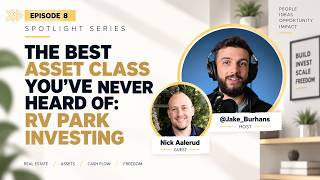
In this Spotlight Series interview, host Jake Burhans talks with real‑estate investor Nick Allerud about the evolution of his relationship with money, the "REI ladder" that moves from survival‑oriented active income to passive cash‑flowing assets and finally to private capital as a weapon. Nick explains how scarcity mindset and fear of money can be reframed through inner work, meditation, and the law of attraction, describing his personal "Reset King" identity forged by multiple financial and personal setbacks, including losing $12 M, divorces, and legal battles. The conversation shifts to the practical side of RV‑park investing: why the multifamily market became saturated, how RV parks offer higher yields, the importance of location attractors (water, tourism, amenities), key due‑diligence items (zoning, waste handling, cap rates), financing challenges (tight LTVs, need for cash or seller financing), and value‑add levers such as amenities, dynamic pricing, and technology. Nick shares actionable mental‑health advice for entrepreneurs – imperfect action, embracing failure, and cultivating patience – and points listeners to his Instagram for more content.
Chapters
Welcome everyone, Spotlight Series number 8. I am very excited to have Nick Allerud on. Nick and I initially met actually through a seller that I had reached out to, um, Mark. He was a seller, he was like a prospect, and he had connected with you. And ultimately we're looking for hosts for a multifamily meetup, and that's how I first got in with Nick. Um, yeah, but we stayed in touch and Nick's been a wealth of knowledge and Um, great mentor for me as well. So excited to have him on. How you doing, Nick?
Oh dude, I'm so— I had no idea that's actually how we met. I was like, some— and it's— I don't know, like, that's cool. I love hearing connections, right?
Such a small world, you know? It's like, it's wild. Is, uh, yeah, because I talked to Mark and we kind of just hit it off, you know? We initially cold called him or something, and he's like, yeah, you know this guy Nick Allerud? He's got this meetup, blah blah blah blah blah. And I was like, you know, it'd be good, good for me, because for one, I was deathly afraid of public speaking for a long time. So like, I gotta do this and I need to, you know get out of my comfort zone.
So isn't that funny? The guy who's afraid of public speaking now calls what, 150 sellers a day? 200?
Yeah, not anymore, but I mean, yeah.
Yep, yep, I love it.
All right, so to get right into it, um, kind of start off hot here. So typically my first question is, what's the biggest misconception about X, whatever the topic is for the day? For you, I wanted to ask, what is the biggest misconception people have about money?
Oh, oh good. I thought we were talking about boring RV parks, but I love this stuff, man. Let's go. The most common misconception people have about money. So I, I mean, you and I know this because I think you're seeing a lot of what we go through, but, uh, we have something what I call the REI ladder, which is what I went through. So at the bottom, at the beginning of going self-employed, or even some people W-2 jobs, right? Like we have a relationship with money where it is survival. We need it to pay the rent, we need it to buy groceries, we need to take care of, you know, our people that we love. And as we move up the ladder, which is really the, the active to passive ladder, right, our relationship with money changes. So at the very bottom, we're learning to trade time for money, like working our butts off, right? Calling sellers or managing rehabs or agency. Wholesaling, rehabbing, and agency are 3 types of active incomes, right? And we move up into the next rung, which is more like providing value, adding value to whether it's forced equity or construction, learning how to manage projects better. And from there, we finally go to the third ladder, which is accumulating cash flowing assets, right? Bringing us more into the passive side. And at the very, very, very top, it is private lending, capital partnerships being a key principle. But it's, you know, what's cool is like, that's the how the relationship with our, with money actually changes as we go up that ladder, right? So at the very bottom, money as survival, which we've all been through. And then as we move up, like money can be considered more of a tool. And then up here, money is like a weapon. I can put some cash behind and buy cash-flowing assets and I get a lot of these bullets back, right? Like shooting a cannonball of cash and then bullets come back every month. And then at the top, you realize that once you start raising private capital and attracting deals and attracting partnerships, money's not even real. It's an energy source. It's just energy. It's not even real. And I think the faster people can get— everyone needs to survive first, but the faster people can kind of get to the place where, "Oh, money's not this big scary thing that maybe we were grown up with, like our parents, like, oh, that's too much money," or "Make sure you budget," or "Make sure you do this." all that's good for like personal finance, but once you realize it's not even real and we just attract with what the energy we put out is, you know, it's— it comes all over the place. One of the best lessons I learned— I'll finish with this— one of the best lessons I learned is when I was, uh, trying to put RV parks under agreement in Florida, and, uh, we worked with a debt broker and he was also an equity broker for us, so he would help us raise some equity once in a while. He never actually did But I asked him like, okay, we got a new one coming up. Purchase price is like $4.8 million. You know, we're looking to raise about like $2 million for it because of all the capex that we have. He's like, oh dude, I, I can't, I can't help you with, with that one. That's, that's way too small. Like, too small? What do you mean? Like, he's like, you need to, you need to have something at least $15 million for us to raise all the equity. It gets so much easier when you start to go higher. Like, whoa. Didn't really occur to me, right? So, uh, but that said, who, like, who do you have to become to get to the place where you can steward, right, $10 or $15 million in other, in other equity? And that becomes the journey, the journey to freedom. Does that answer the question, or is that just a big go-around?
That is phenomenal. So the REI ladder, whatever, whatever you called it, right, in terms of, you know, high level starting with active income, and then, you know, you're investing in assets— then raising money, right? So it's a mindset thing. One of the most difficult things though is how do you have that mindset in the beginning when you don't have a lot of money? Because that was one of the biggest things I struggled with, right? When I had no money and I'm trying to start a wholesale business, how do I come from this place of like, especially in sales, I need to not need the deal. How do I not need the deal when I have freaking $500 in my bank account? You know what I mean? But it's the person who doesn't need it, you know, that ultimately ends up getting the deal. So how do you have this mindset of money where it's like, hey, you know, we're all going to be safe. And I don't know if you tie in, you know, Maslow's hierarchy of needs, like you don't want to be at these bottom levels of like physiological and safety and these mindsets. How do you do that when you don't have any money?
Yeah, you nailed it. So if you're not safe and secure, it's very, very, very difficult unless you've mastered the art, right, of going through, doing some self-work and doing the meditations and doing your morning walks and making yourself say, it's okay, I'm okay, I'm okay, it's all going to be good. Today's going to be an amazing day. Today I'm showing up for me. I'm showing up for the people I care about. What is this? What are the things that I want to do today for me? And with all of that said, I get to work on this business. I get to call these people and impact at least one life today. I get to do all of that. And if I do those things, then I know the universe will provide and the money will come. I do those things and I know I will have enough to survive. So, uh, one of the exercises that I bring through, because scarcity is such a huge problem, right, in, in this society, and it's because of Western society, this is all we care about is the almighty dollar, right? Like, how do I get more of it? How do I keep, keep more of it? How do I— and it's really interesting because I bring people, some of our community members, through their worst fear because so many people are so scared of not making any money. So okay, let's go through it and live it, right? What does it look like for you to run out of money? What does it look like for you to lose your apartment or lose your home? What does it look like for you to not have money for groceries? And we take them through a whole exercise to have them relive their worst fear. And ultimately, people will usually just jump their mind. It jumps to, well, I run out of money and I'm homeless, and therefore I am dead and I'm gone from the planet. That's the worst-case scenario, right? But is that actually the worst case? Are you guys saying that if the worst-case scenario would happen, have you been such an asshole that you don't have anybody else on the planet that would take you in for a home for a while to get back on your feet? Have you been such an asshole and hate people so much that you're not gonna be able to find people that can hook you up with some food while you go through it? The truth of the matter is our worst fears aren't actually the worst fears. It's just stuff that our mind creates in our head, right? And it's our job to tame this beast, this computer that just cycles and cycles and cycles with inputs we've put in it from when we were kids, you know, that we've heard from our parents and our school teachers and our priests and like everything else. All of this is just the computer that just goes round and round and round and round. This is not who we are. So, if we tame the fear, money itself, knowing that it's not even real, knowing that it's just an energy source, and you going out every single day knowing that I'm going to create an impact today, and I know that with my activities, right, with me showing up for me, with me knowing what I have to do today, with me setting my priorities, The money is going to come because I'm becoming the person that money is attracted to, period. And if like a day goes by and it doesn't happen, a day goes by, doesn't happen, we can start to go through that spiral again. Like, oh no, but I just know, no, I'm doing the right things. I am doing the activities that's going to create legacy. It's going to create legacy wealth for me and my family. Therefore, could come today, could come next month. Either way, it's coming. I'm good.
100%. 100%. And I think, you know, you talk about energy and you bring in law of attraction and things like that. I think part of it, whether you're— you are, you know, you believe in those types of things, I think is absolutely real, or not, being open-minded, that is such a key component of everything in real estate. Whether you're shifting your mindset around money or talking about law of attraction, you need to be open-minded as a basis. If you are not open-minded it's going to be so difficult to understand and comprehend these things. So open-mindedness is, is a huge thing. And, and that's such a good point. What's the worst case? What is the worst case? We live in the United States of America. You can so easily go get a barback job, or you could work it literally anywhere. You could get a job so easily where you don't need an education because we live in the United States. So worst case, what's the worst case scenario? Okay, I go bartend, right? And for me, it was always like, it was almost like humiliation. Like, oh, what are people gonna think of me? That was the biggest thing. What are people gonna think of me if I have no money and I have to go work a barback job, or I have to be a bartender? I graduated college and now I'm being a bartender. What are people gonna think of me? Think of me? Think of me? Who cares what people think of me? Because like, personally, when I think about like who matters, you know, my family and all them, they're all supportive of me. So, and if they're my closest friends, they're not gonna give me a hard time anyway. So It's interesting. What is the worst case? Nothing, really. You know, Grant Cardone, I was at the Squad Up Summit and he came and he spoke and he's like, listen, man, he's talking about people have these kind of like these funds, you know, 6 months of expenses so they can feel good. It's like, listen, man, if shit happens, go pick up shit, right? You gotta get out there and you gotta take a little bit of risk at the end of the day. Life is risk, you know, and you could argue there's more risk in not doing the things, But overall, I think that's just phenomenal with being open-minded, then also, what's the worst case? It's really not that bad.
It's really not that bad. And the reframe around it, like, I have now been through, and I can, it's easy for me to say it now, right? Because as you know, people up here, you know, one of my branded names, which whether I liked it or didn't like it, the Reset King, right? Like, Nick's the guy who, you know, made $20 million in real estate, but like lost $12. So it became— because it was really though all because of my self-beliefs, right? My, my— what did I believe that I was capable of producing and what impact that I could create instead of saying, oh, that's too much, or, or no, I'm not that guy yet. Like, I'm not ready for that yet, right? And the moment you say that, you self-sabotage. So the fears around what happens when you don't have money, I've been through most of those, right? Like, losing everything in my first 5 deals in real estate. I lost all my cash and my credit. First 5, like 2005, right? And then I had to relearn how to do the business with no cash and no credit. Okay, well, that's doable, right? I did that. So if I lose everything all over again, I have the basic skill set to understand how to add value, right? And I also knew that I wasn't dead. Like, it didn't, it didn't kill me. So I can come back from that. Right. I think that was a good basic understanding. That was almost a blessing that I had so early, early on where I took 6 to 8 months off. Like, what the fuck just happened? But then after that, I'm like, well, shit, I can't get worse than that. Let's go.
That is, it is good. You know, it's better than having early success because then you have a false perspective on what the business is. My next question was, you know, The Reset King, you touched on it and you just touched on it a little bit. How did you get the name? And also, what benefit has that been to your life though, to have gone through all those things?
Well, it's funny. It's different when you're going through it, right? I didn't want to be a Reset King. That just sort of, you know, call Nick. Nick's been through it before. Unfortunately, the answer has been yes, right? So, Nick's been through it. Uh, or the figure of Nick in real estate has been through an awful lot of things. So the losing the first on the 5 deals and, and partnering with the wrong people on large syndications and having the SEC get involved, and I was a witness for them for a year, and then divorce number 1, and having, you know, other business partners that would come in and we had rough splits and they would take the CRM with the leads but I got the people. And there's a whole bunch of different resets along the way and All of those, like, for me, the way I look at it now, every single one of those things, right, has, has added into the character that I had to become today. So, you know, with everything I've been through, there's hardly anything that I can't really relate to with somebody, right? And for me, it wasn't even business, right? Like, the hardest, hardest, hardest reset I had was my second divorce, where I literally— she, she wanted everything because she was hurt. And she wanted the businesses and the cash and the houses and the kids. And the kids is the only— are the only things that I knew I needed in my life. I needed to raise these kids. And it was a 2.5-year battle. And I— when you are under attack and the people and things that you love, like a business was the furthest thing from my mind. I put everything on hold for about a year and a half and I just had my— thank God I had a team, right, that could try to pick up the pieces while I was gone. But I was, I was out. But even that, you know, coming out of that 2 and a half years later and having the kids the way I have to, I get to father them and, and bringing them up the way I want to, like, I pretty much lost everything again, right? And I, I almost lost my physical health and I lost everything. But you learn, okay, I'm still here, I'm still alive. And if that's the case, and if that was the worst thing that happened in my life I'm still good. And now I can share that with other people, right? I can share that and go there with other people when they're feeling like they're going through the worst thing in their entire lives. You know, your message is your message, I guess.
100%. Yeah, sometimes you need those experiences, you know, so that you can relate to other people, right? You need those experiences. And the person that it's, it's created from those experiences, you know, is the person you are today who is helping a tremendous amount of people. You would not be able to help that many people have the strength or the know-how to do that if you had not had those past experiences, right? So they're kind of a necessary evil in a sense when you look back on it.
So, um, there's a quote about sellers too. Oh, sorry, just— but motivated sellers too. Like, talk about that. My first 5 deals, having lost everything in my first 5 deals, that made me able to connect so much deeper with every single distressed seller that I would contact, right? Because I had been through a reset. Like, let me help you get to the next chapter of your life. I know exactly where you're feeling. You just want the collections calls to stop. I was there. Like, let me help you get there. I now want to be the person that can pay that back to somebody who helped me. And it's just interesting to deeply connect. Every single person on this planet goes through the exact same shit, right? The scarcity or breakups or, you know, physical fitness, physical issues, health issues. Like, we all go through the same stuff. We're all human. So like, deeply relating and deeply connecting. That's why I love real estate so much, Jake. It's like you get to really, really connect with somebody over the phone or at their home. If you allow it, you know, if you're not just the type that's like, here's the offer, take it or leave it. Some people are like that too because they're scaling and they have to do that. But I liked connecting, you know, that was part of my big thing. I would take longer though to get contracts signed.
Yeah, I agree, it's two different styles. When you're scaling, you do— it's going to be more offer-oriented. One thing you'd mentioned, Nick, and I can't remember exactly what it was, you had said it, I think at a meetup or something, but you know, you've done what, $20 million in real estate, right? You've been in the industry for 20-plus years. Um, you had said, you know, I had the big team and I, I made all the money, right? Making all the money. But then I realized, you know, it wasn't about the money. You said something along those lines. What was that realization you had after you built the team and had the money coming in and the money, money, money, but then you just realized, eh, it's not really— it's not it?
Yeah, dude, that's, that's been the biggest journey I've had the last 4 years, right? So I was on top of Mount Kilimanjaro in Africa, um, and I was only there because I had so many health issues that I had to set some impossible target for myself, right? That I— there's no way I could have finished that, but I ended up finishing it. I remember being at the top and just realizing, you know, wow, all of this. Like, I had finally done it. And, you know, we had at the time 8 vertically integrated organizations. Vertically integrated just sounds so professional, doesn't it? Property management, the brokerage, the construction design, the homebuyers team, the commercial holdings, the investor relations, the rental— we had everything. And, you know, we had a team at one point of up to 34 people, and then we had the agents. We had about 45 agents or so. And I just remember being the top of the mountain, being like, I hate my life. Like, I, I'm gonna come down and I'm gonna go back to work, and I'm gonna have about like 23 Zoom meetings this week, and just asset management calls and, and same page meetings. And, you know, CEO marketing and director-level meetings. And like, like I just literally recreated the life that I tried to escape from the corporate grind, right? Like I literally recreated it. And I started to have to ask myself really, really hard questions. Like, how do I escape this prison that I've created? Like, I, this is not what I wanted. And I was completely, completely burnt out. And I had no idea. Like I didn't even know what that feeling was. I just knew that I'm supposed to be happy, right? Like, I had done it. We had scaled. We'd done everything we needed to do, and we were crushing it in like 7 states. And, uh, I remember thinking, like, if it's all gone when I get off this mountain, if I go back to the States and everything shut down and like no one did any work while I was gone and like everything's gone, I would, I would be okay. Like, I would be— that would be actually preferable. And that was a scary fucking thought. Like, You know, and that, that is what led me on the, the, what was the most recent journey for me, right? So who's Nick when he's not the scaled big real estate guru? Like, when he's not the guy leading all the meetups and speaking in all these events, when he's not important, when his calendar isn't completely chocked full of stuff? Like, I had to go on a whole different journey because I just would fill my calendar, right? Oh, I have an empty spot, I can do something productive. I don't have to slide, I'll do this. I don't have to slide, I'll do that. And, and that's why, I mean, you've been kind of at the forefront of that. Like, you moved to Florida, and I was just called to start really stopping and shutting down each company at a time, right? And then stopping our live events. And it's, it's not because I wanted to shut them down, but it's because my voice was telling me, you have to do this to feel what it's like, to feel who you— who are you when you don't have any of this to distract you. It was pretty fucking powerful. And I'm still— I'm still there. I'm 7 months in from shutting down our second-to-last company. We still have our commercial holdings and we still have our investor servicing division, but we've shut down the brokers, the property management, the construction design, the homebuyers team. And it's even just telling you, you're the first person I've really gone through this whole thing with, right? Like, and just it sounds crazy to anybody who worships the almighty dollar. But it's really been a deep, deep, deep inner work year and a half for me, 2 years for me, trying to find out what is actually important in my life.
Phenomenal. It's absolutely phenomenal. And I've been going deep into it. It's the whole Eastern wisdom thing, right? And it's like, it's almost this idea of— you read The Alchemist, he goes on this, all this huge journey to find everything, they realize it was just right at his, at his house. And it's almost the same thing there. With business. It's like you do all these things, you accumulate all these things, just to realize that everything you ever wanted was just what you already had, right? It's the relationships. And I'm just like, I reflect on it like deeply too, because I've pushed myself so hard over the past few years. I'm the same way, booking up my calendar. Where can I be productive? It's almost a disease. It's almost a disease to be like, you just always got to be working. It's like, what's even the point though? You know, it's like you do all this work, make all this money to do what? You know, it's like, I personally think that the most important thing in life is for one, relationships. If you think about back on your fondest memories of your whole entire life, it's probably, it's with someone, right? It's either with a friend or a family or a partner or your kids. It's the relationships, right? And then also it's like, um, this is an interesting point too. I heard, I saw this on a social media clip the other day. The guy said, what if your job isn't your purpose, right? What if your job or your work is just to go work, provide value for the community, support yourself, and your purpose is outside of your work, right? Why does your purpose even need to be with your work, you know? So this idea of like, what is even the, the meaning of life? Like, I love that esoteric question. I'm very philosophical and I love to think like that. But, you know, for me it's just like, I want to explore and like go out and do things outside and four-wheel and hike and do all those things. Like, that's what life's about, you know? There's really no meaning to life, honestly. It's like, right, you know, not to be morbid, but it's just short. We're all just gonna die anyway, so It's just like, you nailed it.
And you know what, Disney— the Disney movie Soul, I don't know if you've seen that. I have kids, so I did see it. Like, they do a really, really good job because the whole point— the guy's, you know, he's a trumpeter, right? He's trying to— he's gonna play for this big band. Like, this is his purpose. His purpose— his purpose is to play this trumpet. And meanwhile, like, I'll fast forward, like, he ends up in a Disney way. They— he dies, a cat dies, they switch bodies, right? Now the cat's in the adult body But like the whole time the cat is just like, he's like still struggling. Like, I gotta get back in my adult body. I gotta do this prep. I gotta do my purpose. And the cat's like, oh, what's that? Oh my God, that's pizza. That smells amazing. Look at that moon. It's unbelievable. Like, it's like literally our purpose is— what if our purpose is just to be? Like, we're here. We fucking— we're one in like 13.8 trillion chances that we even exist. Like, this is the shit I love to talk about, Jake. Right? Like the fact that we're even here means we are worthy. And what I've learned, my inner work, and sounds like you're doing the same thing. Like I filled my calendar because I wanted to be of value because what I've learned now, right? It all goes back to childhood. It all goes back to between 0 and 11 years old where we just sort of take in. There's no judgment. There's no filter. So, anytime our parents or teachers or church leaders or whoever, friends say anything to us, We were just taking all that in, and that is the truth. So if we experienced something where if we did this thing, we got praise or love from our parents, right? Or if we did this thing, we got scolded. We just became like, okay, I have to produce to have value, to be enough, right? I want to be loved, and therefore I have to do things. I want to be loved, and therefore I have to do a shit ton of things and be the best of the best of the best. Like, that was, you know, my thing. And learning that, that story— like, one of the questions I asked my community members, like, what is one thing that you absolutely knew to be true in your life that turned out to be false? And, and, you know, a lot of those for me, one of them is I have value as I am, without doing anything, without producing anything. And that has been my journey the last 2 years. Can I, can I believe that? Can I believe that truth? You know, that's it. I'll be honest, psychedelics helped me tremendously. If you ever want to talk about that in your show, let me know.
Yeah, good to know. And that's, that's kind of the short circuit though. You, you get into these, you know, these areas. Joe Dispenza talks about all those things, right? Getting to that place of no time, no body, no space.
You know, you could just take DMT and freaking get there in a responsible way with a facilitator because that, that's not my shtick.
I couldn't handle that. But, um, But for sure, yes, I mean, multiple, multiple different ways to, to get that done. Um, that's phenomenal. I think that's a lot of, of mindset things for people to chew on and understand and, and go rewatch and, and look at, uh, because the mindset's all of it, you know. It's probably 90% of everything you do in your life is your mindset. It's not even the tactics. Tactics are simple. You can learn those in, you know, weekend. Um, it's the mindset to, to stick through that. So, um, To shift major gears, I did want to just touch on RV parks. We're going to go to asset class, major energy shift here. Good, we're all fired up about mindset. Um, RV parks, I did want to touch on a little bit because it is a popular asset class. I have some friends who are starting to invest in them more. Uh, nothing that I even really know about. Um, what about RV park investing, um, specifically is attractive to you over other asset classes?
Sure, sure. Well, I'll kind of add how we even fell into it, right? So we were multi-value-add multifamily specialists for years and years and years and years. That's been our bread and butter. And in 20— I'm trying to remember the years now— in like 2018, our KPIs were we were analyzing 102 deals to get to 1 closing. Um, and then in 2020— I'm trying to get those— these numbers— number, right? We were analyzing, uh, 204 deals to get to one closing, and those margins were shrinking and shrinking and shrinking and shrinking just because every one of their brothers, aunts, and uncles and sister-in-laws got into the multifamily business, right? The cap rates like compressed all over the country, and like we then shrunk our criteria. Okay, instead of 100+, we're gonna go to 20 to 80 because there's less competition, and ultimately just got too hot. So hospitality at the time in 2020 just had a different, uh, there wasn't a lot as much competition. That's the only reason why I fell into it, but I was concerned because it was actually my friend Ben Simon that was like, hey, we have this RV park, can you help us, you know, raise the capital and help us operate and help us do the thing? And I'm like, I've never touched one of these things before. I don't know, I've, you know, RV'd like twice. I don't know what the heck this is. So we learned anything in hospitality, when you pivot to hospitality— so, and I look at RV parks and boutique hotels as the same asset class, really. They're They're just— one's cheaper than the other. There's a huge element of management, uh, that you have to consider. It's an operational business. It's active. It's not necessarily passive. You need to have a manager in place, right? Because it's an experience-based stay. People want an experience if they go to an RV park. Different than a mobile home park, which is really America's last affordable housing solution, right? But RV parks are vacationers. That are coming either for the whole season or they're coming for just an overnight or whatever they're coming for. And you have to make sure you have amenities. You have to make sure you sell firewood and you sell ice. And, you know, these are all great little value adds. And I like RV parks because instead of just increase rents, you know, get storage on site and bring, you know, rent the parking lots out. And there's all these little levers you can pull, like you can put vending machines in, you can put solar in, and you're billing back electrical to your people. You can sell firewood and sell ice and sell all these things. Like, so there's a lot of little levers you can pull to increase the income, uh, but you need to have really, really solid management in place. Uh, you know, and, uh, we have, like, in our partnerships, it's really the GPs, the owners are the managers, they are on site. And, uh, to be honest, I have— we have not outsourced that. We have not found another third-party manager that, you know, we know could do the job. There's probably out there, but that's why we're only buying like close to Mass and New Hampshire, you know, because we don't— we had one under— we had a bunch under contract down by you. We had one in Ocala, two in Ocala, one towards the Boynton Beach area. And literally we had— it was 3 or 4 under contract and it was 2022, the year that the rates doubled in 4 months. And we literally, after we had spent all this money on due diligence, because to getting, getting these under contract, there's a lot more than you have to spend money on environmental phase ones. You have to spend money on understanding, you know, if there's a feasibility study being done. You have to pay money to understand if it's appropriately zoned if you're buying it to build more pads on. There's a lot to kind of goes into it. In that specific case, we had spent probably $30,000 to $40,000 per deal in due diligence, and then the rates doubled. And we had to call all 3 brokers and we're like, we are even going to have to halve our price, which the seller's not going to be okay with, or we have to pull out. The broker even said to me— it was a really shitty call to make— and the broker's like, you're the 6th call I've had this week, I understand. It's like, all right, that's how it is then. So, uh, it— to end that, to put a period on it, I will say even RV parks, uh, and even boutique hotels now to a point, right? Since 2022, those have become quite— there's people jumping into all these asset classes because they're all chasing the yield like we did. So if you can find— and I'd still like a value-add is a good one, like an older seller that's been managing it himself for years and years and years, similar to a multifamily asset, and you have ways that you can bring it online to technology, put some good software behind it. They probably haven't been effectively marketing the property. Like using just Google and a better website, right? They might not be using dynamic pricing tools, which can adjust the pricing based on events and based on weather and based on demand in your area. There's a lot you can do to add value, but I would just be really careful to not overpay because a lot of the sellers now are knowing that people are overpaying, just like, just like multifamily, just like all the others.
So Yeah, that's incredible. That's good. That's— I didn't— yeah, a lot of different levers to pull there, right? And so essentially, the market, the multifamily market, was a little bit oversaturated, right? Yields compressing, meaning that, um, you're buying the asset with a lower return, right? If it's, you know, it's a 10-cap, it's a better return essentially versus a 5-cap. And typically, if people don't understand, you want to buy at a high cap, sell at a low cap, right? So when cap rates compress, it's hard to, to make money on it, right? And Everyone's been in multifamily for the last 15 years, you know, and the debt jumps from 4.5% to 9%.
So if you bought an 8 cap, right, you wanted to go out down to a 6, you're, you're, you're, you just ate it. You've just lost any of your profit unless you bought it mostly cash. Yeah. So yeah, it's a tough one.
That's why you're chasing returns, right? And it was a little bit more of an untapped market when you got into it. Starting to become more aware now. Still not even close to multifamily, I would imagine, but, um, So what do you look for in a good location though? Like what needs to be around it that makes the location of an RV park good or bad in your opinion?
Yep. There, there has to be an attractor. So an attractor being right, like a kid's park or like, you know, Santa's Village in New Hampshire, or I mean, I was like Disney down there in Ocala. It was the horses, the equestrians there, the horse racing was up there. Um, in Boynton Beach, it was the coastline. Uh, there's— there has to be something that pulls vacationers in, right? They're not going to go to a complete remote location unless they could. Like, we have, um, unless there's like hiking around, like if it's like the White Mountains potentially, but the White Mountains draws its own people, right? I want to go to the White Mountains, I want to escape for a weekend. So if there's nothing around, I'm not saying that you probably can't make money, but if it's like the middle of Arkansas, I'll say And that would probably be better for a mobile home park community, which is more long-term tenants, right? Long-term, affordable, maybe Section 8 tenancies. RV parks are vacationers. They're paying a premium for a nightly stay or a season in order to have access to be around something cool, something special. So one of the big ones is that a water amenity is almost key. You have to, have to, have to either have a pool or you have to have a water park nearby or you have to have a, you know, lake or fishing facility or the ocean. Like water amenity is usually a key, key, key thing we look for.
Got it. Yeah, that makes sense. Or like a river or something like that.
Yeah.
Yeah. That's interesting point. So mobile homes are more lower income, right? And RV parks could be very high income earning people. You know, they could have a nice, really nice RV. They're just looking to go stay somewhere and, you know, experience the ocean for a month or a few weeks or something like that.
Mm-hmm.
Yeah. What are you kind of touched on earlier, but what do you look for in your analysis when identifying an RV park? So obviously at the very base, all business is the same, right? Revenue minus expenses, NOI, get your debt services. I don't know if that's a thing. What do you look for in terms of your analysis? What metrics do you look at to see if it's a good deal or not?
Yeah. So I mean, expense ratios, similar. I don't know if you know, like the base to compare it to multifamily. We would typically run a multifamily value-add asset somewhere between 45% and 53% expense ratios. So depending on who was paying utilities, how deferred maintenance there was. In hospitality, you're up on that. So, you know, expense ratios are somewhere between 58% and 66%, 67% of your gross income because you need a manager, you need to have these amenities, you need to run maybe a small retail store, right? You have to do that sort of thing. Um, we honestly, we're still honing in, uh, our criteria. Like, right now, uh, we're still keeping an eye out for anything that's like 50 to 150 units, uh, pads rather, that are all set up. You want to make sure that you have, uh, some of the biggest issues are how do you take care of the waste, right? Is it like a, a transfer station right on site? Some of them have like their own like cleaning station on site, which is a big mess with the government, and they don't like it, but it's there. Some of them do have tapped-in access to the city sewer system, which is obviously the most— the cleanest way to do it. A lot of them have, you know, septics that you have to get pumped all the time, and they would take their RV and get it pumped out. So that's usually a big item in due diligence, like how is the waste handled, where's the water coming from, are there private wells, is it coming from city, city, um, water option. Um, are there— like I mentioned before, where are the rates as far as where the other comps are in the area? So if they haven't been marketed for years and years and years because it's the same campers that have come back year after year after year, there's probably some value add there to, to, you know, bump some of the rents closer to market. Um, if they haven't been well run. So I would say, uh, cap rates, uh, this, this is probably the best way I can describe how to buy it because cap rates banks are lending— banks are tightening up everywhere. I think everyone's seeing that. So banks are not even looking at an RV park that's trading for less than, let's say, 8%, 8% cap, because they feel like it's just— it's too risky an investment unless it's like maybe, you know, right at Disney World or right on the water, right? So we are trying to look for caps of like 10, 11, 12 And people are like, oh, you can't find those. Well, you can, but it's an older seller and that sort of thing. And we would like a yield spread once we're done with all of our value adds of like 2 points down. So if we buy it at 10 cap, we'd like to refinance it at an 8, right, in 2 years. In this market, I'll just say one last thing. In this market though, you can't even rely on refinancing because the banks are running scared. That's been our experience. So like even our banks like are lowering their LTVs to 60, 60%. 50%, uh, 55% on LTVs. Um, you know, they're not wanting to lend on certain asset classes because they don't know where the rates are going to go. They don't know where the risk is right now. So, you know, we're, we're sitting pretty, just to be honest with you, Jake. We're not actively buying right now because of the capital markets and the risk assessors that are on the capital markets. We don't know where the money's going to go, you know. So unless we can— you can buy something all cash or creatively financed where absolutely that's the best way to go. They get 80-90% seller financing deals. Um, that would be the best way to go right now. If you have to get any sort of bank financing or you're relying on a refinance in 2 to 3 years to get cash back out, that would not be a good deal to us right now. That's a scary one.
Yeah, that's incredible. Yeah, I know a lot of people are kind of sitting tight right now. The market is, you know, slowing down. I see it on the residential side slowing down and, um, you don't know what's going to happen here. You know, when it goes, it goes quickly a lot of times. So waiting, and then, you know, when there's blood in the streets, that's when you buy, right? It's what Warren Buffett says, or whoever said that. Um, awesome, Nick. I appreciate you coming on. Uh, I really do. Phenomenal. Talked a lot about mindset, which I prefer. Got into some RV park investing there. Um, where can people find more about you?
Sure, uh, they can— hey, my Instagram @NickAllerud, it's been my, uh, thing here. That's probably a good one. Um, I just, I post random stuff. I post real estate stuff, but as you already know, just like Jake, I get way more into the life stuff, uh, mindset stuff, and just knowing that really every single thing that we feel is limiting, like we feel we don't have, we feel that we want or desire, none of that's real. Uh, you know, knowing intrinsically who we are and being happy with pretty much anything that happens and being curious, right? Like, how do I want to show up? Who— how can I show up better for me today? What do I want to do today? And who else do I want to show up for? Like, that's been my journey, asking those 3 questions every single morning. So thank you, dude, for having me. Really appreciate it.
I love this. Yeah, absolutely. If you could leave— so for someone who is maybe struggling mentally through the mental challenges of the business, what do you think is the number 1 action step they can take today to begin to get onto the right path?
Mentally? Well, besides just saying self-care, which is the opposite of what everybody who's in the grind and the shut up and do it mentality needs to hear, right? My old podcast being the Shut Up and Do It Real Estate Podcast. Um, I would say the two things that I've learned is that, uh, even if you don't know, move anyway. So, so, so do something even if it's wrong. Then the second one is failure is necessary. To move forward. Failure isn't just not an option. Failure is necessary. So embrace it. Like, learn and run towards the failure. Like, run towards all the mistakes you can possibly make, right? Maybe get a mentor or a coach, right, to help eliminate some of them. Um, and then the third one, which is probably the most important one that I was not good at, uh, knowing that when you're doing the right things and you're still not necessarily seeing the results you want to see in the time you wanna see them, know that patience is the whole reason we're here. Patience with who you're becoming, because you can't make the million dollars in the two weeks if you're not the person to have that million dollars yet. You have to become that person. So know that patience and putting in the reps, putting in, doing the things you know you have to do. And if you don't know what to do, you ask yourself, what is something that I want to do that lights me up and excites me right now? And it probably might have nothing to do with real estate. Maybe you want to go for a run. Maybe you want to go to get a massage. Maybe you want to go to the beach and just stare at the water. I have found that when you actually answer that call, even though it makes no production sense whatsoever, all of a sudden at the beach somebody walks by and you strike up a conversation, and that's your new private money partner. Like, shit happens like that. You're just attracting it. It's unbelievable. So anyway, those are the 3 things, right? Do something even if it's wrong. So move anyway. Failure is necessary no matter what. So move towards failure. And then patience. Once you know the primary— once you have the things that you're doing on a day-to-day basis.
That is beautiful. Imperfect action. Failure is just testing ways that it did not work. And then patience. That's it, folks. Nick, I appreciate you. Thank you. For everyone else, thank you. I'll see you on the next episode. Peace.










