Success, Identity, and Life After the Grind
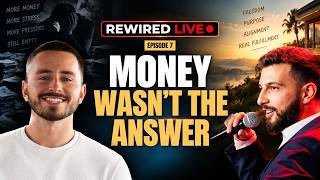
In this Rewired Live livestream, host Jake Burhans interviews top‑producing realtor Kyle Wasiak (≈$21 M annual sales volume) to explore why external success often feels hollow and how inner work can rewire that mindset. The conversation moves from Kyle’s early motivation—seeking financial security through real‑estate—to the realization that money alone doesn’t bring peace. They discuss the "first mountain/second mountain" framework, the Buddhist concept of dharma, and how purpose emerges at the intersection of passion, natural talent, and market value. Jake introduces his Built for Impact framework (Awareness → Regulation → Visualization → Release) and explains the physiological basis of resistance: the nervous system’s default to familiar, survival‑mode states versus a creative, regulated state. Practical tools such as breathwork, interoception, and vivid visualization are presented as ways to shift the brain’s attractor (baseline) state, likened to a thermostat. The dialogue deepens with discussion of emotional imprints, memory reconsolidation, and the need to release stored emotional patterns. They critique "outcome fever"—over‑identifying with external results—and propose a shift from hustle culture to a focus‑centered approach that preserves relationships and avoids burning bridges. Live chat participants add comments, reinforcing the theme that sustainable high performance comes from inner alignment rather than relentless grinding.
Chapters
Oh, I gotta take him off. I gotta remove him. He was on. Um, what's going on, guys? Happy Saturday. Hope that everyone is having a good weekend. Um, we are back with another episode of Rewired Live. Um, kind of changing the direction of Rewired Live. I like the name Rewired, right? My vision is that people come on here, we talk about your beliefs and your limiting patterns, and we can kind of rewire you live. Another vision for this, I think, is having people come on because I talk about the inner work, right? Because I chased this big business and the success and all this stuff thinking that it would give me what I finally wanted. Then you reach some level of success and you realize it's not really what you want. Ultimately, you're still a high achiever, but it's not like the thing, right?, right? And now it's— I really want to bring on other people who have external success, who've made it on their own paths, whether in real estate or other paths, who have kind of come to this realization at some level or another. So I want you guys to see, like, other people who have reached that destination, um, and kind of had a shift in perspective. So without further ado, my good friend Kyle Wasiak.
How are you doing? Thanks for having me, dude. I, I, uh, I was really excited for this and I was looking forward to it.
It's good, man. You got a storm coming up there.
Yeah, I think we're supposed to get that, dude.
Dude, it's like the storm of the century.
Yeah, everyone's freaking out. The grocery stores are mobbed.
It's like, well, bro, if you read the news— I never read the news and I, like, I go on my phone like one time to read it and it's like you would think the world is ending. Reading Fox or CNN or whatever you're reading, it's like death, you know, Storm is a death sentence, you know.
Well, even Trump posted about it. The what? Even, uh, President Trump made it— made a post about it.
Oh really? Yeah. Let's go, Alex tuning in. Alex is our director of lead management for QA. She crushes it. Um, Yeah, Trump, Trump. Yeah, I heard like 18 states are in a state of emergency. Yeah, meanwhile it's like 77 degrees down here in St. Pete.
Dude, I gotta, I gotta plan a trip to come visit you, dude.
You do? Well, if I'm here, I'm going to Guatemala in, um, like 3 weeks for like 45 days with Isaiah.
So you're saying I should just book a trip next week?
Yeah, to Antigua, bro. We got a full place, we have like 4 beds straight up for like 45 days. Yeah. Wow. If, if it is in the agenda, we're going from February, um, right to double check on the beds. I think we do. We have like a house, we have a whole house in Antigua. Pretty sick.
That's awesome.
So anyways, um, cool. So like I said in the intro, I just kind of want to dive into this stuff. Um, I think the biggest— the first question I have is When you first got into real estate, why did you get into real estate?
Um, so what it was for me is the financial security that I saw that it could provide for people, because I, I noticed that all the wealthy people or people that didn't worry about money, they were somewhat in some capacity involved in real estate. So I was like, okay, maybe I should get my real estate license, sell houses on the side. At the time, I was still going to school. I was going to be mechanical engineer and then just sell houses on the side. And naturally, it just gravitated to a full-time real estate role. And that was, you know, me really just burning the ships and jumping into it because I was like, okay, if I really want to make it and I really want to do something with this, I got to go all in on it. Um, and it was like once I bought my first multifamily property, that's when I, I jumped the ship. And then, yeah, ever, ever since then, I mean, long story short, I just, I just think that the financial stability that I saw that it provided for other people was a huge driving force for me to get into it. And coming from a childhood where I didn't have the financial stability, um, it was a huge driver for me to push towards that.
Yeah, yeah, that's probably what a lot of people see. Now, not to put you on the spot right here on the live, but, um, what do you think it was that the feeling that the financial security was going to give you, looking, looking back on it? Like, what is that feeling? Because a lot of times we're chasing things externally because of a feeling we want internally, right? So like, even because I was in the same, the same situation where I was like, I didn't have money— or we did have money, but like, you know, it was tight, right? Um, growing up. So I wanted that. But then I had to do the reflection, like, why did I want that? Because I associated having money with finally being able to relax and feel peace and just feel like secure. But in reality, even if when I had a lot of money, I didn't feel that way on the inside, you know? So it's like this illusion. But what do you think it was for you?
I guess, I guess I just thought in my head that it would be more peaceful, you know. Um, my, my childhood was chaotic because of finances. Yeah. So I assume that once you get to that point, it's like you get to that, the top of that hill, and you're you're then at peace with everything. Yeah, but there's a lot of internal work you have to do in order to find that peace, and it's not the money that brings it, which is why I love what you're doing, because I think it's, it's a huge, huge thing that a lot of people fall victim to. Like, I feel like I'm starting to see it more with like people within my circle. They're starting to get too consumed by it, and it's starting to like seperate us, you know what I mean? It's like people get too caught up in the money and they get too caught up in like chasing the next thing, the next thing, and then they're like, they get to the top of the hill and then they're like, well, what was it for? And like, what did I sacrifice to get here now? And now you're like crazy, right? And I, I made a TikTok about this, um, and I basically was just saying like, once you get to the top of that hill, like you burned all those bridges, you did all these things, and now you're like Well, I wish I didn't do that. And like, I think it's important to tell people that you don't have to burn bridges in order to build a future for yourself. You can maintain good friendships, good family dynamics, all while still being that entrepreneur success, you know, that, that people tend to want. Yeah, I think they have to sacrifice it and go down the, the lonely road and go ghost and stop talking to people, but I don't think that's the case. I think that, I do think that there is pivotal moments in people's lives where they kind of have to sink or swim. And I think that's what, that's, it goes to like the why, like why'd you start? Why'd you do that? You know what I mean?
Yeah. Dude, I think that's very interesting. Yeah, because we tend to do that. We tend to burn all the bridges because I think a lot of it is because we think that what we're going after, and this doesn't have to be money, or entrepreneurship. It could be like a title, it could be a job, it could be something that you're going after. You're basically throwing everything by the wayside and you're just like betting on this thing making you feel okay or giving you what you want to have. So what do you do? You cut out all the relationships, you do all this stuff, and then that's why people are so like miserable, bro, and even like suicidal and all this stuff when they get there, because they've thrown their whole life away to try to chase this thing, and then they get the thing and they're like, shit, this is not it. And then they're like, damn, I am, I am effed right now. Like, I don't have any friends anymore. Like, you know what I mean? So it's like, yeah, it's just not— it's crazy.
Yeah. And like I said, it just— it's, it's one of those things where, like, I wouldn't even say that we're at the top of the mountain yet, you know what I mean?
Well, yeah, I don't think there is a top. I mean, there's no—
it's just the— it's the— what do you call it? The infinite game, you know what I mean? Or Simon Sinek calls it that. Um, yeah, it is just an infinite game of, you know, just constantly being better. Like, and I think it's more of a flex to achieve success and still have like this amazing family dynamic and everyone still likes you versus like becoming the victim and being the most hated person in order to get to the top.
Yeah, dude, just like being that cutthroat 'Cause that just doesn't even feel— I feel like people can convince themselves, but I think everyone naturally, everyone wants to be a good person. They want to do good and they want to provide value to people. And I think there's this like, there's this idea that it's one or the other. You know, you got to do different things. Mark, Mark, killer for joining in. Mark, what's up, bro? You know Mark Kyle or no?
Yeah, I got him on social.
Nice, nice, nice. Yeah, Mark's crushing it. Mark's an OG in the acquisition space. Um, but, uh, yeah, it's like sacrificing this, this thing doesn't get you there. I forgot I was gonna say something else on that point. Um, but talk about, yeah, so the results you've had, like how much did you do in, um, sales last year, just for a reference here for Realtor?
So last year is about a little over $21 million in volume.
21 mil, folks. Come on now, this is like— this is not bad.
Say that again.
This is not small chips right here. That's a ton of volume for a realtor. You kidding me? 21 mil? Yeah, it's huge.
And it's funny because like the, the goalpost is always shifting, as you know. Like this last year, I was technically aiming for 25 mil, but I hit a little over 21. But if you go back year over year, I only did just under 17. So I still did almost $5 million more than last year, which is great, especially for being basically my, like, what is it, 2 and a half years full-time? Because I was 2 and a half part-time.
But how much does the average realtor do in sales volume? Looking that up right now.
They probably sell 1 to 5 houses a year.
Wait, actually, yeah, the median sales volume of a realtor is $3.4 million. Okay, so for reference, Kyle is 7x the average volume of realtor, right? So again, these are people who— it's like bringing people on who've had some success. It's not just, you know, I think that helps with some credibility of these concepts we're talking about, right? Like you do that, you know, I'm building the wholesale business, you know, done, did a couple million dollars in revenue, um, going for like $3 million this year. But it's just not the thing, and it is this process, it's this infinite journey. That's the biggest thing too. I was like, I was going on a walk this morning, I was like, why, where are we all going? We're always going somewhere, someone's ripping here, ripping there. It's like, where are you going though, right? It's like, just be here. Be in the present moment. Like, we're always going somewhere, and then you just did that. You just die one day. You've been going the whole time. You don't even— you don't even like know what's going on. Like, I made a post about today, like, this is life. Like, this is life, the live. Like, life is driving to the gym, it's getting into the gym, it's doing a rep at the bench. Like, that is life. And we're so caught up in just like the future and trying to achieve our goals that we just miss it all.
We get caught up in trying to be the, the better future version of ourselves. Yeah. And I've been, I've been reading this book lately, it's called The True Measure of a Man, and it's, it's a great book. I'll send you it. Um, but it basically says— it dives into the meaning of life, basically, because we're all searching for it, you know what I mean? We're all on this pursuit to find the meaning, and it genuinely just says You just need to work on your character, your wisdom, and your love. So basically, the dynamic of family and love life, being the best person you possibly can be, whether that be diving into your spiritual journey or just becoming a more, um, reliable person. And then wisdom is, is priceless. Constantly learning. So if you're constantly learning, you're constantly trying to be, you know, the, the best you and showing up as the best you possible, it's— it all works out.
Yeah, that's— I love that. Character, wisdom, and love. There's another book by Jim Murphy called, um, Inner Excellence, and he has a similar three trio. It's like wisdom, love, and courage or something, I think. But okay, very interesting thing. Um, I love that. So in regard to the, like, kind of the inner work, I think that's part of it. I know you said you had done some inner work, kind of a subjective term, but what has that been to you? And I guess actually, as a pre— as a pre-question, um, how has your viewpoint changed, like, on life? You kind of talked about a little bit, like, it's the infinite game. Like, when you're first getting into real estate, you know, you thought it was one thing, and then you had some success, right? You did a ton of volume as a realtor, like, enough that it should have been the thing if it was what was going to be the answer to the solution, right? Like, if you're gonna do $21 million and it doesn't do it, then $30 million is probably not going to do it, you know, at that point, right? So what was that initial perspective, and then how has it shifted to the perspective now?
I guess the initial perspective is like you, you're like on cloud nine, like nobody can stop you. It's, it's an ego thing. Yeah, you start— you— that's, I guess that's what I, I started to realize. Like the first couple years, you're like, you're really pushing, pushing, pushing to try to like beat the next guy, you know what I mean? Yeah, I want to have better numbers than this person. And then you realize that you're just playing this weird game of cat and mouse that doesn't really do anything but fuel your ego. Yep. And personally, for me, I just got to the point I'm like— and this goes into the shift, right? Like, my first year full-time, I did $7 mil. Second year, it was basically $17, and then third year, $21 and change. And the natural progression, you know, it's like, okay, it's going up. I feel like I'm not, I'm not really changing like that much in order for it to, to be like, oh, it's just, it's just me working on me and I'm the reason it's getting there, you know what I mean? Like, there is like other internal things where it's like I'm just showing up and I'm being a good person to other people, therefore the universe is rewarding me for being that person and for becoming a better person. And I think that by naturally, um, not letting ego get in the way of it and just being a good person to other people around me. I think it's naturally starting to gravitate towards me.
Yeah, like the results. Yeah, it's almost like you can have your cake and eat it too. Like you can live this grounded existence and, um, and be a good person, do all the stuff, and have all the external success that you want. I think that's the message too. It's not— we're not here to say don't do anything, don't be ambitious, don't accomplish things, don't follow your dreams. Like, yes, go do those things, but from a different internal state of being. Yeah, right, from that grounded, regulated state. Um, it's good. Gordon popping on.
I feel like it's almost harder to be grounded and still get it done than it is to be the an idiot that's just like, fuck you, fuck you, fuck you, I'm doing my thing, I'm locked in. Because that's easy. I could, I could lock in and say fuck everyone around me and just say, okay, I'm gonna, I'm gonna go all in on this and just like stick my head in there and, you know, nobody talk to me. But if you can be grounded and be happy in life and still do those numbers, that is more of a flex.
Yeah, I agree. Why do you think it's easier to do that? Or what about it?
I think it's easier because there's more, there's more distractions when you are grounded because you're aware. I think when you're grounded, you are more self-aware, you're more aware of your surroundings and everyone around you that's in your life and how they're affecting you. You tended to like dissect a lot of the things, the other things in life other than the business. I don't know. Yeah, that's just me, but I feel like you just have this better understanding, and therefore it may like take away from you just like sticking your head down and doing the thing.
Yeah, I can see that. You're more grounded, you're more aware. Um, I think there's also like a— at first our bodies are so— it's interesting how psychology and physiology works. Like, our nervous system is designed to keep us in what's familiar, right? That's, that's how our, our nervous system works. So our brain— we think our brain and our body, like, our brain wants us to reach our goals. Like, no, it wants to keep you in the familiar. So if what's familiar, especially early on in entrepreneurship, what's familiar for you is running around, cutting people out, you know, driving, pressure, fear, anxiety, whatever that is— when you consciously try to change and say, hey, I want to go be different, there's like all this internal friction and it's hard to do that. Why is it so hard to do that? Because our biology is trying to yank us back literally into what's familiar. Because like our— it makes sense physiologically. Like when we're evolving, like dude, we run on this like this incredibly outdated hard, um, hardware. Like our physiology, like it is designed for hunter-gatherers and like we're in this world right now. So when we, you know, back in the day, like we were evolving The brain, the body perceives familiar as safe, and it makes sense because you're in your village, you know everything that's going around, you know it's safe. So you don't want to go outside that village because what could be in the forest? It could be a lion, it could be a, um, an enemy, someone who could kill you. So you're always trying to stay in the familiar. But this applies to our, like, behaviors and our thoughts and our emotions and all these other things. Whatever is familiar to our system, our system tries to keep us in, right? That's like our subconscious programming. So I think a lot of it too is especially if you act that, you know, the first way you talked about early on in your career and then you try to switch, there is a lot of internal resistance and it feels hard until you make that second way your new baseline, until that second way is more familiar to your system than the other way. And then that becomes more easy. It's like your new default, right? It's like your 2.0. Yeah, so interesting.
I like that a lot. You may have just dissected it there. Like, I think I know why I'm feeling the way I am then.
Yeah, so that's what, you know, that's what it is. It's like a little bit of resistance to the old pattern because you've been in that pattern for so long, as have I, as have everyone in entrepreneurship. Because you're taught and you're conditioned that entrepreneurship has to be this pressure, this force, this anxiety, whatever it is. And it could be anything. You could be at school, you could be in college, you could be pursuing a career. You're taught that you need to push and grind and force So as you try to step in this new version of yourself, you have to, you know, you have to rewire those programs and it really just happens through repetition. So I talk about the 4 phases in Built though, right? It's really like awareness, regulation, visualization, and release, right? And then that's what allows you to transcend. But you have to be aware of the patterns first, like be aware of everything that's happening subconsciously. Oh, I react to this person like before my mind can even think about it, right? I react negatively here, I get angry at this, right? I feel like I'm, you know, my ego is trying to be selfish here. And then it's regulating yourself down out of that constant fear and anxiety, which is, you know, cuts you off from being able to think and rewire yourself. Because when you're in that survival state, right, you have creative state and survival state. When you're in the survival state, your body's not open to change because it thinks that there's a predator. So we have to like regulate ourselves, then we can rewire our identity through our— through visualization, basically, um, then release the old patterns. But it's very interesting, the body.
Yeah, that's a good perspective on it. I like that a lot.
Um, okay, so yeah, that's— I think that's good though. That was your first perspective. There's another book by David Brooks called The Second Mountain. I'm curious about your perspective on this. So, and this hit me really hard because I was like Doing this is my second mountain. Your first mountain is basically like you get out into the world and you believe that, um, you believe that, uh, you know, wholesale business is going to do it for you. Like, that's your purpose, and it's like a self-seeking mountain. But then you get to the top of that mountain, $21 million in sales volume or a certain amount in the wholesale business, and you realize that's not actually it, right? So you get to the first mountain, then you realize there's a second mountain that second mountain is usually like the way, right? It's the way of being grounded. It's, you know, seeking to serve other people, um, more versus being so self-centered and focused. Um, what are your thoughts on that concept, like the first mountain and then kind of the second mountain? And what do you see as your second mountain, if you do see one?
Hmm, it's interesting because I feel like honestly Sometimes I get lost in seeing that second mountain, um, just because I think that I, I did see the, the sales, transactional real estate sales as the first mountain, right? And you get to that and now I'm like, okay, what's, what's the next thing that I'm gonna feel that same thing again? Um, but what has been almost the supplement for me, um, not finding that second mountain yet is, I guess, um, reading the Bible, finding, finding my now girlfriend, uh, being closer with family, doing, doing all these things that are impactful to other people, and being present in the moment for the ones around me, and starting to build build a more balanced life. And I think that through that, I think that the second mountain will appear.
Yeah. So to shift, you're kind of in the middle. Like you've realized— geez. Gordon making a great comment here. Gordon's putting some great comments in here. First mountain, success and money and career is going to fill my cup. Yes, Gordon, that is— it's now in the head there. Thank you. Um, better articulation there. But, uh, you're kind of in that transition phase, so you see that second mountain. So it's almost like there's a— there's been a shift in values almost. Yeah, it's like, whereas the initial part of career you valued XYZ, and now it's different. How have those values shifted?
I think it's just like, like being— like I said, being more present and Like, I, I know, you know, I don't think my value shifted in terms of like money. I think like I still value money the same as it is. I'm not a materialistic guy, so I don't like overextend myself. I don't need the flashy things. I've always to my core kind of been like that, so that's remained the same. I just think the overall values are now I have a significant other in my life. I have something else I can nurture. I have my youngest brother who's 10, um, well, 11 now, and I basically helped— I, I watched him grow up, you know what I mean? So being there for him, um, during moments, being there for my other siblings, um, those are things that I've put a lot more value on over the past, I'd say, 2 years. Um, just trying to be the best role model, be the best person for them. Um, and I value— honestly, my— the way that I view my clients is different now too, because before I would do anything to work with anyone, but now I can be more selective. Now I'm at this phase where if you don't want to work with me, that's okay. I'm not gonna, I'm not gonna sweat it. Like, and that's a powerful place to be in because now I feel more, more fulfilled working with the people I work with because more often than not, they're happy and appreciative versus constantly like grinding like gears with me, like trying to like be like, okay, this is the right way to do it. I'm like, why am I here? You know the right way. You know what I mean? Yeah, yeah. So it's like now the people I work with like truly, truly see the value in me, and that gives me more purpose in what I'm doing in that side.
Yep, that's great. I think, I think a fundament— you have— you've had a fundamental baseline shift of how you operate, um, from a place of lack. Because before, when you're trying to get anything, you're operating from a state of lack, right? It's like you need that business to feel complete on the inside. And with that sort of operating and energy, it just, you know, it's not as attractive of an energy because you're kind of desperate. You know, you're a little bit in fight or flight kind of survival mode. So you're not thinking as clear, you're not operating your highest performance because you're just in that lack kind of— you can think about lack as like, so kind of like a survival state versus like an open creative state. Um, so I think that makes it a lot more difficult. But once you're like, I am whole on the inside, like I don't need any of this, I just do it because I want to add value to my clients. You know, you start to open those opportunities, start to just come to you, but it's a much more sustainable way to do business. Yeah, you know, because like doing this now, like you probably see yourself doing this for, you know, another few years and enjoying it versus the first few years it was like just like this grind and this pressure and it wasn't like that fun.
Yeah, I agree. Um, and it's now it's at the point where because I'm at this stage and I do feel that way about it, what is the next thing in terms of this business? Yeah, because I know that I can get things done and I know that 90% of the deals are going to close, um, because I will get them there. But what do I prioritize my time on now that that stuff is a little bit easier? Because like, I have an assistant who helps me with my transactions, I have more time and I'm more like, um, more willing to do these other things. So like, yeah, I've kind of just been filling my time with looking for like off-market deals, trying to find my next multifamily. But like, what's the, the real next thing, you know what I mean? Maybe it's tackling like a big property, get a, get a big 20-unit building.
But it's from this— but you're thinking about this, and this is the thing, it's like, it's not like we're not going after our goals, we're just doing it from a different state of being. It's like more fun now versus this pressure, right? Why is there pressure to accomplish our things? Because we need it to feel validated. That's why there's so much pressure that's created, because you're like, I need this to feel like I'm enough. So obviously there's a lot of pressure, like, I need this, oh my God, you're desperate. But when you're already enough, it's just like, it's just fun. You're like, okay, cool, let's go see if we can get a 20-unit building, that'd be dope, let's go do it, right? But it's not like this desperation thing, right? It's like we are acting from inspiration, not desperation. Yeah, we can just follow that one rule. We're gonna be— we're just gonna enjoy the process because like you said, it's an infinite game. It's just like the point is to do it.
Um, so would you say your next mountain right now is like the, the YouTube channel, podcast, and all that?
For sure. Yeah, yeah, like Built for Impact, like teaching the inner work. Built is the way that I teach the inner work. But yeah, growing my social media, talking about this stuff, especially to young entrepreneurs, is my second mountain for sure. Like, I do this for free. I do it for free right now.
Yeah, I'll be doing it. I mean, I think it's awesome how much, like, time and effort you're putting into it because you can see you are passionate about it. Um, yeah, and that over time is only gonna, you know, be prosperous. Like, you're gonna see the benefits of it for sure.
Yeah, and I'm not— yeah, and I know it'll, it'll come. It's just like, um, I think too is like, if you're just yourself, man, like everyone's so like afraid to be themselves, I think too. It's like no one will ever beat you at being you. So if you can just like go be you, you're gonna crush it in life because no one's gonna be better at that than you. That's why we're trying to fake these things and we got to act this way so people think we're cool and do this and do that. That's exhausting because you're just wearing a mask, you know you know, you're playing another character. Just play the character of you.
I tell all the newer agents that get into real estate, I say my, like, my one piece of advice is be yourself. Because if you're not, you're going to be in the industry for 3 to 5 years playing a circus act, and you don't want to keep that up.
It's exhausting, man. People— I think people can sniff that out from a mile away, bro. Like, when you're just like not yourself, when you're just acting like someone and you're being fake, it's like It's like, it's so stale, you know? It's like being yourself is like a breath of fresh air. You get on, you know, you're quirky and you're weird, and that's cool, man. We're all a little weird. Like, we're all different. That's the point, you know what I mean? The point isn't to be another clone. The point is to be yourself. But we think that we won't be accepted. Again, limiting beliefs, things like that. Yeah, but it's so much more fun to be yourself. Like, life is way better. If you can just be yourself, no inhibitions, like you don't care what anyone thinks, it's great. And then guess what happens too when you do that? You start to attract people that are like you. So this is the paradox, this is the crazy part, because when you're yourself naturally, you start to attract people that like what you like naturally. But you can't do that when you're putting on a front because you're just attracting the people that are attracted to your front or to your, your second, you know, your, your alter ego. When you're yourself, you attract the people you actually want to be around, and you're, and you're happier. So you just get over this illusion, you know? Yep.
Yeah, it's a powerful thing, like, and it's a tough thing to do because yeah, some people who, who are always in this personality to gain the respect and like of others all the time time, it's hard for them to shift that because then their circle dwindles down.
They—
it doesn't feel the same. And they're like, well, like, it's like, who are you when you go home, you know?
Yeah, I think, um, yeah, and that's part of it, you know, because if you've built a whole life around that, you're gonna have to go through a period, like a little lonely period. You're gonna have to shed some of that old stuff, but you're doing it for the ultimate— like, maybe it's a a year of that, maybe it's 6 months of that, maybe it's a little longer than that, right? Of just like reforming. But for the rest of your life, you'll have this grounded, foundational way of being that's in alignment with who you really are. And yeah, I think there's just so much less friction and pressure and worry and all this stuff when you're just being you and doing what you, what you want to do, what you know you're meant to do, right? Um, there's a lot less for you.
How did you find what it is that you know that you're meant to do and what you enjoy and like doing?
That's a good question. That's a good question. Gordon was tuned in for a little bit, made some great comments. Have a good Saturday, Gordon. Appreciate it. Appreciate it. Um, how did I know what I like to do? So there's an interesting concept from, uh, Buddhism. It's called dharma. Have you ever heard of that? Yeah, your dharma.
Talk about that.
Yep, it's in his book. It's actually my— the most recent episode of Built for Impact talks about this exactly, um, finding your dharma. So your dharma is the intersection of basically what lights you up, what gives you energy, what you're good at, which you're naturally good at, those two things, and what the world finds value in. It has to be those three things. It can't just be something that lights you up and you're good at if the world doesn't find value in it. It's not your purpose. It's just, it's just a hobby. Like, I could love to play darts, right? Or I, I love to play pickleball, right? It lights me up, it gives me energy. But does the world find value in me playing pickleball? Well, not really. So that's not really like my dharma. Whereas maybe if someone who's meant to be like a pickleball teacher, that could be their purpose if people got value out of it. So purpose isn't something that you find, it's really something you remember. That's what it is. It's something you already know. You already know this about yourself, right? Because you can look back at early times, like, what have I always loved to do? Because I always, especially as I brought on people in the company and I would be doing meetings and things, I love just the meetings. I loved coaching and teaching, really teaching more than anything. That's what I love to do. I love to teach and talk to people and coach people on this stuff. I was like, I've always liked to do that. Um, so I had in the back of my mind, I always like to do that. And then I would get responses from people like, hey, you know, I really got value out of that. And, um, people— I started to get that feedback that that was— people found that valuable, like what I was saying, how I was communicating them. And then my skill, I think— so that lights me up. I think what I'm naturally good at is Communication, you know, articulating things, maybe things that are esoteric or understood or not very well understood. They might be kind of abstract or spiritual, and being able to communicate that in it in a way that's easy for someone to understand. So yeah, so that's— I already kind of knew that was it, but I never knew the vehicle for it, dude. I was just like, I always knew that, and that's kind of why I started to optimize the real estate community like 2 years ago.
Yeah.
But yeah, and then I was just like— and you know what it really was too? It's the powerful part. It's like in August, I was just like— because the wholesale business, I'm just like, I like coming in. I've reframed my viewpoint around it. I like coming in and helping people develop. That's really all I like about it, right? Is that I could give a crap about calling a seller. I honestly never even want to do it. Do it again. I did it for so long, right? But I enjoy coming in to help people. Now I got a sales manager in there and, um, and just helping people be the best version of themselves. That's like my biggest value add to the company at this point. Um, but, um, I forget where I was going with this. That's your—
that's the answer to your question? Yeah, basically just finding that dharma and like—
oh yeah, dharma. Yeah, so it's something you remember. Right. So thinking back, like, what was it for you that did— oh yeah, so I didn't know the vehicle, right, for it. Really, I didn't know the vehicle. And, um, then I was just like, you know, you— because a lot of times we have this thing in the back of our head, like, I want to do this, right? I want to do that. But then what comes up? Those limiting beliefs. Well, you could never do that. That's because it's too far off, right, from your current reality. Well, I could never do this. I could never do that. But the real— everything will change in your life when you start believing in yourself. Basically, you just believe in yourself. Like, you know, you actually can do that, right? It's like, I literally just woke up one day in September, I was like, I am Jake Burhans, the personal development coach, end of story. Freaking created the Built for Impact podcast, put it on LinkedIn, founder of Built for Impact. Everyone's like, congratulations, all this stuff. I'm like, I literally just made this up like 3 days ago. But that's, that's how it works. Like, you just make a decision to do something and then you just do it, and then you just start doing it, and you start posting on social media, and you create a community, and you create a framework, and you start doing lives like this. And then over time, people just view you as that person because you made a decision. But I think the fundamental error too is like, we want to follow our passions or our whatever we want to do, but we have these limiting thoughts, and they're just, you know, they're fake. It's like, you can do whatever that you want to do is the bottom line.
Yeah. It's, it's so true because like, I think like even it even happens with like little things. Like, oh, I, I, I want to go travel and do this thing, and like in my head I'm like, I can't do that, I can't give up my time, you know. I will talk myself out of having fun basically.
Dude, you know what's crazy about that? That's literally your, your, your physiology trying to keep you safe. This is a mind-blowing concept, dude, is that your brain and your nervous system is always trying to keep you in the familiar, right? It perceives anything that is unfamiliar as unsafe. So you'll literally self-sabotage yourself out of things if it's unfamiliar to your environment. Like, for example, I— Isaiah was always traveling, right? Before we started traveling together, um, like early on in the business. But I was just like, no, I couldn't travel. Like, I don't even know, it's like some, like, made-up things in my head were like, I couldn't travel, I need to stay here. And then I was just like, wait a minute, like, why do I think that? Like, there's really no reason that I couldn't be traveling right now. And I just made the decision. Then all of a sudden we're traveling all over the world. But yeah, your nervous system literally tries to keep you safe. It's like, no, Jake, you need to stay in Florida. It's safe here. You're in the city, you know, there's no risk, blah blah blah, whatever those things are. So as I try to think new thoughts, it's like threat, threat, threat. And it's like, no, you could never do that because you And this fear is disguised as logic, right? Oh, this is just logical, or I'm being smart about it, right? It's like, no, you're just sabotaging this experience you want because it's unfamiliar.
Now, how do you break that? Because I, I, I do it myself, but I have a friend who's really bad at it. Yeah, he, uh, he would stay home in a hole his whole life if he could.
So how you break it is a few-step process. It's basically what's taught in BILT, right? So first is— the first pillar is awareness. You have to be aware that you're doing it, because if you can't be aware of it, you can't change, right? So you're already aware of it. Like, you are aware that, um, you want to travel but you kind of sabotage, right? And the beautiful thing about looking at our subconscious programming is we kind of look at it like a computer operating system. It's like an old program. So instead of being this like self-blame, shame thing about how I can never do this or that, you look at it like a set of conditioned patterns, because that's what it is. And that takes the judgment out of it and helps you be able to change it. So you're aware of it, okay? The second thing is we always need to be back in like a regulated state. There's two mutually exclusive states that we can always be in: one of survival, which is fight-flight, and even this low-grade survival, just kind of like a little bit on edge, a little bit of anxiety, a little bit of worrying. It doesn't have to be this catastrophic thing, but there's survival. Then there's a creative state. This comes down to the nervous system. There's the sympathetic nervous system, which is the fight or flight, and then there's the parasympathetic, which is rest and digest. When you're in a sympathetic state, even a low-grade one, the body is not open to change. You can't rewrite those underlying programs because the answer to your question is rewrite those automatic thoughts so they don't come up anymore. But as long as we're in this low-grade tension, we— the body's not open to it when you're in a fight or flight state especially. And this is why being— pushing with pressure and stress is detrimental for high performance because when you're in a fight-or-flight state, the prefrontal cortex of your brain, the region that's designed for like strategy and execution and planning and creativity, it literally goes offline because your body is like ready to run from a lion. But it doesn't know the difference. You're just pissed off at an email your boss sent you, but your, your body thinks you're about to run from a lion. So your half your brain literally shuts off. You can't even function. So that's part of it. But you want to regulate your body back into this state. And then visualization— this is a new spin on visualization. So it's like, because your body perceives the unfamiliar as unsafe, you feel a lot of resistance as you try to go into these new levels of yourself, right? Or you want to create a different life, one where you're traveling around or doing whatever you're doing. You get a lot of resistance because that's an unfamiliar reality to your body, your nervous system, and your brain. So it tries to self-sabotage to keep you in the familiar. So what you can do is you can use visualization as a way to rehearse that identity. So not visualization as a way to, um, think about the house or the car that you want, right? You're— how does this person act? And because visualization activates the same neural circuits as real life, right? They did a study, like, it's called, like, the Apple Study, and they showed someone this. They had a— I think it was called an fMRI— hooked up to this guy's head. Showed him an apple. He sees the apple. A certain network of neurons lights up in his brain. Then they're like, okay, put a blindfold on him. Okay, now picture the apple. Bright red apple, stem, all the stuff. About 90% of those same neurons in his brain lit up the exact same way. So the brain literally doesn't know the difference between a vividly imagined reality and physical reality. So this is an incredible tool, and athletes use this all the time. Right? Athletes, surgeons, musicians, um, Olympians, whatever. They're, they're not visualizing themselves holding the trophy at the end. Like, that's not going to help a skier hit his run. He's visualizing him actually going through the run. He's familiarizing his nervous system and his body with that state. So if he goes over in his head 100 times, the body thinks that it already happened 100 times, right? He's stepping up to the, the thing and he's like, in his mind he's like feels the wind on his face, right? There's a bunch of people out there. This is the gold medal run, but he's, he's relaxed, right? He's visualizing himself being like relaxed. So the body is getting used to that situation. Um, and then he goes down the run, he's going around the flag, and he feels his leg, oh, he hits some ice, and he recovers, and he does whatever, right? He's practicing how he handles these things. So then when his body physically gets up to the podium, there's no fear and anxiety, right? Because the body, it thinks it's already been there 100 times, so it's a familiar, safe situation. So he steps up, he's calm, freaking nails it, right? And that's what you use visualization for. So in your situation, if you are, you know, you want this different life where you're able to travel, there's some blockages there about why we think that couldn't be possible. Well, you know, I'm going to lose business, my business is going to be cut in half, I'm not going to make as much money if I'm traveling. There's all these thoughts. So we start to use visualization as a way to like rehearse to our body like How would it feel? How would it look like? How would I act when I am able to travel and do the thing? And that becomes more real to you than even anything in your external world. And then naturally your behavior aligns when you're— when you, when you change the identity, because everything flows downstream of identity. So you change your makeup of who you believe you are. Basically, you're the realtor who does the same amount of volume while they're able to travel whenever they want around the world. That path becomes clear because state. And here's the thing that everyone like thinks, it's like, okay, I'm gonna think a thought, implement a strategy, I'm gonna get the solution. But they miss the physio— physiological part of it. Like, your body needs to be regulated, you need to reprogram those stored patterns. So really it's like state, you need to be in the grounded state, right, which dictates your perception, which is how you perceive things, which then dictates thoughts and actions and results. So as you get into this new state of being as the person who can do this your perception of the world will literally change, like your reticular activating system. So how you perceive things will completely change, and you'll start seeing different opportunities about how to make this reality possible because you believe it. You know, your system's familiar with this. Your perception has literally changed. But that's how you would do it.
That's awesome. I was taking a lot of mental notes there in 15 minutes.
Um, to your answers.
Yeah, no, that, that's great though. It's amazing that, um, it's amazing that you have deep dived into this so, so heavily that you are now—
no idea, bro.
You're now that guy. You're now like, you're the, you're the— what should I— how should I put it? You're like the the more digestible Hormozy.
Mm, I like that, bro. I, I, I can get behind that because I have a love-hate relationship with Hormozy though, because he has a lot of good stuff. Super smart guy, like knows a lot about business, obviously very successful. I just think that people have an underlying problem, like they don't know how to operate internally. Like everything I just said there, no one knows that. Right? So if you don't know how those patterns work and you're trying to go implement something that Alex Hormozy is doing and then you're failing, and then Hormozy's just like, no, you need more discipline, more pushing, more power— it's like, dude, you were using— your subconscious mind runs 95% of your daily actions. You understand? That's crazy. 5%. So if you're using the 5% conscious willpower to try to overpower that 95%, obviously it's going to feel like so much struggle and so much force. So why don't you do that inner work to reprogram those patterns so that the 95% is working in your favor instead of against?
Let's, let's start thinking now, what is the, like, the most important next step, like the minimal steps to get there? Because like, you just need a very wide, broad overview of like the, the internal work, like genuine internal work and how your brain works, right? Like, how do you now create this?
The podcaster in you is flipping this right now. This is great.
I'm flipping it, dude. And because, because honestly, it helps. It helps me. It helps you. Yeah. What are the small tasks that people could do to get to that?
Yeah. Yeah, I think being more aware. Yeah, exactly. So it's not necessarily more knowledge. I think the big— the first and biggest step is just being aware of the patterns that are holding you back. Like, just identify those. That's the first thing. Yeah, we got step one.
Write them down.
Write them down.
After this, I'm writing down all the things I'm aware of.
I literally do— do it. Like, what are all this stuff? And, and the more that you, you have this, like, awareness— like, once you understand that this is how it works, you can't go back, you know what I mean? You can't unknow this information. You can't un-understand how this works. So you're aware of all the patterns, and then you'll start to realize it in your day-to-day, dude. Like, like, I had a— just the other week I realized, like, my relationship with time and how I feel like I never have enough time. I was like, this is a dominant belief for me. I feel like I never have enough time. And guess what happens?
You really do.
Yeah, I do. Because what happens, my perception now gets distorted and it filters back to me everything that is in alignment with my dominant belief. I never have enough time. I'm running around. I'm going 3 steps up the stairs at a time. I'm smashing my toe on the bed. All this stuff. I never got enough time. Everything's chaos, right, bro? And I'm like—
I think that narrative is pushed by a lot of people because like you will come across other entrepreneurs and they're saying, man, I'm just like so busy. There's not enough time in the day. Like it's constantly being pushed on you externally. So it's hard to shift that.
Yes, dude, because that's the message. And it's like, but those entrepreneurs don't know what they don't know. That's the problem. It's like, and the problem is that they got results operating that way. So it's not that it doesn't work operating that way, it's just that it sucks operating that way, you know what I mean? And that there is a better way. So, but that's how we form these beliefs because we look at all these entrepreneurs, Alex Hormozi, whoever the people are, you know, Pace Morby. Yeah, you gotta grind and it's just a miserable existence for 5 years. And you're like, ah, fuck. Then you hear 10 people say that and you're like, oh, that just must be how it is. And then you form a belief that you have to grind and struggle. And I'm not saying you don't have to do the work. You do have to do the work. Like, you have to be incredibly consistent over years, over years to really build something. But the thing is, if you really want to build something sustainable, you need to be grounded on the inside. You need to understand how to regulate yourself. So before you're taking another tactic, before you go into another seminar on how to build your million-dollar business, You need to, you need a blueprint for your internal operating system. Like, you need to figure out how to do that work so you can show up as your best self, because peace is a performance multiplier. We think that calm and peace is like this passive thing. I'm not going to have any ambition. Like, who am I going to be? It's like, no, this is going to help you regulate. It's going to help you think clear. It's going to help you execute better. It's going to help you have more energy. It's going to help you have more emotional bandwidth so you can deal with chaos. Like, you will be the highest version of yourself. Um, so awareness of the patterns, I think, is the first thing. And then the second big thing is regulation, right? So awareness without judgment, that's a huge one. So be aware of it, don't judge yourself, look at it like a— just like an old program that's running, right?
And in order to regulate it, it's essentially just looking at those things daily.
And yeah, regulation is really getting out of— because you might when you see those things, you might feel like anxious, or you might feel, you might feel these like lower level emotions that are kind of— remember, there's only two states of being. It's either creative or survival. So you got to ask yourself every day, what state am I in? Am I in more of like an open, creative, regulated— and you know what these feel like.
Like, you know, I like when you said that because it is true. Like, when you're, when you're like, you have David Goggins yelling at you, your prefrontal cortex can't work because you're like, I need to go like protect myself. And that's why I think that, like, I realize that I'm more creative at night. Yeah, like when I'm starting to wind down and my, my body's just like, okay, you're calm, I'm starting to think of like all these crazy different like avenues of life and like what you— what like what rabbit hole could I go down?
Yes, dude, isn't that nuts though? Yeah, because your brain is literally shut off, bro, when you're getting like— when you have like pressure and you're like, go, go, go, everyone's like, you got to push hard, do all stuff. Your brain is like, oh my God. Your body's like, oh my God, we are in a fight or flight situation. Turn the brain off, we got to run from a lion.
Yeah.
And then you wonder why it feels so hard to do anything because you're in this, this survival state all the time. So the regulation part becomes about constantly regulating throughout your entire day, whatever happens, right? Something happens, deal falls through, you need to have what's called interoception. Which is basically the mind's ability to read the feelings of the body, right? So we're constantly scanning things in our external environment, but being present, tuning into how you're like— is your heart beating really fast? Do you feel a feeling in your gut? Is your back tense because a deal just fell through, right? That's interoception. And you can start to look at those, those things as just feelings, right? They're just experiences rather than who I am. Because what happens is like a deal falls through And then you feel the fear and then you're like, oh, I'm incapable. That's the problem. It's like fear happens, boom, I'm incapable. I can't do this business. I'm not cut out for it. That's like the end result. We think that's how it starts. But really it's an event. It's a feeling in the body and we are putting a narration over that feeling. So it's really like being aware of those states and constantly regulating. And every time you choose to regulate, right, how do you regulate? The breath is the easiest way.
Right?
The breath, like being present, feeling your feet on the floor. And these are mechanical things. These are not anything you have to believe in. These are like, you slow your breath down, your body will literally physically slow down. You don't need to believe in it. It's just something that you do.
So, right, I think Jake Burhans talks about that a lot. Yeah, things like a monk. It's like going into your next appointment, deep breath. Yes, reset.
Exactly. So the exhale As long as your exhale is longer than your inhale, you're— you're— it signals safety to your nervous system, right? So in every situation, because we know that when you go into survival, your brain shuts off, when you're like anxiety and fear, you can't think as clear, this becomes a huge high-performance tool because you're in a stressful situation, you always have power over that situation. It's not that you're not going to feel stress or you're not going to experience that, just that you're able to regulate You know, and the goal is not to not go into that. The goal becomes how quickly can I be aware of it and get back into this creative state so I can make the best decision in this moment, so I can execute at the highest level versus reacting from that stress, you know. So awareness and regulation is a lot of the work. And then the, the visualization stuff you do like in the morning, in the evening, to start to make the new state of being familiar to the nervous system. So as you're doing that visualization work less of these negative thoughts and reactions come up because it's not the new baseline anymore. You're trying to condition a new default state of being. Um, yeah, it's basically called an attractor state.
Um, I'm giving you some great content here. Yeah, dude, this is awesome. I really did get you deep diving here.
Yeah, hold on, I'm gonna— I gotta bring it Bring it back to you here real quick. Um, the, um, what we're saying, someone on TikTok was—
you were, um, basically talking about awareness.
Um, oh yeah, so, oh, it's called an attractor state.
That's what it was.
An attractor state is basically like where you always fall back to. It's like your baseline level of being. So think about an attractor state is maybe like a thermostat. So your identity and your patterns are like a thermostat. So if you're set to 70 degrees, right? An opportunity comes in at 85, opportunity to speak on a big stage, which you always wanted. That's way too hot. It's way too much of an opportunity. Your body's gonna regulate you back to 70, right? It's like, nope. And we're gonna sabotage. You know, I gotta deal with the business that weekend. I'd love to go out to the event, but I just can't. You know, and you're gonna make it seem like it's some noble excuse,, but you're back to baseline, right? But it also works the other way. Like if you dip below and you're not performing where you know you should be, you're going to come back to baseline. So the goal is to change that attractor state, change that thermostat setting to the one that you want. That's calm, that's grounded, that's confident, that's loving. And then even when these things pull you out, where are you going back to? You're going back to that baseline every single time. It's like the attractor state.
The other way to look at the book, uh, Courage to Be Disliked. No, that's a great one. He says in there, he says you're, you're, uh, you're like a well. A well remains at a certain degree Celsius no matter what the temperature outside is. And you want to constantly be a well. Yeah, no matter what the external is pushing on to you and making you go crazy, like you're stressing about something, you want to constantly just remain at that state and find that better baseline instead of like having to retract to a bad baseline like you're saying, right?
Yeah, he's literally talking about like you're, you're essentially just like raising the baseline. Yes. Yep. Just think about, think about it this way too, like your attractor state. Think about, um, a marble sitting in the bottom of a bowl, okay? When you are operating as your old self, you have these old programs of limiting belief and all this stuff. When you're trying to just consciously change with your willpower, it's like you take your finger and you're pushing the marble up the wall of the bowl. Okay, great, you can push it up the wall of the bowl, it's a lot of force. But the second you stop trying, what happens? You let go of the marble, right back down at the bottom, right back down. And that's you collapsing or burning out or self-sabotaging back to your— who you believe yourself to be. So the game begins about like raising that bowl or changing that center so that you don't have to force so much, right? Because everything's just going to flow. Yeah, it's great. So, but where do you think that, you know, I guess, I guess those 3 concepts right there, I guess, what is your interpretation on that? How do you think that applies maybe to your experience?
To me, I mean, I think it's great. It's— I'm probably gonna watch this, rewatch this video honestly, because it's like there's a lot of good things that you can take from this. And I think what I tend to neglect is I, I'm aware of what I'm like feeling in the moment. I'm very emotionally intelligent, but I don't do that, that next step all the time that says, okay, how's my body feeling? How am I doing? Like, if I just calm myself down right now, like, what am I capable of? You know. Yes, dude. Um, almost like that, take like outer body experience, like, okay, like how can I just, you know, remain— get, get to the— get to a better baseline and reevaluate.
Yeah, state regulation. No one talks about that. No one talks about your state of being, dude. It's like, it's all mindset. It's all mindset. It's like everyone just thinks it's a cognitive thing. Oh, let's just positive affirmations and we'll think better. You gotta— you need a better strategy. Okay, well, what if you're in fight or flight? Half your brain ain't working. How's your strategy gonna work then? It's not. Your strategy is not gonna work.
It's been tough. I mean, so I've been kind of on the, like, like this bulking journey, like trying to put on a little bit of weight. And seeing the mental shift by putting on weight really does show how your body connects with your mind because I'm now more tired because I have more weight on me. It's not all muscle yet, but you start to think slower in a way, and your body's more fatigued, so therefore your mind's more fatigued. And it gets you— it's, it's, it's so amazing how the body and mind work. And I, I don't know how the people that don't go to the gym at least 3 to 4 times a week survive.
It's crazy how it's constantly getting feedback, right? Yeah, yeah, it is wild. Yeah, there's this concept called interoception. It's just wild. It's like the brain is constantly checking the body to try to get information. Like, it's checking your heart rate, it's checking your muscle tension, it's checking your— checking your breathing to try to get information about, hey, are we safe or are we Or are we in a threat state? Yeah, when your heart's racing, right, you're all tensed up, you're on— you got an email from the boss and your shoulders are tense and you're breathing really shallowly because you're bent over. What is that sending a signal to your brain that like you're in a threat state? Yeah, like you just outran something, you're in a cave, you're hunched over, right? Like you're in danger and so your, your brain shuts off. So, um, it's regulation. It's a huge thing. And once you're aware of it, you just start to notice all these different things that— and the fourth pillar though is release. So you're aware, right? And the beautiful part about this is it puts all these phases together because a lot of personal development just focuses on one. It might focus on mindset or awareness, right? But you can have all the awareness in the world. If you're not regulated, you can't, you can't facilitate real change. Because your body's not open to learning. It's not, it's not in a creative state. And right, and you can regulate all you want, but if you don't actively have that intention to visualize a new identity, you can't shift your baseline. Um, but you need to do those prior two things first. Now the fourth one, it's probably my favorite one. It's all about release. So we have these things called emotional imprints. Um, oh, you— I think you might have recommended Think Like a Monk. What? I think you recommended to me anyways because I read, I read half of it. But he— well, Michael Singer is another author. He talks about them. They're called samskaras. That's the word in Sanskrit for these energy blockages. You hear about them in the spiritual world. You have an energy blockage, your energy is blocked, right? But here's my problem with all these things, like, what does that mean though? I never know what that meant. Like, I kind of understood what it meant, but We have these emotional imprints. So basically, a memory is stored as like an emotion in the body. So basically what happens is an event happens in the past, we react in anger. What happens instead of being present with the anger and just letting it be and not forcing it, right? Um, we suppress it. We go, I don't want to feel angry, and you— I'm fine, I'm fine, right? Do whatever. That is now stored in your body. It has— it didn't have a chance to dissolve and release. You've created an emotional imprint that ties that event to that emotion. So now every single time that that event pops up, what's your natural reaction before you can even consciously think about it? Boom, you're lashing out in anger because that's that stored emotion coming up. But then when the emotion comes up, what happens? We suppress it again. So the goal becomes all these little triggers in our world that make us react in certain ways. Maybe they make us sad, they make us feel guilty, they make us feel angry. Whatever those triggers are, they're opportunities for freedom and growth. Because if we can trigger it, it's called— it's this fascinating category of research called memory reconsolidation, which I guess happened in the early 2000s. But we used to think that memories were stored, could never change them, right? They're like in a file cabinet locked away. But now, when a memory is reactivated, it becomes like what they call labile, but it means that it can be editable. Like you can change it. I don't know if it's from a book. I was just, um, it's just in some research I found.
Oh, okay.
Yeah, but I'd be interested if you knew a book about it.
Yeah, I, I could have sworn I've read about that.
Okay, interesting. Yeah, I'll have to know the book. I don't even know where I find half the information. I'm just constantly looking at stuff. But, um, so it becomes editable. So Now that trigger happens, but instead of suppressing it, you're relaxed, you regulate your system, and it basically updates the memory in your body. So now that event that previously made you angry now has no control over you. And all of life becomes about releasing these emotional imprints because when we have all these, some scars, these emotional imprints, it's basically like Michael Singer talks about it. It's like you have a bunch of thorns in your body, right? And there's like everything in the external world is agitating these thorns. So instead of removing the thorns, what do we do? Like, we're trying to move throughout life and make sure nothing hits the thorn, right? We're avoiding this situation, this person, this call, this event, right? And it's like this constant, like, just avoiding things. But it's like, why don't you just take the thorn out? And then you don't even have to deal with the thorn at all. And taking the thorn out is letting the trigger happen. You feel the emotion of anger or sadness or whatever, and you let it be, right? You have to not— you can't resist the emotion, meaning And this is where the awareness comes in, in the regulation, right? Part of it, you need to be aware that a trigger happened and you need to regulate yourself in the moment so that it just exists. And then if you just relax, it'll dissolve. And then over time, if you keep doing that, that situation will no longer have effect over you. That's a 4-phase journey. And if you do all 4 of those things, you stabilize into like a new baseline attractor state, a new level of being. Um, And then you're— and then you're good. Then you're built for impact. You're ready to rock.
Hell yeah, dude.
Oh yeah, that's great. Face your goals. Yep.
This is— that's, that's, that's amazing.
But, um, yeah, man, good, good stuff. Yeah, it's definitely the second mountain though, you know. It's like, I just want everyone to understand their second mountain sooner. Um, I was talking to my buddy Curiously, about your thoughts on this, he was just saying he calls it outcome fever, but it's like when our identity is just always tied up in the outcome of things— the deal, the job, the money— and it creates this like, yeah, yeah, dude, creates this like tumultuous— you're like, all you can fixate on is getting that next deal, that next thing, because that's what gives you life. And it just becomes this exhausting thing. And dude, it even goes back to like when we're kids, dude, like when we're in hockey. And we're like, dude, I gotta be on the AAA team. I can't be on the AA team. Are you kidding me? I gotta be on the varsity team. I gotta play D1 hockey or I'm not even gonna play hockey. Yeah, outcome fever. I needed that to validate. It's no bueno.
Yeah, I agree. I think it is a thing for sure. And I think we, we are at the point where it's more of like in a— we're attracting the outcome. Instead of having a fear of the outcome or a fear that we won't achieve the outcome.
Yeah, great, dude. Absolutely great. I don't want— I think we'll keep this around an hour. That was good though. That was absolutely incredible. Um, yeah, any last thoughts for the peeps out here? Any last thoughts, things for them to chew on, advice that you have? Um, I think it was a good session actually. It's the first time I've done like a little It was kind of— it kind of was Rewired. We kind of talked about it.
It was—
you were going through, which is kind of cool. Um, I guess, what are any, any lasting last words?
Last words? Um, you know, I don't, I don't know if I have anything. We, we just dissected everything. Oh, I feel like I got some homework to do now. You know, I'm gonna write down a lot of the stuff. I think it's very important to be aware. I also just like I like emphasizing that you can become successful without burning every single bridge in your life.
Yes, I like that.
I think that's the biggest thing that I've been emphasizing lately because I'm seeing it, you know, and I, I think people are starting to catch on to that because the hustle culture isn't as hustle culture as it was 2 years ago.
Oh bro, I'm starting a new wave, dude. It's the focus culture. Focus culture. It is focus culture, bro. It's like, it's not about hustle, it's about focus. Stay focused. That's it.
That's the tidbit that people get to walk away with today.
We're shifting from hustle culture to focus culture. Laser focus, as Tom Brady would say.
Laser focus, laser focus.
Speaking of that, the Pats are on tomorrow, going to the Super Bowl again, no doubt.
No doubt.
Yeah, dude, no doubt.
They got the backup QB in, so Garrett Stidham is, is what's stopping us from going to the Super Bowl.
I don't think Patriots old draft pick, right?
Stidham? Yeah.
Yep.
Ah dude, that's great. I definitely got to come down there and visit you soon.
Oh yeah, for sure. I think, um, I'll end up getting a place down here, but dude, it's great in St. Pete. There's so much going on.
Like, I've never been down there, so you would love it.
Like, I talked with my buddy Thomas who is, um, He's from Maine, but he's like, dude, we— it's so cool down here. It's like you try to explain to someone else and it's like they just don't get it. It's like you have to come down here to like really see what's happening. Like, it is popping. Yeah, it is just amazing. Um, has been a little bit cold lately for down here. It's like in the 50s, which is pretty cold.
Um, I don't want to hear it's negative 2 here.
I know, dude. Yesterday it was like 18 feels like 0.
Yeah, I was like, I think the temperature right now feels like -5. I think that was what I saw this morning. No, it feels like zero.
Yeah, Focus Culture. Yes, Focus Culture is in. Hashtag Focus Culture. I think that's, uh, we got to start that movement. Um, but I do, I do really like what you said about specifically, you said this is a different different frame I haven't actually necessarily heard is that, um, success doesn't mean you have to burn a lot of bridges, because that's very real. Like, stop burning your bridges in attainment of this thing that you're chasing.
Yeah, it's not the thing because people get burn the ships confused with burn all the relationships around you.
Yeah, burn the ships. Yeah, dude, that's so true. You burn the ships, freaking You go ghost, you don't talk to anyone for 3 years, you're like, hey man, how's it going?
It's like, who are you? Like, go keep doing your thing, you know?
Oh yeah, you're too good for us. Yeah, like a thing. Yeah, it's, uh, it's a thing. All right folks, well, um, appreciate you coming on, Kyle. Um, I will be— yeah, you gotta come down here. I'll be up in the summer though. But, um, dude, we gotta go live on TikTok though too. If you're ever— so I'm doing lives every day between like 9 and 10 on TikTok. So if you're ever like in the car or something or just whatever and you got your phone on your stand, you just want to like flip on a TikTok live, it could be a great way for both of us to—
I'll do it. I'm on a mission to post at least one TikTok every single day this year, so I've been very active on there. That's good, it's very good.
All right, bro, till next time. Everyone, all the power.










