Website flipping with former Google Employee - James Camp
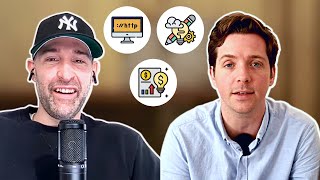
Jameson Camp, a former Google mentor, flips websites and e-commerce brands using SBA loans and creative financing. He sources deals through Twitter and brokers like Empire Flippers, targets 2-3x returns rather than VC moonshots, and scales by structuring deals where risk per dollar shrinks as deal size grows.
Chapters
Jameson Camp is a great follow on Twitter. He's former Google, calls himself a mentor. He does marketing strategy, he does website flipping, he has had 2 exits for his companies, and now he's investing in other startups, in other e-commerce companies. He sat down with me for an interview and we talked about a lot of interesting stuff, including how to raise money, how to flip websites, how to monetize, and also Twitter growth strategy. So if that sounds interesting to you, stick around, this is gonna be a good one. This video is brought to you by email10k. Learn how to book meetings with billion-dollar brands and take your company to the next level at email10k.com. Before we jump into it, make sure that you subscribe down below and give James a follow on Twitter. You can do that, we'll show his handle right here. Smash that like button for the YouTube algorithm, and with that said, let's jump into the video. Guys, today we're talking to Jameson Camp.
James is a former Google mentor. He is now buying and flipping websites. He's had 2 successful exits and he says he's had 1,000 failures. That's what the bio says. So James, welcome. Let's talk about that.
Cool. Yeah. Thank you so much for having me. Um, yeah, I think the, I'm fingers crossed on a 3rd exit this week. It's been like 3 weeks in the making for a business that we've, you know, exits like an interesting thing to call it. I, you know, uh, depends on, I've flipped a bunch of websites. I don't call those exits, right? Like I think about. Website flipping is a different function than actually just like building a business and selling it. Um, but yeah, just been, been, been building websites on the internet and selling them since I was a, since I was a teenager. And 1,000 is just an arbitrary number I've chosen. I'm sure there's infinitely more than 1,000 failures. I'm sure that's something you can relate to.
100%. I mean, I'm deep. This, this year's been good. Normally I'm deep in the failure zone. This year has been good on the, on the not so much failing stuff. What— tell me about these exits, because literally all I know about you, right? You're like a man of mystery. All I know is this black and white profile picture from, from Twitter and like, sure, this, this banner. That's literally it. And I've been following you for months. I've been reading all your tweets. I'll tell you about me.
Yeah, I'm not super— what's so funny is that like, people are often like, oh, why don't you give me more? Like, anyone that gets to know me or anyone that wants to ask me specifically, I'll give them details about my life, like, very candidly. But I always feel weird about like oversharing on the timeline. I just had some weird moments recently where like people saw a picture of my house and then like were sending me my address in the DMs and like weird stuff like that, you know, like, so I'm just careful with that stuff. But, um, yeah, so when I was a kid, I got into affiliate marketing. Um, well, I'll make it a short story. Um, became a decently sized publisher doing affiliate marketing, i.e., someone that runs traffic to affiliate offers. So like lead gen offers. Became pretty big in that and decided that I could start brokering those offers myself, brokering those leads myself. And so I built a CPA network, it's called, or an affiliate network called LiquidOffers that we sold pretty quickly. So that was my first exit. In retrospect, as an adult 33-year-old man, it was not such a major win. When I was, you know, 19, 20 years old, I thought I was like king of the world. And to this day, if it hadn't been like an actual purchase of the business. Like it wasn't massive, it just felt like a big win then. And then in July of 2020, was lucky enough to close on the sale of this holdings company that I had, that really the main stuff inside of it was a financial news website and a digital strategy firm. And, and so that was exit number 2. I bought, acquired a business in March of this year, the The plan, actually, you're the first person I've told this to that's not like a close friend of mine. The plan was for it to be like the conduit and like center of a rubber band ball to like do a big roll-up and buy a bunch of other businesses and make, you know, crush op-ax is what I'd say, but like get rid of some like inefficiencies in the businesses by combining them all. And we got an offer like 3 weeks ago to sell the business to a PE firm and, uh, we're taking the offer. So knock on wood, hopefully it closes in the next week.
How do you— so how do you deal with that? So for instance, you came into the business with one, with one goal to do a big roll-up. Sure. It sounds like you got, you got an offer earlier than you were expecting.
Yeah. I mean, it's just like the story of my life is like nothing, you know, nothing has ever panned out in the way I've foreseen it before. And, you know, you started out by saying it's been a good year. It's been a good year for me too, but not in any regard in the way that I'd planned it to be a good year. Right? Like, and candidly, you sort of, I think, have to have perspective. I went through a breakup of a 3-year relationship. I moved across the country, like all these things, right? Like, because life didn't pan out the way I expected it, but it ended up being, but it ended up being good. So I think, how do, how do I deal with it? It's just like you take the punches as they come. And when you see the right opportunity and I, I, my thesis was not a bad thesis for this business called Common Commerce, which we were buying e-commerce brands and rolling them up. It wasn't the wrong thesis. It just was like, didn't pan out in the way that I'd foreseen it initially. Um, and so you, for lack of a better term, you pivot, right? And so why not pivot and make the best of it?
How do you think about, um, how do you think about opportunities? Because this is, this is something I'm always thinking about, like This is your third or this is not gonna be your fourth time, right? Assuming you're gonna go and buy another business again, that's your fourth time.
So 100%.
And what are you looking at? What are you thinking about?
Yeah. So I've sold, so with that said, I've probably sold like, I think the last I tallied up was 12 different websites. Now this gets into weird complexities about like what are asset sales versus like acquisitions and like selling a business. And sometimes I've been through a stock swap. Anyway, it's like, it gets weird and mired in complexity. Complex. But yeah, I mean, candidly, I'm— maybe it's because I'm scared. But everyone, you know, when I look at opportunities, I'm not looking for that 1000x, right? Like, I'm not that VC style. And I've had a couple wins by chance, because things just had massive explosion, right? But when I look for opportunities, I'm more looking for, you know, how do I buy a cash flow positive business,, right, that does well, that if hypothetically want to use debt, is so cash flow positive that it could service the debt on its own, that then I can make slight improvements to, like, my— that, that then make a much larger ROI for me, right? I'm not looking to 10x my money, 100x my money. It's how do I keep stacking up these, you know, 2x wins, 3x wins. Like, that's, that's my— how I'd look at it. Now, it doesn't always pan out that way, but, but that's, that's sort of the plan, I guess.
Yeah. So how are you sourcing these deals?
So there's a bunch of different websites that people look at. Empire Flippers, FE International, Flippa, Exchange Marketplace. There's tons of brokers and marketplaces where people can go and try and find websites. Now, I've been very blessed, for lack of a better term, I think, to have a lot of deal flow come my way. And a lot of that's just positioning and sort of putting myself out there as this guy who buys digital businesses and sells them. And because of that, people reach out to me and try and sell their businesses all the time. Now, the reason that this becomes really powerful for me specifically, and I can think of a very specific example as of recent, I didn't end up buying the business. There's a business I wanted to buy. It was supposed to go to market through a broker for $9 million. And the seller of the business offered it to me for $8.2 million. And the reason he offered to me for $8.2 million is because the broker wanted a 10% fee for the sale of the business. Right. So for him, he was going to make an extra $100,000 if he sold directly to me. And for me, I was going to save $800,000 by going directly to him as opposed to a broker. So at small scale, that's not significant. And even in the scheme of businesses, that's not that significant of size. But for me, that's a big, big business, right? Like to be buying. And that's a lot of money to save, you know, near, near a million dollars. So I get a lot of deal flow through my DMs on Twitter. If you start playing in these circles, people just are sending you deals all the time. But in general, for the average person, I think you should be looking at like brokerages and marketplaces that I listed before.
How do you think about it? So for instance, what did I— so we, me and Robert, me and my co-founder just invested, it was like $70K into building out this SaaS platform. And when I look at threads like what you post, I'm thinking like the next $70K, I'm not going to say we misspent this $70K. I'm going to say the next $70K should probably go into What SBA loans to acquire a business would be, would be better than what we did?
Well, I think so. It's possible. I think it really depends on your risk tolerance. It really depends on a million different things. The SBA loan stuff is complex because I think that it's interesting if you're talking about MRR-based businesses, you're now, now there's some more players in the space that will underwrite that financing for you. Um, but normally it's again, it's basically invoice factoring without getting too complex, like, like Pipe and everyone who's lending against MRR. Is essentially doing invoice factoring, which is the oldest business, oldest lender business of all time. I go to a lender, I say I need cash today. I have an invoice that's going to get fulfilled in 2 months. They give me 70%, 70 cents on the dollar for it. Yada, yada, yada. The SBA stuff becomes complex in the digital space. I've talked about it a couple of times. Completely candidly, I've never taken an SBA 7 loan, which is an acquisition loan that people talk about a lot and I've mentioned. And it's just hard to find them in— I know lenders that will do it. It's hard to find them in this space because, A, you need, you need X amount of time in business. I believe it's 3 years. I think you need financials that reach certain KPIs that are just a lot of these guys that are selling websites for small amounts don't have. They'll make sense more in the million-dollar-plus range. But if you can get an SBA loan, it's beautiful debt. I mean, it's like, you know, 7% on like a 10-year fixed note with like no prepayment penalties. Like that's just Beautiful. So that's a great arbitrage I've talked about because if you can buy a website, let's say for 4x monthly as 4x the yearly income, that means you're paying down 20, you're earning back 25% of your purchase price every year. Right. So, and if I buy, if I take a loan out at 7% on a 10-year, right, like my point is I'm only paying on a 10-year, I need to pay down 10% of that plus 7%. So 17%. So if I'm making back 25 and I'm paying down 17, without changing the business at all, there's an 8% profit margin of just debt arbitrage there. Right. And so like that's, I mean, that's sort of how a lot of corporate debt works. But that's, that's, I think, a good way for people to look at SBA loans for acquisition of websites.
I just brought it up because anyone who's listening to this should check out the pinned thread on your Twitter. So we're going to link that down below. But you mentioned getting SBA loans off of $50K in cash. So but that sounds like that's not what you do. So, so put yourself in my shoes, right? Let's say you have 50 to 70K that you could invest in a business. What's the best allocation of that capital? How would you use that?
I think if you could find it, I think the website that's listed in that thread, if you find the right business for you and you can do an SBA loan, I think it's a fantastic opportunity, right? I wouldn't do it if you've got no understanding of how to run that business. I think that's sort of what gets a little scary. People will DM me today. I was DMing someone that had said, oh, I bought an e-commerce site for 30K. Can you recommend an agency to me to run ads? Well, you've already lost the game. I mean, I don't, I feel, you know what I mean? Like, because you bought a business that you functionally have no idea of how to understand, and you are so far removed from understanding how the business is run that you don't even know who to go to, to run like the most core function of that business, which is driving traffic. Right. So like, I really wish this guy the best of luck, but I just don't like it. He's, it's a real uphill battle. Um, I think that if you can find an SBA, Business Empire Flipper, I mean Empire Flippers and FE International are brokerages that will list some of them. So when they're available, they'll say they're SBA qualified, pre-qualified for SBA. If you can do that, I think it's a fantastic opportunity. For me, our thesis was a little bit different. It wasn't SBA, but conceptually it's the same concept. It's mezz debt, right? There's— I'm still talking about mezz debt, short for mezzanine debt, has to do with where the, where the debt is in a capital stack, right? So equity—
glad you're explaining this because I don't understand this at all.
Yeah, sometimes I get like esoteric and I forget that like I'm just like living in my little echo chamber, right? So mezzanine debt has to do with like where it sits in a capital stack. So a capital stack being like, like the money that is used for, uh, acquisition or financing, right? So the first layer would be equity. So that's money that James puts up. Then the next layer might be preferred equity. That might be investors that wanted— that were down to like get a big return on their money for some real risk. The next would be mezzanine debt. And then the next layer would be like, uh, like the conventional debt. So, uh, and the reason you'd use the mezzanine debt and the preferred equity plus your own equity is because to you, for you to get that big conventional loan, you have to have money, skin in the game, right? So, and this is also the order of who gets paid back when things, if things fall apart or things win, right? So the top, the conventional loan is going to get paid back, but they're going to get the lowest rate. The next is going to be like a mezzanine debt, right? So just like think about like a mezzanine and like maybe a movie theater, right? Like it's the, it's the raised section, um, where people watch movies or in a theater. Um, anyway, but my point is, is that for me, even if it's not SBA, conceptually, you're still talking about the same thing. You're talking about getting skin in the game with equity and then using leverage of debt to finance the rest of the acquisition. Um, so for, so for, even though that's not actually what we did on our last deal, like that's, that was the thesis of, of of what we're working on.
Were you all cash on the last deal?
Last deal was cash and stock. And so the stock gets complex because without getting into a very long explanation of how stock swaps work and yada yada yada, but we last deal was cash and then a stock swap for, and that meant that like the original owner got equity in a holdco that we have, right? So they got play on more stuff., and some cash and also was continuing to pull cash out of the business. Um, but it's, it's how do you get creative financing? I like to call it, I wish I had it right next to me. I'd find, I'd grab it. It's here somewhere, but I was just unpacking. I just moved to LA and there's like, I have these like stacks of textbooks that are literally just about mergers and acquisitions. Like I dropped out of college. I did not go to school for any of this. Right. But it's all sort of self-taught stuff.
I was going to tweet when you, uh, when you were flying out to LA, I knew it was going to be a one-way trip, bro. It always is. I ended up moving. I was in LA for 8 months and I thought I was just going to be out there for a couple of days. Same thing.
So this started out 3 days for me, it turned into 3 weeks and then I just ended up signing a lease and I was like, screw it, let me, let me, let me come out here. So here I am sitting in West Hollywood, Beverly Hills area.
So you're, so you're going after e-commerce. Why?
Why e-commerce? So e-commerce for me is an all ships rise in high tide scenario. It just is the world I know. I actually have really recent, like 2 days ago, I have a group chat with 2 good friends of mine, Oren and Colin. We have a little podcast together and they run a big cannabis business. And we've talked about, I mean, we just chat every day, but we were like, should we be buying laundromats? Should we be buying, like, should we be going and buying like boring brick and mortars? Right? Because like we all play in like, what I'd say is obviously for them in cannabis, it's like regulatory gray area. You know, like for me, I'm always trying to be on the bleeding edge. I know you're into some crypto stuff and NFTs today as well. Like I'm always trying to find like, how do I dance along the edge of, of, uh, of where the world is going. Right. And so e-commerce, I wouldn't say today is like truly on the edge, but in the scheme of the world, it is sort of where I think the future is. Right. It's, um, so it's an all ships rise on high tide scenario. Also, I've been making money online since I was like 15 years old. So like everything I know. Is like internet money. I, you know what I mean? Like it just fits with me perfectly. Um, and I've always loved the, uh, I mean, the most recent business was in the SilverTech space, I'd say. So like technology for like, uh, retirees or boomers for the elderly. Um, that was sort of a play on like in the next 5 years, over 70 million Americans will be over the age of 65. And so like, this is a rising TAM, like a rising total addressable market.. And so again, all ships rise on high tides. Um, and I'm just not bad at it. I'm pretty good at the e-commerce stuff, I think, at least. So that's, that's why.
When you talk about— when you talk about going for the small wins, you're talking about NFTs. That's exactly what I'm thinking about. It's like aping into a shitcoin or whatever, like you're going for a 2 to 10x gain, except it's just at a bigger scale and with a business instead of with, uh, you know, apes.
Well, dude, I'm— and you know what's interesting is I think we've seen— I won't go too deep into this, but we've seen like really, really generational wealth happen in the past few years, right, in, in the crypto and NFT space. And I think that people don't recognize it, but like these— I mean, some of it's just degenerate gambling for sure, like unequivocally, right? Um, and I'm— and I've partaken in some of that myself. But I think that a lot— that another side of it is like basically like mini VC stuff, right? Because these things are so early And some of these bets are hitting 500x, 1000x, right? And so this is just, that's just the VC model. You take them, you take a fund, you make 100 bets that you hope you hit 1000x and 3 of them hit and the rest go to absolute zero. Right. And so like, I think that a lot of the guys in like the, the, uh, the guys and girls that are playing in crypto right now don't recognize it, but as long as they're taking it seriously and trying to understand these projects, they're being like a mini, they're running like a, their own little fund., you know, and like their own little family office and taking VC-style bets that they're hoping for 100x and 1,000x on.
Actually, that's what I like about it too. And it's not, it's not like you have to wait now. All of these investment opportunities used to be hidden and you used to not be able to access them. So when people see like a 1,000x gain and they think it's a scam, no, it's just that has been hidden this whole time from you. Everyone's been getting 1,000x gains this whole time, but they had to be incredible.
100%. Well, I had someone reach out to me. What's interesting about that, the that those things being hidden is it's actually hidden even in a deeper way that most people don't recognize. Because what happens is people think that being an accredited investor gives you access to these 1000x deals. It does not, right? Like, it is from like, from a traditional capital market standpoint, like, not at all. So people— I had a guy DM me, sweet guy. He was like, hey, I think I'm gonna get my Series 63, some investment banking license. I was like, why do you want to do that? He's like, well, the SEC changed their rules of what's an accredited investor. So if I am licensed, I technically get to be an accredited investor, which is true. But the truth is, I'm an accredited investor. You know, accredited investor just means you make $250K a year, or you have over, I think, $1 million in net worth or $2 million in liquid net worth, right? And liquid doesn't have to be cash. It can be more stocks, marketable securities, like stuff like this. Point is, it's like, no one— I'm not getting phone calls every day to invest in Palantir and private placements of SpaceX. Like that's just not happening, right? Like, really, that's being even more guarded by like the super elites, you know, and like the ultra, ultra wealthy. And, and even then, those 1000x investments, some of them go to zero. But the thing is, if you got enough money to play with, and you get to, then you don't, doesn't matter. Because if I make 10 bets, and one of them 1000x, you know, like quite clear, and each one was the same size bet, then I've still 100x my initial money. Right? You know, 100 bets at $10 each is $1,000. One of them 1,000x's, it makes us a mil— it makes a million dollars, right? It sort of makes— takes care of all the rest of them. So yeah, some of these gains are really, are really there, just about getting early enough. I mean, none of this is financial advice for sure, right? Like, like that's something I try and be careful of.
But yeah, yeah, I haven't had a big win. All I did— my biggest trade so far was just I was able to double my, my biggest gain was I put $25,000 into Ethereum and it doubled to $50,000, like in 30 days. And I was so happy about that. That's a big gain. That's a nice gain, dude. But it made me realize like every time I think I should put more in, every single time, like it should have been $250K.
I know, well, that's the context of 2020, right? I'm sitting here myself and I decided like 2 weeks ago, 'cause I had owned a good amount of crypto in 2017. And shout out to 2 of my good friends. One of them was a commodities trader and one of them was an investment banker. And they were both like, that's garbage. Give her that garbage. Give her that garbage. Like full-on traditional finance dudes. And I was like, you're right. Sold it. Sold all of it in 2017. Missed a whole gang of gains for sure, for sure. So I decided in the past like 12 months or so, I guess around then, to really start getting more aggressively into crypto. I just was like, the cat's out the bag. No one's putting this— I feel about the cannabis sector as well. Like it's just too far out of the bag to be put back in. Right? And like, this is not tulip mania, right? Like, some of it's tulip mania, some of it's total utter garbage, and, uh, but some of it is like actual super real. Um, and I had similar sort of 2-3x gains on this, on this bull run so far. And like, I had made a decision like, I'm done, I'm not gonna put any more money. And then now I'm sitting there like, today I was like, well, I don't know, you know? So I— it's hard because it's like an obscene amount of gain, right? And only in crypto can you be like, oh, I only doubled my money in 30 days.
You know, I'm holding it, bro. It's there. I haven't sold.
Yeah, I haven't sold it. The other thing is, if you truly, truly, truly, truly believe— there's two ways to play this. I'm not a great trader, candidly, right? Like, I'm a, I'm a decent investor, but I'm not good at market timing, right? I'm not a technical— I don't read technical analysis. Like, I'm not, you know, it's just if you really, really, really, really believe in this, it really is one of those buy and hold scenarios because You know, I could try and sell this market top, this cycle top, and buy back low, and maybe I 10x again, whatever. Point though is that like the biggest thing I'm worried about on the sale of this is my short-term capital gains. Long story, because it's under 12 months, which means I'm basically giving the government 50 cents on every dollar, right, that, that I make here. Um, but if you really believe in it long enough and Bitcoin gets the adoption you foresee it to really get the way El Salvador did, then if you just wait long enough, there'll never be capital gains on it because you don't have to sell it. And if it becomes currency, then you don't— there's nothing— there's no gain on it, right?
No sell. Yeah, it's just—
there's no sell. You just use it, right? It's just like you just keep it in your wallet and that's just, you know, your savings. So anyway, we've had some good wins, but not like— I know you see these, the DeFi guys on Twitter just like, you know, I got a little money in OHM, I'm getting my 8,000%, you know, on my own right now. Again, not financial advice, but just obscene, obscene returns.
So yeah, this video is brought to you by Email 10K. Learn how to book meetings with billion-dollar brands and take your company to the next level at email10k.com.
So let's— because it's a podcast, let's take it back. So that's crypto.
Let's take it back.
Hit, hit a button on the, uh, the companies, the acquisitions thing. So sure, what, what percentage down are you putting when you say you want skin in the game in order to get financing? 2 questions around that. What percentage are you putting down? So for instance, let's say we put $70K in, how big of a loan are we getting? Or, and then 2, what, where is that other money coming from?
Yeah, so it's like a, I guess the way lenders are looking at it is like LTV, so like loan to value. And in that regard, like you, let's say $70K, maybe you're getting like maybe, maybe $70,000 is like 30% of the, of the purchase price, 25% of the purchase price. Um, so I guess let's make 25% because it makes the math much easier for me, right? So then another $370,000 is $210,000. So $280,000 is the total purchase price, right? Because you're putting down a quarter of it. Um, so yeah, so, and that sort of really starts to be— the SBA is not handing out loans for $50,000 businesses right now. Granted, like, again, this gets interesting about capital stacks, right? Because let's say the business was $1 million and Alex has $70K he wants to put in.
Okay.
But the lender's like, okay, you need to have $250K. Okay. Well, this is where, this is where the other debt and the other equity partners come into play, right? Alex got— has $70K. He's got somebody else that has $100K, but for the $100K, he doesn't want equal play on the deal. He wants a little bit preferred equity. So he gets paid out first. He gets a Higher dividend, yada yada. Now Alex has $170K. Okay, now he's still short $80K. So maybe you find a mezzanine debt lender or another lender who's willing to come and give you the other $80K, but again, at more aggressive terms. And now, and now you've got your $250K to go and take the $750K from the SBA lender to acquire the total business for $1 million.
You make it sound so easy and it makes the $70K seem so stupid to raise only $1 million. You know what I'm saying? Like, Sure, I've got friends that could probably kick $100K, you know, like I'd probably find 10, 20 of those guys, you know what I'm saying?
Like, it doesn't make sense. Yeah, you just gotta get comfortable with it. So I had an epiphany recently, and I don't— and I don't— like, I, I sometimes try and put out there what I want to do because I like putting that into the energy of the universe. Sometimes I try and keep it close to the chest. I won't dive into it now because I don't have a background in real private equity, and I don't want to sort of like misspeak and poorly explain things. Like, already, like The way I'm explaining things now is like, I'm sure my friends in PE would be like, oh my God, Jameson Camp, like you're just like not even explaining this correctly.
But all that matters is the hype.
Yeah. All that matters is the hype. You know, well, this is one reason I talk about flipping so much, right? Like versus buying and holding. Right. Because like, it's just candidly, like it's an angle. Like people I help that buy sites often are not trying to flip them. Right. They're actually looking to build out a portfolio of cash flowing websites. The thing is, it's like if you talk about the flip, this is just how all value-added PE works, right? If I can increase something's revenue by X, and I sell it for more, I get to capture so much of that, right? This— in real estate, people talk about cap rates. Anyway, um, go— people should go and research what a 2 and 20 is. So 2 and 20 are management fees in hedge funds, PE funds, VC funds, right? So 2 and 20 says that, like, let's say I raise $1 million from people, uh, that means I take 2% management fee on that money as the manager of the funds. And then 20% of the profits of what we do with those funds, right? So, um, in terms of you saying $70K seems small, like, I actually have a whole tweet that I have in my drafts. I'm going to turn into a thread about how you could take— I could, as a GP, a general partner fund, I could put up $50K, go raise $3 million, right? Like, and then again, it's— I think you probably have similar types of networks to me. It's like someone writes a $300K check, someone's writing a $25K check, right? But go raise $3 million. Now we've got $3 million and then go to a lender and borrow $9 million, borrow the other 75%. Now we buy a business for $12 million. Over the next 3 years, pay off that $12 million business, right? And now through the cash flows of said business, pay off the loan. Now we just wholly own a $12 million business, right? And I take a 2 and 20, right? So now we sell that business and we made X amount of money, but because I'd get a 20% fee of the profits, and this is just how funds work, right? I get 20% of that. We put in 3, bought a business for 12, now we've cleared 9, right? After it's all paid off, I get 20% of that 9. I get $1.8 million, right? And so like, I'm now— this is just how private equity firms work.
And that's like 6 to 8 months, right? Like, what do you think timeline?
Yeah, whatever you can pull, you know, it depends on the speed. Depends on the speed you're running it, you know what I mean? But like, so this— it's the— it's the, you know, whether even— even, you know, point is, is like leverage is the magic key. Here and, and cash flow. And I have not mastered either of those. It's funny, I think in like the Twitter, because I'm one of the few guys on like in the money Twitter quarter that also like plays in some of this real stuff. People assume I'm like this big monster, like who crushes it all the time. But like, in, in my non-money Twitter world, like I'm the kid on the team. You know what I mean? I'm like the little baby who's like talking about flipping websites for $50K, $100K, you know what I mean? So yeah.
And it is small. Like when we just started talking, I went from $70K is a lot to $70K is a tiny amount. And it is because most of money Twitter is those 22, 21-year-old kids and they are not knocking it, right?
Like, and you just, you just realize that like life changes as you, as, as, as life changes, right? Like, you know, that like make, make it $10K a month thing, which I think is an awesome goal for most people. We won't get into inflation and what I think and what I think $100K is today versus 15 years ago. I think $300K is the new $100K a year, essentially. Compared to when we were kids, I'm 33, right? And everyone talked about 6-figure salary when I was a teenager and stuff. I think, yeah. So similar conceptually. But you know, that's just my burn, man. That's just like what life costs me every month to live now. Right? So like that, that number changes. And I'm not knocking it. I think that's a great goal for people, but Interestingly, a lot of the mindset stuff, people— mindset is either garbage or the realest, realest thing on the planet. And I think there's some people that push mindset and they're just like shucksters and snake oil salesmen and they're bullshitters. And then all the true like monsters I know, and I mean monsters in a good way, business-wise, mindset's everything, right? Like, like when we talk about $70K being a lot or a little, I tell people all the time, think bigger, not just because like your goal should be bigger, but because I actually believe that execution and margin for error is infinitely easier at scale. So let me give you an example. If I went and buy a SaaS for $80K and let's say it's selling for 10X its ARR, right? I'm just making this up. It seems reasonable to me, right? So that means that that SaaS is making $8,000 a year. Okay. Well, I can't pay anyone. I better be working on that fully myself. Right? Like, and I better understand the minutia of every detail of how to do that, right? I better understand all of every single function of that business. Now let's extrapolate that and say, let's multiply that massively. Let's say I could hypothetically buy a SaaS for $800 million, right? And that SaaS was making $8 million a year, right? Like, or sorry, $80 million a year, right? Because that's the 10x, $80 million a year. At $80 million a year, you don't need to know how to write a single line of code. You do not need to know how to spend $1 on Facebook. What you need to do is be a good manager and have a good holistic understanding of how the business works and basically be a glorified salesman, right? And so the reason, I know that seems extreme, but like I've watched C-suite guys at billion-dollar companies pop from industry to industry to industry because they don't actually need to know the minutia of how to make that happen. The other thing is when we talk about debt, The SBA, remember, the SBA is just a government entity that is securing the debt from a traditional lender. It's not like you borrow money from the Small Business Administration. You borrow money from a bank and the SBA guarantees your debt to that bank to say, like, if this person fails, we got you. Um, the thing is, with an SBA loan, it's what we call— it's a PG loan, meaning it's personally guaranteed. That means if Alex Berman takes out a million dollars on an SBA loan and it fails, you personally owe $1 million. The thing that's great about $800 million loans, i.e., bonds, there's no personally guaranteeing any of that, right? Like, you don't, you know, when you go and buy a business for $50 million even, right? Like, no one is saying, or maybe some, but no one, no bank is like, well, Alex, I need you to personally guarantee this $50 million. It's, it's the $50 million is guaranteed by the asset that you're purchasing. Right. So you end up having like a little bit less risk in some regards and like a little bit, I think, and not that I've bought a $50 million business before, but like, and a little bit, uh, well, you haven't bought maybe not a $50 million business, but if $50 million is a, uh, if a $50 million investment's a $5 million business, I mean, now we're talking, I think we're both, we know what a $5 million business looks like.
I wonder where it breaks down. If it's like, where do you ascend? Is it $12 million a year? Is it $14 million a year? Like where, Where do you get into that sweet spot?
So from my knowledge, and I've run 8-figure businesses and I've been on teams that were involved in 9-figure businesses and like M&A of 9-figure businesses. So like I've seen the guys pulling the strings that don't actually run the business themselves, right? But they've run the funds that own the businesses. Um, but from my knowledge that what I've been told from sort of mentors of mine and people a little bit bigger for me than me is that like The debt world opens up at $5 million in EBITDA, like just open, like the floodgates open at $5 million plus in EBITDA. And like, people are just being like, oh, you need, like, if your business does fine, if you're trying to buy a business that does $5 million in EBITDA and it's for sale at a reasonable valuation, there is a lender who is, who's going to come and underwrite that for you and give you that money. Um, just because they know it can service the debt essentially. Um, and that also becomes the size where it starts Uh, what I've been told at least is it stops being personally guaranteed stuff, right? Like, uh, you know, there was a loan I tried to take earlier this year, or I wanted to take for $5 million and they wanted on a 30-month term at like 13% with a personal guarantee. And I was like, no, I'm all right. I'm, I don't really want to personally guarantee this $5 million loan for a business that I don't even own the majority of, right? It just was like, I was orchestrating the structure of of it. But to answer your question, I think that those big, big, big numbers, uh, happen at $5 million. But I don't— the reason I try and stay away from some of that stuff is because it's unrealistic for most people. And like, the mechanics of all of this like still function at the lower level. It still works with $50K, right? Like, it's, you know, we— I can make it work with $5K. I would be careful the way I explain to people because I don't want them to go take on debt that's really dangerous. And if you are taking on that debt at $50K, you probably aren't the best operator in the space yet. But like, Could I take $5K of my own money and then take a 0% APR credit card for 12 months and take another $30K off that card and then borrow, you know, get an investor for another $10K and now I've got $45K and then go to someone selling a business and be like, I know you want $50K, but I'll give you $45K today and let seller finance another $10K. So you're actually getting $55,000. We're going to finance it over the next year. Like, and that seller would probably say yeah, because they get $45K today and another $10K. You know, you can get creative with it. So my whole point here is that like, what I find fascinating is taking the tenets of like traditional financing and banking and private equity. And like, how do we apply that at a micro scale so that people can sort of access to that leverage? And I think that's useful for people on a much, much smaller scale.
It is useful for people, for other people. I feel like now, now we know, at least I know that the goal should be to raise something more like $50 to $70 million and maybe try to, try to get enough cash stack to put 25% down. And try to push it that way. It depends. Why not?
You know what I'm saying?
Because, because what I'm saying is like, it's going to take the same amount of time if you're scaling it down. It's going to take the exact same amount of time to raise $100K as it does to raise $10 million or even $100 million.
100%, dude. And I'll give you an example. Like, this is why, like, without getting into a long explanation of like how IPOs will work, right? And like with the banks very often, but underwritten offerings, i.e., the bank is like guaranteeing you X amount of money, right? So for someone raising money. So that— and they're offering of their equity to the market, right? And under an offering, normally, even the bank is guaranteeing it and putting up the money, they're then selling that to their clients. This is how investment banks work, right? So they're selling it, selling that to their clients. Now, a lot of that is a function of just calling, not even calling up, being like, I think you should buy this. It's like, oh, Alex, I'm going to give you an allocation in this stock. You're like, cool, great, you manage my money anyway. I've given you power of attorney already to do this, right? So to go along with that same concept, if I'm an investment bank and you come to me and you say, hey, I want to raise $100 million, and, and somebody else says, I want to raise $10 million, and I know that no matter what, I get a 6% carry, i.e., I get paid 6% for raising me that money, and both of it is the same amount of effort because I just know it's pressing a button and allocating clients' capital, why am I ever doing the $10 million raise? I'm not. I'm doing the $100 million raise, right? Because it's the same amount of effort and I get $6 million instead of getting $600,000, right? So like, again, the bigger you think, the more banks are gonna— are interested in doing this stuff with you because banks are just taking crumbs on deals, right? That's just how investment banks work.
The $100 million deal is easier than the $10 million deal.
It's easier. Well, it's— I mean, I'll tell you right now, if you went around and called investment banks, I'm really serious.
Yeah.
And you were like, hey, I want to raise a billion dollars or I want to raise $100 million or I want to raise $2 million. You would get 10 times more people would be answering the phone for you and looking at your deck and interested in talking to you at a $100 million raise than a $2 million raise.
$100 million raise for a $10 million a year business. A lot of margin for error, like you're saying.
Sure.
Sure. I mean, they're lending because it's less risk. Yeah. I don't know. I'm unbelievably hyped, dude.
Dude, I— well, listen, this is like my— this is like what I've sort of weirdly dedicated dedicated my life to. Like, I'm— I love two things. And that is like internet marketing. And like, I call myself like a transaction junkie, a little bit like, because I love like deal mechanics and trying to figure out something can work. And how do we align incentives to make both parties interested? And if I can't, I'm sure there's a way that we can make it happen. And you do that, like, how do we close valuation gaps? Like, Alex wants $10 million, I want to pay $8 million. How do we like use like, like financial tricks and, and, and wizardry to get us both happy, right? Because there's ways to make, to make that happen. So those are the two things that get me excited, are, are M&A sort of, and, uh, and internet marketing.
Yeah, it's so interesting. Um, all right, man, I think, I think we did it. I think we had the most valuable conversation ever.
I hope I'm too esoteric. Like, it's hard to, it's hard to like keep it like manageable because it's just so like, I don't know, high convoluted stuff a lot of times. So I apologize if it wasn't, if it was hard to understand.
No, this was great, James. Okay. Where should people go to check you out online?
Twitter is Jameson Camp or Jameson Camp is how it's spelled. And then nanoFlips.com, N-A-N-O-F-L-I-P-S.com. Those are my two main places and Yeah, find me over there.
Cool. Thanks for being here.
Thanks for watching the video. Be sure to smash the like button, subscribe down below, check out our past videos. We've actually done a lot of great interviews on this YouTube channel as well that you can check out, and I'll talk to you soon. Thanks for watching. I'm Alex Berman.
More from Jameson



You wont believe what else the founder started #opensea #mergersandacquisitions #venturecapital