How Can Experienced Professionals Become Startup Founders? | Part 1
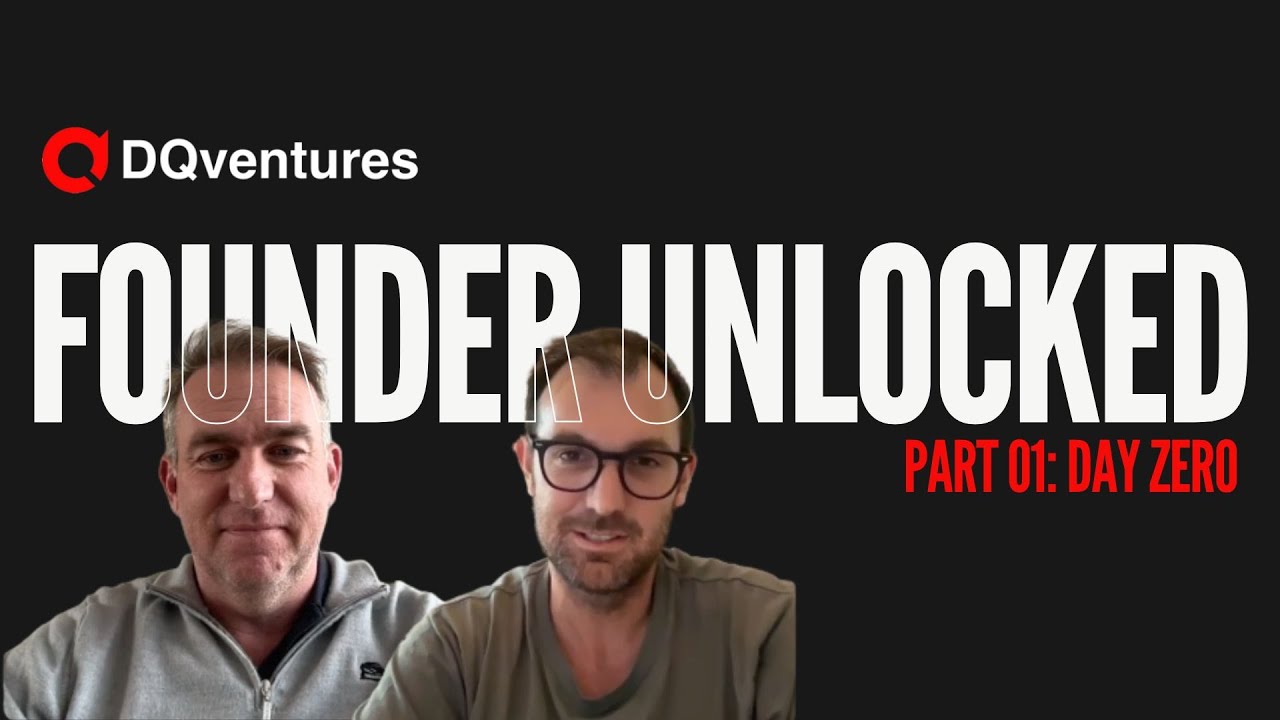
Oliver, Sam, and investor James Green explain how mid-career professionals aged 40-55 can become founders. DQ Ventures uses a three-stage method: Validate, Build, Scale. Older founders bring industry expertise and networks, but often fail on cash flow, taxes, and building features nobody wants.
Chapters
Statistics show that the most successful startup founders are 45-year-olds, but that's a really underserved part of the market. DQ Ventures was founded to help unlock these people from their corporate roles and allow them to become the CEOs and founders of their own companies.
I'm Sam.
And I'm Ollie, and this is Founder Unlocked by DQ Ventures.
We've been through the startup journey ourselves. At DQ, we're a team of 6 exited founders who've built and sold companies, and together we've invested in more than 100 startups. We know what works and what blows up. In this series, we'll be talking you through how we validate, build, and scale early-stage businesses, and you'll hear from some of the DQ team. We're 6 exited founders and investors in over 100 We've now launched 21 Ventures with experienced professionals just like you.
I started my sort of entrepreneurial journey. I was at university in the UK. I traveled around the world. I got as far as Sydney and I never left. I've been here since 1998. Myself and a business partner started a company in 2003 in the really nascent mobile industry, and we were developing very early mobile apps on J2ME for Nokias and Siemens and Motorolas and all those older handsets that everybody had back in the day. In 2007, Apple launched the iPhone. It's kind of really changed the game. We were known as the mobile guys in Australia, and everybody needed a mobile app. So we were sort of inundated with requests to build mobile apps. And on the back of that, we opened up a few offices around the world. We opened up in London and in New York, and we bootstrapped the business for the first 7 years. So we didn't take any external capital. It was basically just being built on the back of software, on the back of this sort of hardware revolution in the mobile industry. In 2011, we raised some money from a strategic investor. We did a roadshow and we sort of pitched our business all over the world. And a company called Aegis out of the UK put $11 million into the business. We opened up a bunch more offices. We opened up in Singapore, San Francisco, and Tokyo and Dubai. We built some really high-profile apps, including The Economist. And we did the Emirates Airline app and the Daily Mail in the UK. In 2016, we came very close to selling the business to Accenture. They got quite excited about what we had to offer. Unfortunately, that deal fell over at the last minute, which was a very traumatic experience, but nonetheless kind of stood us in good stead in the end. Our M&A advisor told us to put our heads down, sort of hit all of our targets over the next year, and then the fact that we got that close with Accenture meant we'd probably have another buyer a year later. And in 2017, we exited the business to Concentrix, and the 4 founders actually left on day 1, and we were, as of of the 1st of August, we were no longer employed. And at that point I retired. That was it. I was not going to do anything else. But as every exited founder tends to do, I joined a VC firm and I worked for an Australian venture, early-stage venture capital firm that was looking to expand into Asia. I was the entrepreneur in residence and my role was to kind of interview potential startups for investment. I was with them for 9 months. In 9 months, I saw about 700 companies and Investable invested in 2 of them. Which isn't bad statistics. For most VCs, we'll see 3,000 companies in a year and they might invest in 10 of them. But I really didn't enjoy it. It was awful. It was just a constant stream of seeing amazing companies and incredible founders and realizing that they weren't ready for investment and just saying no, no, no, over and over and over again. So I was complaining about this to a friend of mine and she put me in touch with 2 guys, Arjun and James, who've been kicking around this idea of a business builder type business, something that would work alongside founders and not sort of say yes or no to investment, but work with them to build the foundations and the building blocks of a really solid business in the super early stages. And the key component that James identified was working with older founders, founders who had great industry knowledge, had a fantastic network, um, and who had subject matter expertise built over the last 10 or 15 years, but weren't in a position, whether it was economically, financially, whatever it might be, to really start a company.
I had been investing in startups for about 10 years, and I was complaining to Arjun, who's now my business partner alongside Oliver, that I wasn't getting any returns from the younger founders that I was backing. They were coming up with these wild ideas, but then often fairly quickly burning out or proving that the idea wasn't, wasn't viable. But the older founders that I was backing were making money. And when we came to look at that, it became obvious why. Older founders have much more insight into the industry that they're working in, especially if they're trying to disrupt their own industry. They also have access. If they're senior people, then they probably work with senior people, and they can open doors that perhaps younger people can't. They have a great network. So, if they need to find partners or suppliers, then they probably already know who those people are. And probably most importantly, I certainly think this now, is that older people often are a lot more humble than younger people. They've learned over the years that they don't know it all, and that they are fallible. They don't have all the skills required to succeed, and they need help.
I probably was not one of those mature founders or older founders that you described there when I did my first venture. All in on day one, managed to set up a sports events business, which has created properties like the Music Run, Redline Fitness Games. We've scaled those properties across Asia. We've had over 400,000 people through the events. Very proud to say that that business is 11 years old, a fantastic team that runs that. And I was able to move away from being directly involved in that business in 2019, where I set up my second business, which was a sports consultancy. We were acquired by a digital agency. I moved into the role of CEO and director of that agency and really took it on a journey over 4 years in its kind of scale-up growth stage. Last year, I exited that business and was contacted by Jim, who I'd known for many years, to come and check out what you guys are doing at DQ Ventures. And I think that the mission really resonated with me, helping older kind of 40 to 50 corporate career professionals transition into entrepreneurship and unlock that kind of deep expertise that they had that That was exciting. So that's how I arrived here today.
Any business kind of begins with a kind of a concept. How do we help older founders do something? And, or how do I change this in the legal industry? How do I change this in finance? And I think working with older founders and getting an understanding of what their business needs without trying to be subject matter experts, we understand our bits as well as we can. And we want to bring in people who really understand the components of the problem that trying to solve. The challenge we have is that older founders generally don't know what they don't know. And we get so many people, this is probably across the startup world, is that they're often, people are building solutions without thinking about the problems that they're solving. And when you work with older founders, they really are able to articulate what the problems are. And they often have ideas around the solution that needs to be built. But when you are able to work with a sort of an experienced team like Deeque, we can drill into that problem and really get an understanding of what is a user experience? Why would somebody buy this? Why should this company exist? And then what's the optimal solution for that? And we can then bring in the right team to support that. But once you've built the solution to the problem, the challenge is how do I tell the world about it? It's no longer a case of just put a few Google ads out there. I mean, it just doesn't work like that anymore. And I think that's where kind of the experience that Sam has, both from a Deque perspective, how do we tell more people about the services that Deque can offer, is applicable not only to our own company, but to every single portfolio company. So we've really built out that go-to-market team such that when we have struck on the right solution to a valid problem, we've got the ability to then take that to the market and scale it. And it'd be interesting, Sam, to hear your perspective on, I guess, some of the portfolio companies and how you see that, perhaps even from a DQ perspective. How do we, how do we kind of really hone what we've got and then, and then take it to a wider audience?
And I think what we both realize having done it before a couple of times is that there are certain steps that you need to do to increase the chances that you're going to succeed and reduce some of those risks that you know you're going to face. And I think that that really is the foundational piece of the DQ model is you've got this 3-stage proven process where you start by validating Really making sure that we've done the work upfront to ensure if we're going to put time and effort into something, it's something that a customer actually wants and is willing to pay for. And you want to try and get to that as efficiently, as effectively as possible in terms of how you use your time, in terms of how you spend your money. If you get that initial validation, that gives you the kind of permission to move into the next stage. Which is where you start building and you can kind of do that testing phase. So you go back to those same people that you went and talked to and you put something in front of them. And it's rather than telling them this is what you're going to do, you're now showing them, you know, this is the initial piece. And I think one of the things that, uh, DQ talks a lot about is that minimum viable business. You know, how do we create a product? How do we create initial go-to-market message? How do we get initial customers? to understand how that business is going to work. And that's really, really important because that gives you the confidence to then go into the next stage, which is, okay, now we can start really planning how we're going to scale and grow this business. And I think those 3 distinct steps provide a solid roadmap for anyone to go about building a business. So that kind of combines with the collective experience that the team has. in bringing expertise in those different areas. And that fills some of those gaps that people are naturally going to have if they've been working in a career for a number of years. They may be very senior in one area and have deep expertise, which is absolutely great because we're looking for that expertise and that spike. We are able to fill some of those gaps as they transition into startup world and learning what's required to actually build and own and run your own business. One of the things that a lot of people forget is it is a process that you go on, and every business that you start goes through that process. And we've got it down to 3 simple stages. You've got stage number 1 is validate, stage number 2 is build, stage number 3 is scale. And so when we think about those 3 stages, there's obviously subsections in each of those stages. So the validate stage often is referred to as the idea stage. So you've got an idea for a business and you need to, first of all, go out and actually validate whether that idea is going to work. So the first thing that you've got to do is you've got to get very narrow on identifying your initial customer profile, your ICP. So, what we try and do is we try and niche right down so that we have one clear customer, and we then go out and we do user interviews. That means actually talking to these people. We do user surveys. We collect data from trying to increase the number of people that we can speak to, to get feedback around whether something is actually a problem. And you use that great phrase, which Jim always talks about, that hair-on-fire problem.
Yeah.
really a problem that people care about? And what we tend to look for is we tend to look for those problems that are going to save people time or they're going to save people money. And if you can save people time and money, then that's normally a problem that we're interested in. And then we start looking at that frequency that the problem occurs. If this is once a year, maybe that's not that interesting. If this is 3 times a day, this starts to become quite interesting. And so that frequency in that the problem is there, you know, how, how raging is that fire, uh, on your head, you know, those are, those are the things that we're trying to look at. And we, we don't just want at that point to take people's word for it, okay? We now want to take that feedback and we want to try and look at the critical thing, like what is the one thing that creates the clear value proposition that people are going to be interested in? So when we have that, you're really trying to kind of test that and put something in front of people, okay? And I think you'll often hear people talk about, okay, can you get people to join a waitlist? Well, like, what does that really mean? Like, at that point, you have to have taken the feedback that you had and you have to have defined a value proposition for something that you're going to offer people. Then you have to put it in front of them, and then you have to get that first proof that they're willing to take an action towards the solution that you're putting in front of them. So that's where you're trying to get the validation, not just that there really is a problem. Secondly, that the solution that you're offering is something that's going to solve that problem and that people are willing to take that first step to actually say, yeah, I'm willing to do something. When you've got that bit, the next bit is, are people actually willing to give you money? Okay? Because until someone has given you money, it doesn't actually mean that you've got anything there. So once you start collecting money and people are willing to give you money, even if it's just £1 or $1 to sign up, that is a really solid proof point. So that proof point allows us to move into stage 2. We now go into build. Build is how do we build something, which means we're no longer just telling someone about something. We're able to put something in front of them, which is the You hear people talk about an MVP, a minimum viable product. Other people talk about a prototype that they're going to create. This is really the first iteration of the solution that you're creating. You're putting it in front of people, you're getting them to actually touch and feel it. So you're showing it to them rather than just telling them about it. And then you're actually getting some feedback on that, and you're getting to see whether they're actually willing to continue to to use it and hopefully pay for something. So that build stage is where you're trying to build not just that prototype, that first edition of the product, you're trying to build an understanding of what that business might look like. Okay? So we're trying to understand, have we got a repeatable initial customer that we can talk to? We can find more of them. And you used that phrase, Olle, that we love, which is, you go out to your warm network, people you know first, okay? They can come from Deque's network, it could come from the founders network. But once you've done that, you've got to go to the cold network. These are the people that you don't know, okay? So you're now approaching strangers and you're asking them to do the same things. If they're willing to do it, then you start to build that level of confidence, okay? So we're starting to then understand key elements of that business. Is our value proposition working? Are we willing to win paying customers? From winning those paying customers, what are some of those initial unit economics that are making sense? How long is it taking to win them? What's the average purchase size? We can start to understand some of the core elements of the business. That really is important before you go into that scale phase because that allows you to start planning about how you're going to to scale up what you're doing, find more customers, generate more revenue, and then start being able to look at the key things that you need to develop in the product or solution that you have. So those, those 3 stages, I think we've now built into the DQ program, and we've created modules within that program that allows the founders that work with us to work through in a systematic way each of those stages. And at the end of a stage, we have a gate, and that gate allows us to come together with the founders to say, have we achieved the things that we need to achieve to give us the confidence to move into that next stage? So we're really building in that systematic way, which is— I like it to building foundations of your house. You're building those strong foundations so that when you go to the next stage, you know that you've got something robust to move forward from. So that's something that I think, you know, we've put in place with the DeeQ program.
And I think the beauty of it as well, certainly from my perspective, is, you know, we talked about that kind of very high failure rate of startups. And that's one of the challenges that people have. They're in a safe, secure corporate job. They've been doing it for a while. They've got this idea for a business, but they know that 90% of businesses fail. So what's the thing that moves you across? What's going to make you want to sort of step across? And going through this process with DeeQ kind of gives you the confidence that this is going to work. You know, you— the excitement on founders' faces when they get their first paying customer, even if it's someone they know, is only surpassed by the excitement when somebody discovers their product that they've never heard of. I remember one of the things in early days of Tigerspike, we'd built one of our first iPhone apps, and it was for kind of a big customer, and it was super exciting. And one of the developers came into the office, and he was so excited because someone on the bus in front of him had an iPhone and was using the app that he had been building in Tigerspike.
Yeah.
And he's like, oh my God, it's amazing! this stuff is incredible. And it's the same with founders. That's the sort of point at which you go, oh my gosh, I am out of this corporate gig. I want to be doing this. And there are different times that people sort of want to make that switch. There's different kinds of decisions that kind of have to be made and different life circumstances. But what we try and do is take people on that journey to get to the point where it's so obvious that this business has got a great chance of success. It's got phenomenal foundations. It's got customers who are willing to buy the product. It's got a plan in to scale it to, you know, large numbers of customers in one geography and possible multiple geographies, because, you know, we're spread across multiple geographies. And it just helps kind of with that decision-making process, rather than the classic example of, I've got this brilliant idea, I quit my job, I spend 100 grand building an app, and then I sit there and think, my goodness, where are all my customers? And what we do with Deque is we make sure that not only do you not spend 100 grand on that app until you have to, That the customers are going to want this and that they're going to be prepared to pay for it. And there's an awful lot more customers out there than you've, than you can possibly imagine, because that's the only way businesses will succeed.
And if you come back to the DQ process where we validate first, then we build second, then we scale third, like why shouldn't you build first? Oh, why should you focus on validating first?
Yeah. I mean, I think on the one hand it's expensive, right? I mean, it's getting cheaper and if you can use AI and a lot of the founders we work with are non-technical. Founders. They've got good ideas, but they've got no idea how to actually go away and, you know, build a website or build a platform, or if it needs to be mobile, put something onto a mobile device. So they have to seek out kind of specialist knowledge, and that's expensive. You can get it built, you know, you can outsource it, and then you can get great results, but it's also— it takes a lot of project management. You kind of don't really know what's going on under the hood, and it might be brilliant, but if it breaks after 10 users or that company, the outsourcing company, goes bust, you're just left with nothing. So, so you don't have any foundations. You've built this sort of straw house and the wind comes up and it blows away. So, so I think the one thing is kind of, you know, de-risking the technical side of your, of your business. The thing that James uses a lot is called the mum test, in that people will often tell you that this is, oh my gosh, Oliver, that's a brilliant idea. You should, of course you should go and do that. Why don't you quit tomorrow and go and do it? It's amazing. Because that's what you want to hear. And you're kind of, you only hear what you want to hear. And they're your friends. And they'll tell you it's great, but they haven't really thought it through. They haven't thought, would I pay, you know, $20 a month for this? Or is this a solution that my business would pay $200,000 for if it's a B2B thing? They just want to tell you that it's a good idea and it sounds awesome because that's good. So The Mum Test is a book and it's really about, you know, your mum just wants you to be happy and she tells you all the right things. But really what you need to do is get that kind of critical analysis of what you've built. And if you've spent $100 grand or £200,000 or whatever it is on building something, and then you go and look for that critical analysis, what do you do if it turns out you haven't haven't built quite the right thing. And that's the beauty of the kind of validate, build, and scale process, because we, we do things to— whether it's prototype, you know, whether it's just kind of a clickable demo or an idea of how it might work, and getting that feedback from people who are not just in the founders network, who are not just gonna be like your mum and tell you that it's great, but might actually say, this is rubbish, and— or, or this isn't so great, have you thought about that? That's that validation piece. And then it's kind of, would you pay for it? Oh, it's a great idea, but no, I wouldn't pay anything for You haven't got a business. You can't build something if someone's not going to pay for it. So I think that's where the having a great idea and then going and building it and not validating it until after it's built is a real challenge. And it's often reinforced by the people around you, whether it's your friends or your network, because they think it sounds good. And the way you describe it is never quite how it looks when you've built it. Trust me, I was told if you're not hugely embarrassed by the first product that you ship, then you've waited too long to ship it.
Yeah.
So I think it's really important that you Understand what it is you're going to build and how you're going to put that into market before you spend any of your hard-earned dollars on just building something, even if you think it's the best idea in the world.
And that's so often where we are. Like, we have this belief, we fall in love with the idea, we fall in love with the product, and we believe our own bullshit. And actually going and speaking to people, putting it in front of them, actually seeing what their actual feedback is, whether they're willing to actually pay for something, whether they will actually use something, Like, the customers are the people that you're going to build your business with. Okay, so the sooner you get out there, the sooner you actually start creating relationships, the more curious you can be about really what their problem is and what they're willing to pay for, the better. And that's why we really encourage at that early stage to be engaging with those initial customers. They may not be your customers further down the line. You may evolve that customer profile, but you've got to start with that customer-first approach and really understand what it is that creates that hair-on-fire problem for them. And if you're solving that, then that starts to become meaningful and interesting.
We often talk about this concept of trying to boil the ocean, right? You've got to start small. What's the key point that you're— what's the key deliverable, the key component of your solution that's going to solve that problem? And I think that's one of the key things that Deque helps with. If we are going to get something built technically, What's the smallest sliver of the problem? There might be 53 different features that the application or the website or the solution will ultimately deliver on, but we've got to work right at the start on the one that's most important and build that. And we work with, you know, one of the Deque portfolio companies, BlueMongoose. They build all of our in-house kind of prototypes, early-stage products. And we're incredibly focused on making sure that we're building only what needs to be built today. Because if you go out with your idea and you go and brief a company on what do you want it to do, they'll sell you everything. You'll get a feature-rich, it'll be filled with all the bells and whistles, and it might well be amazing, but half of those you don't, you don't necessarily need. And you might find later on down the track that they're redundant or they actually detract from what the solution itself does. So it's not just about sort of getting a technical partner on board. By working with Deque, we work out what it is that needs to be built now. And that's not to say, as you said, that that those other features won't be included in the product down the track, but it's always a phased approach. How do we solve a problem that people have with a solution that people will pay for today? And then we've kind of got this roadmap and that's always exciting because a business is never one and done. It's always got to evolve and it's got to cater for a larger customer base. It might need different languages involved in it. It might need to do different parts of, might have different components to the solution down the track. And what we try and do within the Deque program is understand when they will need to be included.
Mm-hmm.
It might cost you $100,000 to do one of those features, but right now we can build something for a relatively small amount that shows there's that problem. But you've got an idea that you either need to generate enough revenue to pay for this feature-rich platform that's gonna do something in the future, or you might need to raise some capital, whatever, whatever the path is that your particular startup takes. And that to me is a core component of going through kind of the DQ process and bringing in the experts to help you kind of understand that process in a logical way.
Yeah. And I think one of the things that is very important for people to understand is that we're not just advising on it, we're actually doing it.
Mm-hmm.
Leanne and Darius, 2 of the team, hands-on, they are— Darius, if I take an example right now, is really helping to refine the value proposition so that when we're actually creating that prototype, we're very, very clear on the key feature that we think is going to be driving the value. Okay. Leanne is then managing with Toby from Blue Mongoose the creation of that prototype. And so, you know, that is Deque actually doing the lifting for you.
And Rachel is an interesting one. She had a particular— so her business is called Journey. It's an Australian-based company, but operating around the world. it's basically sort of having a companion for flights. So if you're like a sort of a nanny on a flight, if you've got young children, someone who sort of sits alongside you, helps you, helps with kids or helps with elderly parents getting them through airports, that kind of thing. And initially, we kind of helped her work on what the sort of minimum viable business would look like. And we worked closely to understand, you know, how this was going to work, the logistics of it, making sure people met after they'd gone through immigration. So there was no carrying things through airports and that kind of stuff. And speaking to airlines as well as speaking to travel agents to understand the logistics, and then kind of getting it out into market, attracting users to it. And we came up with a business model, and she was spending a lot of time trying to match people up, and it sort of worked, but it wasn't generating enough revenue. And we looked at the business model and realized that we'd need to raise an awful lot of money for a B2C business, as hers was, to attract enough users to it. And that just wasn't really an option in today's sort of venture capital market. So after a number of conversations, we kind of— we flipped the commercial model. It's now making a reasonable amount of money, and she's right on the cusp. She can see the revenue she's generating from the people. People love the service. People are incredibly passionate about the business she's trying to build, and she's growing her numbers. I think it's about 1,000 a month at the moment, and reaching that point of sort of that threshold of being able to pay herself a salary. and to move out of a very traditional corporate role that she has. And she has 3 young children. It's a big risk that she's sort of going to take if she decides to do it. She knows she has our support from a technical, from a marketing, from a strategy perspective. And she's going to move forward with this company. So there's a number of examples that are in the DQ portfolio of the way in which this model has just built things that would otherwise have never existed. They would never have come into existence without DQ because the older founders would either have never been able to sort of get the business to a point where it was viable, um, and, and never taken the chance to sort of jump on board. We rely on founders with subject matter expertise to bring us ideas. We're not randomly generating ideas and throwing up— throwing them at people to see if they could run them. We want to turn your idea as an older founder into a reality. And I think that's the beauty of DQ.
And I think one of the things that, that's really interesting there is Any business goes through that test and learn period to kind of find out what works. And the advantage there in that example with Rachel was the initial business model that we were looking at, it didn't look as if it was going to be viable. And so through the collective experience of the team, we were able to look at how we test out a different business model to see whether that would be more viable and continue to support the service that is being provided. And that's proved to be the case. And I think that that's a great example of in the early stages of a business, it's about building the right foundations.
James constantly refers to what he calls company killer mistakes. And hopefully, we've seen a lot of them. But if you're a corporate leader or, uh, you know, an exec who's, who's been in corporate for 15 years, you probably won't have come across all these company killer mistakes as that many entrepreneurs will have seen. And so being able to draw on the collective experience of DQ and, and the rationale behind the program and the 3-step process is designed to help avoid those kind of things that happen, but, but also to sort of, as I said, reduce that timeline to help you, you know, get to a point where your business is generating significant revenue and building towards that sort of $10, $20, $30 million valuation. acquisition, or potentially an exit within a timeframe that's kind of really appealing if you're 45 or 50 or 55. Because a 20-year timeframe, if you're 50, to sell a business is not quite as appealing as it is if you're 25. And that's something that Deque is here to do. We recognize that.
Yeah.
We're not sort of working on this kind of indefinitely. The point is to crystallize the value of the business that you're building, and then move forward and and do whatever else it is you want to do with your life. So, um, yeah, lots, lots of interesting things. And I think that's where the program really comes into its own. It's how do we kind of learn from all of the businesses that have been involved in it and other companies. James has been— is an investor in over 90 startups. Sam, you founded— you founded 2 businesses, um, exited one of them. I've been through one process and I've been involved in another one. So there's a lot of experience there in sort of successful As well as failures along the way, I'm sure. So, that all-in decision is a big one, but it can lead to, in a short timeframe, a hugely successful economic outcome, but also kind of fulfillment on a deeper purpose, more purposeful-driven level. And that's really exciting, I think, as well. Yeah.
And I think it's important to talk about some of those failures because I think that's the other thing that is really interesting collectively between the 6 of us in the DQ team. We've had an awful lot of those failures on our various different journeys, but what that allows us to do is it moves having not had that failure before to actually being able to understand and recognize the potential for that failure again. And I think that that is really, really important. That gives you that step up, okay? Because we are able to be that kind of guide who's able to say, okay, we need to watch out for this. This is a very common thing. People often don't think about that. Okay, we don't want this to be a company killer, so let's make sure that we take these steps to build this in the right way and avoid that potential mistake down the line. So I think having 6 different perspectives with collective experience between them really helps you kind of navigate those early stages where it You are going to fail, but it's about making sure that those failures are not company killers. So, something that nearly could have been a company killer for us was when we were doing the very first Music Run event. We had the idea, the concept, we went out, we sold tickets, we sold 5,500 tickets to the first event. We had AIA as our presenting sponsor. We were really confident that we'd built a strong commercial model. We were launching the event in Kuala Lumpur in Malaysia, and it was a 5-kilometer fun run, music all the way around the course, and then the music festival at the end. And most 5-kilometer runs, marathons, half marathons in Malaysia happen in the morning. And they happen in the morning because it's cooler to run in the morning. So like most other events, we we had the event, you know, in the morning. People finished the event, had a great time on the run. We had music artists set up to do the music festival, and there's a stage with about 50 people in front of the stage, and the other 5,400 people, uh, had, had all left after their run because it was too hot to go to a music festival. Um, and it— that could have been a company killer, uh, for us. The fact of the matter that we completely missed was the other side of our business model, which is the music festival part. If you look at all music festivals in Asia, when do they happen? They happen in the evening. They don't happen in the morning. And so we had focused on the wrong part of the experience and we hadn't tested it and we hadn't really actually understood the experience that we were creating. For the second event, we did it in the evening. What happened? Luckily it grew. We almost 10,000 people at the second event, and we had a fantastic retention rate for the festival. And that became the key differentiator, was that we were creating a healthy fitness experience with a music festival. And that really enabled us to grow. But we went from being a morning event to an evening event. But we were lucky to get a second bite of the cherry there. Our commercial partners continued to support us. And that enabled us to grow.
I think company killer mistakes are fascinating. I mean, probably the closest we came from a Tigerspike perspective was one year, I think in our second or third year, we actually made a reasonable profit, which is something I would definitely advise startups against. It's never a good idea. But because we made a profit, we had quite a substantial tax bill. And we'd always provisioned tax, but because we suddenly had a reasonable-sized tax bill because we'd made a profit, we entered into a payment arrangement with the government. So instead of paying it all at once, we paid it on a monthly basis. And for some unknown reason, the requests, once we'd entered into this arrangement, were going to our old accountants. So we carried on, everything was fine. But the ATO, the Australian Taxation Office, if you miss a payment when you've set up a payment plan, the government tends to get rather annoyed. And about 6 months of us thinking everything was fine, we'd entered into a payment plan, we were just waiting, and our accountants were having the invoices, and we weren't even thinking about it, hadn't featured on our list of things because we'd never made a profit before. Suddenly, the CFO and the general manager of our Sydney office walked in and the accounts were all at zero. And they came to me because I had approval over the bank transfers. And they were like, Oliver, where's all the money? And 2 bank accounts that managed the wages and that managed just general income were zeroed out. And suddenly, we had absolutely no money. And it was the middle of the month. And we were like, this is ridiculous. And we spoke to the bank. There must been an error? What's happened? I hadn't transferred any money anywhere. And the bank said, oh, well, the ATO has a garnishee order over your bank account. So if you fall foul of the ATO, they have the right to go into your bank account and take the money out. So we called the ATO and said, this is ridiculous. We'd fully intended to pay. We can pay it over time. And they said, no, no, no, you'd entered into a payment plan. And because you missed 3 consecutive payments, we retrieved the funds. They also said that for the next 28 days, any money that gets deposited in those accounts will instantly be moved out to the ATO until the debt is cleared. And we had to pay salaries, we had to pay rent on the office. This was somewhat of a disaster because we had about 20 staff at the time and bills were significant. We were covering our costs each month, but we certainly couldn't afford to have zero in the bank account. So Luke and I managed to cover it with some interesting kind of favors and calls from friends, and we paid the staff and we got through it. And we actually ended up paying off the entire tax bill in 2 months instead of the 12 months that it was supposed to happen over. And so it actually put us on a better footing because suddenly we had more free cash. We were in a really bad way, but we managed to pay everybody back. But there was a very close friend of ours who was based in London. They ran a food series of sandwich shops and they generated a profit and then expanded quite quickly in the next year and didn't generate as much cash. And because they couldn't pay their tax bill in the UK, they shut their business down and they lost everything. So serious, you know, taking tax and kind of good corporate governance and putting the foundations in place. It's not, it's not okay to just not worry about a shareholders agreement for the first 5 years or not put in place the right kind of financial rigor and kind of understanding of the fundamentals of business, you know, sort of pay your tax bill on time, for example. Those sorts of things are just the sorts of things that kill companies, much like not understanding how the weather You know, whether it's going to be hot or cold. So, so I think that, you know, those are the sorts of things that come out anecdotally as you talk to founders and you work with people who've been through it before, and it puts you on a better path to success with your own company. So I think as long as you can learn from failure and it isn't the end of it all, then that's great. They're useful exercises and useful kind of learning experiences.
You know, this is, this is a big thing for those older career professionals who are transitioning into entrepreneurship is, you know, many of them have led a team, many of them have managed a P&L, but often they haven't been looking at cash flow. And actually, like, cash flow is the lifeblood of, of your business.
Yeah, absolutely.
It's an incredibly important thing to understand. So the financial kind of rigor, understanding the unit economics of the business is, is really important, but also understanding your cash flow cycles, your cash collection cycles, Putting the structure in place around those things, incredibly important. And as you've just shared there, understanding your compliance obligations, your tax obligations, equally as important because if you get those things wrong, it is that, in your mind, a black swan event, in the government's mind—
Happens all the time.
Exactly. But those things I think are really critical. And, you know, I'm, I'm really glad to, to see those things as things that at Deque we take very seriously as we go into that pre-scale stage to make sure that we're putting the right structure in place to support businesses as they kind of move, um, to grow. And, and, and, and the, the founder becomes the CEO of their own business, and as the CEO of their own business, they have to understand all of these different parts of a business, and they've got to wear those hats. It's about helping people make that transition, and it's about giving them the information that we know is important at this stage and making sure that they actually understand that information and are able to use it in a practical way to make sure they have a strong kind of business foundation.
So that's why we started Deque. Because the world doesn't need another 23-year-old with a pitch deck. It needs experienced professionals who actually understand their industries.
And we know the risks. Between the 6 of us, we've made just about every mistake there is to make. The whole point of this series is to help you avoid the worst of them.
Over the season, we'll break down the founder journey into real, actionable steps. Starting with the problem, building a minimum viable business, knowing when to go all in, finding your first customers, scaling, and if it makes sense, raising capital.
So if you are sitting in a corporate job thinking, could I actually do this? The answer is yes, but do it the smart way. That's what we are here for. And next up, why every great business starts with a problem, Check out some of the articles on our website or come to one of our webinars where you can find out more information.
Our webinars are great.
Oh God, I need to do it again.
More from James



How Marcello Patané Turned An Idea Into Paying Customers in the European Biotech Sector

Why you should interview people who rejected you (as well as your customers).