Rachel Built a Marketplace Without Raising a Dollar
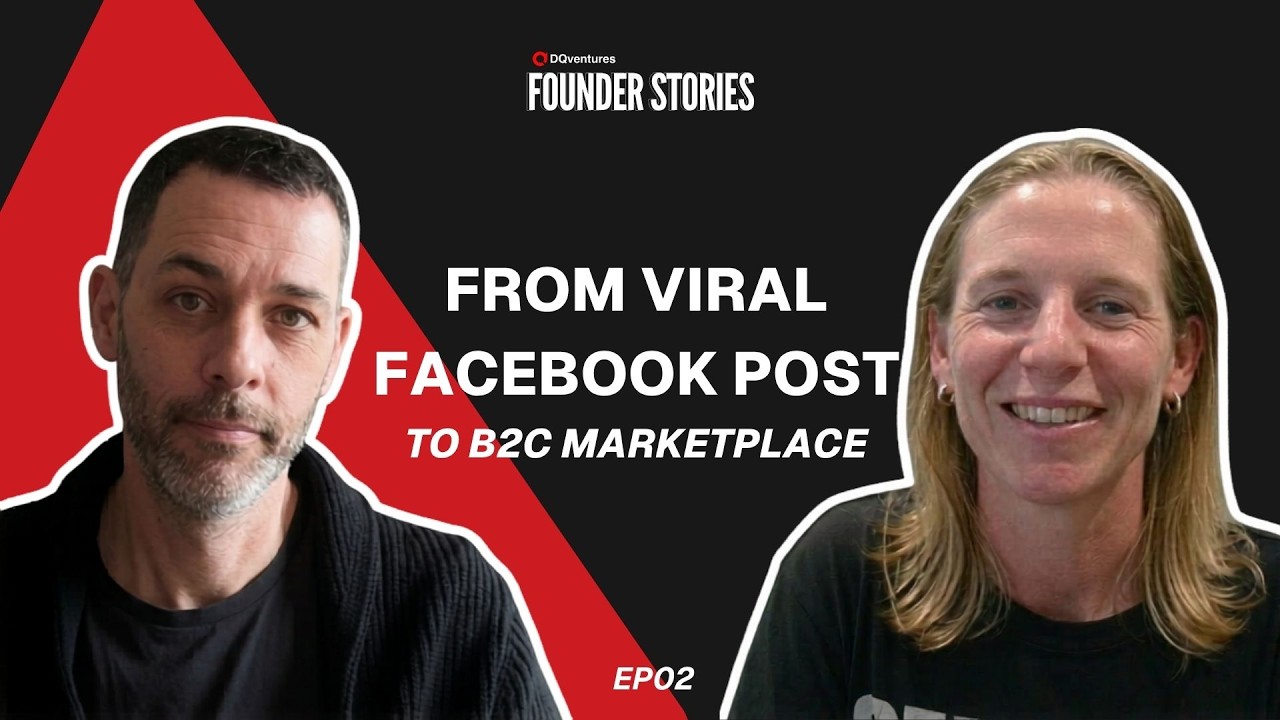
In this DQ Ventures podcast episode, host James Green interviews Rachel, the founder of Journey, a two‑sided marketplace that connects travelers who need assistance on flights with companions willing to help for free or subsidised travel. Rachel discovered the problem when she had to fly from the UK to Australia with three young children and posted a Facebook ad that went viral, revealing a broader unmet need. While working full‑time at Telstra, she bootstrapped the idea using manual processes—Google Sheets, Mailchimp, freelancers, and a simple web form—to validate demand and run early matches. Viral media coverage (Channel 7, national news) generated a large email database and over 500 pre‑sale sign‑ups. Initially operating on a commission model, Rachel pivoted to a subscription model, pre‑selling lifetime access to generate the cash needed to build a custom platform. With DQ Ventures’ support, she hired Toby from Blue Mongoose to develop the platform, launching the automated product in June 2025 after a six‑month build. Throughout the journey she learned the importance of manual validation, realistic timelines, the challenges of B2C marketplaces, and the value of revenue‑based growth over early VC funding. The experience also provided transferable skills that benefited her role at Telstra, especially in managing startup portfolios and understanding shareholder dynamics. Rachel plans to scale further, possibly adding a co‑founder, and reflects that starting Journey was an “MBA on steroids.”
Chapters
So I've never started a business before. It wasn't really like a burning ambition of mine in life. And then when this problem happened to me, that I then thought, well, why does this not exist already? And is this actually a real problem? And at this point, really all I had was an idea. I went through every step of the process so many times that I learned what is good, what is bad, what is a problem, because I knew exactly how a flow should be, because I knew what Works for a user and what's a problem for a user from having done it myself, step by step, painfully, um, thousands of times. I just didn't actually appreciate how long it takes to build a business. No one writes about that part of the business and all the things that went wrong and how they, you know, couldn't even afford a takeaway or whatever. No one tells you about that. It just sounds like overnight some business started and then became a unicorn the next day. Well, more than 50 journeys have happened where people wouldn't have been able to travel if it hadn't been for my platform.
Hi, I'm James Green, co-founder of DQ Ventures. If you're an experienced professional thinking about starting your own business, then please listen to this before you quit. Hello, welcome to the DQ Ventures podcast. The internet is filled with stories from the 1% of founders who are building the next Google or Facebook, but there aren't many interviews with founders who are building real businesses who aren't backed by Sequoia Capital, and we want to hear from them. What's it really like to quit your job and go all in on your own startup? What's it really like to try and set something up on the side while still employed. So, at Deeky Ventures, we work with founders who are still in their jobs, who want to have their own company, but have too much responsibility to just give it all up and go all in on day zero. And Rachel, who's joining me today, is one such founder. She's working for Telstra in Australia, in Sydney. And very unusually, Telstra are fully supportive of Rachel's side hustle. They know all about it, and they have given her permission to do this. It's quite unusual in our portfolio. Rachel's the only one in that position. It makes it very easy to talk about Journey. It makes it— it means that Rachel doesn't have to keep it a secret, and she can, where necessary, ask for help.
Hi, I'm Rachel, and I'm the founder of Journey. Journey began when I had to fly back from the UK with my 3 children under the age of 4. By myself with a 2-month-old baby, and I realized that it was something I didn't think I could do alone without an extra pair of hands. I posted an ad on Facebook looking for a companion or somebody who could help me with my children, and it went viral. I had thousands of people comment, respond, message me, and media outlets reaching out to run a story on me, and that's when I realized that this was a problem that was more widely spread than just me. We launched Journey in June 2025, and since then we've had more than 50 journeys that have completed. The thing I'm most excited about is getting more people matched together so that more people can travel the world, do the things they want to do, see the people they want to see, and not be held back by the challenge of the flight.
We constantly get approached by founders who have big ideas and don't know a lot of the traps that they can potentially fall into. And the truth is that many, many people shouldn't actually start the business. They've got it pretty good in the job that they're doing. They've got a dream, but they don't really know what they're letting themselves in for. So we want to hear from you about what were some of the things that surprised you for the good and for the bad, and what have you learned along the way? So just for the benefit of anyone listening, nobody knows what Journey is or what it's about. Can you give us a very short introduction to it? What problem you encountered and what made you want to set up a business to tackle this problem?
Yep.
So, the problem was I have 3 children. At the time, they were a few years younger, so they were all under age 4. One of them was a new baby, and I was on maternity leave, wanted to go back to the UK. So, as you said before, I live in Sydney. I wanted to go back, go to my brother's wedding, and my husband couldn't come for the whole trip because I wanted to go for 7 weeks, and, you know, had this maternity leave, but he, you know, working, so couldn't take that long off. And so the issue for me was the flight of getting, getting to the UK and back, because once I was there, you know, I had my family, my parents, my siblings, everything to all help out with the kids. But on the plane, just having those 3 children and doing a transit through another country just seemed much too difficult and something I didn't— I wasn't sure if I could actually kind of manage it with the 2-month-old baby. So that was essentially the problem, and that's what kind of is where Journey was born. And that's kind of what Journey is, is connecting people who need help on a flight with people who would like to help and get paid for helping.
A friend of mine, Alex, from living in Singapore, mentioned that they had this cousin with this crazy but cool idea for a business and could we chat. And that was 2 or 3 years ago. So, we've been at this for quite some time. When we first met, I remember you had a pretty cool deck describing your business and you spoke to some pretty high-flying people in the entrepreneurial community down in Australia. I think, was it the founder of one of the big—
Airtasker.
Airtasker, that's right. So, where had you got to and what did you think that you needed?
So I had had a bunch of conversations, also someone who had been quite senior at Airbnb, because I was thinking, you know, what I had was a marketplace, connect, you know, connecting someone that needs the help on the flight, someone who wants a free or subsidized flight. So essentially, I'm creating a marketplace for them to connect and pay each other. So I was trying to go to other big marketplaces and get some info and work out what are the steps, you know, how could I sort of start this business, or what do you do? And what they kind of all said is you need to go away, You know, there's no point talking to Airbnb about this. So you need to go away and try your business, like show that it works and have something kind of small going before you would even come and talk to someone bigger, which I thought, okay, cool. But how do I go and do that and make the small thing that looks really good? And then everyone's really interested. So then I was looking at a few incubator programs. There are a bunch sort of around in Australia, but all of them mean mean that you need to quit your job because they would need you to be 100%, um, all in. And at this point, really all I had was an idea, and I have got quite a good job, so I was kind of— and I've got the 3 kids and responsibilities and, you know, mortgage and stuff. So I was going, well, I can't really just— I don't think I can sign up to an incubator really and quit my job at this point in life. So I was kind of in a bit of a situation where I wasn't really sure how I could actually move forward with the business.
Yeah. And did you, did you have a plan? I can't actually remember this. Did you have a plan for actually building a product of some kind or a platform of some kind? Was it— were you thinking that the accelerators would, would help you with that, or that would connect you with a technical co-founder?
Yeah, that was it. Either connect me with someone else or help, you know, a lot of them give investment and then kind of guide you sort of through that stage, that's what I'd worked out. And I had— there was a friend who actually was a neighbor who was a UX designer, and at one point we kind of went, tried to do something together and started it a little bit and did some wireframes and did some research and got that sort of information so that we understood whether there really was a business here and if there were people interested in the business and then willing to, you know, use it and pay for it. So, I sort of started down the path, but then she also had a full-time job. She was extremely busy. She actually was working for what was then a scale-up. She was getting completely smashed on hours and really high-intense work. So, she couldn't really commit. I couldn't really commit. We also didn't have a technical, like a CTO or a kind of tech person, so we couldn't actually build anything. So, we kind of got a bit stuck again. So, I was sort of trying all these different options, but I None of them were really going anywhere particularly fast.
And then how did that introduction to us happen? What was it about us that stood out, or can you remember?
The main thing was that you said you can start a business without quitting your job, and I was like, great, that's basically exactly what I need, because I can't afford to quit my job, because we're not in a position as a family where one of us can quit our job. And so that was the biggest, um, thing of why I was really interested in DQ.
When you started, did you have a clear idea of what the process was going to be like? And, and did you— were you giving instructions that were followed, or was it a joint effort, or how did it work? And was that what you were expecting?
Yeah, I probably didn't have that many expectations actually going into it. I wasn't really sure what to expect. So I've never started a business before, and to be honest, I hadn't— it wasn't really like a burning ambition of mine in life. I hadn't always thought, you know, one day I really want to start a business, which I know lots of people It was more that because of the idea, and then when this problem happened to me, and then I kind of solved it by finding someone who I paid to help me with the kids, that I then thought, well, why does this not exist already? And is this actually a real problem? And I had, when I posted to try and get the help in the first place, it had kind of gone viral, and I had hundreds and thousands, like thousands of people messaging me, and lots of people saying that they had had a similar problem. And so it was that that made me think, this is actually more widespread than just a few people who are wanting help on the flight. So maybe there's something here, and there is no— this is not a thing that exists. And so it was that kind of that that led me into starting a business rather than this burning desire to want to start one and then trying to find the idea. So I probably hadn't thought too much about expectations, but I guess, yeah, I was hoping you would solve the, you know, for the skills that I don't have, um, which is kind of tech and marketing. I was hoping you would help out on those, which you definitely did, and kind of help me through, yeah, what kind of starting a business, I guess, which was all new to me.
Yeah, and, and for anyone who's listening's benefit, we, we tend only to work on B2B ideas because B2C is so challenging. reaching individuals who all look different but happen to have a similar problem, and in this case, needing to make a journey and needing help on a journey. If you think of that from a marketing point of view, how do you find people that all look different but all happen to be making a journey on which they need help? It's a really difficult problem to solve, and any kind of B2C idea like that tends to be quite expensive. But what Rachel had that attracted us to this idea in particular was she had had a lot of press coverage from some very well-known publications. And we were pretty confident that should Rachel launch this business, then we could go back to those publications who had already written a story about her and about this problem and say, the business now exists, it's available, people are taking these journeys. What a great follow-up to that story. And actually, that is exactly what happened, isn't it? You used your contacts and people featured it. You were featured in I know a big video in Australia that went pretty viral through one of the main news networks and led to a lot of signups.
Yeah, Channel 7, which is one of the main free-to-airs out here, like an ITV or something.
Yeah. But by and large, we tend to steer people away from B2C ideas as much as we can because they are much more difficult typically, especially if you don't have that distribution advantage, or you can't get your message out there for free like we could. it becomes much more difficult. So one of the biggest misconceptions that people have about building a business is that they can just create a deck and go out there and raise some funding. Is that something that you tried to do before we met? I know you spoke to the Airbnb people, but did you talk to investors or?
No, not really. I didn't talk to investors at that point. I did, in my career, I've worked in M&A a bit. So I do know that you can't just go and ask people for money with no actual business at all. Not anymore.
You used to be able to in the early 2010s.
Well, maybe in Silicon Valley or something, but not in Australia. So no, I hadn't gone and tried to do that. But part of the Deakin program was going through the all the building and doing the MVP and things, and then getting to a point where you either raise money or somehow get money, which is what we did with Journey. It didn't actually raise money, but instead changed the business model around and did a kind of presale of the tech platform that I bought. And so, I got a bunch of people signing up and paying in advance, and then used that money to build the tech platform. So, it was a sort of different way of fundraising.
Yeah, well, I'd quite like to dig into that. So, we didn't not raise money because we couldn't. We never actually tried, did we? No.
Well, we started thinking about it and pretty quickly I thought, actually, I don't think I want to do this this way. And I had this other idea of wanting to, which actually was through one of your contacts who I spoke to, who talked me through his marketplace and said, why don't you try this? And then I thought about it some more and thought that was a really good idea to switch the business model around. So that's what I did.
So let's just talk about that a little bit more clearly. So I know we got to the point where we said, If we're going to raise funding, this is still very early. So it's probably going to be a friends and family type round. We're not just going to write to a VC and get a check for $1 million, especially because it's B2C and the challenges that come with that. So we talked about who might be potential investors. And I know you've had a few people say, I'm interested in investing, but we, we, we, or you chose not to do that. And, and when we were looking at other ways to fund the business, and I, the best way to fund a business is with revenue. It's non-dilutive. give up any equity to, to get that kind of funding. But it's also not so easy. So at the beginning, what was the business model before? And then how did we, we change to make more money effectively from the, from the same business? Because I think anyone else who's out there trying to build a 2-sided marketplace might find this interesting.
Yep. So originally, it was a commission-based structure, which I think was right for the start. So commission-based, meaning that I collected money at the very end of a match. So, you know, people signed up to the platform, the 2 sides, my platform matched them together. If they successfully went on a journey together, I then took my fee at the end of that journey once they paid each other, and I took a cut from each of them, and that was the money. That's kind of what I was doing. And then what I switched to was a subscription-based model. So getting the companions, who are the people who wanted to help, and they're the ones who make money, so they get the free flights or the cheap flights. Charging them a subscription fee so that they can sign up for a year to have access to the platform and then apply to as many journeys as they like. And so, switching the model around and then pre-selling it. So, I offered a lifetime deal to my existing user base where it was a little bit more expensive than the annual subscription, but then they never have to pay again to be a subscriber. And so, that generated enough money to then build the platform and do a bit of marketing to try and to sort of Perfect.
And then let's also talk about the platform, because I think for anyone out there who's thinking about building a platform, it's easy to say platform, but they probably don't, especially if they're non-technical, they probably don't know what that is. So, how did you tackle the problem of starting with basically no funding, really? I mean, you had what you put in and what we put in, But it's basically hours more than cash. How did we together create something that enabled you to get journeys done? So to match a traveler with a companion, what did we actually do at the beginning?
So yes, that was really helpful. So Leanne, who people who are listening to this, and if you sign up, you'll get to meet her. She's great. She's one of the DQ people. She helped build all of this stuff for me, like really free or extremely cheap kind of tech. So things like a Google Sheet, you know, an Excel that kind of manually puts every, you know, all the people who've signed up on a sheet. And that's kind of linked to a form which we use to fill out and which you can sign up for for free. And you create a form, it's like a little quiz almost, you know, that people can fill out with what their requirements are for Journey. And then that kind of paid, paid some freelancer a little bit of money to connect that up to the Google Sheet. And then I basically had access to this Google Sheet or Excel thing. And I use that to just track who's signing up. And then I was just emailing everyone. And it was all completely manual apart from those little integrations of those kind of free options. And then we had to sign up with Mailchimp for marketing. And when you have low volumes, Mailchimp is actually free or extremely cheap. And so, we're just using the size of the business being so small, there are loads of things you can— products out there you can use for free. So, it was kind of making the most of those and doing as much myself manually and calling people. I was kind of texting people and calling people saying, hey, I see you've listed Journey. What about this person? Making PDFs of potential people that wanted to help them and sending them a deck. in PDF of, you know, 4 different profiles for them to choose from. So, it was really manual, but it was also really important because it meant that I went through every step of the process so many times that I learned what is good, what is bad, what is a problem, so that when we came to actually building a tech, like a platform, and so, by platform, I mean an automated version of all of the manual stuff I was doing, I had a really clear idea of how to build that. Because I knew exactly how a flow should be, because I knew what works for a user and where, and what's a problem for a user from having done it myself, step by step, painfully, thousands of times. That was a really, really good learning experience. And it was a real just delight to get it automated and take all this manual work off me.
So there's, there's some really cool takeaways there. I think we get a lot of applications from people, especially now in the age of AI. who have a problem in mind, and they come to us and they say, right, this is the problem I want to solve, and I'm just going to build an AI and it's just going to do it all. It's kind of a warped perception of what technology can do. Technology doesn't solve the problem. Technology can automate parts of the solution and create efficiency, and it can do a lot more now than it used to do, but you still need to understand what the technology needs to do. And there's no better way to do that than have a manual process at the beginning to learn actually what is the customer's problem, what do they need, when do they need it, how are they going to get it. And so, I think that process that you went through is what really every founder should go through. And I've seen this the other way around where people get investment from a wealthy uncle or maybe a delusional angel investor, and they go away and they build a tech platform, And they launch it, and they realize that what they've launched and built is absolutely not what the customer needs, because they've never been through that process, and they don't really understand what's needed.
Yeah.
So, that's the first point, that kind of service to product or service to platform. And like you say, so many tools out there for building what is actually a true MVP. I think when people imagine an MVP, most people just imagine their product, and they're like, yeah, there's my MVP. But actually, It's a fully coded, fully automated, $1 million software product, rather than actually an MVP of something that's just been hacked together to get it done. So you did that, and it enabled you to support these customers and to get these journeys done, to make these matches. You learned all those processes. And then we found a way, thanks to advice from Indy, the marketplace guy, who's someone I invested in a long time ago. And he gave us this idea of switching the business model around. We did the pre-launch. How many people did we sign up? Can you remember? And how did we do that?
It was about 500 people, and we did that through a marketing campaign over December, so kind of leading up to Christmas. Again, this was all actually kind of planned and organized by Dee Q because it's not, as I said before, it's not one of my fortes, marketing. So doing this kind of regular email every day that went out to sort of talk about the benefits of Journey and what it can do and what I wanted to do with this, which was create an automated platform so the experience is much better and easier for users, so there can be more journeys that can happen. Because part of the problem I was getting to by doing it all manually is there's only so much time in my life, you know, with my job and my kids, that I could spend matching people together. And so there's a capacity constraint there on how many journeys can actually happen. based on my available time, whereas obviously an automated platform, the capacity is so much larger because it's doing all the work for you. So, all these benefits for customers and talking about, you know, the fact, like, my story as well and me being the founder and what I was trying to do. So, I had a variety of people, some people kind of signing up and saying, like, such a great idea, I want to use this all the time. And then other people saying, hey, I don't think I'll ever use this, but I really want to support you. So, I'm kind of just giving you $50, basically. And so, which was really nice because it's, you know, people who are kind of following the journey. So yeah, so it was almost like getting some angel investment but with no equity in return for some of the people. I mean, small amounts, but still it was good because it got the money I needed, um, so I could put it all into this platform and into marketing to then grow the platform to what it is now.
Okay, and then just to get— I want to step forward and backwards, so remind me to go forwards, but Just to go backwards, you were doing these emails. How did you get the contact of people to email in the first place? Because that was all down to you, wasn't it? You built quite a big database. Can you explain how you managed to do that?
Yeah, the original way the database got massive is from this story that went on the Free to Wear channel. And the way that came about is it was an Australian journalist who had got one of my Instagram Um, marketing pushes or whatever they're called. Um, marketing's obviously not my strong point, as you can tell, but anyway.
We did a little video, didn't we? We did a series of videos on Instagram.
Yeah, we used kind of not, not an influencer, but a freelancer, kind of cheap one, not a famous one, um, to do this video about Journey, which it all, you know, Deeku helped me set up and then put it all into Meta and got that Meta to kind of do a little campaign. And through that, it targeted this journalist, and then this journalist contacted me— well, actually contacted Journey and said, can I speak to the media department? Which I was like, sure, I will pass you over to the media department, which is me. And so talked to her, and she said she wanted to run this story, and I had some real journeys coming up. So we looked at a couple, chose one, asked the people, they were happy with it. So then we all met at the airport with the film crew, and they filmed this These real people heading off on their journey, going back over to the UK with the kids. And then it went on the 6 o'clock news, which is a pretty big segment. Over the course of a few days, it was just thousands and thousands of people signing up every day, and it just went totally crazy. And so me and my little Excel spreadsheet couldn't really handle it at that point. And this is when we built a few of these integrations between all these different free startup Sort of services. Yeah, products to, um, to try and manage it a little bit better.
Okay, cool. That was, that was great. And I can remember that. And I remember we had an automation set up so that every time somebody signed up, we got a notification in Slack saying somebody's requested a journey, somebody's joined the platform. And we had to turn it off because we're just getting so many notifications.
Yeah, because prior to that, it was so, you know, few and far between. It was sort one every week or every few weeks or something. And then suddenly, it was, you know, hundreds in a day, and we were going, okay, the Slack channel's out of control, we need to change that setting pretty quickly.
Yeah, exactly. Yeah. Okay, so that was going backwards. So, then we had a big database of people to market to. They weren't paying us anything, but they were signed up as potential companions or just people who are interested in Journey. And then we used a kind of sequence of emails out to that database to say, With changing the business model, you can now pay for priority access to the journeys that get listed on the platform, making sure that with 2 benefits. One, that if somebody listed a journey and they needed a companion, they were only getting responses from people who were serious about taking that trip and not going to waste anyone's time. And then the obvious other benefit was that it created the revenue you needed to build a platform. And then how did you select who to help you build the platform? Because for a non-technical person, me included, to know how to do that, who do you trust? Do you hire someone? Do you use a company? How did you go about that?
So, we did look at a couple of options. Upwork is a place for founders, which is really good to find freelancers. And so, look at that, it's just full of freelancers who are really cheap, who can do all these different things. So, we looked at Upwork, and there were people who could build what I needed, but off the shelf. sort of base and then tweak it to make it for Journey, which I, which was really, really cheap, but it's sort of still off the shelf and not quite bespoke for exactly what I would have needed. But that can work, you know, depending on how much money you want to spend and things. And then another option that Deque introduced me to was another founder who builds platforms for startups. And so, in the end, he was a bit more expensive, but still not out of my kind of budget for doing this. And I decided to go with him, which is Toby from Blue Mongoose, because in the end, like what my decision was, my tech knowledge is really close to zero. So I thought it was worth me paying a little bit more to have that kind of security of knowing that it was a trusted person to build the platform with. Um, and who would kind of understand my low level of tech.
And how has that been working? Tell us a little bit about Toby and Blue Mongoose. Where have you got to now? You're launched, aren't you? You're live with that.
Yep. Went live in June last year. That was really good. I mean, we're both Spurs fans, so that really helped with the relationship. I think it's very important that you have a good relationship with your tech person. I didn't know that. Yeah. Sadly, at the moment, whenever this goes out live, Spurs are doing really badly right now when we're recording. That was good. And the platform launch, it took, I would say it took way longer than I thought, but I think that from what I understand, that is typical of any kind of tech build. So, any founders out there who which is with me as well. I was going, all right, so we'll plan it, that would take about a week, and then we'll build it, that's about 5 weeks, so cool, we'll launch in 6 weeks. And then actually, it took close to 6 months. And I think that is a realistic sort of expectation gap between someone who has no tech knowledge and thinks things are quite fast to the actual reality of how long it takes to build stuff. Although it is all changing with AI. This was You know, Journey was built a long time before a lot of this new stuff was out, which I think is a bit quicker.
That's true, but I'm sure that there's still a big expectation gap. Things have probably sped up, but now you think it can be done in a day and actually it takes 3 months, whereas you used to think it was a month and then it was 6 months.
Yeah, and you can't underestimate the, the amount of effort that you want to put into planning because, well, without making things too delayed, because it is still an MVP, it's just better MVP than my Google Sheets one. But if you are going to spend, you know, quite a lot of money, which for me, it was quite a lot of my budget that I had, I'm putting into this. I didn't want to have to be redoing things or have things wrong. And because I really knew the flows from having done it manually for so long, I really wanted to make sure that what was built was exactly what I knew customers wanted and cared about, and that I spent the money in the right places.
Just taking you back to what you said earlier, imagine trying to do that planning, having not run the, run the process manually. I mean, what do you think your chances would be of building the right thing?
Well, yeah, I mean, I would have definitely spent money in the wrong place, I think. So, having done it manually, it really helps you to understand what customers actually care about. And it's not always what you think, you know, having been a customer of my own product, being like customer zero, and then also I've used it since to fly my daughter overseas. And having used it myself, you think, oh, well, I obviously am the customer. whatever I think is the right answer, but it isn't, because everyone wants different things, and it's trying to know overall what is really important to people, and then building that, and spending money on that, and not wasting money on things that you might think are really important, and that you must have them for an MVP. But actually, if you do it manually for a while, you suddenly realize that you just don't even need to do that thing.
We shouldn't underestimate the importance of having someone on your team who knows what's possible and what's required, and who really wants you to succeed. I think most development agencies want their customers to succeed, but probably more, they want the 50 grand, 100 grand that they know they can get for building the full platform on day one. It's quite hard to find someone like a Toby, maybe even an advisor who's on your team to help point you at what's necessary and what's not when you're a non-technical person. I've had the benefit of that in the past, of having a technical co-founder who just took care of all that. But without it, you're really flying in the dark.
Yeah, for sure. And Toby was really good at that. Not, you know, if I said, can we do this, he, about something, he might say, well, you could do that, but you know, it's half the price if you do this. Does that still work for you? And things like that, which I thought, that's really good because he's not just trying to go, yeah, great, we'll just build what you've asked, even though it's more expensive and you don't necessarily need it, he would always try and find, you know, a cheaper way, knowing that I was working on quite like a restricted budget.
What a great lad.
He is.
And just for transparency, the reason that we, we love Toby so much is he's another BQ portfolio company founder. Um, so we're, we're trying to build an ecosystem of people who, who support one another, help one another, and, and have each other's best interests at heart. Okay. Let's take a quick break and hear from one of our portfolio companies.
Something that I see all the time is that most companies think that a high-budget wellness allowance and complex bonus structures is going to win great people over. But after 15 years in HR, what I can tell is that what employees actually care about is not the wellness allowance per se, but benefits that they can tailor after their different life stages, so not a one-size-fits-all package. And the problem that I saw in the market was that there wasn't really a benefits platform that was truly built for people but also admin-smooth for payroll. And this is exactly why I built CleverBenefits. I'm Caroline, the founder and CEO of CleverBenefits, and if you're ready to truly attract and keep brilliant people through meaningful benefits, You can visit us at cleverbenefits.com.
Okay, so, so you've got the, that platform up and running, and I know that now you're working with, with an organization to try and help you on the marketing side. What, what's, what's in the future, Rach, for, for Journey, do you think?
Yes, I'm working with a company to help scale up. So I feel like where I'm at now is I've got Journey from 0 to 1, which is really hard. And one of the things you asked at the beginning is what was my you know, what wasn't something I expected or didn't go how I thought. And I just didn't actually appreciate how long it takes to build a business. Because I think, as you said, you hear about Airbnb or whatever, and it sounds like, oh, they just started it and then literally the next year they were a billion-dollar business. But actually, when you read about it, it took them 10 years to even become profitable or something. So there's— but no one writes about that part of the business and all the things that went wrong and how they, you know, couldn't even afford a takeaway or whatever. No one tells you about that. It just sounds like overnight some business started and then became a unicorn the next day. So, I probably didn't appreciate how long it takes to go from 0 to 1, but I'm definitely there and looking to scale up and starting to scale up. So, I've got a company now that I'm using to help with that scale up and looking for and thinking about bringing on another co-founder as well.
Awesome. And just on that front, 2 questions for you. The first one is, what would you say have been the biggest learnings? And this is a big question, so I'll give you time to answer. But what would have been the biggest learnings from where you were 2 years ago with that deck to where you are now? I mean, from where I'm sitting, it seems like a pretty big transformation, but what is it in your words?
Generally, everything I've learned along the way has actually really helped me in my job at Telstra. Not everything, but lots of things. And that was surprising. I didn't expect that to happen. I kind of thought, you know, if I start a business, it's completely separate to Telstra. It's different skills. It's starting a business, and I do a different kind of role at, you know, a massive organization. I'm not running the organization or anything. But actually, so much stuff I've learned, I just suddenly realized how it applies to my other job and vice versa. And so, even though I am working on 2 completely separate jobs in different industries and different stages of life, so many of the skills are transferable. And so, that's been kind of a big learning of how, even if Journey doesn't work out, I feel like I've done an MBA on steroids by starting Journey, which is amazing for my, you know, my career at Telstra. And if I continue on that path, both of them are helping each other, however I end up. So, that's—
Wow, I love that. Well, maybe you've answered my next question, but I was going to ask you, knowing what you know now and how tough it's been, even though you've had, you know, many people's eyes, great success, built a community of thousands of people, built a tech platform funded by your own revenue, if you knew now at the beginning what you know now, do you think you would have done it?
Yeah, definitely, definitely.
So we did.
Yeah, well, it's been really fun. I've learned loads, um, and it's really cool to even, to even have got to where I have now. And I've had more than, more than 50 people— well, more than 50 journeys have happened where people wouldn't have been able to travel if it hadn't been for my platform. Or it's over 100 because matching together, you know. And so because of Journey, I've had been able to achieve what it set out to achieve for loads of people. And so that's amazing. And then personally, I feel like I've done an MBA on steroids, like way more than any actual theoretical MBA. And so I would always redo it for the, for that benefit that it's given me and just the people that I've met as well. My network's really expanded into different areas, um, of in life that I didn't have before.
So that's, that's interesting. Can you, can you give any specific examples of how what you've learned in journey has applied to your job at Telstra?
As part of my Telstra job, I was looking after the portfolio of startups that Telstra invests in. And so, the learning, the cross-learning for those was unbelievable. And actually, a lot of the learnings that I got at Telstra from doing that is kind of what helped me decide I did want to switch the business model away from getting on shareholders, because just dealing with the shareholders, who are invested in these, like, or being Telstra and others in these sort of startup companies that Telstra Incubator does, sound— is like a bit of a nightmare, basically. And I thought, God, the longer you cannot have shareholders, the better. And so that was actually a real big thing that what made me switch away from wanting to raise money as, like, early and push it back as much as possible and try something different.
Wow, that's cool, because a lot of founders learn that with their first business, and then in their second business they say, there's no way I'm raising money. You got lucky in a way that you had the experience of dealing with shareholders without having to have them on your own, in your own business.
Yeah.
And I, I say to people actually who, who come to us and say, yeah, this is my idea, I'm going to go and raise millions of dollars and be my own boss, you say, well, those 2 things don't go together, don't go together. Because the moment you raise money, that's your boss. You're reporting to them every quarter. Whenever they call you, you've got to answer. You're definitely not independent.
Yeah. And the admin involved, the admin's so high.
Yeah.
Which, yeah, it's a big learning for me.
Yeah. Okay, cool. Great. That's so, so interesting and great to hear it in your own words. Thank you for, for being on the podcast.
Thanks, James. My pleasure.
So if you enjoyed listening to Rachel's story. You can get more of the same by searching for the DQ Ventures official YouTube channel and search for the Founder Stories series, or you can also listen wherever you get your podcasts.
More from James



How Marcello Patané Turned An Idea Into Paying Customers in the European Biotech Sector

Why you should interview people who rejected you (as well as your customers).