When Should You Go All-In on Your Business? | Part 4
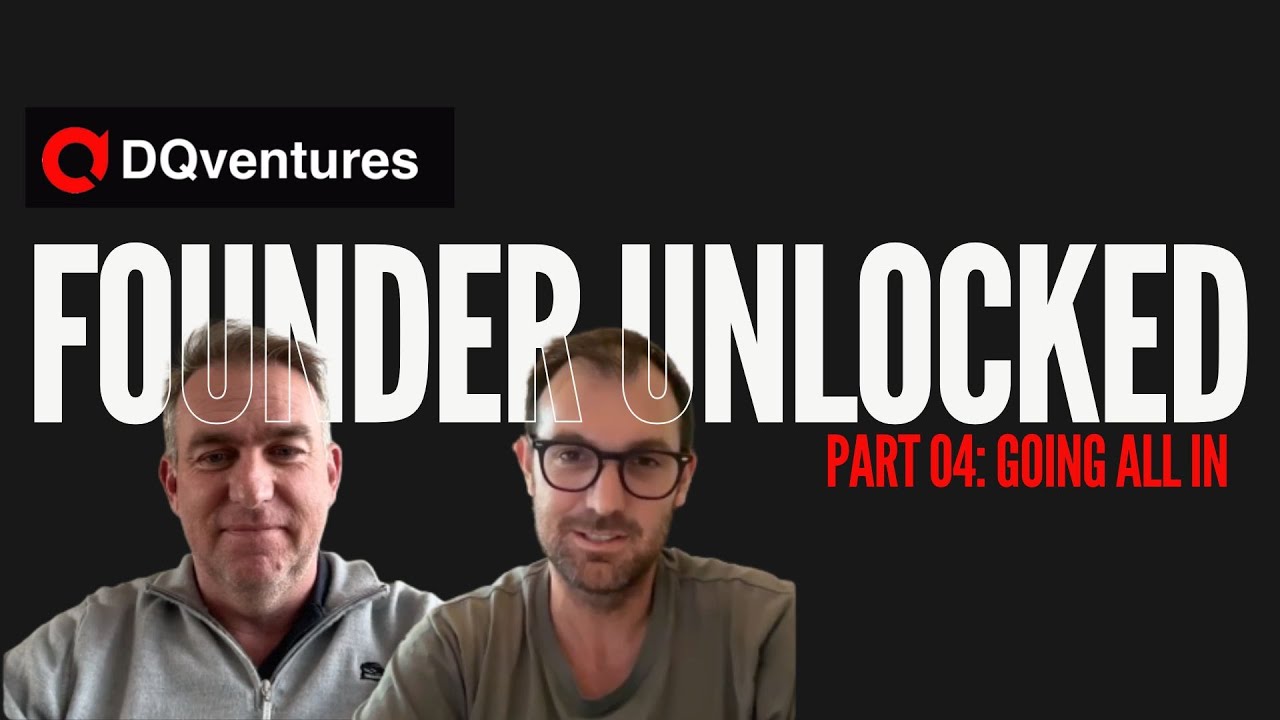
Ollie and Sam discuss when founders should quit their jobs and commit fully to a startup. They share how they recognized the moment for their own businesses—Sam's helmet-safety concept and Fresh Events, Ollie's Global Gossip and Tigerspike—and outline concrete triggers: a paying customer, unit economics that work, and a problem you'll stay excited about for years.
Chapters
And as it got closer and closer to the point where I was going to go and start this new job, Luke was like, this is it. We've got to give this a go. We've got all these meetings and we were building this platform to help people sort of build mobile software. And it was just really starting to happen. And so I called up this recruiter and I said, look, I'm really sorry, but I'm not turning up on Monday. I'm going to do my own thing. Okay. You ready, Sam? Hi, I'm Ollie.
And I'm Sam.
And today we're back with Founder Unlocked from DQ Ventures. This episode today is a little bit more personal as we're going to be talking about that all-in moment, the time when you decide, right, this is it. I'm going to take my business to the next level. So far we've talked about don't quit your day job, the importance of validating first, you know, the importance of a minimum viable business, those sorts of things. But the fact is, in all businesses, there's a moment where you have to go all in. And today we thought we'd share with you some of our own experiences about going all in and how that occurred for us.
Well, I guess I'll go back to when I was a younger management consultant. I've been doing that for 7 years, and I was at the point where I had that entrepreneurial itch. I really felt like I wanted to to run my own business, but I didn't know what I wanted to do. And at the time, I remember I was working in Jakarta. We were running projects there, and I saw all of these parents who were on the scooters going to work, and there would be 2 kids on these motorbikes, and none of the kids would have helmets on. I spent 3 years looking at this going, I just can't understand why this is there. And I genuinely thought that there was a real— there was a problem that I could be the person solve this. Uh, so that was kind of— did, did some research, went and tried to understand how helmets were manufactured, what was the distribution process, what was the cost. And I did all these numbers, and I had this concept of a buy one, give one program where, you know, if adults were buying helmets, a free kids helmet would be given as part of that. That would become part of the brand. Anyway, long story short, put quite a lot of work into this, decided I was definitely going to quit consultancy, and I hadn't actually spoken to any of the people who potentially were going to see whether this was a real problem or not. And so whether people in Indonesia who could barely afford to buy a helmet would really care about a more premium brand to give an additional helmet to a kid, that was very unproven. Having left consultancy, I realized the idea that I originally had was not workable, and that took me down a different path, which ended up being a good path. I started working on the first enduro mountain bike event in Malaysia. Why? Because I really like mountain biking, and that led me to actually putting on an event. 270 people, got people came in from overseas to do the event, managed to secure Red Bull as a sponsor. And in, in a period of 3 months, because I was constrained by the non-compete, we put on an event. We actually made a bit of profit, which was myself, and I brought in the 2 people, Tim and Tom, who ended up becoming my co-founders in Fresh Events. They had experience in branding and they had experience in, uh, event operations. And what I realized through that process from doing something that I actually really enjoyed was I was able to understand a business model that I didn't really understand, and that led to the creation of Fresh Events. So for me, my all-in moment was definitely when I decided to quit my job to become an entrepreneur. That was the moment where I said, right, I'm all in. But I think the moment when I had a an idea that had traction that I thought could become a business. That wasn't till much later when we'd actually set up The Music Run and we had paying customers in terms of participants and paying customers in terms of a brand. There was really a business there. We had that minimum viable business and we were confident that we could go all in on that business idea.
One of the key things for me was when I first arrived in Australia back in '98, '99, I started working for a company called Global Gossip. which was a chain of internet cafes when internet cafes were a big thing. And my job was literally, I stood behind the reception desk and directed people to computer number 6 or computer number 12 or whatever it was. And then as I'd been there a little while, I became an opening coordinator and I flew all around the country opening up offices. We opened one in Venice Beach in California. They're kind of like the Starbucks of internet cafes. Amazing as they were and as good a business as they built, they weren't different to anybody else. They weren't this kind of mythical entrepreneur founder that had done amazing things. They just happened to have a good idea and sort of got on with building a business around it. And they made some pretty sort of big mistakes along the way. I remember sitting in, in a meeting when they were talking to Vodafone about creating a SIM card for backpackers and about putting a SIM card for all these English backpackers who came to Australia. They'd put a Global Gossip branded SIM card in their phone and they'd basically be tied to the Global Gossip internet cafes and phone service as they traveled around Australia on their gap year. And Peter and Philip sort of listened to this and listened to the pitch, and then they said, nah, these mobile phones, that's not going to be a big deal. We're about internet cafes. We're about people coming in, visiting us, and sending their emails and contacting people back home. And I mean, at the time, we all agreed that wasn't their business. They sort of stay in your lane. That's the advice to give lots of founders. But what a huge shift now from where we are, even 5 years later, as everybody arrived with a mobile phone, everybody looks for the cheap of service. People started checking their email on their phones and internet cafes have pretty much disappeared. So, it's amazing to see how you can get up with a business, but it doesn't— just because you're a founder and entrepreneur doesn't mean you know everything. And that lesson always stood with me for my all-in moment. So, we'd started Tigerspike and we'd all had other jobs at the time. Global Gossip had unfortunately gone through sort of a round of bankruptcy and they let a lot of staff go. And so I went and got a real job. I wasn't working for a startup. I got a job with the Roads and Traffic Authority of Australia. I was working for government.
Exciting.
Yeah, I tell you, I'm sure I was a really important part of the team that helped the Australian government, New South Wales government, build the roads.
Were you a lollipop man?
I was not. No, I was the contracts manager. I looked after all the contracts, man, RFPs and all that sort of jazz. But it's amazing because government work can be done in a relatively short space of time and frees you up to be able to do other things, which for me was building, was starting something else. And it had been about sort of 6 months and you're sort of juggling 2 jobs. You're spending your free time working on this idea, which was Tigerspike, this mobile company. I wasn't getting paid a huge amount at the Roads and Traffic Authority. So I was looking around, I found another job and I got a job as the contracts manager for the Sydney Morning Herald for the newspapers here. And it was a pretty big deal. It was more money than I'd ever earned. And I had a 2-week period where I'd finished at the RTA. 2 weeks later, I was starting my job for the Fairfax Publishing Group, which owns the Sydney Morning Herald. And in those 2 weeks, I went into this tiny little office that Luke, myself, and Dean had got. And Luke had quit his job at KPMG, and I was umming and ahhing. And in those 2 weeks, we did more and achieved more than we had in the previous 3 months. I reckon we went to client meetings. just powered through stuff. And as it got closer and closer to the point where I was going to go and start this new job, Luke was like, this is it. We've got to give this a go. It wasn't as if we'd sort of sold anything or done anything much, but we'd got all these meetings and we were building this platform to help people sort of build mobile software. And it was just really starting to happen. And so I called up this recruiter and I said, look, I'm really sorry, but I'm not turning up on Monday. I'm going to do my own thing. And he was not a happy camper. I think he'd already banked his recruitment fee and then he had to go and find somebody else. It just became obvious if I didn't do it now, now, we would never have them. And so all 3 of us made that decision at that point that that was it. And we were in the office full-time. That was around the time when we sort of converted all of those ringtones from one format into another, and we made a large amount of money with a small amount of work. And so those 2 sort of things for me, one was the recognition that if you're in it and it's all good, you've got to go all in. That's what it was. And then the second thing, like you said, was bringing that first significant paycheck in. And one of the things we do focus on is getting that first money in from a customer. How do we get to that as quickly as possible? Because that's such a massive proof point in any business. No matter how often someone tells you it's a wonderful idea or isn't it amazing, and you kind of anecdotally think it's going to work, until someone pays you some cash for it, you don't really have a business. So getting to that as quickly as you can kind of builds that excitement and helps sort of with that going all-in decision, which is really important, really crucial.
Yeah. So I guess similarities in our journey was we were both quite young. You know, we were late 20s, maybe not whippersnappers straight out of uni, but we could afford at that point to go all in. And if it went wrong, we would probably be able to go back to a corporate role or try again. I think one of the things with Deque that we've really thought about is that older founders, you know, let's say those who are kind of in their 40s or 50s, the ability to go all in is more difficult. And so they have more to lose at that point in making that decision. So how can we help them with a proven process that gets them to a point where they have that evidence that gives them that conviction to make that decision? And I think there's a few rules that we internally work with that fits in our 3-stage process. And I think in that first stage where we're really exploring the idea with the founder, one of the things that we're trying to understand is, is this a problem that they want to work on for the next 10 years? And we talk about that 10-year rule. Now, the reality is it may not be 10 years. But if at this point you're not excited about the problem that you're trying to solve, if you can't imagine yourself doing this in 10 years' time, you're probably not going to be doing it in 1 year's time because things get pretty hard. That's the nature of building a business. And if you're not actually excited about what you're doing, that for us is a bit of a red flag at the start. And maybe it's not the thing that you are best suited to be working on. As you move into that next stage, we're trying to validate things, the bit that you've talked about, and you'll hear us at Deque banging this drum the whole time, is that first paying customer. That first paying customer is that incredibly important milestone on your journey where someone is paying you for the value that you're creating, and it moves from actually being an idea into something that has realized value. The next one that we talk about, which is as you've scaled a bit further, you've gone to market, you're starting to get more customers, what that allows you to do is it starts to allow you to understand the cost of acquiring those customers and the cost of delivering that service to those customers. So once you can start to understand your cost, what you can do is you can start to look at your runway, and that allows you to plan into the future and go, okay, you know, how much money do I need to make in order to cover this cost? And you start to look at the economics of the business. And you can start making some decisions about, you know, could I bootstrap this, run this myself, grow profitability, grow revenue, or do we need to get external capital to support this? And that becomes an important decision that leads into that all-in moment. And I think if you line those things up, you should at that point have 80% confidence that this is the right decision to make. And suddenly the risk of not doing it almost becomes bigger than the risk of doing it.
Yeah, I think that the process of understanding the potential of the business is what really helps you make that decision. It helps de-risk that journey because if the business doesn't have the potential, and it's not just our opinion, it's not somebody saying, hey, this won't work. All of us will sit down and try and have a real understanding of what does it cost to deliver this service or this product? What's the potential audience for it? How do we acquire those customers and how do we take it globally? If it doesn't stack up as a business proposition, then that really helps you make the decision because there's lots of ideas out there and there's lots of businesses that can be built. We're here to help you build businesses that are going to be successful and will lead to enormous potential. But if the one idea that we've worked on and investigated doesn't have that potential, then you should know that early. You don't want to know it in 3 years' time when you've sold everything and put your life on the line. You want to go all in on the best possible idea that you can come up with.
That's what we're here to help you To say that a different way, it's much cheaper to kill a bad idea than to kill— it's a lot more expensive to kill a bad business.
Yeah.
And the sooner you can kind of really understand the legs behind your idea, I think the better. And I think one of the things that we try and practice in the early stages of working with the founders is that intellectual honesty. And I guess what we're bringing to the table is the ability to challenge some of your thinking, some of your biases that we all bring to the table. And what we're trying to do is go through a process so that you can make a better judgment call on things and make a better choice about whether to go ahead and go all in or whether not. Do you pivot?
And that's true of any of the founders that go through the DQ program. I mean, once you've got a taste for entrepreneurship and learned the process by which you can evaluate ideas. How do you properly validate? How are you not just swayed by your own personal biases? And then how do you scale it? If at that point we've decided that this particular idea, while it might have looked okay, under further examination perhaps isn't the right one, you've learned so much and you're so ready that that right idea is sort of sitting there and you can put both arms around that one and run with it. And Deekey will be there to help with that. But if you've learned everything that you need to from throughout the process, then we may only be there in an advisory capacity. But equally, our job is to help build successful businesses, but it's also to help you avoid those mistakes and help you understand what the economics are of this business. So I think one of the other things that's kind of really relevant about whether to go all in or not on a business idea is what's your personal situation? And I think if you've got a supportive partner who is in a financial position to support you, if you weren't bringing in the same amount of money or even kind of emotionally and sort of able to be there for you and is sort of backing you, that makes a massive difference when you're building a business.
Yeah.
It's incredibly difficult to kind of do it having earned a reasonable salary and then suddenly have a have that cut dramatically or for a period of time. And we try and minimize that and keep it as short as possible. But it sort of goes like this. The expectation is that you will make more in the long term, but there will be some short-term pain. So there's a number of sort of quantitative and qualitative values that need to be assessed in terms of determining when to go all in. But one of the key ones is your own personal situation.
I think particularly those slightly older founders who potentially have kids, financial commitments that we've already talked about, that partnership that you have with your spouse is incredibly important. You go on a real roller coaster when you're a founder and making sure that you're aligned at home is very important. You have that personal support network. I think that's critical. Certainly on my journey, I have a very supportive wife, uh, who's always been in my corner, uh, and I can recount many holidays that we tried to have being disrupted with me being on calls at different times of the day, including our honeymoon, um, which I, I do get reminded about, uh, at times.
Yeah, yeah.
The other thing that Deque provides is the ability to kind of have external feedback on your business and what you're doing, but having that personal board of directors, you know, other mentors, people that you trust who you can go to not just for input on your business, but, you know, potentially about how you're feeling about things. There's a lot of situations where the stress can be quite high and the ability to speak to people, people that you trust, is very important.
No, it's very true. And sort of dealing with things along the way as well, those experiences. I mean, that's part of what this podcast is all about, right? To give you an understanding and a kind of a broader experience of it. I can top the honeymoon story as well because in the very early days of Tigerspike, we were sort of, we were in a shared house and paying rent and stuff. And we got a bunch of money for our wedding when we got married in 2005, which all went into my bank account. And that's what I used to pay the rent for the next 3 months. And when it was requested that the wedding money be used and put towards the purchase of our first house, it miraculously wasn't there. It had been spent on keeping me going for the first 6 months. Well, I think it was 6 or 7 months or something. So those are the sorts of things that, you know, it's all part and parcel of it. It is part of the journey. And that's, you know, it's possible to do when you're young. It's much harder to do when you're 45 or 55 or whatever it is.
Yeah.
You know, if you're raising money, that becomes a very global kind of perspective and you can jump on video calls and that, but sitting in a VC's office and pitching your story might mean you're jumping on a plane and I can guarantee you, you won't be flying business class anymore. Any budding entrepreneur who chooses to choose business class is not going to raise any cash from a VC. So it becomes an exercise in humility as well, right? You're flying economy, you're staying in cheap Airbnbs, you're going to as many meetings as you can, and then you're jumping out of there and getting back to your family and stuff.
No, I can't believe that AirAsia didn't have a loyalty program because I definitely would have.
Exactly.
Would have been A platinum member by now.
I mean, look, we used to compete for who could stay in the worst accommodation. And there was accommodation that we stayed at in LA because we had a bunch of VC meetings in LA. And honestly, it's a wonder we survived. And I literally was in fear for my life. I think the worst one was when we actually had bunk beds at a place down in Melbourne and there were 2 rooms with 4 bunk beds and there were 3 of us. So we had to have kind of sharing bunk beds and we were trying to raise $10 million for our business. We just felt this huge kind of disparity between the image we were trying to portray of these budding tech entrepreneurs who knew it all and then going back to the worst accommodation, but became a lot of the stories about what we had to do to get the job done. But we had some fun along the way. So I guess we've talked about a number of different kind of factors that's kind of come to the fore when deciding on when to go all in with your business, the personal ones, the business-related ones, I guess. If we can sort of pull that together a little bit, Sam, in summary, how do we put all that into context for people?
Well, I think Deque helps you through the process, and that process is all designed to build evidence to get you to the point where you have kind of that conviction to go all in. But you can get to that point by yourself, by trial and error. Like we did that, Ol. We both kind of got to that point of going all in via trial and error. And I think what we've designed at DQ is to try and take some of the learnings that we've had to put that into that process so that you can get to it quicker. So we're compressing the time that it takes to get to that point where you feel like you have that conviction to go all in. And we can do it more efficiently because we've done it a few times before and we've learned ways to do that effectively. It means that it requires less money, a shorter amount of time, to get you to that point where you're ready to say, yeah, I'm confident to take that step and go all in.
And I think it's really important to sort of recognize the importance of having a dedicated team who's focused on helping you and helping you through that process. We get intimately involved in every single part of that business process, try and understand exactly what it's going to take to turn this into a successful business based on the broad experience of everyone within the DQ team and try and sort of create this because we have a vested interest in its success. We really want to be a part of this process. And some of the founders who've gone on to, you know, We Networks is turning over over $3 million this year. That's 4 years into its business. I mean, there've been some phenomenal success. There've been some others that perhaps haven't kind of gone quite as well for a variety of different reasons. But there are a number of companies where we've sort of demonstrated that by going through this validate, build, and scale process, we can really accelerate that timeframe and build businesses in a sort of a rapid manner, but with really solid foundations so that they're sort of maximizing the chance of success of the company.
And I think when you do decide to make that decision, it shouldn't be a leap of faith, the all-in decision, which it so often is. You know, it should be much more of a calculated evidence-based decision that you make having gone through this process.
Absolutely. So in conclusion, just one final thing, Sam. Is there anything you do differently? I know we've sort of discussed this and I'm putting you on the spot here because you've already said that probably not. But if there isn't, that's totally fine. But is there anything you would do differently looking back on how you built the events business and what you did in those super early stages?
I think the bit that what I know now which I didn't know at the time, is that the way in which you go about building that business is very important. And if you can build things in the right order where you're building things on top of each other, that actually puts you in a much stronger position and you have a platform in which you can scale. I think we didn't understand the industry enough that we were building in, and as a result of that, we didn't understand the business models that drove kind of growth. And we probably chose the wrong business model, which, you know, we, we came back and changed kind of 5 years into the business. What would you have done differently, if anything?
I mean, I think that, like you said, it all worked out the way it did. And we made a bunch of mistakes along the way. And then the conclusion was, was sort of successful. But from my perspective, I think the biggest thing would have been to really focus on the product we were building. I think that always came sort of secondary to the service and the revenue that we had. We were always chasing revenue, which was important and allowed us to do things. But I think if we'd really doubled down, we had an amazing product that we used internally. And I think if we'd really focused on that and put a team towards that and not constantly chased revenue, I think we could have, A, got a lot further along the path of a successful business and also probably been a lot more successful. Because product companies tend to be a lot more valuable than services businesses. When, if you're trying to build a substantial business, the multiple on the product company is 8 or 10. This is where long-term you need to focus. Whereas the short-term thing was, well, you know, what happens if we, if we don't have enough money in the bank in April?
Yeah.
When it was February, rather than thinking, gosh, well, when the, by the time the next year comes around, we'll have a company that's worth considerably more.
So that's our take on the all-in moment. Sometimes it's about timing, but it's always about proof that this business can succeed. Proof is what gives you the conviction to take the leap.
And if you're listening, you might be thinking, okay, I'm in. I know I can get 2 or 3 customers, but what then? How do I scale this?
That's exactly where we're headed to next. Episode 5 is all about your go-to-market strategy, finding your first real customers beyond your personal network, figuring out repeatable sales, and avoiding the trap of being everyone's keyboard cleaner.
So don't forget to subscribe to our YouTube channel and keep listening wherever you listen to your podcasts.
More from James



How Marcello Patané Turned An Idea Into Paying Customers in the European Biotech Sector

Why you should interview people who rejected you (as well as your customers).