When Should You Raise Money For Your Business? | Part 6
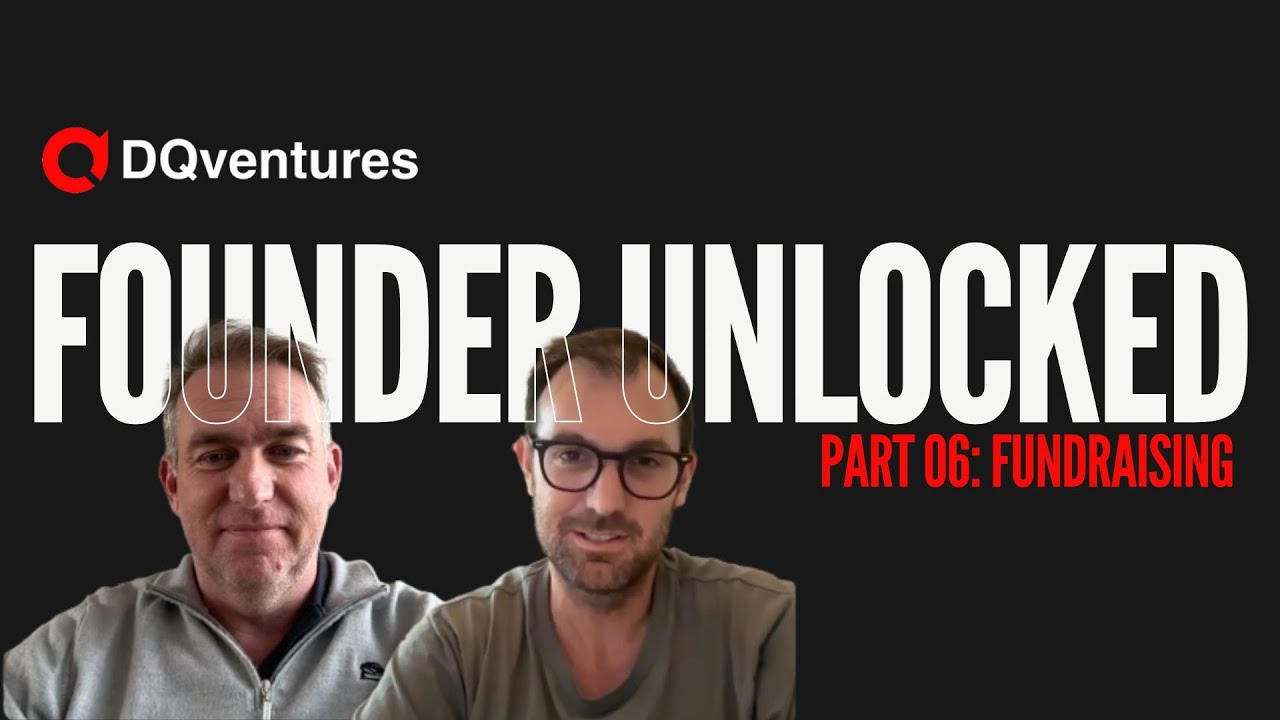
Ollie and Sam explain when founders should actually raise money: only when it creates a clear step-change in growth, not as a default move. They break down investor types, share how Tigerspike's $11 million raise and Julix's self-funding decision played out differently, and stress that you need traction and proven unit economics first.
Chapters
That sort of common misconception is that, you know, you come up with a business idea, you create a great PowerPoint or, you know, something online, and then you go out and raise money for your idea and you build a business. That's how people who aren't sort of in the startup world think this happens. Fundraising is not the only option for your company, and nor is it the goal. Hi, I'm Ollie.
And I'm Sam, and this is Founder Unlocked. Today we're going to be talking about all the things that first-time founders need to understand about fundraising, whether to do it or whether not to do it.
I'll be telling you a few stories about my founder journey, in particular, the way we raised $11 million for Tigerspike. back in 2011, and some of the, I guess, the things we got right, which was raising $11 million, and the things we got wrong, which was spending $2.5 million of it on an office in San Francisco that we didn't really need.
That's a common thing that we often see founders do is not actually understanding what they're gonna do with the money once they've raised it. But let's kind of start from the beginning, Olle.
Like, how do people typically approach Yeah, I think the first thing is that even before that step is whether you need to raise money in the first place. So that sort of common misconception is that, you know, you come up with a business idea, you create a great PowerPoint or, you know, something online, and then you go out and raise money for your idea and you build a business. That's how people who aren't sort of in the startup world think this happens. Fundraising is not the only option for your company, and nor is it the goal. The goal, what we always used to say, um, is that fundraising is really the start of the journey. Whatever you've done prior to that really just helps you get to the start line. And I think that's a really interesting way to think about it. We bootstrapped Tigerspike for 7 years before we raised money. And that wasn't because we were just building things and thinking we were amazing. We were going out year after year to try and raise money for the business, but we weren't able to do that because the business wasn't in the right state or the timing wasn't right, or there were a thousand other reasons why we couldn't raise money. Until we got to the point where we got to that yes. And then we realized that that wasn't just sort of, as it is today, an opportunity to write a great LinkedIn post. It was really kind of the start of building the next phase of the business. And that's, that's how I think you have to think about fundraising. How does it, you know, does it create a step change in your business? And do you have a business that you can even raise money for? I think early founders really, or first-time founders, for example, don't really have that understanding of what types of business are even capable of raising money?
Let's start by addressing the types of business that typically are suited for raising money, and then let's think about at what point do you raise the money. So if we look at what we have at DQ Ventures, there's 2 types of business that we typically support. The first type of business we would call an income-focused business. So what, what does that mean? It means that you're running a business that is focused on generating sustainable profit. Okay, we want to grow revenues, but we also want to grow profit. We want to reinvest that profit into the business. I think of Julex, Pat and Dan. I think of Rob, We Network. I think of Toby, Blue Mongoose. You know, those are typical businesses where they're kind of income-focused businesses. The second one is the growth-focused business. This is where we're trying to grow a business by growing revenue and also growing that equity value of that business. So I think of new portfolio companies, Mintillium, LES with Daniel, those businesses are focused on trying to grow and scale, but they're doing it in a way that is about driving that equity value. Those are not the businesses that you typically see on LinkedIn, people posting about and talking about these big valuations. Those are the kind of venture-backable businesses. So Those businesses typically form 2 types of business. You've got the, what we would call the rapid scaling business, where it's all about growing quickly. Okay. And why do you need to grow quickly? You need to grow quickly because you need to try and capture share of market, because typically these businesses are the ones that are trying to become category leader businesses. Okay. So they require a lot of money to spend on marketing, sales, product, tech growth. And they're going to do that before they actually start getting a return on that money. Okay. So they're not going to be profitable for a period of time. They're basically going to grow before they get to profit and they require a lot of money. Those are businesses that VCs love putting money into. The other ones are the kind of breakthrough kind of businesses. They typically tend to be on frontier markets. You know, look at all of the stuff that's happening with deep tech at the moment. kind of AI foundational layers. These are very, very capital-intensive businesses because there's a lot of upfront investment in equipment and technology, and that requires a lot of capital. So those businesses are businesses that DQ doesn't tend to support, but they are the ones that people tend to talk about on LinkedIn. And that often leads people focusing on these unicorn valuations and raising X many million dollars. That's not where we're playing in. And I think what we at DeeQ do is we try and bring it back down to real businesses being built by real founders that we can actually support.
I mean, we really focus on what we call rational startups, that startups that are building something meaningful in a meaningful space with a focus on revenue and revenue that's sustainable and grows as the company grows. And that's something that kind of makes sense to everyone. It doesn't matter what the latest hype and what the latest kind of thing is. I mean, for example, just talking about the fundraising landscape, I think it's 75% of all venture capital money in the US went into AI businesses last year. 3 years ago, it was blockchain. And back in my day, back about 20 years ago, it was dot-com. And we all know what happened in the dot-com boom. So there are always these kind of bubbles. And so we're focused not on kind of just bubbles or whatever the latest kind of buzzword is. And there will be some incredible AI businesses.
Yes.
There were the Ubers and the Airbnbs. And there will be amazing AI companies which revolutionize the way we do things. We don't doubt that. And the people in Silicon Valley are very smart. There's a reason they're putting 75% of their money into those types of companies. But from a DQ perspective, fundamentally, we're about helping your business grow to a point where you've got a viable business that you can step in and run and be the founder and CEO of. We've talked a few times about the journey for us, which is validate, build, and scale. You know, you can raise money at any stage in a business depending on what the fundamentals are. But you might be able, with DQ, you can build something that kind of proves that you've got an idea that's going to fly, but you might need to raise money in order to build that out to cater for 100 companies rather than the 5 that you use to prove the idea. And then most likely you'll probably need to raise money to scale. You can only grow to a certain size with limited resources. And what raising money does is allow you to sort of increase those resources and therefore increase your growth. But no investor is really going to put money into a business so you can carry on doing the same thing you've always been doing.
It has to provide Yeah, I think that's a great point. So, let's put that in kind of context. So, you talk there about the DQ process of validate, build, and scale. So, typically, when DQ is helping our portfolio companies with a fundraise, that first fundraise, it normally happens in the scale phase. Okay? So, let's just unpack why that's the case, and then maybe we can look at how other people approach this and why we have this specific way of doing it. doing it. So we approach it in the scale phase because we want to demonstrate that an original idea has been validated, that there is a minimum viable business in place. We have paying customers who are paying for that product or that service, and we can demonstrate the unit economics that are going to support that growth. Okay? So it's very rational way in thinking about it. We've validated the vision, we've built the initial product or service, we've understood how that resonates with customers, we've got paying customers, so we now have revenue, okay? And we now have a way in which we believe we can scale that business. So when we're raising capital at that point, we're raising it to then fund that growth and accelerate that growth, okay? So that is a very clear point in the process that we're going and asking for additional money to help us. And I think that that's a very important thing. We're advising our founders to raise money once we have clear traction, okay? This is a word you hear talked about a lot. Effectively, that means people are paying you for something that you're doing now. Um, and we're not asking investors to fund an idea, okay? Like, we're asking them to actually fund growth, and that becomes a much more simple concept for people to buy into. And you can tell the story around the future growth story because you're not focused on whether there's traction or not. There is traction. You can show it. You don't need to talk about it. And that show, not tell approach is so important in fundraising.
And I think the thing to remember is that, you know, there's different types of investors. There's angels who put money into, you know, kind of all sorts of different types of ideas.
If we just unpack angel investors, that's typically high net worth individuals who are quote unquote accredited investors. Accredited investors mean that they have a certain amount of capital themselves, normally over $1 million, or they earn a certain amount of income, normally over $200,000 a year. You can become an accredited investor, you can become an angel investor. They typically invest at the early stage. So we talked there about the kind of pre-seed, seed stage. That's typically where your angels come in, that they may even be people within your personal network, family and friends. And you sometimes hear people talk about family and friends rounds. Okay, that's for that first initial bit of capital. But that's typically where your angels play.
There's venture capitalists that we've heard about, they're trying to get those returns. And then there's sort of strategic investment where there's a strategic kind of link. If you're building something that resonates with the cosmetics industry, then you may get money from L'Oréal, for example.
And there's different types of venture capital. I think that's really important to say, depending on the size of the firm and the stage that they're investing in and the types of business they invest in. But they typically are putting money in at that seed stage. And then you've probably heard of a Series A or a Series B or a Series C. As you guessed it, they follow sequentially. A comes after seed, B comes after A, C comes after B. And what that means is just the number of the funding round that that is, that typically follows growth of the business.
From Tigerspike's perspective, we raised from a strategic investor. We were building mobile kind of, not quite mobile marketing. There were sort of advergames and there was a strategic imperative for Aegis to have a mobile offering for its thousands of customers around the world. And so they kind of understood what our business was and what we were developing. And they felt that by them investing in us, it would have a material impact on sort of their customer base. And that was, we had been to Silicon Valley and we'd met with all of the venture capitalists over there. But for us, or for all investors at really early-stage businesses, they're looking for a minimum of a 10x return on their money. So you raise at a certain valuation. If you raise at, say, a $5 million valuation, and a venture capital firm gives you $1 million, then their minimum expectation is that they get $10 million back. And so you have to be worth $50 million. So you have to be able to sort of plot out a path to when your company will be worth 10 times what it is today. And venture capitalists have, and all the investors see thousands of decks. You've seen your one company and you're working hard and it's all going really well, but it's about how you stack up against everybody else who's doing the same thing. And if you can't really easily map out a route to them getting 10 times their money back in 5 to 7 years, the time horizon changes depending on what sort of investor you're talking to. But with early stage stuff, you're looking at minimum 5 years, probably more like 10, and everybody settles on 7. So they want their $10 million check in 7 years' time. And it's very hard to have a convincing story about how you're going to get there if you haven't validated, got your minimum, minimum viable business in place and shown that you can reach this number of customers. And from TigerSpike's perspective, we, we sort of really ticked the box of strategic value to our investor. They had a large investment fund, but it made a material difference to their bottom line. And then interestingly, 3 years later, we raised a further $6 million from a boutique investment fund. And they didn't care what we did. They didn't care what industry we were in. What they cared about was the story, and that in 3 to 5 years, they wanted to make a significant return on their money, much more than the 5 or 10% they could get by investing in the stock market, or the sort of growth that you see from the Apples. They felt by investing in a private company like ours, they would see this enormous growth in their capital. And so their time horizon was a lot shorter. They were a private equity fund, a boutique private equity fund. They wanted a significant return on that money. And then we had our exit in 2017. And so the sort of the returns paid out to ourselves and the investors.
So the private equity company investing in Tigerspike, they're investing in you when you are further down, you're more mature as a business. A lot of that early stage risk has already been removed. You've demonstrated traction, you've demonstrated growth, you've built scale. So they're putting money in there and they're looking for that return. And I imagine you probably had a conversation with them all about, exit horizons. So they were able to then look at that in when they were going to get a return on their capital.
I think the interesting thing is just how much that venture capital landscape has changed over the last, I mean, I'd say 10 years, but it's probably even 3 to 5 years in that there are relatively smaller numbers of companies getting investment in, and investors are looking for extremely large returns on their money. It's incredibly hard to raise money. Um, well, it's always hard to raise money, but even today, it's very hard to convince investors because they'll— the average venture capital firm in Australia sees over 3,000 decks in a year, and they will make 8 to 10 investments. And they don't necessarily, they don't necessarily invest in the best ones. They invest in the ones that happen to be what matched with what they were looking for then, or one which didn't, they didn't have in their existing portfolio. They may have a company in a similar space, in a similar industry, and they don't invest in you because they don't want to cannibalize their existing investment. But the interesting thing is that it's possible to raise money and there is always capital available to expand the growth of fantastic businesses. And fantastic businesses are very early stages. And that investment will create this kind of gigantic leap, taking them to the next level, whether it's a technology development that puts them in a particular space or expansion to a different market or whatever it might be.
Understanding where that capital plays on your journey is very important. But the bit to always, always remember from an investor's standpoint is they're ultimately putting money in to get more money back. Okay? That is the premise.
Not for love.
If I put money in, I'm going to get it back at some point. So, the question is how long? And then how much extra am I going to get back? Now, typically, the earlier they put it in, the higher the risk, okay? And therefore, they're going to ask for more in return. Typically, what are they asking for? They're asking for more ownership and control of your company, okay? This is something that entrepreneurs often forget, okay? This is a two-way street. They're not just giving you money to get that return down the line. They often want protections, and they often want influence over how you operate and run your business. There's the economic side of things, but there's also the control side of things, like the control that they exert over your business. And typically, when you're dealing with venture capital or private equity, not only do they want higher returns, better economics, they also want more control.
In the early stages of a business, angel investors and early-stage funds are investing in They're investing in you as a person. The idea really doesn't matter. The business doesn't matter. It has to have some semblance of reality, but they're saying, can you make a success of this? Will you build something amazing? And when you get to the next stage, whether that's a sort of Series A or pre-Series A, they're thinking, okay, I get you. You're pretty good. Does this business have what it takes? Is it in an industry that works? So the business itself becomes a little bit more important. And then as you get to private equity funding rounds, sometimes sort of Series B, Series C, you as the founder become less and less important. It's, have you built a team that can help this business scale? Have you got technology? Have you got a moat around the business that you've built? So different investors are looking for different things, but where DQ sort of sits is the most important part of the entire conversation is the person. It's, it's, can you be the founder that drives this to an outcome that an investor wants? And you could have 10 different people pitching this amazing, incredible idea, and all 10 of them will fail because the investor doesn't think that person has got what it takes. So, it's really about understanding those kinds of nuances when it comes to investment.
So, let's go through what that journey tends to look like. So, come back to the DQ 3-stage process. So, we start in that validate stage. So, we've identified you as a high-potential founder. Typically, you're currently in your corporate job at the moment. You've got that deep domain expertise, you've identified a problem, you have an understanding of who that initial customer might be, um, but you don't know how to start that journey. Okay, so option number 1, you can go, right, I'm going to try and do a side business here. I'm going to try and bootstrap this myself, get it off the ground. Quite possible that that could work. Often, you're spread too thin. You start failing at your corporate job. You start failing at home, being a wife or a husband, and possibly a parent, just because you're spread too thin, and you never get that business idea off the ground. Option number 2 is you go out and you try and raise some capital to support you making that transition. Maybe you have some friends with some money. Maybe you go and pitch to some VCs, but at that point, you're asking people to back an idea. when you're not full-time committed to that? That's pretty tricky. Okay? Often that doesn't work. This is kind of when DQ comes into the picture and we say, we really like you as a person, but we also really like your idea. Okay? We like the vision that you've got. Okay? And we think that we can see a path to supporting you, to validating that vision. Okay? If we can validate that vision, prove that we can get interest from customers, prove that we can actually then create that minimum viable business by getting people to pay for that product or service that you have a vision for, we think we can start building that into a business that can actually succeed. So we're going to help you do that. That's where Deque comes in. And we go on that process with you through the validate stage, through the build stage, and we get to this point of what we call the pre-scale stage where we start saying, right, we understand who the customer is, you know, who your ICP is. We understand what that basic version of the product or the service is, and we understand what that route to market is. So in order for us to scale this, what's it going to take, and how do we get you out of your corporate job to being the CEO of this business? Okay, so that is the point where DQ is helping you to say, right, could you bootstrap this? Do we think the business can bring in enough revenue to support you as you transition into this business? Is that possible? Yes or no? That's going to depend on your personal situation, your personal finances, whether you're willing to try and do that without taking on external capital and diluting some equity. Okay. Or do you think, no, actually, I think it makes sense at this point for us to try and raise some funds to support me transitioning into this business, potentially to support some key first hires to accelerate growth, to export, to spend some money on sales and marketing to accelerate our customer growth. Those are the things that we're working with you on as you approach that first-round funding conversation. Yeah.
The only thing I would add is that there's no one sort of founder journey is ever the same as another. There's no sort of cookie-cutter approach to this process. Validating your business might mean finding, you know, a particular company or an organization that will, will buy your product. It might mean finding, you know, 10 companies. It's, it's really about kind of getting under the bonnet of your idea and building out that for what it will take to get your business to a point where it's a minimum viable business. We're trying to understand the business that you are are hoping to build, adding as much, I guess, inspiration and operational and everything else that it'll take to get this business to work such that either it becomes that income-generating rational startup that can continue to grow and grow organically, or is ideally positioned for a particular type of investor who will see this as something that really meets all of their criteria. And then if you happen to pitch to enough of them, you're quite likely to get to a yes.
Let's jump into a couple of, of DQ examples. So I think a nice one for us just to talk through was what happened with Julix. Pat and Dan did a great job. They thought, okay, we think we're ready to take on a first round of funding, but then things changed.
Yeah. So interestingly enough, it was not only did things change with the business, but things changed in terms of their life situation, as it were. Initially, 2 founders, both had jobs, both sort of set up this business, which was a corporate secretarial company based in Singapore. And they had some initial success, they were able to deliver a service and then back that up with a platform and a product, which kind of augmented the service that they delivered and created what we call sort of a productized service business, which is a way you can deliver a service, but then you can scale it. So it's not just about what you can, what you as a single person can do. And then Pat's situation changed in Singapore and he went full-time into the business with the support of DQ. And he had some savings when I was able to not necessarily draw a large salary so that the business could grow. But the timing of these things is always very difficult to predict. You hope it's only going to be for 6 months, but it takes 12 months, or it might take even longer. So they reached a point where it was no longer tenable for Pat to continue to work in the business and not draw a salary.
Yeah.
So they looked at what the different options were. The company was generating revenue, but it certainly wasn't generating enough to support 2 sort of fairly significant salaries. And we talked about going out into the market and looking at raising money. Now, it's difficult to raise money for something that investors see as a services business. They don't command quite the same multiples as more of a product business.
Yeah.
And that's just the nature of the way investment kind of works. But Singapore has a fairly robust kind of capital market investment opportunities. It's got a group of angel networks. We talked about doing— you mentioned a friends and family round. Have you got some, some friends who might want to back your business? Um, we call it an FFF round. It's called Friends, Family, and Fools because it's incredibly risky and super early stage. But the interesting thing is that you've got to remember that you're never asking someone for money. You're giving them the opportunity to invest in you and your idea. It's got to be that way around.
Yeah.
It's never, please, uh, can I have some money? It's always hey, the capital you give with me is going to come back however many fold. And that's the kind of the shift that you have to make when you're trying to raise money for your business. You're providing them with an opportunity to invest in your incredible idea, business, you know, wherever you're taking things. And with Julix, we helped facilitate, we helped them work on a deck and we structured the model and we put them in, we helped introduce them to a number of venture capital groups in Singapore. They were looking to raise sort of between $250,000 and $500,000.
Yeah.
The use of funds, which you always need a slide for in any investment deck, was to build out the technology to enable the productized service offering that they had, to bring in some support at a more junior level, and to help them expand. So a bit of marketing to get to a broader audience. So things which would help the business grow, but there was nothing that was a sort of real step change. They weren't suddenly going to get from where they were to, you know, 10 times revenue with this capital. It was really about just helping them on the journey, basically what's called extending their runway.
Yeah.
And so the opportunity was really around what type of money would help. People talk about smart money and dumb money. So smart money is where an investor puts money into a business that they can then actively help. So in the example of Judex, it would mean money from someone who was, you know, involved in another part of the corporate secretarial world. and could bring a number of clients. Or conversely, it would be that Julix's service offering benefited their particular audience so that that company would then have a benefit that went beyond the money. And the flip side to that is dumb money, where someone just says, here's $100,000, you know, don't want to speak to you ever again. Call me when my million dollars is ready. And there's pros and cons of both. Smart money, as you mentioned earlier, Sam, can be quite controlling. That person might have a really, really clear idea of how they think your business should be run. And because they've invested in your business, they feel they have a right to tell you that. And that can be great. Dumb money often has a lot of strings attached because they just want that return, right? They don't— by hook or by crook, they want their cash back. And they don't care how you do it. And if things aren't going quite right, if you're not reporting on the right kind of growth, the right kind of numbers, they'll come down on you like a ton of bricks because they just want their money back. They're not telling you how to run your business. I think dumb money also can be money where you just get left alone.
Yeah.
And we had that example at Tigerspike, where we got— they wrote us a check for $11 million, and then never spoke to us. And we used that money in the business and grew in different areas, but we opened up an office in San Francisco. We didn't really need an office in San Francisco, but it was fun to have an office in San Francisco. And $2.5 million later, when we closed the San Francisco office, we suddenly didn't have, you know, 30% or 40% 25% of the money that we'd been invested. If it had been smart money, they perhaps would've questioned our decision to go to San Francisco, and we might've put up a fight and blah, blah, blah. But we would've saved ourselves $2.5 million with hindsight. But to get back to Julix and just to sort of finish that story, we went through this process and pitched to a number of angels. And along the way, Pat and Dan recognized that giving away a large portion of their business, for a relatively small amount of money, for say $250,000 or $500,000, didn't make sense in the context of where they wanted to take their business.
Yeah.
And so they felt that they'd be better off sort of doubling down on backing themselves, as it were, and driving forwards and trying to get to a point where the revenue of the company would sustain their salaries without just taking in capital from someone else. And they actually invested in the business themselves. They put some cash in, and that allowed them to get to the next level. And because they got to the next level, they were then able to take the money back out of the business. So they were kind of back where they were, but the business was significantly larger and is now doing incredibly well in Singapore and is expanding to other markets. And they still own all of their equity.
Yeah.
So equity can be incredibly valuable. Founders can use that equity to leverage different outcomes. And it's really, it's an incredibly useful tool to attract the right kind of staff or to bring in the right kind of money or to get you from, from where you are to where you want to go. So understanding how the equity in your business works is a really, really interesting part of the process.
I think one point that it's very important to stress is when people are typically going to raise that first round of funding, you're looking at anywhere between 10 to 25% of equity that you may have to give away to get that money in, depending on the value of the business, who you're taking the money from. So if you don't use that capital to grow the business, then you're not getting any return on that. And I think that's the absolutely critical point. You have to grow the value of the business in order to get that return from that money. You've got to put it to work. Founders often are afraid, I think, to say, look, I need to earn some income from this business. It's perfectly reasonable to factor in there a salary for yourself, but you need to recognize that investors are not investing in your business to pay you a salary. They're investing in your business for your business to grow. Grow? Okay, so it has to be part of that framework. The second one is then first hires. Okay, who are those critical first hires who you're going to bring into the business to help you accelerate and grow? You mentioned it earlier, sales and marketing. Okay, a really important part is obviously bringing in more customers, more revenue into the business. Okay, so how are you going to spend that? What is the plan around sales and marketing? And then the, the final area that you typically would spend money on is on the product or the service itself. That may be around the technology that's used. It may be around building out the actual platform that you're developing. Totally depends on what it is you're building, but that's also another use of fund. So it's very important that you have that plan because if you don't have that plan, then you're just asking people for money, as you said earlier, Olle, and people tend to not look at it in that way.
You know, the whole, if I raise money, I can pay myself a large salary. That's always an interesting conversation because the move from sort of a big corporate world into startup more often than not involves a reduction in one's monthly salary.
Yeah.
Just because you've raised half a million dollars doesn't mean you can suddenly pay yourself $200,000 a year. That's not the way it works. An investor will assume that if you pay yourself $50,000 a year, you will do exactly the same amount of work as if you pay yourself $200,000 a year. So for them, spending $150,000, that differential on the business is way better than you increasing your salary.
Yeah.
One little sort of story around that from, from Tigerspike was when we raised our $11 million, we reserved 30% of the invested capital for the founders. And so that got paid out to the poor struggling founders, as we termed ourselves, but we took $3 million off the table. And so suddenly the equity in this little business that we'd started in Sydney resulted in us sharing $3 million between, between 4 of us, which was amazing at the time. Investors don't particularly like that because they think they'll— that you'll lose your hunger and you, you'll lose your drive. They want you to get to the outcome. But by taking that money off, our contention was that it de-risked the business for us. It meant that our, our wealth wasn't all tied up in Tigerspike and, and freed us up to make, you know, better decisions for the company rather than sort of kind of clinging to it in the hope that one day it would be worth something. We felt that by creating these opportunities to sell some of our own equity through investment rounds, we freed ourselves up to make the best, best decisions for the company. And so we did that each investment round. And it's something that investors sometimes will voice, obviously an absolute no-no at a really early stage because they want all of that money to go into the business.
Yeah.
When your business is at a certain size, there's a recognition that you can't live like this forever. You know, you've put your blood, sweat, and into this startup, and it's got to where it is because of that. But if you burn out, or if you hit a brick wall, or if you can't do anything, then the business will fail and the investors' funds will be lost completely. So it's important that there's a recognition of, of kind of reward for what you're doing, but as long as that focus is purely on, or primarily on, building an incredible business.
This is an incredibly important point for people who are transitioning from corporate careers into into startup and the expectations that they have, having had probably a very good corporate salary, you are exchanging that corporate salary for ownership in an asset, a business, and you are trying to grow the value of that asset. So, in the early stage, you are going to have to take less in order to grow more value. And that is just such an important part of the transition. And we obviously want to minimize the period of time where you having to take less out. But there has to be recognition that you need to take less out at the start in order to build that asset value that's going to give you that return over the longer period of time.
Um, you know, um, my business partner at Tigerspike, Luke, he was at KPMG. He was, you know, fairly senior there when he moved across. You know, the argument for taking— I think, I'm not quite sure if the numbers added up exactly, but when we took the money off the table on the first round, he said that was almost exactly the same as he would have earned if he'd added up all the 7 years, you know, at TigerSpike on his KPMG salary. But there was a, there's a giant risk involved, but he said he wouldn't change it for the world because being the founder and CEO and having the autonomy and the drive and the purpose that goes with having a business is then, you know, it far outweighs kind of the financial rewards, I think, for a lot of people. And I think that's, that's kind of, that's as exciting as, you know, a LinkedIn post saying that you raised $4 million. I think the things we've talked about in this episode are incredibly valuable for understanding how to kind of build your business and how to use capital or not use capital from external investors, how to focus on what kind of companies, uh, you know, are right to raise money. But even if you can't raise money, that doesn't necessarily mean you haven't— you can't achieve success.
Yeah.
I mean, we would, It took us a long time. We were going to Silicon Valley every year for 3 or 4 years after we reached a certain size. And we spoke to hundreds and hundreds of investors until we finally got to yes. And there was a gentleman in Sydney who said to me at an awards dinner, we didn't win any of the awards at the time, but we were at the dinner. And he said, that's fantastic. I heard you raised some money. That's wonderful. And he said, it's funny, isn't it? It takes— it's taken you 7 years to be an overnight success. success. And that was spot on, right? We were suddenly— everybody knew who we were because we happened to have raised $11 million, which was the start of the journey. But it had taken 7 years of not having very much money and a huge amount of experiences and kind of fun, but also kind of challenge along the way to get there. As I said, that's when the journey starts. That's when you really suddenly— it's not just about you. You can't just suddenly decide that you don't want to do this on a Monday morning. Right? You really have to have that passion and that drive because somebody is backing you. And that's, that is, it can be an important motivating factor, but also remember it's still your business. You talked about the amount you give away. If you give away 80% of your business to someone at a really early stage, you're not going to have that passion and that drive. So you need to make sure that that $500,000 or that million dollars represents a relatively small portion of your company in the early stages so that as you grow and as you, you know, you can benefit from the remaining 75 or, or, you know, 70, 75, 80%. of equity that you've retained throughout that investment round.
Yeah. And the only way you do that is by building value in your business.
Growing the pie. That's what it's all about. It's all about having a small part of a very large pie as opposed to a large part of a small pie. That's what we heard many, many times from US investors over and over again. We got completely sick of it, but really that's what it's all about, right? It's about trying to get your business is to grow your business in a smart, rational way and build something that is sustainable and fulfills everything you've ever wanted out of the company that you conceived. So that's fundraising. And let's be clear, it's not for everyone. You don't raise just because you think that's what founders are supposed to do, or you want to put it on LinkedIn. You raise when it creates a step change in your business, when it helps you build something or move faster that you couldn't do with growing organically.
And that also brings us to the end of Founder Unlocked. We've walked through the whole founder journey, starting with the problem, winning those first customers, building a minimum viable business, deciding when to go all in, and finally, how to think about raising capital.
And if there's a theme through all of it, it's that the founder journey is never easy. The LinkedIn version makes it look linear, but in reality, it's sideways steps, false starts, high highs, and low lows. But it is absolutely possible, even if you do decide to do it later on in your career.
We built DQ Ventures for people like us, people who saw problems and wanted to leave safe careers to build their own business. If you've been listening, hopefully you feel a bit more confident about your own path. With the right problem, the right timing, and the right support, you can do it too.
Thanks for being with us this season. If you've enjoyed this or found it helpful, please send us a message, because we'll be back with more stories, more founders, and definitely more terrible analogies.
And until then, keep your focus on solving a real problem and building a good business. And if you want to learn more about doing that with DQ Ventures, then check us out at dqventures.com, follow us on LinkedIn, or join one of our free webinars.
More from James



How Marcello Patané Turned An Idea Into Paying Customers in the European Biotech Sector

Why you should interview people who rejected you (as well as your customers).