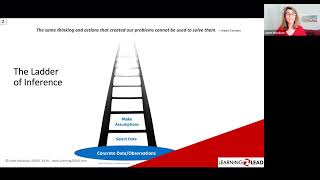
Janet Macaluso explains the ladder of inference: how we jump from observable facts to assumptions, conclusions, and beliefs that drive our actions. She shares a story about misreading a leader checking his watch, assuming boredom when he was just checking the time until lunch.
Chapters
This is the ladder of inference, and it starts at the bottom, where, if you think about, there's this pool of data that our eyes, ears, our senses can pick up. For example, you can see my hands moving. You can see if I scrunch my nose, you could see that I'm looking at my watch. If I had my watch on my wrist. These are things that are so concrete, you could videotape them, you could audiotape them, and they would be admiss in a court of law. So this is all the concrete data that we can see. Then what happens is we go up the ladder of inference and we choose. Of all the data, let's choose. Janet looked at her watch in the middle of the meeting. You could videotape that. We're going to go up the ladder very quickly in a New York nanosecond, make some assumptions about that and then draw some conclusions about that, make some beliefs, and then take some actions. I'll give you a real story. I was giving a presentation to a leader, a report on his department. I'm using the PowerPoint slides, and I'm going through them. He looks at his watch. Concrete data. I select that. Of all the things going on, I select that. I make the assumption. He's bored. I'm going too slowly. Then I go up the ladder very quickly, and I take actions. I click ahead in my PowerPoint and I go, let's move ahead. He says, whoa, whoa, wait a minute. Why are you moving ahead now? I knew this material, and so I said to him, I saw you looking at your watch, so I assumed that I was going too slowly for you. He returned back to me and he said, you see the bagels over there? I said, yes. He says, I was looking at those to see how much longer before lunch. Can I wait or should I eat the bagels? That's an example. I selected data very quickly. I went up and I took action.