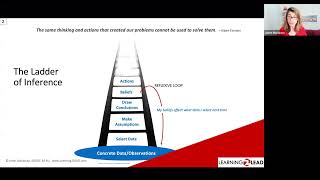
Janet Macaluso explains the reflexive loop: your existing beliefs filter which information you notice and remember. If you think Joe is a jerk, you'll hear him talk loudly and take it as proof, while ignoring evidence that contradicts your belief.
Chapters
Of, let's say we're thinking of someone and we think the guy is a jerk. As an example. Well, that's our high level belief on the ladder. And this is called a reflexive loop. What that means is that the beliefs that I have affect the next piece of data that I choose. So next week, when I see Joe in a meeting, he. He might be doing all these things, but I'm going to choose one piece of data that he was talking loudly, and then I'm going to say, that confirms it. He's a jerk. So what happens is, and this is part of our brains, it's the reticular activating system, part of your eyes and the retina that we see what we value and what we think. So all this different data, I believe Joe's a jerk. So I select one piece of data that confirms that.