How to Design Your Next Chapter in Life and Work
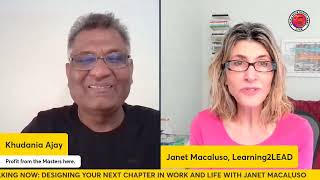
Janet Macaluso helps people in their 40s and beyond design what comes next in work and life. She uses Socratic questioning, year-long masterminds, and hiking retreats in Spain to move experienced professionals from success toward significance, rejecting traditional corporate talent models for a regenerative approach.
Chapters
Sa.
Welcome to this very special edition of the KJ masterclass Live, the show which ensures that you profit from your time spent here with experts either through the industry insights, information or simply learning from them. And today we have Janet Macaluso. She is the founder of Learning2Lead. Welcome to the show, Janet.
Great. Thank you so much for having me. Ajay. Looking forward to our talk today.
Thank you, thank you, thank you for pronouncing my name in the Indian way correctly. So thank you for that. And you are welcome to the show once again. And I'm sure a lot of people will be able to benefit from what we are talking today about. Designing your second chapter in life. So Janet, I just want to understand, you know, a lot of people generally focus on, on the initial part of life that, okay, that this is the type, this is the time we must utilize the best years of our life. You talk about designing, you know, your next chapter in life, business work. Why is that focus? Help us understand that's. Let's start with that.
Well, first of all, I think from a, just from a very personal reason, I'm in my second half of life and so people can relate or not with that. The thing is that we're actually now humans are living on the planet 30 years longer than they did in the 19th century. But there's no infrastructure or protocol or process for people we know. You have parents and coaches and schools and university. Then you get a job, you get married and have a mortgage. There's this whole expectation and infrastructure of how you live your life and maybe you get an mba, you know, whatever it happens to be, but then it's supposed to be, you're done. What happens especially when we're living 30 years longer and my job, my calling now is to help bright, smart, educated people who don't want to just sit on that couch for the next 30 years. In fact, there's this kind of dirty little secret about retirement. When people retire, the dark side of that is they're watching too much tv, they lose their identity, they eat too much, they lose the cognitive stimulation, social interactions. So my job that I'm now committed to is helping like minded people move to their next level. Taking what they have but designing it their way this time.
Absolutely. Absolutely. So for every designing that happens, there are certain tools. So what are the tools that you use that help that you know, help us, midlife change makers, practical visionaries and lifelong learners transform their success to significance? How? What are the tools that you employ to bring this significant change or redesigning into the lives of such people. So how do you. You do that? Who is this for anyone who is. Is there a particular age to it, or. Or how. How does one feel that you know, know exactly that I need redesigning in my work life or life itself?
Well, I'll answer that last question. You might know that you need or want, or there's something calling for you, maybe just because of your chronology and your age, and you're realizing, I'm getting at the age where there's more people younger and work than my age, what am I going to do next? But it also could be for someone, I would say 40s and beyond is my target group of people? Because it could be, I use this analogy of the chewing gum has lost its flavor. Or you might have 10 years of experience, or do you have one year, 10 times. And if you're starting to feel like, how many mornings am I going to copy paste the same thing, maybe to a different company, but just implement the same thing I did? Is there anything more? It's those little voices that I want people to pay attention to. And I'm saying, yes, and there is. And so what I use, which is actually different because I spent, like I said, 30 years in global corporate organizations in learning, leadership, organization design and development. I know the traditional way. I probably lose money by not doing the traditional way anymore, which is I could be a coach and ask your boss, your peers, your employees, what do you think of Ajay? And then I write up a report that I got from everyone else, and then I give that to you, and I say, here, that's what I used to do. I would hire consultants and coaches to do that to our people. Now I don't do that type of work anymore because I think it's outsourcing the development. So what I use instead, you called it tools. The process that I use is a Socratic method of questioning that actually develops you. And often when I work with clients, they say, I'm exhausted after this because I'm asking deep questions. And why did you say that? And where did it come from? And what's the source and what's the value and what's the opposite? Asking those types of questions, I believe, and I have seen not only in myself, but in others. It. It builds your will and your. Your potential to do more and be more. So that's one. The Socratic method is one of the. I'll stop there. But that's one of the ways that I help others.
Right? Right, Janet. So to understand your method, your what is that you call it an anti hero approach to developing professionals for the. What is this anti hero approach here? And you use masterminds and hiking retreats in Spain. So that that's a very new sort of a stuff. People do it. But being it a part of this whole redesigning of the second chapter in life. This sounds interesting. So help us three aspects here. One is the anti hero approach, the mastermind part part, and as well as the hiking retreats in none other than such a wonderful place as Spain. Why Spain?
So my last job, we used to take the executives to Spain. The company's headquarters were in Switzerland. It's a global company. We would meet in Spain and go hiking and we would take them on retreats and then sit under a tree and ask them sort of Socratic method question questions. They would have a journal and then they would do team building with another person and hike. And as I was doing this for others, I would look around and say how could I want to live my life this way? Because we were asking them deep questions. What's your best future self look like? How are you going to get there? And as I'm asking those questions, of course they're going through me. And I said is there a way for me to design my my best future self that brings what I know, leadership and organization development, but my way this time. And right now I'm talking to you from my home in Malaga, Spain because I designed that. Now that took me five years to work it all out. It didn't happen overnight. But I know and that's the process that I want to help people work through is what is your best future self? Let's start thinking and planning and moving in that direction because time is not stopping. And then part of that like before was the hiking. And I want to continue doing that hiking. And I do it with one on one leaders now, but I want to start doing it with my groups. So that's my answer to your Spain question. Antihero approach is very much this. I call it, instead of coaching, I call it resourcing. And that is returning the source of power to the person I'm talking to versus me being the expert guru who's going to fill your head up with all of my best practices and research. I'm going to use that Socratic method I told you to help you think about how you see this from multiple different perspectives. And so that's. The antihero approach is not telling you the answer. Although I will tell you I come from I'm an Italian American. And I can be a little bit strong willed. So sometimes at the end my opinion will come out. But mostly it's the anti hero approach and then the mastermind, thank you for asking. I am starting that up at the end of the month and I have about four people already joined and it's small group of professionals who want to spend a year meeting once a month to work on how could they design their second half. And like I did, it took me five years. But starting that process and I think a year is giving us number one, enough time to really rewire our brains and unlearn some of the stuff that doesn't serve us anymore and then learn the new stuff, the new way of being and doing so. It's a year long process that will work with me and other like minded professionals to develop a conscious approach to leaders, leadership. So that could be, and I work with a lot of businesses, but also it could be some cause that someone has. The only difference I would make is that earlier on in my career, Ajay, I was focused more on personal development and self improvement. And now the people I want to work with in my mastermind is they want to work on themselves in order to evolve the ecosystem, whatever that happens to be like the work that you're doing now, helping people learn and earn. You are developing yourself in a way so that you can serve and evolve others. That's what I'm here to do too.
Wonderful, wonderful. Now look, those people who are looking at, say designing, redesigning their life and especially the second chapter, especially leadership and whoever it is, so what are they actually looking for? Is it about thinking about a legacy for themselves, you know, when, when they know that now this is the time, is it about regeneration that they want to, you know, create a second work life, you know, much more fulfilling, which can be, you know, which can extend their work life. Many people want to work for a long, long time. Or is it more about self actualization, about spiritual attainment, about things when they can see things from much more, you know, a bit away from the happenings, relook at things and then rejoin the workforce or the life itself and try to live it in a better manner. The second half, you know, as I said, the Life begins at 40. Maybe now it's a regenerative life or the redesigned life that will begin at 40. How do you look at that? How are these executives looking at the second part of their life when they try and connect with you?
I would say it's all of the above, Ajay, from the Things you said one, two or three. I'd say all of those. So a difference from how I've traditionally worked in corporations and now I work now is I take a living systems approach. And if you think about the world that we're in today and the climate change and all of the things that we want to improve, I would say that the thinking, this is from Einstein, the thinking that got us here isn't going to get us where we want to go. So what I help people do is first look at the paradigm. Do they know the source of the thinking and the doing so? For an example, I used to own talent management succession planning, where we would rate unique people and put them on a bell curve or put them in a box, one of nine boxes, whether you had high potential, low potential, no potential. And so there was a lot of this haves or had nots, and we were slating and slating, plotting and ranking and putting people in these boxes. But living systems doesn't work that way. That was really good for the industrial age when people were making widgets in a row and things were very linear and mechanical. But we live in a very complex world now, full of diversity. And so I take a living systems approach. I'm a living system and you are a living system. Together we're a social system living in a planetary system. There's so, so I want to, that that is the source of my thinking and this is really important. All living systems, you, me and your listeners as living systems, we are in a process of becoming, we're always becoming the next level. That's like the edge where I want to work with people. You are always becoming. Do you want to do it deliberately, consciously, at a higher level of thinking and discernment, or are you just going to go with the flow and see where the waves take you? I want to work with the people who want to take the reins, use this kind of deeper thinking to go to the next level than before. And so that's that. When I talk about regenerative, that's the living systems approach that I'm talking about reinventing, regenerating our lives because it's happening anyway. So we might as well work with our living systems approach. And so it's very much self actualizing like you said, but I am self actualizing on behalf of the system that I want to help grow and develop. I don't know about you, Ajay, but this is all new to me, this social media, being on podcasts and posting a lot. I was a lurker. I didn't do any of this. The reason why I do it is because I ask. I have such a compelling vision now and aspiration of the people I want to work with that it calls me to be more than I am. And that's what I work with people. What is your third line of work, your next chapter that is so powerful and compelling that you're willing to be the author of your book or the puppeteer and not the puppet anymore. So that's why I'm talking, talking to you today.
Wonderful, wonderful. Talking of social media, we all are learning and unlearning, unlearning as, as you say, learning and unlearning. That's the way you know, sign your emails and, and even in social media's concept I can tell that we all keep on learning and unlearning not only about social media but so many other things in life. The good part is that in today's age we are getting hold of some new technology which is very helpful. But at the same time you also have to have a good balance so that the technology, our life, the technology revolves around us and we are not revolving around technology. As long as we are able to do that, it will be a good, good life, a wonderful life for all. So now coming, coming to about your you know, you talked about the living system approach and you have done so how do you tell us a bit more about your company learning to lead, what exactly it is? And secondly, you are, you know, taking applications for the third line, mastermind. So how do people apply for that? How can people connect with you so that they are able to make the best out of out of you through being a part of the living systems approach that you take for themselves.
So I would say to go to my website and that is www.learning number two lead as you see on the screen. But in case you're listening, it's learning2lead.com and you'll see more about my third line mastermind or my one on one coaching. And for this founding group that I'm starting with this mastermind, I'm including for the founders who join this Mastermind coaching as well. So I think it's a sweet deal for just this founding group if anyone wants to join and please reach out to me at JanetearningNumber2Lead.com to ask questions. I'm happy to talk to you about that. So that's my website and that's where people can find out more about the work. And I work now, I do some coaching with companies that keep me very busy and we look at the whole system and how the leaders can become change leaders for the enterprise as they're actually thinking about their five year plan and how they have to evolve as leaders and evolve the company because the aspirations that they have, they realize that their current organization and talent and capability will not get them to the five year plan that they have. So the people I work with in corporations are evolving their capacity to evolve that enterprise. And then I do one on one coaching for sure. And now I'm starting this mastermind. It's me and a couple of like minded colleagues who work with me as peers who think the same way. A philosophic approach, a living systems approach that incorporates I would say modern science and ancient wisdom.
Wonderful, wonderful. For that's very much required. Modern science and ancient wisdom. That's the best way to go. And as you have put it very, very correctly, that's the way we must follow. So on this note, it's a wrap on this very special edition of the KJ Master Class Live. Thank you so much indeed for joining us.
Thank you.
More from Janet


Why Training Doesn't Change People (What 13 Years of Harvard Research Found Instead)








