Pathways to Conscious Leadership with Janet Macaluso & Cindy Reiss-Clark
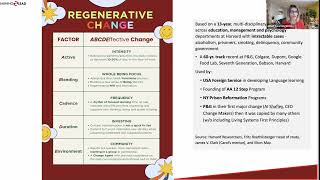
This is a recorded workshop-style conversation led by Janet Macaluso with Cindy Reiss-Clark and Guild participants about applying a developmental, living-systems approach to conscious leadership. Key elements: Janet’s ABCD Effective Change (A=Active practice, B=Blending whole-being development, C=Cadence, D=Duration, E=Environment/change-agent), the universal law of three (activating, restraining, reconciling forces), and a four-level paradigm model (Extract value → Arrest disorder → Do good → Evolve/inherent potential). The session includes a short wake-up/reflective exercise, participant examples (e.g., leadership decisions, course development, assisted-living choice), and a case: Cindy’s multi-year effort to shift West Pharmaceutical Services toward regenerative/conscious practices within a large, publicly traded company. Practical invitations: use concrete projects when applying frameworks, prioritize embodied cadence for lasting cultural change (research-backed durations cited), and consider offering deeper multi-session workshops to the Guild.
Questions this video answers
Three to seven years.
13 years.
Four years.
Six years.
West Pharmaceutical Services — described in the session as a New York Stock Exchange–traded company with over 5,000 employees.
Chapters
Or if you're going to record. Yes, I see that recording. All right, so on that note of what's learning you, this is Janet Macaluso and my dear friend and colleague Cindy Rice Clark. And we, I think, booked this time to get together and share our. Our journey of what we've been on for the last four years. We're going to share that with you. We started it. We booked this in 2023. So we're delighted to share. Well, it goes right to the experience. For you to be able to experience a developmental approach. And that word is not used casually that we've been using for the last four years. It's based on living systems worldview as well as ancient wisdom that goes back beyond Socrates. So it also has indigenous ways of thinking, certainly modern science, and a solid track record of 60 years. This has been, I would say has started 60 years ago, specifically in P and G. It's been copied and written about numerous times. But what we're going to do today is apply a systemic thinking frameworks, the very frameworks that Cindy and I have been using for years now. For you personally, especially if you're new to the guild, you'll be able to think about, apply what we're talking about to your specific project program pursuit. Also, I'd like some of us to consider using these frameworks around our together experience in the clg. So you have those two options. But I'm Janet Macaluso. I've been doing this type of approach now. I've been learning it for six years and applying it with Cindy for the last four. This is a refresher for the last session, in case you weren't there. The whole methodology of the developmental approach is based on a Harvard multidisciplinary study of 13 years where they took the most incorrigible cases, like people who were in prison or had drug addiction or alcoholism. They went through this methodology. I'm going to read it here. And as I say that, I'm then going to turn it over to Cindy, who has experienced it with herself and her organization. But I made it into something more memorable for me, calling it the ABCD Effective Change. The A for active means that the folks in the study and what Cindy and I and her team do is we bake the new patterns that we've been learning into our daily practice, 10 to 20% of our day, if possible. Then the B for blending is we're looking at whole being development, not just the brain, not just filling our tool kit up with more knowledge and more Stuff. There was certainly a structural or functional process, but we also work on the state of being and also regenerating will. Will is motivation, and motivation vacillates very quickly or easily. So there's something about the C for cadence that we come back together on a regular rhythm to regenerate our consciousness, our learning to go back to the well on a regular cadence. Otherwise the will deflates and collapses. The research showed that the duration of true organizational change takes three to seven years. Now, Cindy will attest that there's already been changes happening, but permanent, lasting, organizational, cultural change is an investment. And then finally, the E for environment. You might have heard that we're the average of the five closest people we hang out with in terms of finances, intellect, health condition. I'm not sure if that's true or not, but I kind of like the idea. So are we hanging out with people who are also going through this on the journey of developing and regenerating ourselves? And the other thing around environment is having a change agent. In this case, it was me who has been on the same path, but just a tiny bit ahead. That's how Alcoholics Anonymous was founded, or Weight Watchers, because then they're able to reframe and catch you when you maybe collapse, because they've been there themselves. I just went through that very quickly to give a sense of the framework that actually is the foundation of how we work. But, Cindy, I'm going to turn it over to you to introduce yourself and maybe share how this has played out.
Thank you, Janet. So I'm Cindy Reece Clark. And you know, I certainly am still on my conscious leadership and regenerative journey. But as Janet said, we've been working together for four years, specifically on this type of work. And, you know, my profession, I lead our commercial organization, which is our sales, marketing, customer service organization, product management, at a company called West Pharmaceutical Services. And when we started this journey, it was right in the heart of COVID And you know, the company that I work for, you probably know west, but have never even realized it. But we provide a lot of the containment for injectable drugs. So if you've ever had a vaccine, used a syringe, or had ever had to have an infusion, you know, West. So as we were embarking on this journey, we. We really forced ourselves to kind of think differently. And I had worked with Janet a year prior to introducing this to my team. But if I look at this framework, this is exactly the. This is exactly the change journey that we started. And, you know, when I Think about the intensity we deliberately put forth, you know, whether it was like through quarterly retreats where we would spend multiple days either virtually when, you know, it started virtually. But then obviously as Covid started to kind of shift and we were able to be more. Had direct engagement, we shifted that to more face to face. But it was around like the cadence, the, the intensity, the duration and the focus. And you know, we were introduced to a lot of different elements, but always around like keeping the whole in mind, understanding the energy that we brought to our work, the energy we brought to our teams, because that was very important because there was just so much uncertainty. So how do we manage ourselves? How do we be a resource and guide and lead in the right way across a larger organization to be able to create and bring about the effect that we wanted to have? And we are still on this journey. You know, we're four years, kind of three years into it as an organization and we are starting to see our efforts and our pursuits kind of come to fruition, which is fascinating. And it was, it's really about a shift in a bigger organization. But we started with myself and the leadership team and now, you know, we're now sponsors to other parts of our organization and we're the sponsors to our own teams further into the organization in this developmental process. And it's a lot about, you know, it's Socratic questioning, it's understanding really on a much bigger, on a much bigger scale, the source of our thinking, the source of our energy as to what are we trying to achieve as a business, but really more so, really about what do we want to achieve on behalf of our customers and the patients we serve.
Beautiful. Thank you so much. Great. And Cindy, keep bringing in your, your war stories all along the way as we share this. So thank you so much. And one of the first things that we do, I know at the Conscious Guild, we, we usually start with the meditation. A little difference is we do a wake up that actually it creates an intentional field and it helps us regenerate our focus, our attention and our consciousness. So we're about to. Right now I'm going to introduce a wake up exercise. I will ask you all, if you have a sheet of paper, please bring that out. We're going to think on paper.
At.
Least for a few minutes anyway. And what we're going to do to start is I'm going to introduce this framework, an ancient framework. It's universal really, that in any type of process or event in the world, you certainly see this, let's say in movies where there's some type of activating energy and then there's also a restraint, by the way, we see this in politics, black and white, Republican, Democrat, back and forth. But also there's something that an energy that can reconcile that is above and beyond. It's not cutting the baby in the Bible sense of compromise. It's coming to something totally different. So what that is. And welcome, Deborah. She just joins now, the universal law of three. A little bit more information and then you're going to apply it. But this activating force on the left hand side, it initiates some type of action or change. It drives something into being and it represents creativity, that creative impulse. Now, on the right hand side, always when there's something activating, there's always a restraining force. It's not always bad necessarily, but it opposes or denies or diminishes. You know, it's like the boy meets girl, but then daddy says, no, there you go with the movie. There's some restraint. So there's some inertia, something that is inhibiting it. I always thought when I first learned this framework, oh, you're like a buzz kill. This restraining force is like slowing me down. But over time I see the value. The restraining force actually governs and it refines, it balances somehow, let's say. Like I don't have, here's my phone to let's say someone wanted to create an iPhone, but then the, the restraining was. It had to have these limitations, this size, these amount of chips, whatever. There's some type of governing guardrails. So that's the restraining energy. And if you don't have a reconciling, you just go back and forth. So the reconciling energy, it harmonizes around core issues, it integrates, but it also lifts up beyond current existence, so it creates a new state or new result. Kind of joking. I say Yoda energy or the bumper sticker, what would Jesus do? Or what would Obama do? Sometimes that type of energy is, is helps you think about the reconciling. And although this is an ancient framework, you can see this play out the couple of business examples, if you all know post it notes. Well, the activating force there was. They were created, but the restraining was they weren't sticky enough. But then a whole new category reconciled that. The same thing with Airbnb as an example where folks wanted a hotel but they couldn't afford one, or there weren't enough. And then there was a reconciling force for that as well. So these energies play out all the time. Now here's your application. But what I want you to think about is either have two sides of your book. If you have a book left and right or just put a slide page down the middle, a line down the middle and the questions we're going to ask. Put your responses on the left side and on the right hand side. Because our intention is to regenerate our consciousness and our thinking is to also become aware on the right hand side. Make note of any judgments, any comparisons. Oh, I know this. She said tomato. I call it tomato. It's just like this. And what I'm asking you when you answer these questions is to regenerate your mind by listening for what's new. Break out to any. Break out from any ingrained routines and thinking patterns and catch yourself when you go on autopilot real time. This is what the very same exercises Cindy and her team have done numerous times. So here's the questions we're going to ask when you consider the potential life affirming effects on the world either from your own personal project, program your own work, especially for the new folks who don't know the clg, choose that one. But you also might consider what are the potential life affirming effects on the world from the clg? Keep that in mind and now use the law of three. What excites, energizes and engages you? That's the activating energy. What challenges, opposes, questions or refines or diminishes that energy. I'm going to give you time. I'm just reading them now and then the third energy, the third force, what would harmonize or integrate or lift up and focus and clarify both energies to something above and beyond the two opposing. So I think for just keeping pace, let's keep the whole we won't do a breakout. As much as I love, love that, let's just give a couple of moments, a few minutes of silence, reflection. I'll be quiet. If you have questions, ask them now. Otherwise go ahead and write for a couple of minutes. And by the way, if this helps, I have that backup. So you just let me know what helps.
Anna, can you put the questions up again?
Certainly. Just about one more minute. We always break out yet I just felt like I didn't want to break the field of us. It's a small enough group that maybe we are our own breakout. One of the differences I've learned from this methodology of working that's different from my 30 years, you know, I'm like I've been a master trainer of Facilitators, which meant that after groups would break out, I would say, oh, let's hear from you. What did you. And what did you say? And they would go to the flip chart and read off the flip chart. Well, what I've learned is if you're reading off the flip chart and you're just regurgitating what you already know. So I'm not going to ask you to report out your answer. What I'm going to ask you is, what's the next learning from that? And what is shifting in you when you did this exercise, what was the effect that it had on you just stopping and doing this. And if you remember, maybe from last time, if this helps, when I talked about every gap in performance was a gap in ability, and I talked about will, being and function, that might be something that changed in you, your will, being or function. Maybe not. Now I will stop and open it up. What has shifted? Anyone?
I'll start. Janet, it's 10 seconds on what I was focusing on two friends who may need to go into assisted living. I found a facility, but they still have some renovations to finish. I want to make sure that my friends go there. They're going to have good experience. So I saw the push pull. What shifted in me was to tune back simply the energy that's going on there, rather than trying to think it through and to feel, is this really a right direction? Does the. Do the energies do. Do they actually harmonize together or is this not a good fit? And so it was more an energetic shifting rather than trying to think or even feel it through. Right. So. Thank you.
Thank.
You.
Yes, I had an energetic shift too. It reminded me of. Arlene is familiar with this. The attempts at the university that we were a part of to have these micro credential offerings to the public. And there was this push for us to develop all of these courses that we would as another offering to the public other than credit bearing courses. And so we developed out of this enthusiasm, we started to develop all these courses, but there really was nobody taking them. In a sense, it was discouraging because the school was dying also. The school was dying like a lot of small colleges and universities. So there was this. So when I, when I started creating the courses, like course I'm creating for. For the Guild, I had that same sense, is this going to be futile? That there's. That there's no way that. That we have our budgets or whatever it is. We have to make this known to the public for people to. To take these courses. And and then some new ideas came out of it from the. From this third. Third piece. I'm in a meeting right now. Yep. In. And I could see a way for. Make this. This work. And so I'll be sharing this with William afterwards about some of the ideas that have come to me. In many ways, this is almost like the bottom of. Of the U in theory you. Theory or theory you. This bottom place where something new arises out of it that has integrated that somehow. There is a. There is a seeing of the whole. And out of the seeing of the whole and then just going empty, something new arises out of it. That is. That. That harmonizes it and inspires it and makes it a possibility. And it. And it comes to you like. Like that. It. That's the gift of most of successful and really creative people. They. They have a practice that allows them to empty themselves after they've immersed themselves in it and after they've pulled back to see. See their own seeing and then go empty. And then somewhere out of. Out of the emptiness, out of this fecund emptiness, comes this. This beautiful resolution. And when it hits us, we know. We know. We know. Yes. That's the direction we need to go. We may need to. We may need to create prototypes or whatever to find out what we don't know. But there is a. There's something that knows. And we can also communicate it to others in a way that they get it too. There's something strange about. Mysterious and sacred about this place.
I'm going to ask, just because the two. William and Rick, those. Those examples. But I. I'm betting most everyone. Whatever you thought about when Cindy talks about Paradigm, I want you to assess where your thing, whatever it was, is on the levels of Paradigm. Is that two of them? I've already done that for you.
Yeah.
Thank you.
One more thought.
Wow. Janet. Oh, Craig. You're ready to go? You go.
Well, I was gonna ask if Arlene or Kimberly or Dana wanted to go. And if none of them did, I was gonna offer something.
Thank you. Thank you for saying what I should have said.
Arlene, Kimberly, Dana. All right. I was just thinking about. I'm in Vegas right now, and it's its own world. And I'm thinking about the challenge of bringing love and spaciousness into work. And. And. And just the challenge of that is that the real world, like, we're on a train, man, and we can't slow down because, you know, that's. That's. It's not productive and it's stupid and it's a Waste of time. And we got shit to do. And. But I was. And it's very seductive. And I've seen. Well, love can be energetic. You can love energetically. Love. And magnetism is more efficient than force, although force can be quicker. So really thinking about, you know, what are. What are those. What are those reconciling forces to kind of help pull people towards that and bringing that into work. I was thinking about the Guild. What's the Guild's role in the world? And, you know, and then one of the judgments that came in as well. That's great. If you've got a PhD and you've been a consultant for 30 years and you're super, you know, and you live in San Francisco, blah, blah, blah, what about normal people? And that just really kind of brought me to spiritual training. This isn't something that you need an advanced degree. You just need connection to source. And so what's the role of spiritual training, which is accessible to all, you know, if you're going to be one. I know the developmental guys love to talk about, you know, red, higher tiers. And so anyway, so that was kind of the shift in me, maybe a little bit of hope, but cracking the code and how to make love and spirituality attractive to the masses. As attractive as Vegas. How do you make that as attractive as Vegas?
Way more attractive.
I don't know. It's more attractive to me.
But how wonderful. Craig.
I have a working premise that is we have to be in a state or a field of consciousness for consciousness to emerge and grow and bear fruit. And I'm. I. This has been a long thought, thinking process of mine. Is that going back to the change theory of cadence, the sea. The cadence is important to regenerate my consciousness because I can guarantee after this beautiful session that we have and I go away, I will collapse into automatic pilot. So it's this field of consciousness. We're conscious. This is my premise. But any final. One more burning thought before we.
Yes, Louis, you know, I can't resist. And even I'm so glad I waited because what you just said. I want to answer your question by complimenting you. So trust that I'm doing my own work first. And that is when I had my first one on one with you. And when you started this process, I found myself getting totally defensive because of the way I was raised and educated about being told, here's the way to do this and this and this and start this process and this. So I knew how to just breathe. And just like in our first one on One, something's going to come out of this. And just that exercise opened me up to something I had never so simply felt. And then when you say, oh, I had to go through a thinking process to do this, and then abc, I go, what? But, but, but however you got me, you met me just with that exercise so wonderfully that I have huge respect for how you think and how you get to the being so well with your exercise. I'm in fact going to use it one week from today in my belonging session, either with you or without you, as you wish, because it's a wonderful exercise, as wonderful as anything I've used in decades. Thank you.
You're welcome. And a note of caution. I have the. There's thousands of these frameworks and given my experience and yours is similar, I fell in love with them and then thought I'm going to go do it. And they fall flat because there's an energetic presence that needs to be with that. Otherwise it's all, if you remember will being and function, it's all functional and there's enough function. We. I don't think the guild needs to offer more functional skills. So that's my note of caution with that. Moving on. Keep your, your thinking, your project or the CLG in mind. We're going to talk about paradigms. And so they're this invisible force through which I'm seeing the world. It started in sciences and or certain domains, but if you think about how we educate or how the field of medicine, there's traditional medicine and all different types of types of medicine, or how we manage and lead or parent our children, all of these are paradigms. But what happens is we only see the elephant, in this case through our own paradigm. And then we become paradigm blind like the rhino. We see the world and we don't realize we're seeing it through our own lens. My question to you is, are we deliberately deliberate about the source of the paradigm that is sourcing how we lead, design, manage, coach. Oh, so keep that in mind. And that's what we're going to be talking about. Because you might say, oh well, we're not in the industrial age anymore with time in motion, I Love Lucy in the Candy Factory, all of that. We're not in this industrial world, but maybe it's just old wine in new bottles where we are carbon copying generic offerings to distinct beings. Imagine your beloved child. Would you want your child to be slotted into a bell curve or a box? But that's what happens. So those are just a couple of examples Because I'm, I'm seeing the world through the paradigms and saying we are stuck in a paradigm that we're so used to, we don't see it anymore, but it's there. And so what we're going to do is these ancient frameworks can become very esoteric. So we always ensure, ask that you use a real specific concrete example. Don't make it theoretical. And I'm asking you to self assess a real project. Program pursuit could be the one you just chose or the clg. It could be current or past, it could be successful or room to grow. It doesn't matter, but just choose. It could be the same one you just chose, but something real. And I'm going to turn it over to Cindy, who knows this well and I think she was saying it this morning, play out in one level in real life. Okay, here we go then, Cindy, here we go.
So as Janet said, just keep in mind, because I, I want to premise this by saying that just because it's on an order of things doesn't mean it's bad, but it's about are we conscious of it? Because it's very easy to live life on autopilot. And when you're thinking about just like I'm just going to check the box and I just need to do certain things without kind of taking a step back and saying, well, how, what context or how am I thinking about this or how am I viewing it? You know, that's where I think the consciousness comes up. So if we're conscious about how we're, how we're view what our view of the world is, these things can be nested and they're not bad. But if this is kind of our natural mode of operating, it is about creating that awareness and you know, I can speak for myself on this journey is once I saw these paradigms, it's, it, there was an awakening, there's an awareness now that I, I can't unsee. And so hopefully this has the same, you know, awakening in all of us during the session. But at the very, at the, at the kind of, the lowest level of paradigm is extract value. And when you think about that value return, it is competing or dominating human or non human assets for our benefit. Benefits. And I look at this in a couple of ways. When we, when, when, when the team first started our journey with Janet, you know, there was a lot of discussion around, you know, this is my lane, right? I'm going to stay in my lane. I don't want to be able to, you know, Product management should do this or sell should do that. Or maybe Craig, even some of the comments that you just provided in, in, in, in your, in your thoughts that, that you shared, you know, when you, you, when you kind of look at the world as extract value, you know, this is where we're not really necessarily thinking about the effect that we're having on the choices that we make because we're thinking about what is it doing for me right now and what can those effects be. It could be disengagement of teams, it can be, you know, exploit kind of exploitation. So, you know, we can think we're doing really good things and we think we can be, you know, growing a business. And because we are, you know, growing a business business and thinking we're creating and capturing value, the effect may be something like this in this picture, right? At the same time, you can now move to the second level of paradigm to say, okay, now I move from just extraction without thinking about the effect of it to what we call a REST disorder. And you know, we, we now understand kind of the damage that we're causing, but we're not actually maybe getting to the root of its core. We are still reactive and just kind of putting a band aid on something. So when I think about this arrest disorder, you know, going from hey guys, you need to stay in your lane. If what this person could just do this, that would benefit me to where now you may want to go into an organization and instead of really, you know, doing the discovery work to the root of a cause or the root of what we're trying to do, we may put a, a team on it, a task team or a tiger team, or I'm going to put a COBRA team. And you know, basically it's still fairly reactive. You're now working as a team. But, you know, it's, we're not getting to kind of the root to be able to truly think about it in a different way. We're just kind of plugging that holy. So that's kind of the, you know, we, we, you know, I, I can tell you by experience, you know, when we were trying to solve or engage and interact with cut with clients, sometimes it was just, we just got to put out this fire because we're too busy, right? It's almost like you, you're, you're too busy and people can be very busy. But are you really busy? Are you really driving where you want to go? So it's kind of keeping that in, in the forefront at the next, what.
Was the, the line I heard numerous.
Times, like, we love a good crisis.
We love a good crisis.
We love a good crisis to bring us together, right? Like we, we love a good urgent thing that, that brings the teams together because that became the purpose is the fire we're putting out versus the direction that we're going as an organization or what are we trying to achieve on behalf of our clients. It was more. Our purpose was to go from one burning issue to the next burning issue, right? That's how we were coming together with.
I heard stories how, you know, if you don't have some higher purpose that you're all sort of swimming in the same direction to. It's like your team, regardless of the customer. Maybe if, you know, you. This isn't your, your desired customer. Everyone's giving them like white glove reactive results because they're arresting the disorder. It's. How do we stop it? Plug the hole. So I've saw, I saw it and you must see it. I think you saw it this morning too.
Yeah, it's true. So on, on our third level is, is do good. And in, in this case, you know, we are really looking at, we are, we are looking at kind of more around culturally idealized versions of what is perceived as good. And I think most of us have heard of, of gurus or, you know, benchmarks, right? I, I can tell you, like, if, you know, there was, there was a time that if, if you didn't mention Gartner or McKinsey or some or one of the other big consulting firms, it wasn't kind of perceived as best practice or good. And I think that, you know, from a personal perspective, I think we all have in our own mind the, the idolization of what is good. You may compare yourself or, you know, depending upon the culture you're in, you may have a different perception of what is good because it is, it's, it's. It's subjective. And I, I can give you an example of, you know, one of my leaders, like, how he conducted meetings, right? It was very much in a do good where, you know, they, they were, they were discussing the right, the right things. But the way that they were conducting the discussions was really more of like, making everybody feel good versus really addressing maybe a conflict or, or something that would really elevate the dialogue in a different way. So it's not to say that it's, you know, this isn't bad. There's a lot of, of good things that can come from benchmarking. There's a lot of good things that you can kind of look at, to say, you know, where am I on. On the maturity of things or where am I on my journey? But if that's the only place you stay, it goes back to the will and being. Am I really rising the energy, raising the energy? Am I raising the bar for, for myself or am I being self directed to kind of go into another, another paradigm? And if you go to the next slide, Janet, this can kind of just illustrate. It's the gold standards, the ideals and gold standards. And you've got to look at, you know, you look at best practices, you look at a lot of things. But again, it's still very fairly subjective. And who sets the gold standard? Right? Is it self directed? Is it. Are we now just more in going. We don't want to go against the flow, right. Because I may identify myself in certain areas but not others. Or others may put me in a box like a nine box or a bell curve. And is that where you want to stay or be, right, in terms of your being? So then if we go to the last. Did somebody have a question?
Yeah, I was just going to say I spent close to 30 years working. The source of my work was the do good paradigm. Emotional intelligence. Listen, don't interrupt. Psychological safety, warm and fuzzy noogies on the head, team building, golf, you know, all of these things now they're not bad, but I wrote an article called why well intended Coaches, leaders and consultants Aim too low and reach it.
Low goals.
That's all they reach for is do good. Which I did. I'm like a converted smoker. Okay, that now doesn't want anyone to smoke because I can't unsee. If we aim too low and reach it, what happens? Go ahead, Cindy.
And then the other one is really, how do you rise to that evolve inherent potential where you really are seeking a unique essence to essence approach where you recognize that you know, what you're working towards has a different level of potential and it is the work that we need to do. And I can say, you know, just to echo, Janet, you know, I too was leading from more of a. Probably a do good or an arrest disorder. I was, I was creating urgency within my team. And if you think about the energy levels like we, you know, what is the energy that you, that you associate even with the tears, you know, when you create as a leader or when you're trying to impact the world in a different way, the energy that you're creating, whether it's reactive or purposeful or you know, vital or creative, that matters because it then it comes back to kind of what is sourcing the energy, what's sourcing your will, your motivation, your being state. And you know, had, had we not gone through this work and we had not gone through these, these, these frameworks, you know, are we at evolve inherent potential in every meeting, at every, every gathering? I'm going to say no, we're not. But when we think about our customers and what do we want to bring forward in the world as a team, that is what we're striving for. And so how we use these levels of paradigms, if you go to the next slide, is we ask ourselves are we coming from a space of existence or are we really driving to our potential? Are we reacting to something or are we being proactive in how we're thinking, how we're managing our, our being and our will to drive where we want to go and what we want to bring about? And we use this in how we think about innovation. We use this in how we prepare and have discussions with our customers. Because what are they trying to achieve when they bring a new medicine to the world? How, what role do we play in that? And it, it just gets us thinking very differently on behalf of others. I use it even within my family. I'll, I'll sit back and say, okay, how, how, how did I come across there? What, what level did I, did I start from? And I just want to state that these aren't bad. I think what, what I've learned and what I think through a lot is it's about the consciousness because even at the lowest extract value, people wouldn't be in business. They've got, they've got to, you know, if you are working for a pro, a for profit company like you know, you've got to extract some value or you wouldn't be in business. Right. But it's about being conscious about what you are doing in the different levels and if you're staying or if your mode of operating is really only in one, like what do you need to do in order to reconcile to a different level? And that's to me is what this brings in, in leadership and even how I engage differently with my teams. Yeah, Bill, I see your hand up.
Yeah.
So it would be helpful to me.
Excuse me.
To have a better delineation between involve inherent potential and do good. I'm, I'm, I'm struggling to see where the demarcation line actions are.
So one way of thinking the do good, I believe sources diversity and inclusion, affirmative action, sustainability and what happens Often, Bill, is that it becomes kind of like a source of colonialism. It's like I'm the one who's telling you what it should look like as an example. And now there's a lot of do good. There's a lot of good in do good. It's above the line. So don't get me. L. I'm trying to give you the different. This. What you. The question you're asking is exactly. The skill that we build is that create discernment on the subtle nuances so that each team, a person knows. So it's really about an example. When I first started with Cindy, they used to talk about their leadership team, her group of vice presidents. That's what they talked about. Then they moved the conversation up to start talking about west as a multi thousand person organization. It was the whole company as a whole. Living Systems looks at the whole. Then over time, I've heard Cindy and others talk about the medical device industry. They want to. They want to. They're not following the best practices of what's out there. They want to disrupt the industry to make it more accessible and affordable. And that is like totally different kind of blue sky thinking that is needed because they love their people and know their people so well. And how can they not just sell their product, this medical device, but where does their offering fit into their customer B2B, their customer's value adding process so that they're increasing the ableness of their customer. Not just saying, you asked for this order. Here it is on time at the price you asked, we've increased your ableness. Cindy, any thoughts on that?
No, I. I would just say that, Bill, from that nuance of do Good, I do think it's, you know, I can give an example, and I'll use sustainability as an example because I think it is a hot topic for a lot of people. And you, you can. We can use sustainability and go through the different layers. But when I think of do Good, you know, you can. The difference in my mind is we recycle, you know, we want to eliminate waste in our manufacturing to shift it from do good to evolve inherent potential. Like Do Good is like we want to be recognized as one of the top 20, you know, businesses on a. On a standard. And we have different standards, but can we. Can we do more? Right? So there's, you know, Europe is wanting certain things by 2030, others are wanting certain things by 2030. And we're looking at that as like some people can greenwash, right? You buy green credits, you can tap into an energy. Well, that's not bad. Right. But I think the difference is if you really move to evolve inherent potential, the conversations we're having now are, are how do we truly build products and use packaging that everything can be reusable or regenerate, like reusable, recyclable, you know, what are we doing in terms of what energy we're using? Not buying into it, but like really walking the walk of is everything. You know, do we have a goal to use renewable energy in all of our factories? So that way we're not just looking at it from a carbon neutral, but truly thinking about it in a different way that makes a real true impact on the environment. That would be maybe a nuance that, that how we think about the difference. Because it's not bad, right? Do good isn't bad, I, I think but it, it's like there's probably another order that if you really challenge yourself, you could strive towards. And I think we all have more potential than what we think we, you know, it's like we all have more potential in us than what we probably give ourselves credit for at first glance.
Thank you, William.
Yeah. You know, a conversation, I think that builds upon what we were talking about here from conscious capitalism and others about having a purpose driven company, which to me is defined by having a purpose bigger than what you can do yourself or bigger than what you can achieve yourself as a company. For example, Patagonia says our purpose as a company is to save the planet.
Yes.
It's not something you're going to achieve by yourself. And I found a quote from Mary Barra, the CEO and chairman of gm, that said our purpose as a company is zero emissions to save the planet's health, zero crashes to save lives and zero congestion so people can have time back. Now she's not going to achieve that with gm, but if that's what you're striving for. So where does that fit here? Does it even, is that even beyond inherent potential or is that part of what inherent potential is referring to? Well, because it's beyond self interest is what the real sense is there. It's beyond your self interest that you can achieve as a company.
I do believe it is, but probably I don't want to give like a quick and dirty answer just to reply to you. It needs more thought. It's certainly moving upwards though.
Yeah.
I mean, one of the things that I mentioned to Cindy is like, okay, so you use rubber in your manufacturing and so are you regenerating the rubber farms in his Earth a stakeholder in your organization or are you just extracting the value from the rubber plants? And then, thank you very much, don't let the door hit you in the ass as an example. So I can be conscious, but I'm also, I'm also a street kid. Tom, what's up?
Thank you.
Yeah, I'm just wondering. I get it, the distinction between do good and evolve inherent potential from a.
From a business practices and from a materials perspective. But can you speak to it in.
Terms of the leadership qualities. Leadership qualities and as a, as a.
Human being and human, human relations, human interactions.
So I, I can start from a, from a do good. I think that naturally most leaders are here and I can speak from experience in terms of, you know, if you, if you look at it from self directed, you know, like everybody can have good intentions and you could still tell somebody what to do versus ask a lot more questions to really get to the source of how are they thinking about it? What is their view? Really consider them in, In. In. In the outcome or in the discussion versus giving an answer. Right. So when I think of leadership and even my own growth in leadership, there's always questions that you ask, but it's really kind of thinking about, you know, can you elevate, can you elevate the perspective? Can you, can you be a resource for somebody to be self directed, that you can create a different being state a different motivation and will, that they would want to take an, a different initiative or that they would want to do something on their own because they were, because they thought it through in a completely different way from a different perspective. And to me, it goes back to what Janet was talking about. It's all three. It's will, being and function.
You wanted to ask me anything or say anything or not. Okay.
I'm sorry, what?
Lewis, put yourself on mute, please. Okay, go ahead, Cindy. Sorry.
But I, I think when I look at do good versus the evolve inherent potential, you're keeping all three of those in mind. The, in, in that inherent potential, you know, it, it is about the being state. It's about the will as well as function. And it's really looking at kind of what effect do you want to have, not just the outcome.
Yeah.
If that makes any. If that made sense, Tom.
Yeah.
Thank you for that.
So what we're really talking about is when Einstein said, you know, we can't solve the problems with the old way of thinking, we need to think anew. So what I'd like you to do is to think about a different Direction using this on your work that you have been thinking about. So if you go and assess your project, your program and it could be a learning leadership program program by the way, or, or the Conscious Leadership Guild and you know the topics we talk about, the work we do, what's the dominant paradigm that is sourcing the design or the process, the activities, the focus and are we consciously choosing that source paradigm? How do we know? And then when you think of that, what is activating in you or restraining or perhaps reconciling? Now I'll tell you in terms of leadership development and education, I would often give all the best practices and this is what you're supposed to say and do. And it was an expert model, this developmental that is different from. I think it was Craig who talked about color some. This is far different from that. Not far different. It's. They have the same word developmental. But what we're focusing on is increasing the ableness of the people we're working with so that they can think differently. Their state of being is more imperturbable and their will. I remember there is this wonderful teddy bear on Cindy's team. Everyone loves him and how he's changed now where he goes no more Mr. Nice Guy. Well the guy is just exudes night Mr. Nice Guy. That's not changing. But he has such a higher purpose now that he's not going to let people off the hook or he's not going to stop the conversation when it gets uncomfortable because he. He's working on behalf of evolving the patients, the end users and building their capacity and they deserve more. And when he holds that in mind, that level of potential, next stage potential, then he goes from do good. And he has said that, that's an example. So why don't you just maybe as we're getting close, spend a few minutes here maybe just thinking in answering those questions. And if we do have time, I'd like to talk about the levels of thought and the effect that also somehow I think maybe Tom was the one but somehow that came up for me. So I'm going to ask you to just answer those questions quietly. Just for the sake of time. Let's maybe bring it back together. Or do you want some more time? It's yours. I see you all writing. I'll give you another minute. Go ahead. Thanks. I say let's have a conversation because for this, this is only, you know, the first conversation we've had on this and it takes time but just wanted to know what's maybe exciting you or shifting in you, maybe. What do you find of value so far?
I think the most. Well, I love the presentation, but the most impressive thing is that there's a New York Stock exchange traded company with over 5,000 employees that is actually practicing this. That's, to me, I wouldn't have bet a dollar on that. So, Cindy, congrats.
Comes from leadership.
Right. But most pharmaceutical companies are led by Wall Street.
Yeah.
So.
Well, right. It's the, it's the constant restraint and activating that we're looking at, obviously, because like, that is still a stakeholder. But, you know, the conversations we're having is if everybody, if all companies, if all they are looking at is focused on the value of it and how do you continue growth? Well, if you grow and grow and grow and grow, at what cost and what are the repercussions of that and the effects? So I think, Bill, you and I have had this conversation before. How do you redefine success in companies on what time horizon? Because if it's, if it's, you know, it's earnings, seasons. Right. We just came out of earnings last week and we're in a bit of arrest disorder right now around like the sense of urgency in the back half of the year. And it's not to say that we're always at the top. Right. I mean, but I, the. There's a cognition that it's where we are and how do, how do we, how do we actually build capability and what role do we play as leaders for all of our 10,000 employees versus a few? You know.
No, it's refreshing. It's great. Some others on this call that know more about healthcare than I do sort of led me to not expect great things from the healthcare sector. So it's nice to have this shining example of the striving because that's all you can do. Right? We all live in a world of constraints. I mean, you can't be a company of your size and not be publicly traded. I suppose you could be, but. So, yeah.
So I'm going to go to William next. I, I just wanted to say some things that I kind of forgot about was I see do good as a portal to the next one. So it's not saying you don't need.
It.
Not aim there and reach it, because there's another level. And the other thing that I think I forgot to talk about was with evolve potential, we're always talking about the whole, the whole system. Not my piecemeal department or my fragmented project. It's the whole. And the system includes the customer and even the end users always. We're always looking. Who are we forgetting? So I wanted to add that. William.
Yeah. Two insights I have here. One is, if I look at this as like a nested system where extract value is the kind of least expanded consciousness you expand it to a rest disorder, expand it more to do good, expand it more to evolve potential. That means you can be operating from evolving potential and be consciously doing good, arresting disorder and extracting value at the same time, but you're holding it in a larger space.
Yes.
It's kind of like you can hold non duality. And duality is a small piece of what the non duality can hold. The other thing I can see here is that the activating, restraining reconcile. I had a chuckle about choosing a source paradigm, and I capitalized the word S. Choose a source paradigm. And I see that the reconciling is the source. Capital S. Source. It's like when we as personalities feel like we're activating and something's restraining us. That's at a personality level, but energetically that moves up to the source to guide us. It starts harmonizing things automatically. So I saw those two pieces kind of blending into these other conversations we've had in the guild. So thank you.
Thank you. Who's next? Myron and then Lewis. Myron, we're going to see your pretty face or just the lake.
Oh, maybe not a pretty face, but maybe just a. A face. So a brilliant insight that came through for me in this session is that in every dominant paradigm, there is always activating and restraining. Statistical process control tells me that. That there's always variation, and that's normal. That's typical. And to consider the activating and constraining as something special really distracts from the inherent poss. The inherent potential, which is completely different than either one of those or both of them. It is its own realm. But then when it's engaged, then it brings in whatever else is going on. And so that's really fascinating for me. And then in the context of the guild, I didn't want to say this, but I'm going to say this. What is the dominant paradigm and what's happening in that dominant paradigm, and what is away with being with inherent potential. But even calling it inherent potential, like consciousness, it's so big, it's so broad that it's actually nothing. Inherent potential is the same way. It's so big, it's like, you know, world peace, you know, eliminating hunger. It's so big that I can think about it and feel Good. And yet, you know, that's really about me feeling good. What is it that I can do right now? And that's, that really just this insight really reinforces how important it is for me to be present to what's actual and aware in terms of the wholeness, not just my own parochial view, but the many views that make up the whole. So thank you.
Yeah, and the point on that is the, the, these frameworks I've been at, I've been asked numerous times to dumb them down because their, their words, the semantics are unusual and can't you make it easier? And, and so what we always ask is apply these sacred frameworks to specific concrete work. And so it's not just like, oh, inherent potential of the universe. No. What's the inherent potential of this medical device that we're talking about right now? It's always concrete. And I'll stop there. Thank you, Craig.
So this is, this has been a really useful session, so thank you. And I'm also going to research West's stock later. But you know, I'm, I'm really thinking about dominant paradigm. It's been on my mind because I'm working with another organization that I think of as a really conscious indigenous women led organization. And I've been surprised by what I perceive as kind of fallback onto kind of dominant male, get shit done, throw some systems thinking methodology at it and, and let's solve climate change or etc. Right. A lot of that do good stuff. And actually it's funny, I did what William said without even realizing I was doing it. How I read are we choosing a source paradigm? I really read that as are we choosing a paradigm grounded in source? And in the case of this organization, I think they really think they are. But I'm wondering if there's just stories about what that looks like, about what right or conscious ways of doing things look like and are those actually the constraints? So what I'm curious about is.
The.
Quality of energy that we bring.
And.
How does that, what does that do to inherent potential? Because what I think I'm seeing is people who actually really have a sincere practice, like real, and have connection to source, really have it. And then they, but they come, but they default back to these ways of getting things done that we've always done. And so what I'm curious about is how does the, what I wrote down was how does the quality of our energy impact outcomes? How do we really pay attention to that? And then at the same time, how do we meet others whose energy is different or. Or in opposition to our own. And how do we navigate that without falling back on force? Or oh, I'm going to, I'm going to convince you that the way of sacred reciprocity with the earth is the right way. I'm going to pitch that or I'm going to force you to adopt that. Anyway, so that's what I'm really curious about. And what is a way of being, being with inherent potential? Myron, I thought, is a really interesting question. So. So those are the things rattling around in my head as I leave this.
Today's crises invite us or call us to a higher level of being, thinking and doing. And for me, these frameworks help us see the subtle nuances, discernment and distinction. We have this one we've shared around paradigms. We have another one on levels of energy which is from vital energy. Ah, life or death. I'm going to get a pink slip or something. Or automatic or sensitive like do good or evolve or conscious energy. We work with Cindy's teams know these.
Yes.
So they know what level am I coming from right now. It has to be kind of embodied, this type of work. And we also have these four for her looking at her product offerings and how do you make yourself non displaceable in the marketplace or are you just offering one product or something? So she looks at her suite of products through the lens of non displaceability. These are all levels of thinking. But it starts with yourself before you go to that. That thinking. Louis, go ahead. And then I realize we're running out of time.
Yeah, I, John, I, I experienced this process and your facilitation of this process so enlightening that I really would like to experience two different full sessions that you facilitate on this one for those of us who are just trying to get better inside the guild with ourselves developing our own consciousness more fully and in our circles. And I'd like to have another session for those of us and I'm in Beach who would like to use it to figure out how we as a guild along with what everything William's suggesting and others how we as a Bill guild can offer things to the outside. Your the whole process I find so wonderful. I really would like to have a full session led by you to use it for each of those.
Well, I'm gonna bear me with me. I might go a few minutes over but as I'm. Thank you. You've. You've g. Given a great segue. I will offer this. This is my colleague Bill Reed. Is Bill Reed was like on the certifying board of lead buildings, you know, like green buildings. And if you see somewhat he wrote about it and used this. And then someone took his framework and edited it. He. He told me he didn't like it. But if you see there's conventional, green, sustainable, restorative, regenerative. And in this piece of work, they have the SDGs in the middle do good. But what we're looking at, how do we get the whole system, the living systems. You will get this deck, by the way. So we'll make sure you. Because I'm going very quickly. But I just. That was next. So I wanted to show you. We're trying to move away from degenerative all the way to truly regenerative. And what does that mean? So very quickly, if you think about business and we're often talking about as leaders, what are the results and the outcomes and if we kind of re engineer that, we see that those came from actions or inactions. I mentioned Cindy's teddy bear employee. He was a leader. He was doing inaction because he wanted to love his people so much. That creates a result. And what, what that those actions or inactions are sourced from our thinking or what David Bohm would call is thoughting. He would question us. Are you really thinking or just copying your thoughts? You know, I, I met a woman recently and she doesn't know this work at all. She's in finance and she goes, these leaders, they always want to hire. Did you do it before in the, in another company? Oh good. Come here and do it. I've done workday change management in four different companies. I just changed the PowerPoint slide copy pasting. That's an example of thoughting. It's off the shelf. It's not looking at who are those beloveds and where are they aspiring to grow? How do I help their ableness that requires this discernment and thinking that they deserve. It's not thoughting. And then from the thoughting it's really thinking about, well, what are the subjects we pay attention to at the guild or at work? Are we over attending or un underattending and is it by choice or default? It just happens because that's how we always did it. That's how my, my boss did it. So I'm doing it the same way. And then there's the how. And what we're saying is that the power is upstream so that we can create the effects in the world. As an example, Cindy and I just had a conversation a while ago when you're thinking about Ozempic and these drugs that they're weight loss drugs. Well, that's making a lot of results in terms of money. What are the effects on the system on young girls or whoever? You know, do we think about that or we stop here. And what we're really talking about, this evolved capacity or inherent potential, it's about the implicate order that David Bohm talked about. Something out there in the source that we want to create together with the source. It's not dealing with existence because we know how to do get stuff done real good. So finally, and this is Lewis Teed this up is how do we evolve our potential? Not on our state of being, but on our becoming. Last time I talked, I said it's not, it's not cushy, it's not the flow. Becoming is not the Zen zone. So it. And it would require a cadence of regular meetings and focusing on that. So I guess that was the invitation. If there is an appetite.
For more.
Of this thinking, that is something that Cindy and I are willing to offer the Guild. So seeing some thumbs up. Thank you, Bill. But if you'd like that, that's something we. Because if we just do this once and done. We're not walking our talk. So reactions on that as I know we go over, but just final thoughts and then we'll say goodbye. That's it.
Yeah, I'm excited by it. I think the fact that you're blending so effectively the theory with the practical application that Cindy and you experience. This has been great. And I don't feel like we've reached the bottom of the well.
Greg, did you have something to say?
I just wanted to say thank you for this and I mean, I'd love to hear. I know we're over time, but I'd love to hear from Cindy about how kind of through this process and through this kind of way of working, working what it has, what shifts, it's maybe created in your own way of being in your own relationship with work.
I don't know.
I'm curious about that kind of personally. What it's.
How it's.
Yeah, I mean, I can. I, I, I think like many. I, I came to a point of. I was really, I was having to reconcile in my own mind, like, what is the effect I want, like what do I want to bring about in the world? And you know, I've, I've been successful in many companies, but I would say one thing that I kept kind of coming up against was, you know, the change that I wanted to make, whether it was in health care or in, in communities. There was something that was self directed that I had to address within myself regarding kind of whether it was my, my mode of, my mode of operating or was I reactive, was I purposeful? And so, you know, I brought that into the teams I led. I brought that into the organizations that I was a part of. And I think what it, what it, what, what it came, what came forward to me was a lot of different things were coming at everyone at the same time. And it made me take a step back and say, hey, how, how do you actually lead and manage through uncertainty? And I don't, I don't have something from my past that I can thought or recycle or bring forward to meet this new challenge or to do these things. Like, I've got to, you know, I've got to be the phoenix that comes out of the, out of, out of the fire. And how do you do that? I don't know. And I knew that, you know, if I was feeling that way, you know, it was, it was stirring, it was stirring emotions and energy in me that I wasn't familiar with. And I think this work, using the frameworks, kind of just level setting on not just kind of how you think about it, but also like the energy. You spoke about it beautifully, Craig. I can feel it like I can feel myself being vital energy. And I can now say things like why am I reacting to that? I, I, I can kind of fill it in my throat, if you will. And it's, it's more about like, if I can't manage myself, how am I going to help others? Right. And so that is what it has brought to me. And that awakening, I wanted to share that with my teams. I wanted to share it more broadly because I do believe that there, there is a power in a community and if we are driving in, in a way that you can really, truly create the change you want to create in the world, but you can't do it alone. I think, Bill, you, you made that comment in so many ways. It is about like, how do you integrate and how do you engage to truly make that type of change? And I was, I had the opportunity to be in a, an ex, you know, I'm a, I'm an officer of a company and if I can't do it there, where, where am I going to do it? Because like there comes from, you know, certain levels. But are we all 100% there? We're all on our journey, but the conversations we're having and what we're, what we are thinking about today is very different than what it was four years ago. And that to me has been that journey. That's the reason, you know, working with Janet, joining the Guild, because I do believe that there's more that we can do if we really want to, to truly change a bigger system, whether it's the financial sector, Bill, or how. What is the definition of success? These aren't small things to your point, Myron. These could be very big and they can be very nebulous. So how do you really focus on, you know, how do you break it down to something that you could really affect change to? And that's what I'm doing with the company is I truly want to develop my teams and I don't want them to just, I don't want to develop them to just extract value. I want them to come to work because I truly believe people want to, they want to contribute to something big. Right, and that's what you want to. How do you tap into that? How do I, how do I create that environment that, you know, you're self directed and you take an agency and you take an initiative because you, you really want to drive something and you've got that conviction. And to me, that is truly the essence of conscious leadership. So that's the journey. I'm still on it, you know, I'm a, I'm still a conscious leader in progress because you know what, I collapse and I, I collapse and I, you know, I, I get into get shit done mode too. But it's like, you know, I now have a team that say, well, what order is this? Or what level are we working at here? And you know, it kind of, it kind of puts it into perspective.
Or how do we reconcile this?
How do we reconcile. Like we bring frameworks and we try not to be automatic because. But there's more frameworks and we'll bring them out. Like I. How do you, how do we approach this? Well, let's look at it from the law of three. We use the frameworks now in a bigger, in a much bigger group to, to, to kind of think through things or how do you approach things? It's, it's, it's just a very, it's, it's a change in, in our approach and how we work together and how we think.
So and even when you do, there are times when you need to arrest the disorder. There is some urgency with the customer yet. Before it was just get stuff done, reactive, where now you know that there is a higher State, looking at the whole. The whole thing, building ableness. We need to dip down, get this done. But we go back to this kind of base camp higher and more frequently. And the final thing is these frameworks, they help to order. In this case, what we're looking on the Right. It helps us order complexity and then. Or organize complexity. So the other one we showed the reconciling, that's called the law of three. That helps us order or organize. So there's. There's different ones we use helping the whole team build their own capability as they're building the capability of their system. With that, I think we should probably say thank you very much. You can see we really love this, and we're glad you're interested. So we'll keep you posted and talk to Jessica and get on the C for Cadence so we can continue these discussions. Thank you very much. Thank you.
Thank you, Janet and Cindy, for your insight and just being a beautiful source, even today in your very presence.
Yes.
Doctoral student and a nurse. So very highly professional in the healthcare industry. So thank you.
Does she know Dana?
Dana in.
In our. In our group.
I invited her.
Oh, we should connect you with Dana because Dana's former nurse, now CEO in the healthcare field. So.
Yeah, I'd love to meet her. Thank you so much. Very, very insightful. So much to think about. Right.
Okay.
Thank you.
Very good. Thanks, everyone.
Thank you. And thank you.
More from Janet


Why Training Doesn't Change People (What 13 Years of Harvard Research Found Instead)








