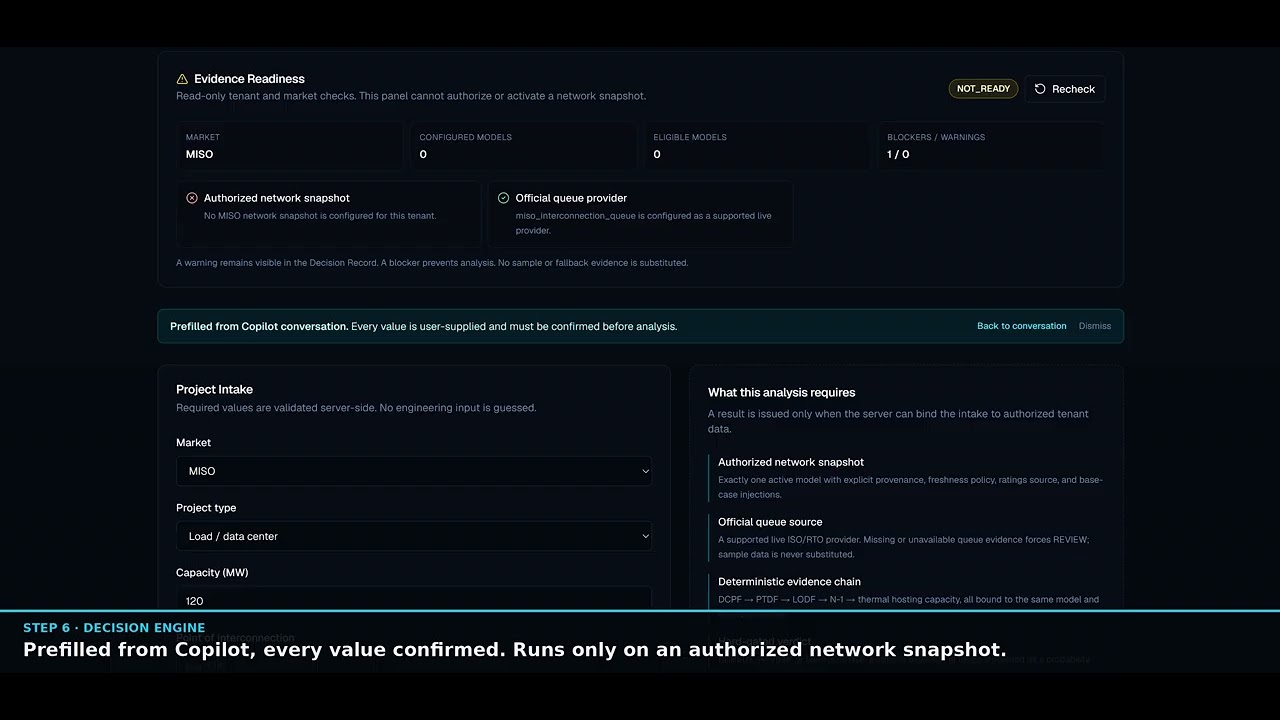
GridVision AI walks through a 120 MW AI load project with two interconnection paths, tracking each assumption and refusing to rank options without enough evidence. The platform structures the decision workflow across five gates and five owners, then runs formal analysis only on authorized grid data, generating a report that stays separate from live ERCOT telemetry.
Chapters
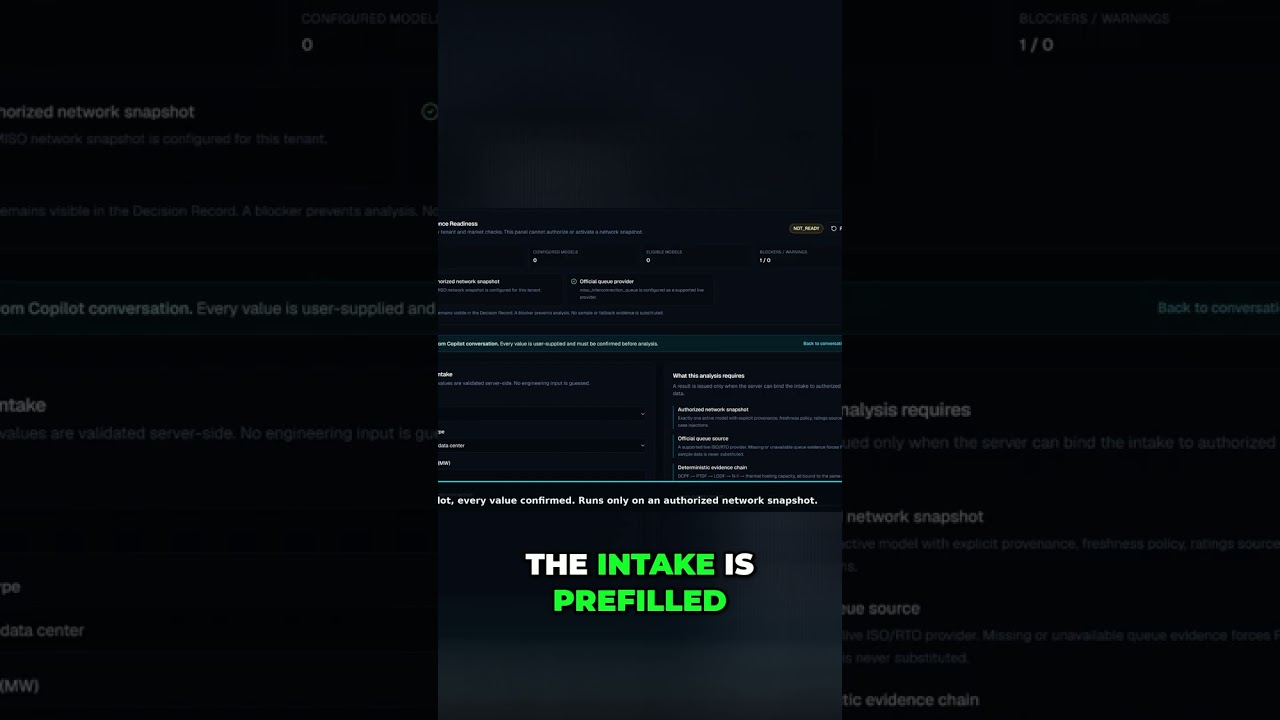
Grid Vision AI is the interconnection decision layer for energy developers. This is a 3-minute walkthrough. Everything you will see uses hypothetical data. No customer information. Developers do not need another queue database. They need to know where to invest, what to advance, and when to walk away before the next study deposit, engineering commitment, or land option is spent. Sign in and you land in the decision workspace. There is no dashboard to decode. You bring one decision with two or three candidate paths. A decision starter drafts the case for you: a 120 megawatt AI load in Meso. Path Alpha at an existing 161 kV substation. Path Beta at a new 345 kV tap. One fact per line and you edit before you send. The answer leads with the management disposition. Here it is review. Insufficient evidence for a defensible ranking. 11 user-supplied facts, 1 assumption, 5 unknowns. The platform says so. Instead of picking a winner it cannot defend. Every dimension, capacity, schedule, cost, distance, land, permitting and study status is labelled as a fact, an assumption or an unknown with a its origin attached. Nothing is inferred. Nothing is invented. Uncertainty becomes an execution plan. 5 owners, 5 gates. The utility lead confirms capacity and study path. Engineering normalizes scope and cost. Siting tests land and routing. Management sets the criteria and only then re-ranks. One click hands the case to the decision engine. The intake is prefilled from the conversation, and every value must be confirmed. A formal analysis runs only on an authorized network snapshot. When there is not one, it says not ready rather than substituting sample data. For management review, the executive decision report states its method plainly. Cost and schedule are rule-based screening estimates, Not utility figures. Alternatives are compared on a common basis, with evidence coverage shown for each option, and the whole record exports as a PDF. For operational context, ERCOT Live reads ERCOT public dashboard feeds without credentials, grid condition, and demand against committed and available capacity. Each tile carries its source, It's as of time and it's fetched time. Fuel mix and settlement point prices refresh every 60 seconds. It is telemetry for context, clearly separated from queue data. Formal utility, ISO and engineering studies stay authoritative. Grid Vision structures the evidence and records the decision. Bring one live decision and we will walk it through together.