Token White Person
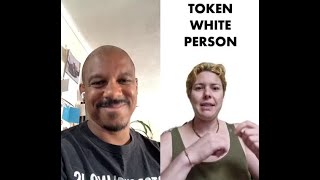
A Latina peer-support worker who is white-passing describes the pressure to do DEI work for white-owned companies that prefer her over Black women. The conversation explores whether accepting such roles reinforces white-saviorism, and argues that systemic change requires inverting power dynamics to prioritize the most vulnerable, not using the master's tools for liberation.
Chapters
What I'm seeing as a person who is Latina but white-passing, and people make all kinds of assumptions about who I am and what level of privilege or unearned advantages I have because of the way that I look. They make tons of assumptions about what I'm passionate about, who I align with, what I align with. And because I've been very outspoken as a peer support a worker who has primarily been specializing in neurodiversity and supporting neurodivergent individuals. I'm getting a ton of companies and organizations that are white-owned and managed, and they're inviting me in to be a diversity, equity, you know, inclusion person, uh, because they're like, oh, you exist at the intersection of all these marginalized identities, But then recently I've even had one of these people talk about how they didn't want to hire somebody who was a Black woman as this role. And I just kept thinking to myself, but why? And why are they choosing me? Is it because of my skin color? Is it because they feel safer with me? Is it because they think that I'm gonna be whiter culturally and thus it's gonna be easier for them to interface with me? And this has become a thing that I'm nervous about because I am not easy to interface with when you're indoctrinated in white supremacy. Like, I am very much against that and very vocal. And so what I've— what I'm afraid of right now is that my whiteness or proximity to whiteness with my pale skin tone is causing people to think that I am somebody that they want on their team to help them appear more intersectional or more aware or more geared towards supporting minorities. And I am struggling ethically with this right now. So I would— I wanted to bring this to you to ask, you know, have you heard of this been happening with others like me? Like, what would you advise to even say to these people? Because on the one hand, I need work and I can't just shut down everything, especially as everything's being pulled from me to survive. And some of these people are what I would say, well-intentioned white people who do genuinely wanna help as much as they understand. But as they're going around and talking about mental health and what mental health support means, it's like, ooh, you're still stuck on the individual self-care when we need community care. And there's— starting with, but if we teach the white people about trauma and their prefrontal cortex, then maybe they'll understand and help and wanna support, you know, the people of the global majority. And I'm just like, this feels a little backwards since trauma largely comes from colonization and white supremacy and is impacting everyone regardless of your race and background, right? So this is where I'm kind of wanting to have this conversation because intersectionality to me is so important right now, intersectional advocacy. Mm-hmm. And I've been struggling no matter where I go, because if I try to go to a sphere that's primarily designated for, again, Black and brown-bodied people, then if I make any comment, my skin tone is immediately at the top of the conversation pile. Well, you look too pale to really understand. Well, you don't really have a voice here. You know this. And so then it's like, well, where do I go? Who do I talk to? How can I find community when every single place takes issue with some part of me? And that is the crux of the intersectional identity issue. So I would love to hear your perspective and your ideas on this particular strange issue that is cropping up right now because of whiteness just being just shoved down everybody's throats right now, and especially, you know, in Turtle Islands.
Sure. So I I appreciate your sharing that. And under the banner, the literal banner that's above your head, I think there are a couple of things that come to mind. One is you've talked regularly, and for those— I imagine that there are many people here who are not familiar with you. I welcome all of you. I believe there's all 4 of you. Thank you for being here. You've talked about the word white as an adjective and a noun in a couple of different ways. In this conversation, you've already now talked about proximity to whiteness. So you described that as being white adjacent. There is white passing, which is very much about— Mm-hmm. The photons that hit other people's eyes. In other words, your visual appearance. And then I think there's one other term that you have used.
White presenting.
White presenting.
If you are a person who, according to photons, cannot pass as white in any capacity or European descending, Then what happens is colloquially called whitewashing and code switching, but to the point where it's like you've lost your original identity, whether it be Black or Indigenous or whatever, and then you are presenting in a white way. And that can be the way you talk, the way you dress, the way you act, the activities you participate in, who you hang out with. And that's part of that proximity to whiteness because the more that you present as white, the more you are adjacent and adhering to or upholding that system.
So we've talked about these in terms of relationship to whiteness. So there's the passing, which is appearance. There is the presenting, which you've talked about is associated with identity. And then there's the adjacency, which has a cultural aspect, but all of it is relational. What I want to hone in on here with that context, do you think— well, okay, I saw something very interesting before we started this livestream today. It was on LinkedIn of all places, but really LinkedIn is like the only social media I'm on apart from TikTok. Mm-hmm. Well, and YouTube. I quit Facebook and Twitter and all that many, many years ago now. It was an interesting post by somebody I really appreciate, a person who is an Indigenous person, and they made a post about how if a person who identifies as white comes out as non-binary, it does not automatically inherently make them a member of every oppressed group there is. That privilege still exists in that case.
Yeah.
Even though there is a piece of identity that is a marginalized identity.
Mm-hmm.
And that, within that conversation, there was the distinction between self-identity, the way we identify, and positionality, which is where we are placed within systems of power. And I would like to, as best as I can gently in real time, surface this a little bit in your case, because you are white passing.
Yeah.
But you do not identify as a white person.
In any way.
So could you—
I mean, the most I would say is, you know.
So could you elaborate on that for our audience just a little bit?
Yeah.
And the distinction between white passing as a relationship to systems of power and your identity, the way you identify. Right.
Yeah, absolutely. So the only reason I would even like say that I'm half white is because of the positionality more so than anything else. I would say culturally I'm barely white, like in any way, right? Like even in on my mom's side of the family, and they're just white American, like that's it, right? They've been— yeah, like European mix.
They are from Europe?
Well, many, many generations ago, right?
Yes.
So yeah, they've been born and raised on Turtle Island for generations, and thus many of them do not have any cultural or like personal attachment or affiliation with any of their European ancestry, like, because it's just been so long that they've been in this particular place. So the— so that side of the family would constantly, as I was growing up, be bringing me into white spheres.
Mm-hmm.
So I was put into various Ivy League prep schools, and even though they were considered progressive and liberal at the time, trying to focus on diversity and making sure they always had a specific, you know, quotient or population of students who were from marginalized backgrounds and whatnot, it was very clear. It was, they were all white systems, white run, white, you know, supremacist, everything. And as a child, who on my father's side, I'm Catalan-Cuban. And this is very confusing for a lot of people because they're like, "Well, doesn't that just mean that your ancestors are all just European, so you're still just white?" And I'm like, "Okay, well, here's the thing. We gotta talk about what whiteness is and we gotta talk about what Latinidad is." Mm-hmm. And that is another thing that's having a lot of conversations right now because of the split that we're seeing amongst the European descended and white adjacent or white presenting Latinx, right? Because there are people who are not white passing that identify as Latin and don't identify as indigenous. And so those people will often have this level of cognitive dissonance where they think they are a member of the white ruling class. And thus we see a lot of lateral violence And we see a lot of, in the minority spheres, people policing each other. It happens in Black communities too. I've heard a lot about how it's like, oh, if you speak with good grammar, you're like being white, you know? And it's like, well, hold on now. You know why, why are you saying that? You know? So in every culture you see it, you see proximity to whiteness as a mixed thing where half of the population is trying to do that and then half is making fun of the other one for doing that. So we have this split in each of the minority community, and that's yet another divide and conquer tactic. So we are not even seeing how the whiteness is creeping in everywhere. And whiteness pretty much has very little to do with actual, like, melanin and, like, skin tone. That's the weird thing that people don't really understand, is that everybody thinks that white means looks like me, right? That's what people seem to think colloquially white means. But actually whiteness has pretty much nothing to do with your skin tone because it's a mental system and it's, it's rooted in a binary thinking. And it has to be binary because binary is only two options. It's the idea that there is a one right solution or a one right way to think about things and a wrong way. And that's intrinsically a supremacist colonizer mindset, and any human can be infected with this. It doesn't matter our race or, or our appearance or our ancestry. Yes, we can talk about how the more generational trauma a family or bloodline has, that can lend to two things. It can lend to one, increased awareness of the systemic— Mm-hmm. Discrimination and thus increased immunity to it, or it can go to the other side where because you have so much trauma, your prefrontal cortex and executive functions and ability to see things clearly has become warped and you've fallen prey to the propaganda of the ruling classes when they're talking about how proximity to whiteness or this superiority-based mindset that is elitist, that is classist, that is rooted in nothing other than materialism, capitalism, colonialism, and imperialism. And anybody of any race can do this, but the reason it's called whiteness is because with whiteness comes Blackness.
Mm-hmm.
And with Blackness comes anti-Blackness.
Mm-hmm.
And this is where we have to talk about how anti-Blackness is everywhere in the world, even in Africa, which is just mind-blowing, right? It's mind-blowing. And then we— and then how anti-Blackness isn't just about like literal Blackness, it's about melanin. And it's about how communities of Indigenous people who are brown naturally, but not necessarily this like as dark or as brown as someone from Africa, and then you see them policing each other saying, Don't go in the sun, you're gonna get too dark. As though that's a bad thing. And it just blows my mind to see how this is being this white mentality, this whiteness, right? And thinking that, oh, the idea that there's civilized and uncivilized cultures, that there's, you know, right ways and wrong ways to do things, that there's a one-size-fits-all mentality, especially like when it comes to healing, mental health, when it comes to survival and what you think is important in the world. Like, all of these things are rooted in whiteness when it comes to discrimination because even though these mentalities did start before white people and Europeans ever even existed, it wasn't until Europe and white people evolved that guns, germs, and steel were used and then boom, the global empire of genocide was created and we have been stuck in this hellscape ever since. So to me, we have to talk about whiteness as something that isn't actually intrinsically or inherently linked to European culture or European people, but really how Europe took something and made it in a certain way, whether intentional or not. We can, we can, you know, debate about that because there were still Europeans during the time of the conquistadors. There were still Europeans and white people during the time of the initial colonizers who were fighting against that. And that is why I will always push back about white people are just European descended, because it's like, no, you can find this mentality everywhere. And to me, it has a lot to do with trauma. It has to do with whether or not you've been supported. Are you still in a neo-colonial situation? Have you— has your culture been taken from you or what, right? And so all of these have to do with both individual identity, cultural identity, and then your social relationships with each other, with people in your own community, people outside your community, and the earth. So to me, all of this, like literally all the issues in the world can be linked back to whiteness, white supremacy, colonization, and like the imperialist mindset. That's just my personal opinion, but that's just the more I read about everything, that's what I'm seeing. It's all connected, you know? Mm-hmm.
Yeah, definitely. And so from— and we could have, I think, a more extensive discussion about Europeans as people who went through the act of colonization. We could have a more extensive conversation about that even more another time. I would be interested now to take, for the purposes of this discussion, take what you have said about whiteness and map that into this specific event that happened to you earlier today or yesterday, which is— and I'm oversimplifying perhaps just as a summary— which is you have spoken with an organization regarding diversity, equity, and inclusion, and you were specifically told that they did not want to hire a Black woman to perform this function. So there is an element that you raised earlier, the ethical quandary that you feel as a person in determining whether to, I would say, have a relationship with this organization, not just like take the job, but have a relationship with this organization at all.
Exactly.
Tell me without revealing, I mean, 'cause the name's not so important. This organization does not have a unique mindset. I'm sure it's in many places, as you pointed out. Tell me from your perspective, given what you've said about the nature of whiteness, what do you think motivated them? Yeah, not just to have that position, number one, but number two, to actually say something like that. To you specifically?
Oof, gosh, that one. Yeah, that's— that question alone is like a punch in the gut, you know? Like, just thinking about that hurts because it simultaneously demonstrates the white savior mentality and how justified people feel in saying these things because they think that since they're in that position of power and privilege, even if they're not thinking it literally, like in those words, they still are acknowledging— like, I was specifically told that, oh, we're going to be focusing on these demographics because, like, in some words, it's easier, is kind of like the language I was hearing, right? And I'm like, okay, I don't know how I feel about that. But to me, the reason it's tied to white saviorism, and then plus also it's It's an invalidation of my identity and it's literally not even seeing me as a person to say that to me. When people, and that was the video that blew up on my Instagram, the video that blew up on my Instagram that went viral with the MAGA people. It was the wrong crowd. I did not wanna go viral with them, right? But it was because I was complaining about how people who are white will say things to me as though I'm one of them and how yucky that is to me, right? And then I just got so many people shouting at how I'm white and shut up and blah, blah, blah and like saying horrible things. But then they would say, they would say I'm white and then in the next breath, oh, we can tell you're not white and go back to where you came from. So it was very confusing, right? 'Cause I'm just like, get your story straight. What do you even, you know what I mean? Like, what are you even angry at right now? Why are you mad, people? You know, like.
Yeah.
And that's why I kept thinking, like, to me, it feels like a last ditch effort to hold onto the supremacy, a last ditch effort for the global empire of genocide that was built on white supremacy and really has this heart here on Turtle Island, right?
Mm-hmm.
Well, I'm not gonna go into that, but it's like, I think there's a subconscious level where people know that this way is dying. White supremacy is on its way out. Too many people know, too many people are awake now. And so there's, to me, it feels like a last ditch effort to hold onto some level of power. And that's where I'm concerned because I feel like I have to discern, find a way to discern, like, are these people serious in actually wanting to help and what they're doing when they're specifically trying to get mental health services to, and quote, "hero communities," like the cops, veterans, EMTs, right? These people, right? And I'm like, sure, they are statistically more likely to experience lots of traumatic instances because of the nature of their work, and sure, they need support to work through things like all humans. And just helping these people with their mental health is not actually addressing the systems that are causing them to have mental health problems anyway. And I think the issue is it's one of those things where white people can't see whiteness, you know what I mean? Like, it's like— and that's, and that's one of those ways that I found out that I wasn't really white. I I was just like white adjacent or something because I could see it clear, it's clear as day since childhood. I'd be like, well, hold on, hold on, hold on. And I'd be getting in trouble for saying that, right? And so I feel it's the same thing where I'm like, look, haven't we all realized yet that the reason we have mental health crises and this CPTSD epidemic is the lack of systemic and community and cultural care? Mm-hmm. Like, why are you still going to the individual place, you know? Like, even white people need community. Even white people need better, you know, environments than we have here. This hyper-individualistic society doesn't work for anybody. And so to me, it's like, how can you talk about changing things for the better? How can you talk about addressing mental health crises without addressing the systemic issues that are at— Mm-hmm. In my opinion, the root cause.
Yeah, and so I think that brings me to a thought I had a moment ago that I wasn't able to articulate until now, which is when I, when I've been coaching people, I have been talking specifically and the way I present myself in spaces, like let's say LinkedIn, in terms of my profession is,— a focus specific to organizational leaders, also freelancers, but like for the purpose of this conversation, let's talk about the boundary of an organization, right? Specific— a specific boundary, which in some cases, like from a legal perspective, can be a very rigid boundary, like you're registered LLC or nonprofit or so on and so forth. And in other cases can be a little bit more amorphous, like Maybe you consider yourself a member of a certain neighborhood or community. You have an online space, right? To what degree does the nature of the organization as a boundary of focus cause us to look— let me phrase it a different way. Organizations have a certain function. And I'm not just talking about a mission statement, right? The mission statement may be the function that they want you to think that they have.
100%.
But leaving that aside, leaving aside the marketing copy, all organizations have a function, or at the very least, you could say all organizations have a set of things they're able to do and a set of things they're not to. Not able to do. For this particular organization, the one thinking about these hero communities, let's say, to what degree do you believe, using them as an example, that addressing these, I would say, target audiences, addressing these target audiences would actually help advance— I don't want to say replacement, but I'll just say replacement for the— for lack of a better term. To what degree do you think focusing on these hero audiences, firefighters, police, etc., in terms of their mental health would actually help advance the replacement of today's system, hyper-individualistic system, as you said, would advance the replacement of today's system with a more community-based system? Because I imagine that may have an influence on whether you choose to work with certain organizations. And so I think I want to broaden this out a little bit because there may be organizations that focus on these specific audiences—police, firefighters, as the one you just gave an example of. There may be other audiences—or sorry, other organizations that focus on audiences like youth mental health, maybe for students, maybe for people who have gone through the foster system, right? Each of those are still oriented toward individuals and helping individuals. And I'm trying to grapple with that a little bit. Because what would it actually look like, I think, or maybe I should say, what are you hoping for when you think of this observation, focusing on individuals is not enough, we need to focus on systems? What would be the nature of a set of work that an organization could do that would be addressing systems? And you've shared with me an organization, actually one based here in New York City, that is coming to mind that talks about mental health in terms of systems.
Yeah.
I've looked at some of their work and they seem, and this is gonna be unfair because I haven't studied them, but when I look at their work, I see them as a sort of like a knowledge base, a learning space. I wouldn't say, I mean, I hesitate to say more academic, but that's sort of what's coming up.
Okay.
It almost seems like a space that teaches practitioners to think in systems. So tell me about this work, and I know we're going all different places, but let me see if I can go back to this focal point. If you were to highlight work that does the systemic analysis and systemic intervention that you're talking about, what would that work look like? What would we do to be able to recognize that? And would you say that that kind of work should take priority over care for specific individuals in circumstances, police with mental health or youth with mental health, people in the foster system? Mm-hmm. Just tell me a little bit about what that would look like for you.
Yeah, so the interesting thing is that for me, I don't actually think there is a need to prioritize one over the other because I believe that if you actually address the root cause, it's like dominoes. It— because the root cause to me is the, is the systemic barriers, and the systemic barriers are literal laws. And these laws basically dictate what certain organizations, including government-affiliated organizations, can use taxpayer money for.
Mm-hmm.
And this is important because social services are paid for by taxes, and when they're cut, that means that the most vulnerable, the most marginalized, and the most endangered populations are suffering first. So to me, if we— if we're honest about what's happening, then literally the thing that we can do that will basically set all of the dominoes in motion Is to invert the power dynamic immediately and to prioritize those who are most vulnerable and cut from the top instead of the bottom. So that's the first thing, because if that is done, then we have enough money and resources and access to create the services, to create communities, to fund into everything. That's like the number one thing, which is why I'm like, more organizations or more individuals who are well-intentioned using their privilege to create more legal entities that are again, just playing the corporate rat race. And like, they just get bogged down by having to collect donations or have to sell things and market. And then they lose sight of what they were originally trying to do anyway.
Mm-hmm.
So to me, it's like, no, we gotta actually look at the fact that the USA on a national government level and on a state and local level is through legislation and the courts barring entire populations from getting services. I'm— I, I care about all living entities, and if one population is already housed clothed, fed, and for all intents and purposes okay other than their mental health and stuff like that, I'm sorry, but I'm gonna say, look, y'all need to support yourselves for a bit while we get everyone else taken care of, and then we can go to the next level of healing for everybody. But while people are still, you know, dying on the streets, still homeless, still overdosing, and these are kids I've heard, sadly— I attended this webinar about the urban Indian organizations I think I was telling you about, And the statistics are so sad about the Indigenous youth because the addiction rates for substance use, it's, it's, the age is lower and lower every year. And these children, because they're trying to just cope with reality, they're getting addicted to opioids and fentanyl and things like that. And I just heard that kids are trying to use meth to come off of fentanyl. And it's like, children. These are children. And these are the kids who are fortunate to not be disappeared or missing. You know, these are the kids who are fortunate to still be on the reservation. Like, ugh, think about that. Or in an urban center situation. It's just like, so to me, I don't understand how anybody can be thinking about getting people the next level of help when there is genocide and famine and ridiculous nonsense happening just because of the colonizers in the global north backing each other up and people continuing to not be aware. Again, I'm giving you the benefit of the doubt that you don't know how your iPhone's produced, that you don't know what's happening in Congo, you know, that you don't know that there's 3-year-old kids in the mines.
Mm-hmm.
Like, I'm gonna give you that benefit of the doubt because if you did know and you're still doing it, then I'm gonna get even more scared I mean, where's your humanity, right? And yes, trauma-informed care and legitimate healing practices can help people come back from that level of apathy, that level of cruelty. I've, you know, seen it firsthand. I've experienced things like this firsthand. So I am all for everybody getting the individual care that they need too.
Mm-hmm.
But how can we say that we're a society, that we are a community, that we're a civilization, that we're a species that is prioritizing the needs of only some of our members over others. So to me, it has to start with decolonization. It has to start with land back. It has to start with unlearning whiteness. Otherwise, there will never be a real level playing field where everybody can have access to the basic needs. So that's— and to me, that in itself is actually healing. As we adjust systemic inequities, we feel empowered. We feel we're doing something important. And so much of mental illness is feeling helpless, is feeling powerless, is feeling despair and despondency because you're like, everything is so horrible and I— what can I do? I'm just one person. And when you use your one personhood to start making these changes, it starts transforming mental illness too. Yeah. And that's what I just think white people don't get, that the reason mental health and loneliness is this epidemic against the white, especially white men, white boys, well, look at the cultural messaging. Well, look at the family dynamics. Well, look at what they're being told is important, right? It's like just changing the culture and the community will immediately cause a ripple effect when it comes to mental health. So that's where I feel like— Mm-hmm. Look, pre-colonial, decolonial, everything that happened before Europe took over everything. Look at those practices. Look at what gets you in right relation with the earth and with each other so you don't have to be dissociated and intellectualizing everything, because that's so unhealthy. So I'm like, I don't know, to me, it all will come from the same starting point.
So, I think certainly in our conversation, we never pretended to bring our audience all the answers. Maybe we would like to bring the audience a set of questions. And I'm thinking probably I'd actually like to draw this to a close by focusing again on what you talked about at the beginning and pulling in two elements that are sitting in my head right now. And I wouldn't say that these are questions maybe to answer unless you have something off the top of your head, but more some questions to go away with, for all of us to go away with and think about, because I'll be thinking about these too because of everything that you've said. So we opened this conversation when you shared that you were engaging with an organization very recently, either today or yesterday, that was looking at work within the space of diversity, equity, and inclusion, or DEI. Mm-hmm. Specifically said to you, for reasons we've elaborated on already, that they did not want a Black woman doing that work. I want to hold on that, and I want to introduce something that somebody shared with me last year. It was a conversation around privilege and positionality, and it was somebody who said, like, listen, If you can get money from white people, go get that money, right? So you can get the resources you need to do the real work. If you have white privilege, use that privilege so you can get the resources you need to do the real work. And that brings me to the comment that I think is attributed to Audre Lorde, which is You cannot dismantle the master's house using the master's tools.
Yeah.
And to me, I feel this conundrum about this. I try not to think in binaries, and you and I have both practiced that in our own ways. And I'm also a policy person. I'm a government person by training. I started my career in government environmental policy where I was able to see in complex multi-stakeholder projects that that everybody had their own positions and no one could be perfectly happy and there was compromises to be made and nothing could change overnight. Things had to go step by step. And so when I think of privilege, and I also have privilege too, not the least because I'm a cisgender man, and we can have a whole conversation about my own privilege in the future.
Mm-hmm.
When I think of privilege, privilege that exists and was even produced really by exploitative, extractive, oppressive system, I think to myself, what is it that I am to do with this privilege? To what degree does my privilege bring responsibility? That I need to live out? And again, not maybe not to answer, it's something that I'm sitting with, it's something that's become more clear through this conversation. I might phrase the same question to you, but again in the context of, well, if I'm using the privilege assigned to me by the system that is still oppressing me and the people I care about, then can I really move toward liberation?
Hmm.
It's something I'm grappling with, and to a certain degree, it's a very academic type of question. But in a real way, as you've talked about with this organization that you just spoke to earlier today, it's not just academic. There are really people who think that way. There are really people who are oppressed but would like to be the oppressors instead of liberating everybody, to just use one small example. So that's what I'm really going away with today, um, not a set of answers but, um, more questions and really a certain clarity, an additional level of clarity that comes from this conversation because I see the ways in which these abstract issues are made very real. Mm-hmm. On a daily basis? I'm just wondering if you might have any closing thoughts.
Yeah, I think about those questions a lot because I feel like I constantly am having to weigh how much I'm willing to compromise, you know, that's some— so the cognitive dissonance of trying to survive while still only seeming to have options that are leading to a level of complicity or participation in the system that is actively oppressing and hurting so many? So I think, I ask myself that question all the time. And I think, you know, not to answer anything definitively, right? Like these are, it's just more of a thinking guideline that I use to help me not fall into binaries. And, and that's where I just try to apply dialectics all the time and remember that it's almost never either/or, it's almost always both/and. So I try to think about how might it be— how might both of these things be true simultaneously? And if they're both true, what does that mean and how does that influence the way that I will choose to move going forward? That's kind of how I do it, because I figure, yeah, maybe it is a level of complicity, and I have no other choice. Maybe this will continue to work towards collective liberation, even if in the interim I am still working in the system, right? Like, I don't know. I mean, I'm just another human, right? So I definitely don't have all the answers, but I definitely think it's important that we at least always ask ourselves, what is more important to me in this moment? Collective liberation or comfort?
Thank you. Thank you for today's conversation, and I really look forward to the next one. Likewise. Been good to talk to you. Be well.
More from Jax



Some context of who tf I am lol. I may try to edit this later so it is less rambly. We shall see.