20000807 || Śikṣā and Dīkṣā Seminar || Kuala Lumpur, Malaysia #JayapatakaSwamiArchives
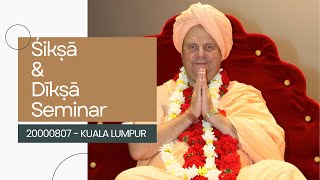
Transcript of a 2000 seminar in Kuala Lumpur (YouTube archive) on Śikṣā (instructional) and Dīkṣā (initiatory) guru roles within ISKCON. Primary speakers (Bhakti Vijnana Goswami, Ajita Maharaj and others) discuss distinctions between dikṣā and śikṣā gurus, appropriate qualifications and etiquette for initiation and instruction, practical limits of guru responsibility (counseling, business, family), organizational governance (GBC authority, temple presidents, bylaws), problems with canvassing/re-initiation by outside gaudiya groups, needed oversight (visiting supervisors, training, judicial council), and local issues in Malaysia (30th anniversary, local bylaws).
Guru relationship Diksha Diksha shelter do not have a good one compassive table too technical. This is more than just more something guru talk applications. That prophet said ISKCON was like a hospital and in the hospital sometimes people ask Prabhupada why is it that people don't always act properly in iskcon? So then rather please come forward and get more people coming others please come forward. Then we also heard that there's some problems come up sometimes that people may be taking someone who's guiding them as a Shiksha guru who may not be really qualify to be an absolute authority for that devotee. It's like in the hospital if somebody takes the nurse as the doctor or some other assistant as the doctor certain persons have got more responsibility and certainly if you're going to have open heart surgery you don't want it to be decided by the Internet or trainee doctor. You want a specialist to give their opinion and you want a personal physician to give his opinion as Maharaj Mosman. So serious decisions. So my spiritual life also when we accept somebody as our Dishar guru that means that we're taking him to be the final authority for our personal spiritual decisions. And he's assisted by many other senior people who also need to be respected and heard from. And some of them may be authorized to also be like fully Siksha gurus whose instruction could be accepted just as non different from the Diksha guru. But apart from a very specific authorization in that regard, it's not that all the Varga Muhammad gurus or general devotees who give us instruction are all on exactly the same level for us to follow as a Dichen guru. He said that generally any kind of major decision we make we want to make a double we want to check it with the Diksha guru to be sure that's the right decision or with someone who's a Siksha guru of that caliber in you heard that in the Nauha teaching maybe some Nauhat leaders and the group members they can settle on his maisation to which in one sense may be true, he may be a kind of Sikchen guru but then that's not the position of a non hab leader to be the official Sikshanguru but rather to be a facilitator for the group members and to the extent that they are representing Krishna in the gurus of Prabhupada the guru crown prabh and they may be functioning also as a type of Shiksha guru but that's not in a formal sense. It may be In a practical sense that they're giving the guidance, we take it in a formal sense. If the dealings are different, could create so much kind of confusion. We don't have any specific minimum training. Would be, for instance, the Bhakti Vrikshalida. Maybe they're in the movement six months or one year or two years or five years. And that doesn't mean that they have got all the training to be able to make major decisions on people's lives. They can give some advice, but for more serious things, if you go to a more serious senior devotee and I was gone, that sometimes there's confusion about what should be asked to whom. Just like people come to Srila Prabhupada and ask him that I'm having arguments with my wife, what can I do? Marriage problems and then Shiva problem. But only he was experienced. He was a householder, but then now he's a diamond and renouncement of life. So this madness for me to really get into the marriage and counseling. They're very gorgeous senior grihasta devotee and get some advice from them. So Shiva Prabhupada having then a grihasta and then a sannyasa. If he says that, then what to speak of some of us who are not griha. I don't know. You have grinhasta before. But like for myself, I know I was in a grihastad before. I don't think Bhakti Vijayana Maharaj was a grihasta either. We went straight from Brahmachari to Sannyas. So what an experience even. I mean, all I know is the theoretical experience or from seeing other people's lives, we pick up. But in terms of the practical. He tells you about my practical experience? He said it wasn't his position to do that type of. And we can see that by taking some counseling courses. Just as something that GBC should do is more about counseling. So you understand that part of counseling is you have to put yourself in the other person's shoes. Or if there's two people and you're doing conflict resolution, you have to get the one person to see from the other person's point of view. So if you're dealing with an emotional issue like family relations and things, then it's not really what a sannyasi should, you know, starting to put himself in the shoes of this person or that person getting too much into it. So if there's a division of labor, in other words, even if somebody is a guru, but we don't Go to him to resolve marriage problems. You may have a question that I'm facing this problem. What is my duty? That's another thing. Everything is my husband is taking intoxication and going out with this thing, that thing, whatever is happening. And you want advice. What should I do in this circumstance? That's another thing. But sitting down and working out in nuts and bolts relationship is not what Ragi should be doing. That's what someone who's been a Grihast Ashram is better equipped. Who's trained to do counseling. They can do that. So what to speak of, you know, some Vedi or brahmacharya if they are faced with this kind of thing to deal with people's family problems. But the Sannyasi gurus are allowed to do that. I want to speak their home shines. Reduce the sound effects. So there's all these kind of issues that were coming out. I gave a seminar once a person as I give him about guru.
Putting.
It, do we have any more colors in the future? Say that blue lines are extremely so many generations coming. Of course, Shiksha gurus also. Then this is a Shiksha line coming down. Prabhupada is also the then I don't have enough colors here. But they're saying a special thing that Prabhupada is the founder Sharia. He's like everybody's special Shiksha guru that everybody has a direct bhakti. Ginnutaka mentions that whatever they're Siddharti Guru and they teach some type of bad guidance Vaishnava association. There's many influences. I don't have enough colors and different grades of influence. But there's also different dealings with each. It's even I was in the neet were having a kind of Vaishnav etiquette for us. Because when you have initiated this basic etiquette of how we deal with each other like usually call another initiative devotee as a prabhu. And then if somebody is a Sannyasi, you call him Maharaj. And if somebody is your guru, your diksha guru or Asiksha guru, then you consider calling him as Guru Maharaj. Gurudi. You call your guru or someone you revered as a guru as guru. That's like calling, you know, the prime minister as Mr. MP or something. I don't know. I don't know. It's just not the right protocol. But maybe not so seriously. They're doing it very respectful that it's innocent. It's just you wonder that after five years why they didn't learn that basic thing, brand new people, you understand, everybody's kabuk. So because we have a lot of brand new people coming in all the time, they don't know exactly. So between the different responsibilities, like a Diksha guru, he's responsible to get the disciple back to God. Some Siksha gurus take that personal responsibility with the blessing of a Diksha guru. Then there's other general kind of like. Like we read this morning how Sumiti, the mother of Ruva, told her son to look for God in the forest. So she also was acting as the Varma Pradarsha guru. But she didn't understand much about Bhagavata Tattva. She didn't even know exactly much information, only that maybe he's in the forest. But somehow he told his son to look for God. That was considered to be an important factor because we didn't get that impetus. He won the book. So he was so grateful, that's why he recognized. So Prabhupada explained she was basically a pata Paradarshak, a guru, someone who showed the way. So in our Krishna conscious movement, I don't have the. Actually there's different grades of Sikhsha guru. Maybe it's a category, but there's grades of Sikhsha Guru, Sikh Guru, which is giving some kind of element advice from time to time. But you don't take him as an absolute authority. Then there's somebody who you will take as someone on the same level like Disha Guru and whose instruction would take a decipherhaturamandika. So what's happening is maybe sometimes some of our, within the lack of a better word, I would say formal, formal Siksha pretty personal. This matter. You have got relevant Siksha, then you have got preliminary. No one should feel grateful to all the levels. Were they different? Like I consider my Padma Darshan to be people like Jaya Nandar Prabhu, Upendra Prabhu. Because in the very beginning they kind of gave me the encouragement to serve Prabhupada and dedicate myself to Ka consciousness. But I didn't have an ongoing relationship with them like that. Basically Prabhupada was my. The Diksha guru is also a Siksha guru who want to sing. I father, bring down here the Diksha guru. The Siksha also comes down and he's for some people, depending on the situation, maybe that's maybe another Siksha guru who's more relevant. But that's that if someone is not still Scripture says that ultimately where the buck stops, who's giving her Shelter, it's normally yadik shabru. That's the normal traditional thing. If he authorizes some perception to that, then that can be done. Some exceptions are allowable in scripture. Maybe somebody sent a disciple to Jiva Goswami in told the disciple, you serve under him as you seek guru. I mean, they came back after two or three years of training and then they reported to the shaguru and things went on like that. So that's the kind of formal teacher where the guru authorizes it. And we see that in the practical lives of the six Goswamis. And that happened from time to time. Then there's. So there's a different category and put everybody on the same level. So even in ISKCON law, it technically says in order to be recognized as an official siksha guru in iskcon, you have to also be approved in the same way you have to do for vichen guru. Because technically of Sikhsha, guru is not different than a dikshengu. So that's why it's important to understand it's talking about particular level of sikshangu. So I want a balanced approach here where we are, we have a situation like here you have ISKCON gurus working in Malaysia, like, you know, prohibition of mamraj, and very senior devotees, obviously they are qualified to give siksha. And then maybe where you have other devotees who may be giving also good instruction, but they don't yet have that responsibility to be giving formal siksha, then you have people in the administrative hierarchy, they have a certain responsibility. So we have to respect them because they're representing a management responsibility and they're supposed to guide devotees. There's all different kinds of factors. So in our nahat movement, we also respect both the side depending on the ecclesiastical, spiritual side of it as well as the administrative side. Both the sides, gradually devotees have to be trained up. What's the difference between prabhu and a maharaj and a guru? And what's the different responsibility that's taken? Just like Paul, Rabbi Hind says we shouldn't give out beads to people free because if they chant on the beads to give it out free, then it's like you become the guru. If they chant on the beads and they commit offenses, you have to take their karma. So it's better when someone gets on a beat to say, give me one, give me 10 cents. Just a token, give me something. I'm not even profit, I sell it below cost. You know, just give me something token. So that way, in exchange I sold it to you. I'm not responsible for your karma. I'm not. I give it to you. The saikurup said giving someone a Tulsi plan. If you give them a Tulsi plan and later on they offend the Tulsi plan, you're guilty of the offenses. You gave them the pleasure. If you give somebody a deity, install deity, the guru installs the deities or the priest and then later they offend the deity. Then even the person who called the deity in is responsible. So called. You don't get any karma. You take money for the tulsi deeds, you don't get any karma. So the time of initiation, we're giving the beads. We have to take the karma for that. If you're not wanting to take people's karma like that responsibility, then you have to be careful about the things you do. I don't know. I discussed this in different seminars, different ishtagosis with senior devotees. We kind of came up like this, that ISKCON is bad. We believe that this is a role there from the Dushanburg. It's where the buck stops kind of. And how in a society or in a situation where he has so many devotees and maybe they have day to day problems. So it's for most problems they can get it resolved by their local leaders and local authorities. So that by some, in some cases they may have developed a faith. You say, I'm always welcome or open. If somebody develops the faith and they want to have somebody as a formal Sushant guru to get authorization from me for that purpose, I would just see that the reasons are right and that person is capable of doing that kind. Otherwise informally, the people who do help us and guide us, we should respect them. But we should also not just sometimes take them as some absolute authority. We should protect them. Just to repeat them, which is not their responsibility. I mean, sometimes people come out and ask me whether I should invest in this business or that business. The spiritual guru's role is to help people out to decide about spiritual questions in their life, how to keep the spiritual progress and get rid of their doubts. Maybe in principle, whether I should invest in the stock market or whether I can invest in this. There's certain things, maybe at a certain point is all right. But then, you know, if it goes into too much detail, like how many barrels of oil should I buy and how much this thing obviously where not stock marketing advisors. And that's not the goal. So there's a kind of. One has to see where it's dealing with the Principles of spiritual life. And basically the principles, how we can apply it. Then we go to our guru and the guru will guide us and give us the principles. We can make these decisions. That's for like really practical things in terms of material life, marriage, business. That is not to go to the guru or even to speak, to go to the local Brahma leader. Sometimes you find that the preachers who are doing Brahma are doing even a small center, they get involved. And then sometimes because there's so much involved in other people's material lives, it also can contaminate them. Or they get into business ventures and they get distracted from what they're supposed to do. Then you get people saying, well, that ISKCON leader took a loan from me, or he did business with me and he cheated me, or he lost the money. And then it becomes a kind of a scandalous situation. So you should separate. Like Prabhupada used to say, business is business plus one habit. You do business hours, especially if you're with Dolores, you have to take as many precautions as you do with anybody else. It's a separate category. Business is business. Don't mix your business with your spiritual things. Spiritual things is another category. That's where we deal with how to make progress in our ka consciousness. He similarly qualified as an investment guru just to put something out in the ground. When this last comment is in the Krishna Bachmanhari Sartre, he mentions also how that whatever we hear, like if we hear something, why we take a guru is because we're taking somebody that, okay, this person, what he says, if I follow it, then, you know, this is my standard. I'll follow what his advice is. For me, as an expert in the Krishna conscious movement, I personally have faith in this person's vision. That doesn't mean that we don't have faith in other people's vision. But this means that to personally taking that person. So technically, if you hear something they didn't hear before, you don't know if it's true or how to apply it, then Narahari Sarka said, you should bounce it off your Niksha guru. Anything we put in our database, okay? This is absolute knowledge. If it's not very clear from scripture, if it's not clear from some of the, it's something that seems to consciously. Finally, with the Diksha guru, if there's a doubt like that, otherwise we may get some different conflicting ideas and it won't be so clear. That's what Narahara Thakur said. And they had open society there.
They didn't have.
There was like so many gurus working together and hundreds and hundreds of associates of voichitanda were all gurus. But it's just like he says, like a father and son relationship may hear so many things, but then ultimately you have to fear with your father.
So.
I was told that we should bring that into perspective because maybe all the development now as our preaching is going on and on, that some people are being accepted as Sikhsha guru, maybe prematurely, in a very elaborate way. So there are some people who are just bring that into perspective on bringing up these issues. I like to have a follower first and then other gurus here, swamis would like to say something on issues. You know, I have a slightly different perspective, maybe shiksha guru.
So in his book, he mentions that all of these gurus, whether they're Diksha, Vartamhra, Daksha, Adi guru, that they're all shiksha guru. Because the function of every guru is to give shiksha. So from shiksha we see how Niksha comes about. The Prabhupada writes in Caitanya Charakamrita that that person who is giving shiksha, who is giving, is usually the one who will become also the Dikshit. Eventually is expected that that person who has been giving you regular sh. Shiksha, regular instruction, he would become also your dhiksha guru. And he would go on, of course, giving shiksha and the Bhagavad Gita to awake may not be so well educated as other men, but you shouldn't look down on him thinking that, oh, my father's a fool, he's not educated, or my father's poor. The relationship is still there, that this is the father, you're his son. And similarly also with the spiritual master. So this relationship with the diksha guru, this is of course crucial importance for the disciple. Therefore, it is not something which we should rush into prematurely, but we should move into it. Just like people are cautious about finding a marriage partner because they understand that this is a relationship which we don't need to break. Once you take that commitment, you know this for the rest of your life. So how much more serious we have to be and taking initiation is that responsibility is there with the disciple. It's also there with the spiritual master that both parties have to be cautious, that neither parties should be to be too premature in moving into the relationship. Because becoming a father is a big commitment that you. You have to take so much time and care for your child to see that he grows up nicely. And similarly, a spiritual master also has to Take a lot of care, give a lot of time for his disciples. Prabhupada told us that he said, I am traveling and preaching so that you will not all fall down just to prevent us from from falling down. So so much trouble spiritual master has to take on behalf of the disciple. As it is a risk for the spiritual master, it is also risky for the disciple if he moves into that relationship without properly understanding the relationship that we have to have that faith. To see this spiritual master as Sakshar Hareem Bhakti. We know Thakur describes like that Sakshatri Tena Samasthastra, that the spiritual master is honored on the level of the supreme Lord, not that he is equal to the supreme Lord, but the disciples see sees the spiritual master as the representative of the supreme Lord. So this is of course especially true for the diksha guru. And the shiksha guru in some ways is also seen on unequal. He's also on an equal level to the diksha guru. The qualification is the same, not different. But shiksha is not. That should be done with the permission of the diksha guru before. You don't just take a diksha from one person and then at the same time think that I'm going to take shiksha from this version, you know, but you should take, you should decide if you need shiksha gurus, then that should be done under the guidance of the diction guru. Because the function of the Shiksha guru is to strengthen the faith of the disciple in his own diksha guru. If a shiksha guru will damage the faith of a disciple in his diction guru, then that is not a shiksha guru. That is detrimental, that is very damaging to the devotional creeper. So one has to be very careful before selecting or before deciding on shiksha gurus. Therefore, one should take the help, take the guidance from the DK Guru that the diksha guru knows. Which people he can trust, which people he has faith in, are going to give good instruction which are going to help to nourish the Bhakti Vata beach. So this is an important point. I mean, I didn't know we were going to speak on this topic until Jaypataka Maharaj came in and started talking. So I didn't have any time to prepare on it. But it's a huge topic. I mean, we can talk for many, many days on this subject matter and it's very advanced. There's so many things which we need to talk about and we should be talked about nowadays. Just the other week on the Internet, there Was a somebody brought up about how they're doing initiations in other countries. I think it was in Melbourne and Yeruda was. He said he had his exam for the devotees and then Vipramukya Swami came in from London saying that, yeah, we have a very thorough system now in Bhaktivedanta Mana. And he was describing their system. First of all, people have to wait, I think 18 months before they're allowed to get shelter or something. And then he also had the questions which they asked people and were really. I think I discussed it with the signature. Right. And I talked to you. Yeah, some of the questions were just relating to what we're talking about tonight with what are you going to do if the temple president tells you to do something different from the instructions of your guru? And what are you going to do if the GBC comes and tells you to do something different from the instructions of your guru? Well, we were on point. Why not? You know, what is the answer to these questions in fact we were looking for? I think they better give some answers for this.
I think Krishna difference, you know. But anyway, even a Sikhsa guru can take one home back to God. Guru means that realize the absolute truth.
I'm sitting on the platform of the absolute truth. So anyway.
You know, he said the book we had proper select shift. He says there are thousands of Sikhs.
Of gurus also in his conference, you.
Know, then Maharaj made it very clear, you know, that different categories of Sikha gurus also. So I can't read much about it. I have not read so much. Anyway, so we should. We also accept the Sikh guru. It should be sanctioned by the teacher guru. Not that every sochi they are all saying. They call it Indians. That's what I say. Human dropper even said in the book that even a diksha can't take one back home back to garage. Even the Sikh chat can take one back home.
So.
Being Shiksha guru doesn't. It's not that everyone who gives shiksha becomes a shiksha guru. But just like in Srimad Bhagavatam, there's instances. Oh, I think it's in that book the Enlightenment, the natural path from the 11th Canto, which Buddha Ananda Maharish translated and it describes about Maharaj how he took instruction from so many. Oh, he met a person in the forest and he could see that this person was enlightened. And he asked him how he had become so enlightened. And this person described to him how he got enlightenment from so many different phenomena in the material nature. He Said he was enlightened by seeing, by seeing the foolishness of the fish who was simply eating, attracted by the bait, and then caught on the hook of the fisherman. And then he told the story about pictures, pigeons and how the two pigeons were enjoying wonderful happiness together. The male and female bird. And eventually the female bird produced some young chickens. And then they had the small birds and they had their wonderful family. And they were living so happily until one day a hunter came. And then he caught the young birds, and then he caught the female bird. And the male bird was watching the male bird decided he should also give up his life and entered into the trap of the hunter. So the hunter, the person was saying he was becoming enlightened by seeing all these different things going on in nature that they were. And she realized the only person who could satisfy her was the Supreme Lord. So this book, Enlightenment the Natural Path, describes how we can get instruction from so many different phenomena in the material world, but that these things don't become shiksha gurus. You may take some lesson from them, but they don't become shiksha gurus. Just like somebody may show you how to shave your head and how to put on a doti and tears and stuff, that doesn't make him a shiksha guru. Qualification is quite different. They may be they're giving you some shiksha, but it doesn't put them on the level of a shiksha guru. Shiksha guru is one who is actually enlightening the person about his relationship with the Supreme Lord, which is a very. On a whole different level from taking basic instructions, how, how to put on tea, like different things, how. You know that we should offer obeisances to this person and we should call this person Prabhu, this person Maharaj. You know, these are on a very. These type of instructions don't make the.
Person also giving us instruction. But it's not a formalized thing. This is a way we respect, you know, learning from so many different people. And those who specifically show us the path, what we should do, they are giving us showing that they're the pardarsha gurus, those who give us regular instruction. They are also kind of informal Sikhsha guru. Usually we get from them a lot of instruction. Then then they may also become our kiksha guru in the sense of iskam. Maybe we get that instruction from many different devotees. Prabhupada personally told me that. He said, you are a sannyasi, you are qualified to give initiation. But etiquette is that in the lifetime of your spiritual master, you should Bring the disciples to your spiritual master for initiation. This case, he is one of the spiritual masters of that generation. So that is the etiquette. Sometimes the Greek teachings say that why did Graup whatever tell you to be guru? But he directly told them. He told so many people, told Usta Krishna in his letter, he told many people, you're qualified, you can give initiation, but etiquette is you shouldn't do it in the presence of your guru. That's another topic. But directly, indirectly, desire you want that our devotees become qualified, you see? So one as they become more responsible. So when somebody said he is he or she is my Sikhsha guru, then it's like a personal thing that this person is my authority, my guru. Before you can say that this person is giving me siksha, or I get guidance, or these people are my people, counselors and guides. Or maybe in one sense they're also a kind of Sikhsha guru. But to be a personal Sikhsha guru as Maharaj consciously I mentioned that's a specific qualification. And a formal acceptance of someone as a Sikhshan guru, who you accept as an authority needs a permission of teaching. So because the same term is used, you know, it's like there's doctors and there's my doctor, there's doctors and there's specialists. Somebody hands up doctors, there's a doctor. There's also intern who's house training doctor. So in one sense, whoever we get Sikha will respect that, who we take instructions from as being absolute, something we should follow. That's a special step. And even that this has to be balanced. If a guru says something against what the founder Acharya says, or the founder, the guru Parampara says, then even that guru we can question Guru Day, why you're telling me all along one thing and now you're saying something else. It's like Babi Maharaj, he questioned this guru. You're telling me, do not give to the supreme person. I got you as possible. I should worship the supreme Lord. So if we have to even sometimes use our discrimination in relation to the Diksha guru who is in such a formal position that want to speak of others who are giving us diksha, we have to do some discrimination. So we just should blindly find everybody. At the same time, you should be respectful. So it's like Bhakti. Yoga is very complicated in one sense, because it's not black and white. It's not okay. It's just diksha Guru, nothing else. But as you get more advanced, you see there's so many Relationships and variations. Some of this got such a mobile handy form. So just like Krishna does. Kaviraj, he says he had six diksha gurus. Nityana guru was his diksha guru. And his six Siksha gurus were the six Goswamis. At the same time, we know from Chaitanya Charavida, he knew so many devotees. He also sometimes he said, I respect all of them. Like, like Shiksha gurus. So in one sense he's respecting all the senior Vaishnavas and he worships them and he glorifies them. But then he specifically says, six are my Sikh shakuras. Why accept his absolute authorities? There was Rupa Samaraguna Dasum. He was worshipped to personally have their association and g instruction. So there is that kind of a difference. Somehow we need to learn how to balance all these things. So any questions? You can say, would you like to get the MMR product read in the Internet? If a member present, give instructions different from the guru or the gpc, give different instructions. She decided, well, I've been so busy recently with other things. But my question would be, what was the. What was the contradiction? What if the temple president says waving Krishna or something which, you know, this kind of wa says we should have made no wa. We shouldn't do that. What if we. So it would be a question of what was the difference if my guru advised me that I should do painting the temple presences. Right now the temple means that Sankir time collection or whatnot. So then probably the etiquette would be as far as service, because the service is delegated to the local authorities to give that one should go along with it, where we can send a message to his guru and find out, you asked me to do this and all that advising to do that which they. In other words, it's things like the temple president is not a surrogate guru of the disciple, but he is responsible to engage the disciple in devotional service. If you are a temple devotee, you're living in the temple ashram. That means that you had to do some service for the temple. Usually sometimes that can be worked out between the guru, the disciple and the local manager. So just to put a question like that seems like a lori question because it's not so black and white. It depends what is the. It's not that everything the president says you should do it. It's not that everything he says you shouldn't do it because the guru said something. Actually, the way the GBC law is written as guru shouldn't tell Things to their disciples which just kind of override local authority. Gurus should be sensitive. They put more of the responsibility on the guru to be sensitive about the responsibility that the local managers are fulfilling and take that into consideration when they're advising their disciples. So now it's like they're putting the onus on the disciple to decide which in a sense seems like changing their tables. What is a new devotee study that missionary as you decide all this, the Buddha and all. But inside we never divide out the question. Things which are against scripture and against somehow morally against the guru's instruction. Things which are just dealing with the service and other things which might fill in between where it's not so urgent needs to be penalty. What do you think?
Lot of.
And also.
And you know, Maharaj went to Prabhupada and then asked, you know, what he should do. Baba never answered in any question.
So.
Prabhupada honestly cares the authorities, I mean orders the authorities. That is very important. Maybe that's very important. Even in time they fund the golden. I mean we take some money taking money away from the tax. I mean why was being shopping. I mean this is much only.
Trying.
To make money like that.
And the temple president, you should read that.
And I was around 90s and Archananda found out that and told that what did he said I come and these are household. And then God I can. And I was the one who walking down with the railway station coffee machine.
So that we should have rules and the law should be bigger than the individual. Nothing in other words prophet said should have a constitution. It should be stated who does what and what they can do what they can't do. And they should follow that. So if somebody's within there eventually the devotees that need to be trained on the levels that a different manager what he can do what he can to also. So in case our manager oversteps, then they can also question. Now they have a system that someone present shouldn't just make a decision and can leave. They have to go through some procedure. They should depending how serious it is. So there's quartz here. Because I mean sometimes it was adjusting. Sometimes it might not be just to help the local managers to do some system so they can make a proper decision and act in a proper way. So this was worked on by the Governor Navari. But Chiranjeevrabhu was asking about it. He said the law of ISKCON is over order. And then the laws these are over.
Everybody.
Everybody's agreeing to cooperate together under the gbc. So GBC made some vas so that all the gurus also take a vow to follow the gbc. So they should also follow the Islam wad. But it's because Kabbalah Bhad is above us and it's his instruction. That's the problem of following his instruction. The actual problem. That's how we can cooperate together in a big worldwide movement. Otherwise it is real for each one. So to work together there has to be some basis how we work together, how we cooperate, how we interact. So that's what senior devotees, not only the GBCs but other temple presidents and senior devotees, deputy GBCs, they also participate in some the of these discussions and they give also their input. And after that it goes to the temple president committee who also agrees it. So it's something that's gone for a lot of discussion and a lot of consideration, a lot of affirmation and was accepted by everybody, at least the majority of people. If someone doesn't like the rule, they can again propose there should be change growth pattern the whole cycle. Again I would qualify that whoever it is, they should follow his karma. If he gives them instruction against his karma then the Lord has the right person.
Guard your mind. There is no DVC body. That's what we all speak. How many branches this we have an authority that is BBC body is an authority. So everybody has.
My humble obl. I've actually got three issues on my mind I like to raise today. First of all, I'd like to thank my wife for giving us a wonderful class today on the importance of the Piksha Rule and the six I been in the ISKCON woman from the age of 17 years old. Still not initiated at the age of 41. Being in the movie for many years, I realized three important issues. The first issue I realized is we have visiting Sanyasis who are also in the gpc. They fly down all the way from any part of the world. They transit in Singapore for a while, then they come over to Malaysia, just transit over. They bypass the temple authorities, they don't consult the temple authorities. They come over and their disciples come down and give us a phone call saying Maharaj like you to take shelter under him conversing for devotees. This is happening Maharaj. So I just wanted to bring this up. If you need names, I can give you the names of these people. So just want to show. Can I just finish the two other issues? All right. So we have other Gaudiya Mahas also who come to kl, set up centers in PJ and We go into the shop and take the sari and all that, then say, why don't you come to our center directly telling somebody what they should do. That's considered hand listing and scan.
We have.
We, we just want to respect the right of an individual to use their own discrimination who they want to take as guru. They don't need to have someone else tell them, you take this guru or that guru, they can't decide for themselves. We should respect their decision, whoever it is. Just as Bhakti Digna Abhimasana Maharaj has explained someone, maybe we don't get a choice of who our father is, you know, but whoever it is, we respect him wherever he might be. But we have a choice who your guru is and whatever you decide and let people decide, even if someone decides that want to be initiated by another Islam guru, should respect that, be happy about it. They're part of Prabhupada's family. For us, that's perfect. It's wonderful. We're all one family, all working together now in the future, I mean, I'm trying to. Prabhupada said I'd like to see all the Goriyamats reunited together with ISKCON in some way. So that's a long range goal we have. But the reality is right now that there is not so much unity at this point. There's certain degrees of unity. In Mayapur, we have joint programs because we're living there with all the other holy mats. We have a joint Vyas Puja celebration. Every appearance day of Bhaiti Vino Tagore and Srila Bhakti Siddhanta Saraje Takva and that's about it. We have also we have annual meeting of the Saraswat Gaudiya Vaishnav association where we're trying to work on how we can cooperate together and work together and have a certain common respect for each other. So. And I need someone to help me put up a webpage for that actually, because I agree to do that. So we have that effort. At the same time, in those meetings, it's not only us. There are certain gauni and mas which are basically almost like woe and their feelings. They're paying this canvas, everybody, they say our guru is, you know, whatever Manjari from Vrindavan or he's this or that Uttamarikhara, you should take from him. You have another guru, you're really lost out. Reject your guru. Take again. Initiation. There's some particular gurus, one comes to mind, maybe one another, maybe to some degree less than that. Who's doing this kind of revolution. Very negative canvassing and sends people to come out like that and doesn't care about re initiating signs that want to be initiated by another Islam guru. Should respect that, be happy about it. Part of his family for us, that's perfect. It's wonderful. We're all one family, all working together now in the future. I mean I'm trying to Prabhupada Sid. I'd like to see all the goriya mats reunited together with ISKCON or in some way. So that's a long range goal we have. But the reality is right now that there is not so much unity at this point. There are certain degrees of unity in Mayapur we have joint programs because we're living there with all the other goni mats. We have a joint piyaspuja celebration every appearance day of Bhaiti Vino Takur and Shilabhai Siddhanjay Tah. And that's the glory also we have annual meeting of the Sarasa Ghodi of a association where we're trying to work on how we can cooperate together and work together and have a certain common respect for each other. So I need someone to help me put up a webpage for that actually. But I need to do that, man. We have that effort at the same time in those meetings. It's not only us. There are certain Gaurian monks which are basically almost like woe and their dealings that they just can't risk. Everybody they say our guru is, you know, whatever Manjari from Vrindavan or he's this or that Utah you should take from him. You have another guru. You're really lost out. Reject your guru. Take again initiation. There are some particular gurus. One comes in line, maybe one another, maybe to some degree less than that who is doing this kind of very negative canvassing and sends people to come out like that and doesn't care about re discerning and they don't care for anybody. They don't have any fences on their garden. They just break in everywhere. And ultimately after five or ten years many of the people that go with they come back again to Iskapa. They don't really care about us. They just told us all this. They gave us institutions later. They didn't engage us. They didn't care anything about us. We want to come back. This is happening now. A lot of people are coming back. Ever examtered many years ago. Some people are just so frightened. They love their own comeback. So we have to Also be, you know, with this like Lord, Mr. Nait's Sidney is about we have to pass in Kodiyama. So some people you see like Govinda Maharaj they tend not to be very aggressive, that kind of peaceful. But then some vocal person might, you know, maybe one local person who tied his own agenda. I personally talk with all the other Godiyama leaders. If you get a report of somebody doing anything wrong, tell me. And as long as it's not one person who does in this study but even here what it is and we can approach. Why are you doing like this? I went to Govinda Maharaj was here at Vrindavan. I have the meeting and then I asked him. So there are different people at different programs deal with why Iskhan. Basically we are following Prabhupada. We believe that Srila Prabhupada had a vision which is a more accurate vision of what will satisfy Srila Bhakta Siddhartha's nature. They may be all sorts of various degrees following to whatever degree they are following. That's good. We respect them with Vaishnavas. But we are personally dedicated. We want to follow Prabhupada. And if somebody is doing things like canvassing, you shouldn't be. Or in one case I just like to tell you that it was one situation where particularly Narayan Maharaj in Aleshava he reinitiated a disciple of Veer Baba Bhuvu Bir Babhu is a guru in good standing. He's a Grihasta Guru in his Khan and the regional secretary her Khan Arabodol. He went over there and he publicly challenged Naivaj. What are you doing? Why are you giving him initiation? He's the Bodhis Guru is mortifying. Guru is not following him. Why you should give him initiation. And then he said oh, I'm sorry, I didn't know. Okay, your initiation is unknown. Took him out of the Yajna. So you know, if you actually face him, you know, they don't. They're not used to anybody confronting them. If you're in a right strong position in confront, he back it off and said okay, you're not my disciple. I didn't know this time you can't be friends. Maybe they're also misleading. A lot of it is people left ISKCON to join these people and feed them with misinformation. And they do a lot of the canvassing and they mope for their own agenda. I don't know what to say about ISKCON Opposing elements. Exactly. I don't know they should come and discuss with Pablo Shrimash or myself and Babaki Jnish these people. We have, you know, this is a big country and we believe here I think Malaysia is quite open and we have somebody's responsible. There's enough scope for them to work within the structure. They can say what their problems are. We can work at them. You know, I think it's unfair as to, you know, when they blame this person or that person. If anybody has any complaint we're always open. We believe that we follow also by what we decided yesterday of our national ISPAN Malaysia National Council to come up with specific bylaws for Malaysia. So I can just tell you now if anybody has any points that they want to see put in the bylaws. You can put things you're concerned about, you can boost the committee for that Vijay Goranga, you can send to Vijayakarana your concerns and those things will be go through the mill. So we're trying to do things also in Malaysia that we follow rule of law. I'm not nobody I can tell you although I hear sometimes complain like that about sinners who are in this type of meeting. But nobody has ever made a formal complaint to me that he did this or this thing wrong. To me I don't see anybody that he is ordered to be out of Islam and some something like that. I don't find that kind of situation. So I don't know why those complaints come up sometimes whether it's ill or not or just something they're listening. But if there is any kind of whoever it is, whether it's local, branch leader, whatever we want to establish we've also made a judicial council that if something goes wrong, if there's some complaint about somebody that cannot be dealt with on the local level then it can go up to a judicial council and they'll assign three judges from the pool of seven judges who are the seven judges that were elected for a three year period. Ravi Lord Central Lord Shanti Rupa Vinny Goranga Prasa Prayana Das Parananda Krishnanand. So the seven people are official judicial council and they can be assigned to deal with some kind of a judicial inquiry or case there's some complaint. So that way initially if there's a serious complaint then a local authority will be obviously the bylaws given has a basic right to suspend somebody or to put some kind of restriction on what they're doing and then bring it up for a judicial hearing. So we're trying to establish in ways we're growing society. We're still young. We've only been here how many years now? 30 year anniversary this year. What are you going to do? We should have some special thing this year. Yeah with you know, battles and ministers. The 30 year anniversary, right. Oh, next year it's worth 1971. So next year is the 30th. Well that 30th anniversary. 30th anniversary of Prabhupada is coming. Then when we are registered you can have another one. It's a thankless task to be a manager. I remember when Devoni the temple president asked him to manage for two weeks while he was mowing to a meeting in Florida. She gave the keys over everything. Said you please manage her. When he came back he took the keys through them. You made me suffer so much. Everybody coming to me. Where's the soul? Where's the miss where's the all the time demanding Anthony I couldn't take. I hate this. I'm leaving. I now want to be a manager. So we don't know how much stress it is to be a manager. Shanti Bharata told me this morning. He said wow, I feel so much relief. I'm not a manager. So we should also be grateful that someone is taking this responsibility. You don't say that you have to be a manager to go back to godhead. It's not that. But if you are me this management for KA taking that responsibility, we should appreciate that it's a big load they're taking. If I didn't have anyone willing to take this load and I couldn't at all push the movement forward here in Malaysia. So probably was so grateful to people who took some responsibility. Whether it's as a temple president or as a senior regional secretary, whether as a Namha leader or whether as sand department hand or a member of a committee, all these things are very important. The whole spiritual life focus of our preaching depends on people taking responsibility for their own spiritual life and taking the spiritual life of others and taking for pushing on the movement. So someone may be doing management or someone may be doing it by teaching or educating in different ways their nature we should appreciate it. So I don't know that's a separate department actually how to win over the people who are bitter for some reason or other. So if there's someone to talk with me, with these people, church even helping in that regard we don't want, you know, as much as possible we can't stop. Sometimes people actually spiritually unqualified doing bad things and then you Want to discipline them or help them or something and then they revolt instead. There's little you can do about that. Then we should clarify if there is an opposing people, we should do the best we can to bring them in. I would say within us. And if we can, if they're. Then we should also identify what's the problem and educate the people. This is the problem with these people. Why we should avoid it wrong with the devils.
Some people.
He had to say that avoid this association with Israelites. I don't know specifically, but it's not. We don't want to have out of Islam centers. Let's try to keep everything within the family and we hope visible people. We can try to work out nemethism. Thank you for bringing these things up. I hope nobody will do canvassing.
Everybody can do guru this spiritual master. The disciples should not take as many devotees as the disciples. They should bring the disciples to the devotees to their spiritual master. So we have to understand that disciples should work for the benefit of the gurus. Now the problem is that when we try to stop someone for canvassing and all, they say that I'm not making them as my disciple, but it's my duty then to take them to my spiritual master. So in this way that in that way they are making some investing. What is the knowledge we should do on there?
Since Prabhupada giving initiative to the devotees.
They should not be canvassing for the Laguna.
Should not.
It's an offense. They should come with your own.
We can understand. Many times people ask me, give me a diksha. I don't know if they knew what DK was or anything. But sometimes people can say like that. So we'd say, oh no, no, I'm not giving diksha. You go to my spiritual master Bhakti, bid onto Swami Prabhupada, he's giving diksha. And now we're in a situation where in iskcon I think I got many gurus, you see. So somebody comes and says, oh, I want to take initiation. We explained that in the system we have, see, our person is kinda. I have my guru and this who initiates me, initiated me. And we have in Iskayan, we have these other gurus and you had to study Prabhupada's teachings. Understand the first we follow Prabhupada, we follow his teachings, teaching, teach. Everybody is Sikhsha guru in that sense, as a primary Sikhsha guru. And then you decide which sah guru inspires you most for serving Prabhupada in your Spiritual life which the guru is inspiring you more, who's giving you a better understanding about eradicating the doubts. You see and like this. And you take initiation from that guru. We can have a standard, you know, reply. We give it. You don't say, oh yes, you want a guru take for my guru. He's the greatest. Everybody thinks Mahguru Jagatguru, there's a saying in Sanskrit, my guru is the Jagat guru. So everybody will think that my guru is the best. That's a natural thing. But we're living in a society, we're living in a community and we don't. We're a little more intelligent than that. We may have our own sentiment. And people, if you have a good example, people are not so foolish sometimes. Just like here we got an example. Somebody can listen. They said, why don't you take initiation from my guru? And instead he was offended. Why did somebody ask me like that? You see, you cheapened the whole thing. In fact, it may be that somebody even wanted to take from a guru. Somebody can listen to like that. And you think, well if the disciples are like that, then what's the guru like? It actually makes a bad name on the guru. The disciples are going and doing such things like candlesticking. And like Bauhishi Chami says Apani Acharya Dharmapur that you teach others by your good example. If you are a good disciple and you are showing good qualities and Ashley, people will both think, well if that disciple is initiated by that guru, then maybe I want to also be initiated by that guru. Let the thing happen an organic way. Not that you have to go and push and becomes like a political thing. Then everyone will be offended. And it's also some kind of what I mean, I've been since the guru, I've seen so many situations and it's quite amazing. You don't understand really what makes a devotee have faith in one guru over another. As a Vishnu guru, I know it's what I could say for me it's like a mystical thing. How faith is established in Saharat. So if faith is there, we don't want to do anything to destroy that faith. If somebody is sheltered by Sanyam faith, we should encourage them. We said every Diksha guru has to be also Siksha guru or like the Siksha guru for the other devotees. And every devotee should be as a Siksha guru. Means if someone is having faith, you should see, well, if someone says I want to take guru, would you have anything? Then they say, well, I Don't know. I and I decided that. All right, I need to say one way. I have faith and this way. Oh, she knew nothing. You don't have to chicken. I present things like handles it and brings it down to the very rules level so it believes any intelligent, sensitive person will feel otherwise. I think I don't have discrimination either. I ask them what it is said to be a little more. Gentlemen, gentlemen. How we build, understands, present things in a positive way. Respect someone's choice if they have faith. Whoever they're representing Prabhupada we should respect that. Ultimately we want them to have faith in Prabhupada and ka and whichever representative of Prabhupada that is inspiring their faith, we should be glad about it. Because faith is as some people lost faith someone in ISKCON or in der Guru. So faith is a volatile thing. So you want to encourage faith and not do anything to destroy it. And if faith began artificially imposed. I remember years ago in my empire there was this campaign summons that you should take from my guru because he'll give you a ticket to America. So then what kind of disciple you'll get? Then I go to Sen me I get in the sense but the disciple thinking, you know, my guru is my guru but my American tikit guru. So you know, you know want to bring disciples to the guru whose motive might be not Krishna conscious. You want to actually inspire people in Krishna consciousness. And unless they take the initiation to a guru then they'll benefit and a guru also will be benefited from by having substance or disciple. So if we keep things transcendental then it's very nice and everyone is very encouraged. And if things come down to some mundane level then it spoils everything. That would be my realization on the matter. You don't have to automatically it happens it's signed that whoever is basically preaching somewhere. He said whoever normally where there are disciples who are normally giving samadhi siksha. It's kind of almost natural. People might look to that disciple's guru or might look to that guru who's helping. Sometimes not sometimes, you know, they get inspired by somebody else. Normally it's not always, but normally I've seen them like that.
Maybe we could just add more one.
Of the people coming here and preached. So that's not. They don't have. Nobody has to do it under the table. But I don't couldn't imagine who would do that. Who is a GBC member. Others might not be GBC members like that.
Maybe something wrong there in him And Bhaktadevu was saying that no, this.
Then under that there was more Song circle. He had a circle, Sematati circle, 3 and actually 7 levels. So why that system is. I've read in different books about small group preaching and different religions. They say that a small group has got autonomy. It's meeting a separate place. And it's easy for one group to go off just like it's easy for it to grow. It's a wonderful way. But the weak point is that each group can go off. And in some cases it may be that group, maybe this person that could go off too. It's over five groups could be. That's why I didn't put this like a totally different layer, depending how expanded it is. That it's essential that this person visits the different groups. So that this person here visits these different people. Is essentially you have a hierarchy of supervision and association. So that you get early warning that people give regular reports that they also have a connection. They give reports to the head office. These are not, you know, some people think, well, this is all mundane. Or this is. Prabhupada didn't give us. I get so many comments. This was given I Bhakti Dino Tapper. I found out of August from Prabhupada's magazine when he was the president of the Goya Padika. So this is definitely given to me by Prabhupada. This is the reason why is because groups need supervision, group supervisors need supervision to see that everybody stays in line. That's the only way you can do it is once in a while somebody visiting, not the same person, only some other person has to occasionally visit a and see what's going on. It is true that in Malaysia we need to be visited by many different spiritual masters for inspiration and what to speak about. In Ramha, they need only more than one person visiting sometime. So that's the way that we can prevent this is by having a proper system of visits and supervision. And also training for the group leaders. Training so that they get together. Sometimes these things are discussed. We wanted to supervise the assembly supervising him. And as it grows. Thank you for watching our videos. Be sure to subscribe to our channel. We publish new videos every day and don't forget to like and share our channel.
More from Jayapataka

20260205 Mayapur Academy Zoom Class at Śrī Māyāpur, India #JayapatakaSwamiArchives


Jayananda Prabhu is a Super Empowered Devotee as is Jayapataka Swami. Offering by Ramesvara Pr.

Jayapataka Swami Empowerment Is Beyond Human Comprehension. Offering by Ramesvara Pr ACBSP

Prabhupada Planted The Bhakti Lata Bhija in the West. JPS Vyasa Puja Offering by Ramesvara Pr ACBSP


Prabhupada Sent His Personal ISKCON Ambassador to India. JPS Vyasa Puja Offering by Ramesvara Prabhu


It Has Been My Great Honor & Privilage to Serve Jayapataka Swami by Ramesvara Prabhu. ACBSP

Prabhupada Planted Spiritual Energy into Jayapataka Swami. Vyasa Puja Offering by RamesvaraPr ACBSP

Вот русский перевод текста песни «Любовная песня матери Лорри своему сыну Джею»