20030530 || 6th Malaysian Hare Krishna Convention || Malaysia #JayapatakaSwamiArchives
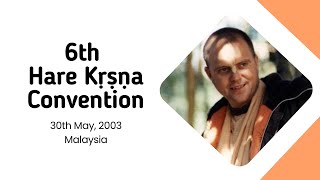
Transcript of a 2003 talk and workshop led by Jaya Pataka Swami (with contributions from Gaurav Sangradas and others) at the 6th Malaysian Hare Krishna Convention. Covers youth engagement games, training for congregation/temple facilitators (BTE prerequisite), front-line hospitality and phone etiquette, organizational structure for regional outreach (Bhaktivedanda center / BCDAC), and practical preaching/follow-up methods (contact → cultivation → commitment).
You can only pass the ball twice amongst your gender. Like if you want boy to one boy, they gotta pass it over the girls. One girl. One girl that passes it back to the boys. Okay, how about you start Sam? Whoever touches last, give me back the and see what you got. San Francisco. Give her the mic. You have to. How is Prabhupada? Did you hold it for. How is he doing? Kicked out. Jump in and help her. So when you hold the mic for Sa eating clay.
Where is mother Yasoda.
Sing and dance like Chaitanya Mahabhar. Okay, next one. Dominic got roar light Machandy. Okay, who was the last lady of all touch all the group. Little girl in the yellow dress. Moment of reckoning. Thai delivery and Madai got hit on the head. What did he say? What did he do?
One more, one more.
Maybe she needs help. She wants some help. Goes good. Hear the mic. Okay, thank you all very much. We got some very good ideas. Hanjo get over obstacles today for the youth and how they have youth oriented programs. And in the end we have a little ball game of Krishna Leela. Thank you all very much. Thanks to Babichanda Maharaj, His Holiness Bhakti Siddhanta, Swami Maharaj and all of you. And next year we hope that during this year all these ideas will help to promote a more youth oriented temple program. Thank you very much. Hare Krishna. I'm here to help the youth and everybody. Anything. If you ever have to ask me, you can come.
Okay.
This is the second part of the congregational preachers seminar.
This is Malaysia Langkawi Convention 2003, 1st of June.
One of the papers, none of its cardboard is folded out. Anything else from yesterday? Probably some stuck behind the wall. Folding wall. Many different points are brought and everybody agree it's here. So everybody agreed that it's a priority and it's urgent we have to do it. Now. I was explaining to you a little bit yesterday that we're trying to come up with different types of seminars. Coming up with different seminars, training programs. We need also some devotees in Malaysia to be trained as facilitators to present these training programs. In order to be a trainer, you need to do the BTE teachers training course. That's a one prerequisite. After that you need to take the course yourself from someone that knows how to do it. Then after that maybe assist the person and present him. And after that you do it. So we've heard from Devorians around the world that in our temples we don't put always the best presentation forward. And this of course is an area where we are not alone. There are many. Almost every institution has got its front line. Hotels have receptionists. In hospitals they have a receptionist. So many churches, businesses, temples, that people who greet the guests, the visitors would be surprised. Maybe in America they have retainment store called Walmarts is something like Carrey for here. It's the biggest retailer in the world. They hire two people, generally elder, like senior citizens. Their only job is everybody that walks through that door. They tell them, good morning, good afternoon, thank you for coming. Practically a totally useless thing. Practically. They don't have any function except tell you you can get your push car over here. Welcome. They took a poll about all the people that come there. They found that people appreciated that more than anything. That's the thing that stuck in their mind. When I went to that store, they welcomed me and said hello. You ever been in a shop? You go in, you start looking at stuff and the shopkeeper comes up. Are you rookie or you buy? You lucky or you buy? You waste my time or you buy. Obviously you feel like really welcome. Maybe like heavy pressure, especially in Hong Kong, you know, some places you go, you get these heavy. You feel okay, forget it. So next. I'm sorry I scared the baby. Well, that shopkeeper scared me. So somebody did a study in America of all the new religions. Maybe all the religions, at least not all of them. And I think all the religions. And so they did different studies. They said who has the best philosophy, that is, who has, you know, the best presentation, receiving, who is more friendly and things like that. So they have different categories. So on the philosophy, Hare Krishna was number one. Without the reception and greeting the people and taking care of you, making people feel welcome. Hare Krishna was worst on the bottom. Now what do you got? A great philosophy. And your philosophy is that we are God Sandu Das, or the servant of the servant. Isn't kind of ridiculous that we're the lowest in the terms of our service orientation. So being inspired by this wonderful report card we're developing, we gave up. We launched one, but we're refining it still special course, introductory introductory course for the congregation wishes department providing ministry letters, 60% dealing with guests. And one of the things that unfortunately we had a professional come and explain to us what their training, $10,000 training course. They said that the most important thing is, they said, I mean, this short period more like I'm just giving you a little hint. Some of these things, there's not much to be covered on an hour. And so but maybe what we can inspire with this is a little introspection. Because you can also organize some training course for those people that have to deal in the front line with people. But he was. Where's the cordless mic? The. They divide it up into many, many small details. It'd be really. For me, it was eye opening. You just think, well, say hello. No, that's not only it. That's all kind of existing, just saying hello. It's how you say it, how you say it. Face is index and alignment. Face is your business card, your personal. So when the person comes and smiles at them and they say hello, you got to say, what feeling hello, how are you? Good morning. You got to be positive. You gotta take that vibration and project it across. You gotta look them right in the eye. Then we're gonna shake hands. So it's very important. It shouldn't be like that. Shouldn't be a. Should be a firm, assertive handshake. That's a man, if it's a woman, all kinds of, you know, little details. In this course, you'll be surprised how many little things they figure out how the people. So that the first impression is the most important. And when you answer questions for the person, it's very, very important not to blow it. Because sometimes it's like if you think there's a man and a woman and the kids. Now, worst thing is that it's the brother and sister. And he says, oh, you're married, you know, nearly. No, my sister. So then right now, you know, you just kind of got off on the wrong foot. So then, you know, don't speculate. Oh, who is this? Could you introduce your family to me? Your associates? Don't take a chance because if you make the wrong guess, you look stupid. Uphill all the way. So then you look at, oh, can you introduce who's with you? Oh, this is my brother, sister, this is my uncle's, you know, children. Something totally never expected. Sometimes people bring other people's kids. One of the boys that I pulled out of Ocean yesterday was a guest. A Krishna Balra promised the father he would watch over me. And eight, he never. Rahul Tsuru There are many different details like that, how to lose your temper. So that's just like one aspect for people who are marketing, people who are greeting. So these things are very well known in the business area. And we don't really have a different situation. Only thing is, we're marketing Krishna, representing Krishna. So although we are doing spiritual things, but the same formulas work. Even if you're Talking about Krishna being nice to people, reading them. In some temples, every Sunday feast, Surdival is one, that is two, maybe more. Sometimes are designated as official greeters to welcome everybody as they come in. They have this in church. They call them the ushers or the aldermen. People come in the. No, people just say, someone said I welcome everybody and new people. Then they designate them and they. They recognize the new person. Sometimes they give a name. Came the name on it? Oh, hey Gopal. How are you everybody? Some people do that. It's not necessary in Chopati temple for the new people every day, every Sunday feast, they ask do they get a temple room that has the capacity almost as big as this home? It's not quite as wide. No, maybe even as wide because they kind of broken off or it's at least this long and maybe a little less wide. They really packed them in. Maybe 2,000 people, no chairs, all sitting on the floor. And every Sunday maybe 10 or 15 new people. So they ask who's here for the first time. And the people, you know, want to give you a gift. Maybe they'll be science. They do give everybody gift. So then everybody raises their hand and they go okay, we want everybody to weld them with a big hearty bowl. Now Jack had Chaitanya, he tried to get every big hearty bowl. I tell you, give people here flat compared to what they chopat. When they do haribold, they tear the ceiling off. Everybody shouts Harry bowl very hard and three times the people there probably. But they wow. They feel all the vibration coming. And afterwards they have others go gather and then they welcome them. They have a whole procedure. What they do. They do give them a little gift. They invite them if they want to. They can register and get on their mailing list. And they basically leave a little introductory talk to them and welcome them and explain what's happening. And then for the people that are the second time, they also give them a welcome. And then they follow up the second timers after that. It's okay. Different temples have developed their program. I don't know in your temple how many new people come? How many people come? Maybe it's not just for your king, but even then it's very important people come that they feel very welcome. Yes, I guess nowadays instead of listening clients and customers or even a visitor, a visitor for somebody's visiting and somebody's a client or customer, we use that. But then they prefer the word guest. These are honored guests, successful restaurants, Disney World, anybody going. They have a training program for all of the staff. They tell their staff that you are all actors when you go out here. You're on the scene, you're on the set. All of you are performing artists, even if your job is clean, because you're part of the whole presentation of the Disney World. And many of the people who are just cleaning, cutting along, they get approached. My people, where's the bathroom? Where's this? They have to know that it's not their job. They're only a cleaner. They have to know what to tell people. But you go to somebody and ask them something, and if they say something weird to you, you'll never forget that. I know this is a problem. Even like in Mayan quote, everybody's so busy. Everybody's got so many jobs to fill in. Krishna paths together, the book distribution. They do their temple work. So sometimes guests come and they answer, where's the temple?
I miss you.
I have service. People say, leader, what's going on here? Why they don't talk? Normal people, we have many talks on this in Maya purchase our devotees. The guests are not a moderation God. Purposefully, the guests come here. Even if you don't know, Just be friendly to them and tell them where to go. We set up, with the help of Bhakti Purushotta swami, we set up visitors facilitation booths at strategic locations. So somebody say, well, I don't want something. Oh, I'm new here or something. If you go over there, they can help you. At least they know that much. Direct somebody to whom, to someone else who can help them. We have many complaints. The devotees just like, push. I get down. They don't stop for nothing. They're like football players with the balls. I guess they can't understand that. They don't know what an ashram is anyway. They figure ashram means people are all saints. They're realizing do stuff. So dealing with the guests is a very important part. Many times when we have a big temple, like in LA or around the world, big temples where the congregational department is separate or it's a department. And you find that when the preachers, like book distributors, congregational Development preachers, they invite people come to our temple, right? Then they go to the temple and nobody listens to them, nobody talks to them, Nobody just kind of walk in, you know what's happening here. People walk by going away, and nobody notices that here somebody's come for the first time and they need some orientation, they need some reception. Now, I've been around all of many temples, not all of them, but many Temples in India. And I was most impressed with temples at Puskar Tirtha as well as the temples in Assam in terms of how they greeted and took care of the people that were visiting there. The ones who went into the temple, the priests, they would say, sit down, please sit down. Okay, take this flower in your hand. Hold your folded hands. Repeat after them. Immediately they came in there and they had to engage, repeating after me, nemo rabbanaya levayat, word by word to the pranam. Okay, now throw the flower here at the feet of Lord Krishna. Bow down. They took total control, but it was the blitzwa. They were engaging you. They told you about, you know, this thing you should not prepare. Okay, and then, you know, next. Thank you very much. They weren't having pressures a little bit. Those guys pushed for the donation. But that sounds. Was this very mellow and nice and engaged everybody in that kind of service. So I want to do that in Mayapur. So we set that up in Mayanpur that when the guests come, we have now bhoga, they can offer ayurthi. We have some trained people that take them from deity to deity and let them offer an ayurati. Let them offer. Give the boga, the priest to offer some fruits and flowers and aras and things. So it's become a very good. What a lot of friends people relate because sometimes our deities are not the same deities people used to worship. We have Jagannath temples, Borgatai temples, where people used to organ used to Garabadi, Awam, Qing or maybe Tirupati or Viktor or something. So they don't know. So they never used to say, like, these deities are unusual for them maybe. So somebody comes and explains Krishna and Maharaj. Maya is the form of Jagannath Puri and worship this form are very special because they're very merciful. They come out of the street to give everybody blessings and they're very merciful, very beautiful. If they're interested in mori, become a mori. But this is something, you know, that people can relate. This is Mauryani, Thai incarnation of Krishna Maharaj and Kali Yuga. They came as devotees, but, you know, they must say no. They should know. Someone should know something a little bit and explain to people and really engage them and really like the offer. Like the offer some flower or give some channel. Read diversity. It's important that the people who are in the temple. Temple is like inflation. That's where people are showing this. They come here many times. There's nobody in the temple. Right. There's hardly anybody there. Whoever's there, somebody happens to drop in whatever way they deal, that's the impression they're going to leave with. So instant during the day, even the cooking borga for the needy. Someone may walk in to get you off the street. Hey, just. Hi Bishop Champone. Get out of here. You're not initiated. There's a chicken. You'll burn the person out for life. So everyone needs to be a little bit oriented how they have to deal with all of the people who are visiting and they someone doesn't know. I mean here everybody is Indian, Hindi and of course some Chinese. But you know, like in the west people don't know that you're supposed to eat with your right hand. I remember sometimes some guest comes to give them pasada. They don't know that. So even with their fingers they're just eating with chopsticks or schools and forts. So you have to understand. You put yourself in the feet of the person who's coming. You like a spoon or a fork, you like chopstick or something. We with our fingers because feeling is opposed to the vibration of this holy food. But you can with our mind you can also use a spoon for it if you love how you want to understand it. So that people feel little explaining because they see all this weird stuff. All of a sudden something comes up and sees the person is leading with the left hand. Don't eat with your left hand. This is offensive. I saw Western and said what's the difference left to right. What's wrong with the left handed y with a 7 year old? So so many thoughts come in their mind. So we have to be. When you're dealing with guests, you have to be very sensitive to what where they're at in their mind. And if you want to take them somewhere else and remember the soma. So now I think we come out of that Elijah deep. It used to be that everybody was only preaching all the guests to shave off their hair if they surrendered the temple and become Brahma charities or something like 10 years ago that was the thing. I remember New Orleans one musician, this professional musician, like 55 years old, maybe 50 years old, 40 foot, a big wall here. Plays the banjo or some guitar type instrument, sings and people leave no nation. So he meets the devotees that are distributed in books. He keep asking help for the Sunday feast. He comes to Sunday feast and the first thing you know is in 20 minutes some fanatical devotee comes up to him. You should shave off your hair. That's Maya. So Maybe Krishna. We sound like, you know, the fanatical Helen Brimstone preachers. Burn, return or burn faith in the blood of Jesus. We'll go in hell. Maybe we're not that heavy. You know, people can't relate why I should shave my hair off. Why have to? I just come in here as a guest, invited to come and take asylum, take food and see the whole ceremony. And suddenly I miss here. The first time he gets guy tells me I shave my hair off and says, forget it, I've never come here again. Steve probably would have been a friend that he was able to come. He did it nice and then he would have, maybe even when I start seeing Hare Krishna sometime on his banjo. Obviously he's not some of his friend, so we forbid him. When I was GBC in America, I used to say nobody can ever reach anybody to move in the temple. Only the temple president has that right. If you think somebody is someone who could be a temple devotee, take up the president and get permission. Because otherwise they keep burning people out. We're not already the temple devotees and we want to make people our congregational message. That's our reaching. And if you find somebody amongst him, what do you think could be a temple? Beloved, discuss with your president. And if he agrees, okay, then you make a plan. But I hope just showing how we face the difficulties. Many times I phone out temples in elation and I know in Malaysia, all over the world. I remember once I landed in Lima, I'm not aware of that. I landed in Rio beach in Aero. And it was, I think at the same time they're having a world ecological program. So somehow they have taken all of the phones out of the planks of the temple because they're bringing new minds in for this family. So I could call the temple, nobody could answer. So then I had in the back that God had 12 temples numbers in Brazil. And I called every one of them. Some didn't work, some gave an answering machine only of course Portuguese. And then some people answered, pak the bill here, I don't know nothing. And fakta for all numbers. I couldn't get any this one. Finally I was like, Krishna, I'm not loot. Because I didn't even know. I didn't know that the temple of movement and the grass. Then somebody came up and said, hey, are you Jayvatakatiswami from my airport? I was a temple devotee 10 years ago and now I'm working outside. I think you look at my life, need some help. So some officially happened, but I experienced this. So here's some answering the phone. The University of Maryland in America, they said, what's your phone etiquette iq? They train anybody who answers the phone. You're representing the entire university there. So it was important that they got somebody designated. They answered the phone and they know how they answered correctly. So they made some tips up. Answer the phone with three rings. Let the caller feel the smile on your face. They make a standard greeting. Good morning, good afternoon. How may I help this Daddy? Identify who this is, whether it's a wrong call. A. This is iskcon, the main Hare Krishna temple. How can I help you? Visit ISKCON Kuala Lumpur, Hare Krishna Cultural Center, Whatever you want to. You have a standard thing. Every time somebody answers the phone, it should be right by the phone. This one they have to stay up to get Italian visa for a friend. Italian or Calcutta. Every time he called up, even if it was a different person answering them, they all gave the same answer. Good morning, good afternoon. Italian Consulate General. How can I serve you? Immediately you knew okay, the person was responsive. Were you called in case you happen to be calling the German Council generally, not Italians. Oh, excuse me. Don't waste any time. So these little things are very important that people answer. They know they got the right place. Then they have people trained how to speak slowly, distinctly. You may be saying the same thing every time. Hello, this is. How can I help you? Good morning. How can I help you? Hare Krishna. 20 people call up the same thing 20 times. If the person calls up, he only hearing it once, maybe twice. So every time you say it the same nice way. Then we have little tricks, little tips. If you hear the person's name, repeat it. Okay, Mr. Swami, actually note it down. You call up to everybody else is coming right down. Oh yes, Mr. Swami, would you like any special meal? Mr. Swami, would you like to Jews at the beginning of the seat and use that personal touch. That's not anybody representing this kind of Guru Maharaj. Here's an interesting tip. They say maybe you couldn't pronounce a person name. You can ask them. Instead of asking, spell it out because that won't help you anyway. Because sometimes the spelling isn't pronounced the way that they pronounce it. So it's an accident how to pronounce it again and try to catch it phonetically. WA L. So when you're trying to accommodate somebody's request and you're not able or they're asking something, give them alternatives. Suggest something. Would you like to more about our come to our assembly feast. You want to know about our congregation program. It shows you're interested in helping you first this is really far out when answering a call another department I don't think we have other departments but in case you do some of the big temple like family stay on the line until the third party announcers ever get that. So he called up somebody said okay I transfer you to this other department. They transfer you Ding ding ding ding ding ding ding ding ding. Now it goes on for 20 minutes. Here's a really good one way down the line to the other party answers tell them that here does not bill from this place is calling and that's really personal and tell the person you're there me I'll be always here and call me back. So trying to actually help the person that's why it says we should be confident we've done something to help that person's needs. This is from a University of Maryland. This is not that Hare Krishna love this is like the carvings they got it all worked out how to make the people feel that they serve and somebody calls university they're probably not even they're not business they're educational institutions. How they respond to the people that's going to leave an impression of what this institution maybe it's so they have a certain pride to present themselves in a nightmare proper way and also just serve the people that are calling them. So actually that institute of all the leaders phones are answered properly A lot of devotions just like proper phonians. I'm going to tell you a little more about some of these things but first I'd like to do is I was very impressed by the program presented by Kuala 14 upgraded and Pulakara he has we just had a program Give me a chair. Bring that chair to the corner. We don't have as much but it was also to inform all of the congregation what's happening. Get everybody get everybody to buy into it.
We have beautiful presentation I will just show the congregation as to what we're doing. So in order to make the congregation.
Be part of the success story that is going on here.
Division to systematically teach, disseminate and promote Krishna centered balance we applied based on Vedic philosophy and to create a vibrant cohesive progressive congregation. And of course what follows up the mission statement is the objective for the objectives we have also these three things clear. I mean start out very clearly to manage and develop Navahs in multiple chance to provide management and development assistance in our hearts in multiple chants and to train and create new bridges and existing creatures. And for this we have a management chart. And for this management chart, the organization that actually manages this is known as BCDAC or Bhaktivedanda center for Vedic Arts. And where it has got number of divisions of which CP is one of the division. And for CP division I'm heading in and for CP division under Indian expertise in Vaishnava training we have the devotee who's managing it is Gaurav, Sangradas. And then like that we have youth development, book distribution, sensors and distribution. This is managed data data of our devotees congregation. We have Harilam and Sangetra division, Electronic Preaching division. We have special project Namahand development. Special projects are items, I mean things like Dhammadaraman which is considered a special project. And then we have a division that manages Jagannath Mandir temple itself in terms of congregation development and also multicultural development. And we have also area managers who will take care of the field activities. We have like one go to the next slide. So this company or known as BCBAC organized managers, six parts of language, Bata, Presentai, Rawang, Xinjiang, Mampang, Kajang, Banding, Klang, Punchong and Bangsan. It all comes under area and is managed by area manager and Banting. And this covers the entire state of Selangor, Klang, Jagannath, Bandung. So all in all we have close to about 60 reaching points of program that goes on in the state of Osamo.
To come in, see the progress I got in a few minutes you get an overview of what's happening. Of course I also got a similar presentation from Shankaranga. When I went to not only him, but mainly the other sync. They didn't have it on a PowerPoint but they had it in a folder. The pictures and everything. I don't have a way of showing that to all of you, but just to get the idea that if we set goals, we organize things. That's what the difference is. Now in 2003, 517 Korabdha in its kind of somehow it's much more organized, systematic and effective way to care for our language, to build up the individuals, train them, to make them feel, identify with Ka consciousness and to support them and to back them up. So as things are happening, developing an area like they gave me a different presentation in January and this is May. They already changed because they realized they even had a program for the expats from India that were here program for the youth. So they already expanded many different sub programs according to your environment, according to your situation. Then keep changing and Adding new ideas. When I go to the Middle east, it's a strange environment that will become. Although in the Arab countries, most of the majority of people that live in those countries are expats, the Arabs hire everybody to do most of the dirty work, most of the work. So that's changing in some places where they have a large indigenous population still minimum 40% are expats and most places 50 to 60, 60% in some places, 75%. So what happens is you get a whole conglomeration of people working there. So as they're trying to expand their net, how they can save more conditioned souls, they realize that if they have language oriented programs for expats in India, they don't want India, but they're from Andhra Pradesh, Kerala, so they're having programs in the different local languages like Malayalam, Tamil, Telugu, Hindi, Bengali, etc. Etc. Then they have Akiva Krishna groups giving programs in those languages. So then that attracts a particular clientele, particular kind of people that are more comfortable with their own mother tongue. And this way very quickly they could establish. Then they found that they have labor camps there where people work in construction sites and that normally they're almost like indentured slaves or something. It's like they're working in very tough conditions and 50 degrees centigrade sometimes and. But they found that a lot of them are Hindus, a lot of them are very accessible. So they started doing programs for them. They talked sometimes to their managers and they got rules available for having prayer meetings and songs. So like that, very quickly they started developing the net and reaching more and more new people in different ways. So that's their environment. Now your environment is going to be different. Now there's more expats working in Malaysia, so that's one area. But most of our audience have the local Malaysians. But how to reach the different kinds of people, how to make it more relevant for people? This is a whole thing where you need to get your creatures together, thinking how to organize it so all the contacts you make, all the people that you meet, that the favorable ones are somehow brought into the mercy of Lord Chaitanya Mahapab. Part of our congregational training is cultivation. First is contact cultivation and then commitment. Engaging the people, having and helping the people to make some kind of a commitment. So first you make a contact. You don't want to lose that content, but you want to be able to remember the person and follow up later. Whether you follow up yourself or you have people who are following up, those are the kind of people you can do the house programs. It's important. Everybody who does book distribution, food for life, even when they're just going shopping, they sell. Somebody comes up, oh, you're doing some kind of spiritual practice, have books. One of the things with me now is the shastrada for people who have the financial capability they donate. Prabhupada's books, libraries, institutions and one disciple. He was working as a quality control officer for Woodco. There's a company that makes matches and he used to have a little. Can he go around and give everybody a book free from his own salary. He separated one tenth of his salary for book distribution. So that much every month he would buy books and that many books he would develop. But he told the people he gave the book to, the book is free. But if you'd like to contribute something towards the cost of reading the book that much, I'm going to buy more books and give it out to more people. So in this way he put some donations and about 60% of the parts of the book he get back, he'd add that to his mountain he was living. That would increase poop distribution. So in one year, I think he covered one whole factory that had 6,000 employees. But in that factory there were some communists. So he didn't give that because he thought maybe his communists don't want. Some of the communists came to him and told him, look at the Communist Party, why don't you give us books? So no problem here taking the Lord's bank. So then they also gave something. So he found everybody in the factory basically took. Maybe here you got a situation where you can't give to the Muslims because of the environment. Whether you give to the Hindus or maybe you offer to the Chinese or somebody once approaches you or you give to anybody. We like to get the Boris inspired also. How they can preach, give them ideas, how they can be part of the preaching effort. How they can, you know, if they meet a friendly person, how to direct them that in their area there's a bhaki, vriksha or namhapta that they can participate in. It's getting everybody into the spirit of giving the mercy of Ka out. Because it's such a wonderful thing. Anybody, anybody who takes the Ka consciousness, somehow through a devotee's effort that above that person gets back to godhead. All the people that have helped that person, they get a free ticket quite a great deal. Apart from just the personal satisfaction. You're helping someone, you're helping a spiritual master of Prabhupada. You also get free from so many offenses. Haribra Stagbur said, well, you know somebody else to be Ka conscious then if you've made any offenses against Vaishnava's thinking of Dhamma Paradmi preaching, you get free because abrupt means you've somehow blocked someone's Ka conscious progress by some bad behavior or something. So when you help somebody, it counteracts that. That's the only thing that can counteract it. Punia doesn't counteract it charity, but Krishna conscious preaching does counteract it. Extensive chain of Hare Krishna counteracts it. Otherwise directly begging for forgiveness among the the directly. Sometimes we commit offenses, we don't even know the people we've offended. So preaching will help us to overcome that. So I think it's very nice that we've heard maybe take a few minutes here. If anybody has any questions or they'd like to share something that's happening in their area that also repeats fine prayer.
Noise, hearing, lifestyle, accommodating others. There's a statistical fact that for every positive encounter we have in the preaching field, seven people hear about that. In every negative encounter we have with persons, 11 people will hear about that. So as representatives of Srila Prabhupada, the Lord Shukra is a mission. It is so important that we maintain that personalism because behind every project is a person. And I found in different areas of our society where there is that focus on personalism, persons behind projects, personal focus on the deity, worship, that wonderful things happen. It's not so much we have to provide extensive facilities to capture people just by that personal touch. People come automatically see the examples to.
A prophet in New York City, how.
He would cook and how he would dress, how he would clean up, worship the deity. He covered all the bases of personal relationships. So I'm very inspired by the different seminars to see how I can increase my abilities in these areas. In New Zealand we have different programs In Australia where we're trying to add health professionals, add Krishna. So in different areas of Malaysia and Mayapur, Bengal, there's such a deep Vaishnava culture that we can really learn how to reach out to persons in a personal way. Even in foreign settings like the western lands of how to just help one and all, add Krishna.
Like to say about changing. Like Guru Maharaj was saying in the beginning, we wanted everybody to shave up.
And join the temple.
Srila Prabhupada intentions that everybody can become Krishna Funkshow and only few people is going to be living in the temple. If you wanted their house to become just like temples. So we we show the example in.
The temple and the people can do.
The same at home. So this process is the next step in Ka consciousness. To make everybody able to practice Ka consciousness at home.
Doesn't matter if he is a person.
Who is an executive in a company or just a student or anybody, a child, a lady. Whatever profession they have, they can practice. Because this is the next level of our society. We have to put all interest and make ourselves available.
Whatever we know is so much more.
Than what the rest of the people.
Of the world know about Ka.
So we have to become available to the people. Like Guru Maharaj said, become very personal. Personal means caring and caring means to Lord shit like a gift. So we have to follow this example from the top.
Lord Krishna himself and Srila Prabhupada and.
Guru Maharaj and all the other devotees that are around you. Just getting comfortable that the people is closer to us. And in the depot itself I presented preaching activities for the year. Planning for next year's preaching. Like a preaching goal. What we could achieve something like seminar or group instrument goal or something like a get together gathering and of course some photoshop activities. So many things. Thank you for watching our videos. Be sure to subscribe to our channel. We publish new videos every day. And don't forget to like and share our channel.
More from Jayapataka

20260205 Mayapur Academy Zoom Class at Śrī Māyāpur, India #JayapatakaSwamiArchives


Jayananda Prabhu is a Super Empowered Devotee as is Jayapataka Swami. Offering by Ramesvara Pr.

Jayapataka Swami Empowerment Is Beyond Human Comprehension. Offering by Ramesvara Pr ACBSP

Prabhupada Planted The Bhakti Lata Bhija in the West. JPS Vyasa Puja Offering by Ramesvara Pr ACBSP


Prabhupada Sent His Personal ISKCON Ambassador to India. JPS Vyasa Puja Offering by Ramesvara Prabhu


It Has Been My Great Honor & Privilage to Serve Jayapataka Swami by Ramesvara Prabhu. ACBSP

Prabhupada Planted Spiritual Energy into Jayapataka Swami. Vyasa Puja Offering by RamesvaraPr ACBSP

Вот русский перевод текста песни «Любовная песня матери Лорри своему сыну Джею»