20080913 || Bhaktivinoda Ṭhākura Āvirbhāva || Port Dixon, Malaysia #JayapatakaSwamiArchives
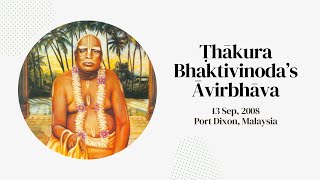
A recorded lecture describing the life, teachings, and preaching tours of Bhaktivinoda Ṭhākura (Bhakti Vinod Thakur). The speaker recounts Bhaktivinoda’s role in re-establishing guru-parampara and pure Vaishnava practices, his administrative career (including service at Jagannath Puri), extensive village Harinama/Namahata outreach across Bengal and Orissa, devotional methods (kirtan, songs, Namahatas), and his emphasis on faith and communal worship.
Today, very special day, Bhartavino Thakur came down from the spiritual world to re establish a guru parampara which had been somewhat diluted because of so many different kinds of Upper Sampradayas. Know about Upper Sampradaya? When there's deviation, it looks like something like the real thing. But it's actually diverted, deviated. That's Apa Sampradaya. If it's a Boges Sampradaya, that's called Chala Sampradaya. Completely imitasable. Doesn't even look like the original. When he came to all this Appa Sampradaya, Chala Sampradaya. Asam Pradhaya. Asam Pradhaya means like totally out of the another Sampradaya. He wrote that in one song that there's so many occasions on the Daiyas as Owal Bawal Patra Bachi Narayana Chuda Dali Jagosai. What else? Saki Beckin. So many different kinds of Vivian. So he thought that when he came, his first impression was Vaishnavas, all these Apa Sampradayas. And then he found that Chaitanya Maharabhu while reading the Chaitanya Chera reader. And he realized this was the highest philosophy. Then he started to preach. He's actually born in a place called Birnagar. How many of you been to Birnagar? Nobody. I went there several occasions to Biryanagar. Many, so many. Maybe with Prabhupada, several of us. Two, three times. There's a little bird place, temple by the side of a man made tank Kunda. And just say Robert was very upset because he went there. And one of the sons of the brother of Bhakti Siddhanta Saraswat Malita Prasad Thakur was there. And he proposed that let us do something. Join it. Let us. Because Bhakti Vinothak was such a great Acharya that his birthplace should be glorified. It's actually on the way between Mayapur and Gautada. But by the internal road, not by the national highway. Little diversion. And it's also called as Gwadasa Mandir because there was 12 Shiva mandiras. He was born in some aristocratic kind of some of their family, but landlord family. He spent a lot of time in his youth in Orissa. He was a school teacher, a headmaster. Then he decided to go into the government. Became an ICS office in Alegre called ias. Then there was ics Indian Mahawat's Indian administrators. Then what Indian Dhammatist he has. So some of you will trace out he had different places where his pastimes were held. When he was working for the government. Then they posted him as first they knew that he was a religious person and he was a Vaishnava. So they put him as the first administrator of the Jagannath Puri temple. There was a lot of problems with the Jagannath Puri temple management. So the government took a particular oversight role as an executive officer. And he was the first one. Then that's when Bhakti Sivanta Saraswati Thakur was born in Jagannath Puri. He and his wife were praying the Ka to have a real Vishnu. And they got Bhakti Siddhanta, Saraswat Thakur Jagir Rathkar stopped in front of their house. They took out the wife, took the baby and laid at the feet of Jagannath upon the rod. That's when Jagannath's garland fell down over Bhakti Siddhanta. So like that. Then he applied that he wanted to find the birthplace of Lord Chaitanya. So he applied for being posted at Krishnagar, the district headquarters of Nadia district where Loyal Varnavadhip is situated. So that's when he had his house in Gudrum and next to the Surati Kunjal. How manybody seen that? How many seen that? We should have a special curriculum for the Malaysian devotees from Dubai they fly over now they have this non stop flights Dubai they Calcutta. So about 50, 60 come every year for the normal parikrama. How many bin on Parikrama? Then you must have seen Bhaktivedinod Thakur's house. So he had. In those days the magistrates were both executive and judicial. They had both the powers. So he had to do administrative duties as well as he had to do judicial duties. This daily program was like it could be a time management guru. Apart from being a spiritual guru. Get up early in the morning, chanted stuff. And he was from 7 times 6 till about 7, 738 be available in study if everyone wanted by Darshan. Otherwise he'd be reading the books. Then give the US morning duties, take his breakfast, go out to the office, driving in his horse and bugging. There was the 1800s or no drive to the work, do his judicial work and said that he was he wish he had all the judicial rights. And he was completely honest. He would do the judgments very quickly. And he said none of his cases ever got overturned by the higher courts. Judgments were so proper, correct, complete, logical, whatever. Coming assistant couldn't find anything wrong with his judgment. Then he come back for lunch, go back again the afternoon session. Otherwise he finish all his work in the morning. Then in the afternoon and evening after work he would do some naha piqshi. He had some time every day, couple hours with his family, then again take early rest, get up again in the middle of the night. He'll be writing his songs and books. No laptop, no macros and all the speed. No clipboard or anything. Just write everything by hand. Whatever the latest technology he used, he had a fan. The first fan that he built was run by kerosene. Somehow the kerosene propelled this fan. They still have it there. They had. I don't know. They had it last time I saw it in this house. So for the 1800s the kerosene fan was high tech. So one window into his to his activities after his work was namhata. Now it's 5:22. And this was Chaitanya 406. That means 116 years ago. So in the seventh of Aswin he writes here at daybreak Sri Sanketa and went out with a great gathering of Ram Jeevanpur villagers. The special decorations and mandappas in front of the houses were a wonderful sight to see. Thereafter the Sankirtan party went on the main road and from the houses of devotees in great devotion were chanting the name of Hari Hari Hari Hari Hari Hari. One Mandapa, the traveling salesman and Bhakti Binon tour explained the glories and the truth of the name. Well, from all four sides the village women folk raised their voices and ulay ululation. Do you hear? The ladies know how to ululate Wiggling their tongue. Let's hear again then cover your mouth. A one, three. Pretty good. That's supposed to be like a pancha sound. In its effect the demigoddess is devis and apsaras and darvikas. Everyone in heavenly Planets they know how to make that sound. So Bhakti Vinod chakra are like that they go in Bangladesh. They're very expert. We had a program with 50,000 people. So maybe 25,000 men. 25,000 or 25,000 all at one time. Ulu lady they call ulughuani. In the English dictionary there's a word called ululation. We like that. The women folk raised their voices and udling in some places that school children breaking rules from the teachers here crying ran towards the Sankirtan party. All of the devotees were feeling mutual bliss. The minds of everyone present was captured by this enchanting scene. Sijuta Shivashandra Adyan Gangadhara Pal, Sri Radanath Das, Sri Manavat Chandra Chandra Modak Chai Lokni Adas, storekeeper Sri Jadannath Pal and the best of the Brahmanas, Sri Yuta Veenanath Rai. Each had at their houses separate individual Sankirta meetings. So he went out on this inspection to see how the navhats are doing. At that time, India was 80% people living or 90% living in the villages. Now they say it's about 60%. And then in the next 10 years they expect to go down to 40%. People want to move to the urbanization. So when they go and visit the Namhatas, they do a harinam go through the village. So see, this is what he was experiencing at that time. It was something very ecstatic that children even that they were spontaneously attracted to the chanting. And they came running to see the kid done with the ladies with hullulating. We have a competition when we go on the naval. Who can get the ladies and the men on the side of the road as we're going on to chant Honeyball ladies to Ululip or the Chandragir Goranga. So like this, we have a little competition and see how we can get them to. But here it was all very spontaneous. They just came running out and chanting. And we didn't have to encourage them by a loudspeaker or anything, just they were doing it naturally. So that was making everyone feel very blissful. When you do some program, like if you do the Brahmadhar Month program, people come out and participate and they do the art thing. They like to do the things. They show some enthusiasm. They do a hari nama and people come out and join it. Then it's more blissful. Once I was in Hong Kong and we had about 15 devotees. We're all chanting in Hari Nama, two, three swamis, everybody, anywhere would be a very powerful hari nama. But nobody stopped. Sometimes they would just look out at the sight of their eyes. They wouldn't turn their head. Then this last year in October, during the Chinese New Year's, not New Year's or Chinese holidays, national days in Hong Kong, we had a very big group, maybe 200, the Chinese devotees, some of the Hong Kong Indian congregation, they're all chanting and dancing. A lot of people were watching. And this time they were clapping their hands and they were participating a little bit. So it was very exciting to see that people were participating and how everyone was dancing and so enthusiastic. This same mood we were feeling in our Humble attempts to follow Bhakti Mah Takwa's words. You see how he was taking his group, some of the people, like he says, the storekeeper or the traveling salesman in the beginning of this. This is an old book about. This is a newsletter about Namhat preaching, basically. And so everybody in the Namhat has a service, basically getting more than one service. So to be a salesman, traveling salesman means you are a traveling creature. You would go around house to house. If you are a storekeeper, it means you are a Namhat leader. Since the Namhat is the market of the holy name, then you are opening up your shop to distribute the holy name. You still with the holy name. You have to pay for the holy name. How many ringgit? Anyone know God? You don't pay a ringgit. It's not free. You have to pay for it. But not in ringgit, not in dollars, not in pounds, shillings or pence. You have to pay with your faith. The more faith and devotion you have, the more high quality harinam you get. You have more faith then you get harinan. The basic faith is that like Shraddha Satsanga bhajanakriya, like as it goes up, Ruchi Ashakta Bhajanakriya Mishta Ruchi Ashakti Baba. So Baba is static. Love of ka was considered like a silver coin. A peyma is like a gold coin. Is a gold coin worth more than a silver coin? Same size, one ounce of silver, one ounce of gold. So like that, according to how much faith you have, that's how purely and how ecstatically our chanting will be. So like everything, his whole, all these descriptions have got a lot of analogies to make it very easy to assimilate. So now he's going around from the different villages that he had a list of Namahatas over about 3, 400 were in the list. And we don't know of course how many were there subsequently There were because even I went to Bidnipur and I went to one place. And he would call his namahs that had a regular program and were very spiritual. He would call them as prabhupanashrams. Let us say the Prabhupada ashram means the ashram for surrendering to ka. This is where the devotees could learn to surrender to ka in association with the other devotees. At that time he wasn't making any temples. But sometimes I saw there was this Prabhupada ashram. It was a temple for that community. That namaste temple was bringing everyone together. Later Bhakti Siddhanta, Saraji Thakur and following his Lord Shiva Prabhupada, they established temples just like we have our Karlapur Jagannath Mandir, Jagannath Mandir in Bangalore they also have Jagannath Mandir. The idea is we have temple, we have that facility. Then we bring people together and we have a greater community. So connected to the Jagannath temple there are many Namahs. How many know? 43. 43 Namahans. And like this the bodies are getting some care. This is how the temple can give care. Whether or bhakti, rickshaw or counselor groups, some kind of smaller group and some senior devotees who are overseeing their programs, interacting and facilitating the devotees and their devotional service. This helps to make it more of a Ka conscious environment. We feel all connected to the temple. Namahantas are extension of the temple. The Namahanta is a little corner store, like what they call convenience store. Then a temple, many more programs that will be something like a supermarket. And when you go into the holy Dhaam Vrindavanapur Jayanapuri, that's like a whole, like a spiritual urban marketing area. Like some places you go and there are many big malls and big multi complexes and things with various shops. So holy ground has got so many things. The temple is in that area like a supermarket. Some people get their day to day. They need to go just to the convenience store and pick up some salt or sugar or whatever you need. Sometimes you go to the supermarket to buy bigger quantity of some special items you can't get locally. Then when you come to some festival like this here, at a festival and my birthday at Bhakti Bino Shakur, then it's something very special. There's only devotees that come together. We can consider how we want to develop our community. Encouraging the devotees in the devotional service, giving them encouragement and shelter. So now we have of course websites and email and telephones and many facilities. You can imagine that for these devotees, maybe once or twice, or maybe not more than once in a year, these are places quite distant. Prabhupada Vinod Thakur is making his personal inspection, going with some senior devotees and visiting the places. And they're doing Hari Naam, they're having classes, singing Bhajans. Said later at the village of Srinagar, the Harisabha established by the Na Mahatha Bhakti Vinod and the Devoli employees of the Namah gained the affection of nearly 2000 assembled persons by their discourses. Sri Juta Hadayanath Karmakar and other Namhata singers sang sweetly and dancers, Sri Juta, Sitanath Hara and others danced to the kirtan and chanted all those present. It's also giving people credit. And here an ooh, sadhur was being written. So he mentions who are the different people, what they did. Maybe just a little basic mention, but that also is interesting for people in other places. It's the kind of kirtan and the dancing, singing. Everybody, not only Bhaktavin Thakur gave lectures, but others also gave lectures. All these things were the method they were preaching. It was really graphic exactly how they're doing the things. So that day they had a morning program, a day kirtan program. They had an evening program. Hari Sabha means that it's a kirtan group. You see, like something that are not mandir or some pavilion or something. It's built with us in Hari Saban, especially in the khandhas and purnimas and different holy days, they perform kirtan. So it was a Hari Sabha established by the namahatha. Next day, 8th of Aswim in the massive gathering at Ramjeevanpur, all the Namahatha employees did Nam kept them from house to house. The houses of Srijuta, Umesh Chandra Modak, Srijutha Anantha Gyan, Srijuta Ramchandra Datta, Sijuta Srinivas Rout, Sijuta Ram Kappa Rao. A great multitude of persons received the message of Malhaprabhu. Finally, at the Natra Salaya, the dancing mantra of Sri Parvati Mahadev, nearly two and a half thousand persons came together for the commander Gauravprait Mahaprabhu from the Vedas were honest and Anderling said for the whole area was senapatis. This was Senapati, one of the senior Senapatis who are leading the Prabhupada. I mean Bhakti Vinod Thakur said Sena means soldier and apati is protector. So that literally is the word they use in Hindi and Sanskrit for general Par Khivinod said Sena means the Lord is and Patti is the protector who is protecting the devotees. The commander glorified Mahabhar from the Vedas and Puranas. At the time of pure devotional teaching. The sweep of Bhakti Vinod showed the uselessness of the impersonal philosophy. Later, at the Prabhupada Nashram of storekeeper Srijuta Janunath Bal, the Rasik Mandal performed Kirtan See, because of all the pitching of Lord Nityananda and Lord Chaitanya. There's thousands and thousands of Kirtan Buddhas, Bengal and Orissa. We should also have thousands of Kirktown groups all over Malaysia. Everywhere you go, they can perform kirtan. I was thinking it'll be nice. I don't know if it's in the schedule. Have some bhaktavid on Takur Bhajans. Songs sung by. We have some of our youth. Used to have youth kirtan groups. We still have no more. No more kirtan. Any kirtan group Singers here. Forgot them. Screen the song. Some of his really great preaching was through songs. Every day he was out there, camped out in a particular area. Going on in one place to the other. 9th of Aswin. All the Namhata workers gathered at Hatipur Devakant where nearly 3,000 people assembled at the matshala of Jagadhanani. Padrakali. The traveling salesman of that place, Siju Prakeshachandra Chakravarti had made many preparations with gates and mandats. Ali was giving lecture to 3,000 people and here a few hundred. The microphone is a little bit far from the mouth. You know, they're really concerned. They have to adjust it. I'm sure that in the 1800s there was no microphone. So people to preach to 3,000 people. It's a logistical problem. Must have had a very good voice carrying out. People must have been very silent and very attentive at that time. Every day, 2000, 3000. There are a lot of people attending his programs. He's a grihasta. He's a government officer. Must be taking some leave or some vacations. He's going on his inspection tour of the Namah. Visiting and doing all this haridams and preaching and different festival programs, dances, drama. People thought it was noteworthy of them making preparations with gates. And like in Mayapur, when they have the Ranastami, they have Rana's picture everywhere. They have. They have all kinds of decorations for Radharani. So that's here for the. For the inspection tour of Bhakti N Thakur. The sweeper of the Naamah took the humble role. Keep the Namhata as the acharya. He was a sweeper taking out any kind of contamination. So whatever he's saying here, whatever he's highlighting, it's also Raman. It's also like evidence that these things were bona fide. This was right thing to be done. Otherwise he won't be mentioning it here. The villagers took the Nama workers with great enthusiasm from the bank of the river to a candle. Along with this woman filled with ecstasy were ululedi. Those present will not forget the enchanting scene. At that time everyone lost women Ululay. The men also say those women that don't know ulay lady can also say honeymoon. At that time everyone lost consciousness submerged in the ocean of Krishna Pera. After all the devotees were properly seated in the mantap. The following song was sung in the bowel melody. The bawals I wanted the upper sampraday owl bowel. They say that whatever is. Since the body is created by Ka, whatever Ka creates is pure. And this body is also a microcosm of the absolute truth. So all the things done by the body, everything is pure. Whatever you can imagine, good, bad, sinful, it's all pure. It is done by the body which is made by Ka. In fact, you can put on a stool as a tilak because it comes from the body. Bona fide teaching. But they were very popular because they had a particular way of singing. Using a. What they call ekatara. It's like a kind of a bongo drum with a string or a wire in the middle and held together by two bamboo strips at the top. So it was a percussion plus a string instrument at the same time. When you would hit the string with a pick, they would simultaneously make a sound pop. Because it's connected to the middle of the skin of the drum. And it would also make a string sound. I can't make those sounds with my mouth. It has an interesting sound. So they would sing ballads. They would sing a particular melody that went with that instrument. And sometimes they are just foolish ballads. Like there's a dal. We don't take the red dal or red lentils. That's called masoori dal in Bengalion. But some people like to eat that. They're not necessarily vegetarian dal. So you don't offer that to ka. It's not considered to be vegetarian. It's like onion and garlic. It's red dal. They'd have some song. Everyone's hearing some guy. Masoodi da lakayo. Such a nice thing to eat. And then like that they have a little song. So they weren't necessarily. But bhakti vinod thaka said the melody doesn't matter. You can use any modern. That was the modern melody at the time, vowel melody. But he said the lyrics, the song should be Ka conscious. So from that instruction you can have your traditional Baja group. Or you can have also your Hare Ka mantra rock group. As long as the lyrics are Ka kanthas. This was a song Italian. Mahate. But I don't know the vowel melody. Okay. Jabhi devai ay chute. It's kind of like a reggae, Reggie. I mean something like Ate Ansi Mahajan si Advaita Sanatan Bandari. Sri Girahar Pandya Bichaksan. Achan Chow Kidar Haribas Adi Holen. Sri Sanjay. Sri Sridhar Mote Dalal Keshavarati. Sri Vidya Vachaspati Paricharak Achin Karnadas Praviti Aung Kosa Dyaksa Siva. Like everyone here, all these people were present to deliver their fallen souls. The partial capitalist Advaita Sinatra. Goswami. The storekeeper Gadagar. Everyone had their different roles. So they mentioned all their names with their roles. The Praacharaks, the different preachers, the different treasures. Like Srivas Pandit. Chadodar Kedar. The sweeper. Kedar. Kedar Bhakti. Vinod. Thakwa's name was also Kedar Doctor. So like this Bhakti was being expanded everywhere. Everyone was getting the pure faith, the pure Harima. So this tame was rising in everyone's heart. They were getting the pure instructions. The pure Harinam form was being manifested. There was no hatred or enviousness against anyone. Everybody was eating in one line, one plate. Just all friends and all brothers and sisters. Here's a translation. Nityananda has come to the marketplace of the Name, holy name. Whoever is coming, run quickly. Those two rascals Jagay and Madai have looted the storehouse and taken all the goods. You will find the partners, Advaita Sanatan, the storehouse managers that I'd have. Pandit is the guard, Haridas is the watchman. Sanjay and Sridhar are the bearers. Keshav Bharati and Vidya Vajraspati are brokers. Krishna Das and others are managers. Shiva's Pandit is the treasurer and Kedarnath is the sweeper. The cost of the goods in the store are nine kinds of devotional service. The gold coin is Prema. There is no limit with whatever you have by there there is no shortage. People. Take as much of the goods as you can for obtaining love of God. This is good advice. The message is the nectarian name of the Lord. So let there be no useless strife. Let everyone, whoever he may be, eat from the same plate. Events of the 10th and 11th Aswina are knitted for brevity's sake. This is note by Bhakti Vinod Thakkar. So like that Bhakti Vinod Thakur. Sometime he was preaching and sometime he was writing. When he was in his house, he had a vision of a grand temple of Lord Chaitanya. So trying to build that or build something anyway in that direction. He also had a vision of the light coming from the birthplace of the Lord Chaitanya. So really fortunate. Bhakti Vinod Chakra came in our Sampradaya. We're coming rather in his Sampradaya feeling his mercy. So we can offer him our obeisances and pray for his mercy. That we can spread the Namah. We can spread this family of Ka conscious devotees. You can see the kind of mood he was encouraging. Very loving mood amongst all the devotees. Fully awakened and blissful in hearing and chanting the holy names and the message of the Lord. Pretty colorful kind of programs he was holding. Today we're here and we hope that Bhakti Vinod Chatwa was also with us and inspecting our activities. Very nice to be here again. Seeing the wonderful congregation of Pradhanatman here. Kualmanpur and Kling. Also the whole Klang Valley, Selangor State. What does Selangor mean? Siramban and Sri Rambong. This is property. Oh. It's like everybody in Malaysia. They write in the passport. You know, instead of Lakshmi they put Lachumi. They spell it in some different ways, some new unique ways. I'm sure that Shivanga probably has some spiritual meaning. This way got pronounced a bit different. Sheila. Sheila means Anushilano. Follow. Think about it. Sri Lanka. Sri Lanka. Sri Lanka. Anuba jumping in Sri Lanka. Sir, you have announcement for us? We have a group photography session. Group photography. Before we disperse, we can have pornography session there. Thank you for watching our videos. Be sure to subscribe to our channel. We publish new videos every day. And don't forget to like and share our channel.
More from Jayapataka

20260205 Mayapur Academy Zoom Class at Śrī Māyāpur, India #JayapatakaSwamiArchives


Jayananda Prabhu is a Super Empowered Devotee as is Jayapataka Swami. Offering by Ramesvara Pr.

Jayapataka Swami Empowerment Is Beyond Human Comprehension. Offering by Ramesvara Pr ACBSP

Prabhupada Planted The Bhakti Lata Bhija in the West. JPS Vyasa Puja Offering by Ramesvara Pr ACBSP


Prabhupada Sent His Personal ISKCON Ambassador to India. JPS Vyasa Puja Offering by Ramesvara Prabhu


It Has Been My Great Honor & Privilage to Serve Jayapataka Swami by Ramesvara Prabhu. ACBSP

Prabhupada Planted Spiritual Energy into Jayapataka Swami. Vyasa Puja Offering by RamesvaraPr ACBSP

Вот русский перевод текста песни «Любовная песня матери Лорри своему сыну Джею»