20241203 || Śrī Caitanya-śikṣāmṛta Class || Śrī Māyāpur, India #JayapatakaSwamiArchives
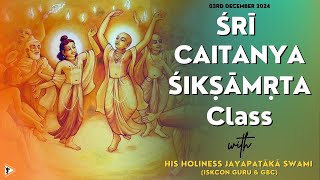
Recorded class by His Holiness Jaya Pataka Swami Maharaj (Dec 3, 2024, Śrī Māyāpur) teaching from Śrī Caitanya-śikṣāmṛta. The lecture analyzes five types of knowledge: (1) Indriyārtha jñāna (sensory knowledge) including five mental stages of perception and material sciences; (2) Naitika jñāna (ethical/positivist knowledge) dealing with right/wrong and social consequences; (3) Īśvara jñāna (knowledge/belief in a personal Supreme Lord) and its practical/fruitive implications; (4) Brahma jñāna (knowledge of Brahman/impersonal reality) including Māyāvāda and Advaita distinctions; and (5) Śuddha jñāna (pure knowledge, realization of the soul). The speaker contrasts these knowledge types, warns of attachment from ethical knowledge alone, and summarizes philosophical schools (Māyāvāda, Vivarta/Vikāra) that deny individual reality. The recording also includes brief audience interaction and channel promos.
Be sure to subscribe to our channel. We publish new videos every day. Don't forget, grab your smartphone and download the Lava Mantra app and stay in touch. Guru Maharaj's message is your the following is a Sri Chaitanya shikshamrita class given by His Holiness Jaya Pataka Swami Maharaj on December 3, 2024 in Sridhar Mayapur, India.
Yes hi Krishna Dear devotees, today we will continue I think hi Krishna Day devotees, today we will continue with the reading from Sri Chaithanya Shikshamrita, Vaiashuda Sachidan and the Bhakti Minor Kapur continuing with the fifth shower consideration of Bhava Bhakti and we are starting with the third stream, Gyanavicha and Five Types of Knowledge in relation to the analysis of knowledge, some may wish to know as to what is the endeavour of the persons who have awakened Baba before the awakening of Baba, during the practice of Vaidi Bhakti a person gains a certain understanding of all Vedantic truth in the scriptures of the Lord and the misfortunes caused by ignorance and ignorance has been removed. Once the Baba awakens, the devotee no longer engages in discussions discussion of other aspects of knowledge being absorbed in the taste of that Baba alone. Five types of knowledge are as follows. Take knowledge of the senses and the objects Naitika Jnana Ethical knowledge Ishvara Jnana Knowledge of the Supreme Lord Supreme Lord Brahma Gyana Knowledge of Brahman Shuddha Gyana Pure knowledge so now Babhivila Thakur is explaining each one of them. Indriyartha Jnana Knowledge of the senses and their objects Acquired knowledge is possible for every living entity with senses. External objects perceived by the senses are conveyed to the brain through the nervous system. The mind acting as the internal sense processes this perception. In several stages it brings external perceptions to the mind. Second stage it stores this perception as memory. First stage it combines or separates this perception from the imaginations or conceptualizations. Fourth stage it classifies its perceptions, reduces them to simpler forms of small numbers or redivides them to increase complexity in large number large numbers. Fifth stage it extracts logical meanings from the combined perception known as reasoning or logic. Reasoning is used to determine what is to be done and not to be done. All mental and material sciences, material sciences are discovered through reasoning.
So knowledge is the loyalty.
So knowledge is divided into five types, five stages.
First.
This is knowledge of the senses and their objects.
Are always divided into.
Five stages and that is divided into five stages.
Also higher, lower, higher than hearts.
There are also 5. Knowledge.
And where are the drama?
First is the first is in the art and Gnara knowledge of the senses and the objects.
Great detail.
Sisha Bhakti indeed is going into great details of different types of knowledge. Material sciences Material sciences include various fields such as science of matter and motion, magnetism, electricity, medicine, Ayurveda, physiology, optics, music and mental philosophy. Scientific knowledge of substances and their properties leads to the development of various arts and crafts. Manufacture, science and art assist each other in the performing of significant greater tasks such as railways, electrical communication, telegraphs, ships and architecture, temple and house construction. All these are part of sensory knowledge and their activities inspired by geography, chronology, astronomy, zoology, neurology and surgery are all parts of India. Turkeyana those who are engrossed in this knowledge refer to refer to it as positive knowledge. However, human nature does not remain confined to the sensory knowledge alone. In 6 5. Knowledge.
How they study of the earth, God's types of true life Essentially, knowledge.
Brings one up to the level of brings one up to the study of various material knowledges. A part of this is astronomy, zoology, meteorology and surgery of all parts of India. All parts of India and the planet.
Parts of India, parts of parts of.
Israel, A part of Indriya Antharkya Sanctuary College so some people are interested in this. Some people are interested with the senses.
Here.
But higher things are discussed here. In the Naradiya Haribti Sudodeya it's mentioned desiring pleasure, the embodied soul look outwards through the openings of the senses. Just let someone inside the house, look outside through the windows. They perceive only their external objects and do not understand the true essence. Therefore, the seeker of the highest truth should abandon worldly desires and distractions, aiming for the supreme goal with a focused mind free from impurities. Naitika Gyana Ethical knowledge in sensory knowledge and a principle of ethics is added. Considering the auspiciousness and inauspiciousness of the world, ethical knowledge arises. The root of pleasure and pain is sensory perception, meaning love for favorable condition and aversion for unfavorable conditions. This is the subject of ethical knowledge. As these events are conceptualized through reasoning to form a code of ethics. Guidelines for enhancing love and mitigating aversion become necessary. In this there are various types of ethics such as primary politics. It include laws of trade, utility, nativism, division of labor, rules of health, socialism, rule of life and training and development of feelings. Ethical knowledge alone does not encompass knowledge of afterlife. All the Supreme Lord Some individuals refer to the ethical knowledge as a positive knowledge of Positivism however, human nature possesses higher faculties so ethical knowledge alone does not satisfy humans. The ethical knowledge in ethical knowledge there is only the name of righteousness and unrighteousness, virtue and sin and their physical, mental and social consequences. However, after that however, after death there is no result for the individual influence, the fame or infamy. There is also no hope.
So some gravelock who we are the sensitive self to see he aspects.
How so some people go beyond the sensitive perception to see the aspect of.
How also answering the part not understanding what goes out of their life with aspects.
Of their physical, mental and social consequences without understanding what will happen to them after this what happens after death as mentioned in Haribhakti Suddhodera 918 oh dear one what use is the study of economic science if it only increases one's material attachments? What is the use of is the study of scriptures which leads to self destruction. Following ethical principles can amass great wealth and strengthen attachments. But entangled in this attachment a foolish person drowns in the ocean of material existence. Even if a foolish person desires external wealth, what benefit can ethical principles bring him? A lot of wealth should always be served.
So the law has since he got all wealth, he desired wealth.
So because Bhagawan has all wealth is in charge of all wealth so by worshiping him we can get more wealth. Ishvaragyama Knowledge of the Supreme Lord by analyzing the formation of all objects in the world, their interrelationships, their mutual dependency and improvement, human reasoning concludes that the world cannot originate by itself. It has emanated from the supreme knowledgeable entity. He is the one worthy of worship in the world. He is an all powerful individual. As mentioned in the Sriman Brahman of 4th Canto spoken by Spoken by Narad Muni When Narad Muni asked Parishina Bahishar, my dear king, what do you desire to achieve by performing prudent activities? The chief aim of life is to rid out all miseries and enjoy happiness. But these two things cannot be realized by fruit is activity. The king replied, O great soul Narada, my intelligence is entangled in fruitish activities. Therefore I do not know the ultimate goal of life. Kindly instruct me in pure knowledge. Pure knowledge so that I can get out of the entanglement of fruitive activities. As some conclude that he has created the entire universe and it's our duty to worship him with gratitude, by doing so he will be pleased and provide us with more benefits to remove all our scarcity. Others give the conclusion that he out of his own high nature has created us and provide us through provided all means for our happiness. He does not expect any response from us with such varying inconsistent conclusions. The belief in God is connected to ethical knowledge and establishes the knowledge of God.
We do not ideas.
How the different ideas of the function of the Supreme Lord. We will rank the conditions.
The Lord will not need anything.
The Lord may not need anything if someone offers in worship and respect. He appreciates that how he wants unalloyed love. So in Allah he doesn't need anything. The fact that he receives love and appreciation is useful for him. According to the knowledge of some believers in personal God, actions performed as duties yield rewards like heavenly pleasures, while action not performed as duties result in hellish sufferings. While rational Dharma, standard yoga practices, finance and various God realization practices in different countries are considered different prescriptions arising from knowledge of God, some amount of knowledge and all actions fall within this domain. This knowledge does not include the realization of eternal perfect nature of the soul. Individuals realizing the limitations of this knowledge seeking higher progress, they become anxious about how to achieve it. Those due to impatience repeatedly apply logic find that logic, failing to proceed further resorts to secondary metaphorical usage of words. Usage of words and according to their qualification give birth to the conception of a separate indirect impersonal entity. Essay form exists, but ultimate truth is formless. They say there is transformation, but the ultimate truth is changeless. Attributes exist, but the ultimate truth is attributeless. Restriction exists, but the ultimate truth is indistinct. Thus they imagine an undifferentiated entity and seek the ultimate goal in it. So there's different exercises. They lead one to the impersonal truth and first they don't realize the highest truth. In this context, knowledge of God transforms into knowledge of Brahman. The fourth type of knowledge, those who accept in the nature of patience, seek the soul's essence within themselves will attain the fifth type of knowledge known as pure knowledge. The Gurumaj is the fourth one. Brahma Gyan Knowledge of Brahman Brahman is the fourth type of knowledge. Rama Gyan states that this world is imagined by ignorance, meaning its false. The only true substance is called Brahman. Belief in the World Belief in the world is merely an illusion. The individual soul under the influence of ignorance is Brahman. When ignorance is removed from the individual soul is realized as Brahman, at that point there is no grief, fear and delusion. This is known as Mayavad or Advaitavada in English philosophy called this philosophy is called Pantheism, Mayavad and vivektabad Advaita vada is of two kinds Mayavada and Vivarta vada. In Mayavada nothing has happened. The world appeared through the illusion of Maya. In Vivarta Va, some amount of action is accepted. And it's also two kinds, namely vikara transformation and vivara Apparent transformation. Transformation Vikara is an apparent transformation Vivaratha acknowledging an object that has undergone transformation, leading to the knowledge of other substances called vicara. For example acknowledging milk. Yogurt is produced as another substance, a transformed form. Vivara or apparent transformation refers to the illusion that arises without acknowledging the principle. For example perceiving a snake in a robe or seeing a silver in an isa shirt. Mayavada and Niveda vada further encompass encompass various philosophies like Chigavad among others. However, they all share a few fundamental points of agreement. We will briefly subramat Would you like to comment anything after this? Would you like to say anything before we mop? Would you like to comment? Say anything. Okay. Okay. Sure. Shall I read this? The two will briefly examine their views. There's nothing better one what appears. What appears to exist is not real. It's merely a practical perception. The individual soul does not exist. If it does, it's a transformation of all illusion of Brahman.
With their owners. False.
The Bible is the thing that the material world is. False. The only true thing is the grammar.
It was a long.
In my mother it says that one is befriended by illusion. Like that it establishes Advaita vada.
Our roads are.
Show the misleading force of Mayabad push one in some kind of illusory meaning.
Of the individual stall.
First, so they don't believe that the individual soul exists.
Thus there is a small type of illusion.
So they think that the individual soul is a type of illusion.
Exists.
Does nothing exist except the law that the only known name is Rahman and everything else is an illusion. Everything else is an illusion.
This is a positive.
This is a philosophy that you have to be very.
Thank you for watching our videos. Be sure to subscribe to our channel. We publish new videos every day and don't forget to like and share our channel.
More from Jayapataka

20260205 Mayapur Academy Zoom Class at Śrī Māyāpur, India #JayapatakaSwamiArchives


Jayananda Prabhu is a Super Empowered Devotee as is Jayapataka Swami. Offering by Ramesvara Pr.

Jayapataka Swami Empowerment Is Beyond Human Comprehension. Offering by Ramesvara Pr ACBSP

Prabhupada Planted The Bhakti Lata Bhija in the West. JPS Vyasa Puja Offering by Ramesvara Pr ACBSP


Prabhupada Sent His Personal ISKCON Ambassador to India. JPS Vyasa Puja Offering by Ramesvara Prabhu


It Has Been My Great Honor & Privilage to Serve Jayapataka Swami by Ramesvara Prabhu. ACBSP

Prabhupada Planted Spiritual Energy into Jayapataka Swami. Vyasa Puja Offering by RamesvaraPr ACBSP

Вот русский перевод текста песни «Любовная песня матери Лорри своему сыну Джею»