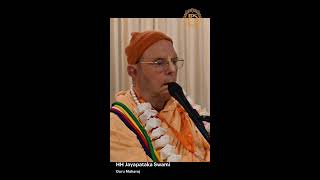
In this devotional lecture, Speaker A, with occasional interjections from Jayapataka Swami, presents a detailed exposition of the Madhuriyaras—50 auspicious bodily marks and lines described in various scriptures—that fully manifest on Śrī Rādhārāṇī. The marks are enumerated on the feet, hands, and palms, each associated with symbolic motifs such as lotus, conch, elephant, and various weapons. The speaker emphasizes that while other divine beings may possess only a fraction of these qualities, Rādhā alone embodies them completely, signifying her supreme spiritual perfection. The lecture then shifts to the classification of the five types of sakhis (companions) of Rādhā—Sakhi, Nityasakhi, Pranasakhi, Priyāsakhi, and Paramapriṣṭhāsakhi—listing principal sakhis within each category, especially the eight foremost paramapriṣṭhāsakhis (e.g., Lalitā, Viśākā, Citra, Champaklatā). The speaker urges listeners to understand and emulate these transcendental qualities in their own devotional service to Krishna, noting the difficulty of serving Krishna and the need to adopt the sakhis’ attributes. The session concludes with brief audience interaction, acknowledgments of devotees from various countries, and an invitation to visit the guru’s book table.
Chapters
Today we'll be reading on the subject matter of Madhuriyaras. Auspicious lines the auspicious signs and lines are described in Varaha, Samhita, Jyoti, Shastra, Kashikanda, Matsya Purana and Garuda Purana. At the base of the large toe of the foot is the mark of Yava Bali Khan. Below that mark is a disk, a lotus at the base of the middle toe, a flag below the lotus and a banner. And then the Urdu Reka line beginning right of the middle toe and extending up to the middle toe of the soul. Elephant goat at the base of the little toe. Further, a conch shell at the base of the big toe, a fish upon the heel an altar thrown at the base of the little toe a chariot above the fish, a mountain circle, mandala, a maze and a shakti symbol like sphere. On the left hand, line of longevity, Paramayurekha. From the junction of the index and middle fingers to the base of the little finger. Another line beginning from the palm and passing through the middle of the index and thumb line starting below the lifeline, extends from the middle or outer side of the palm below the little finger and travels up between the index finger and thumb. And another line rising from the wrist beneath the thumb, curving upwards and joining the middle line between the index and the thumb. Five spiral symbols resembling Nandyavartha at the middle of the fingertips, totally eight lines. An elephant below the ring finger, a horse below the lifeline and a bull below the middle line and below the little finger, an elephant goat plus a fan, a bilver Sri Lakshmi bale fruit tree, a sacrificial post, an arrow, a spear and a mala garland. On the right palm there are three lines of longevity as on the left palm, five conch shell on each fingertips and a yak tail chamara fan below the index finger, an elephant goat beneath a little finger, a palace, a dandupi kettle drum and a thunderbolt, a pair of cards, a bow, a sword and a water pot. Bingara on the left foot are 7, on the right foot are 8, on the left hand are 18. On the right hand are 17. All together there are 50 auspicious marks and lines. Would you like to. Okay. These qualities exist in living entities in the form of minute drops. The goddesses and divine figures. They appear in somewhat greater measure in Sri Radhika. All are present in full form. All of her qualities are transcendental. A Prakrita in Gauri and others. The purity and fullness of these qualities are not there. In Sri Radha alone. Is present the supreme pinnacle of wonder.
Truly amazing.
I mean it's truly amazing that rad Rani has 50 signs that Radharani has 50 signs.
Other devis, They may have a drop like this.
Other Devi or human beings, they may have a drop of this.
Has all these lines and auspices. Lines will he manifest.
But actually Radharani has all these lines and auspicious things fully manifest.
So. It shows that she's completely spiritual.
It shows that she's completely spiritual.
And we should understand that.
And we should understand that Shri Radha's group alone is supreme. Sri Radha's group alone is supreme. The maidens who belong to that group are adorned with all noble qualities. Their playful pastimes constantly attract Sri Madhava. The five types of Sakhis of Sri Radha are Sakhi, Nithya, Sakhi, Prana, Sakhi, Priya Sakhi and Paramaprishta. Sakhi.
Are brilliant.
So different types of sakis are present and.
Shirada group are these five types.
So those who are in Sri Radha's group are five types. Of. So what to say?
They are really transcendental.
They are really transcendental. So Radharani is surrounded by the devotees Gopis with such a qualities, with special qualities. So.
Krishna.
But.
Serving Krishna is not a easy thing.
I mean we want to serve Krishna but serving Krishna is not an easy thing.
All these qualities by.
So all these qualities are held by his intimate devotees.
So he should try to adopt these qualities.
So we should try to adopt these qualities. Shall we? A quotation from. Okay, anyway a quotation from. From the scripture. Renowned are the five types of friendships of the Queen of Vrindavan. Saki, Nithya, Sakhi, Pranasakhi, Priya Sakhi and Parmapreshta Sakhi. These are considered the five fold division. Shri Radha's circle of Sakhi, Kosumika, Vanda and Danishtha are known as Sakhi, Kasturi, Manimanjari and others are Nityasakhi, Sasi, Mukhi, Vasanthi, Lasika and others are Pranasakis. This often attain the very nature. Swarupatha of Vrindavaneshwari, Kurangakshi, Sumadhya, Madana, Lalasa, Kamala, Madhuri, Manjakeshi, Kandarpa, Sundari, Madhavi, Malati, Kamalata and Shashikala are counted among the Priyasakis. Lalita, Vishaka, Chitra, Champaklata, Tungavidya, Induleki, Induleka, Ranga, Devi and Su Devi. These eight are the foremost among all Sakhis and are referred to to as paramapreshta sakis. They being impelled by the supreme pinnacle of Radha Krishna's love, sometimes express greater affection toward Krishna and at other times toward Shiradha. Within each Yuta group, the subgroups are called Gana subgroups.
We are now.
So we all know now Radha Madhava. The Asta sakis with Radha Madhava, they are all paramapreshta sakis. Yeah. Vice versa.
And very special.
So we have Lalita, Champakalata, Chitra and Tungavitya.
And the lake ranga devi, sudevi, ranga devi and sude.
We have vishaka, induleka, ranga devi and sudevi.
So these are all.
These are all parama prama. Shall we continue?
I don't know.
Yeah. I mean.
I'm getting fired.
Okay. Should we end here or. No questions. Any questions? I think they understand. Guru Mach, you are tired. Please bless them. Krishna Matu. Different devotees from different parts of the world. Anyone from the us? Oh, three of them. Okay. Let them come from Australia. Yeah, we have devotees from Australia. From Malaysia. Yeah, we have devotees from Malaysia. Okay. From Delhi. Okay. Hari. Haribo. Also please go and visit Guru Maharaj's physical book table and contribute something.