Lava-Mātra: A Moment with Jayapatākā Swami: HG Mahāmāyā Devī dāsī [ACBSP] #JayapatakaSwamiArchives
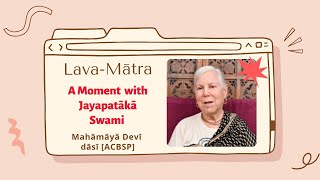
Mahāmāyā Devī dāsī describes joining ISKCON in 1971 at the Boston temple and working on Srila Prabhupada's books using IBM Selectrics. She traveled to India from 1974 to 1976, serving at festivals in Mayapur and Vrindavan, and later became Jayapataka Swami's secretary, managing daily life in the ashram.
My name is Mahamaya David. I am a part time resident of Mayapur and a part time resident in Alachua, Florida.
My story of how I came to.
Krishna consciousness is a little different than most people. And I wish I could say, oh, I read the books, I understood the philosophy and therefore I surrendered, you know, some form of that. It wasn't like that for me. It wasn't like that. So I could just try to be brief. I'm not a brief person. Detail person. I'll try to be brief. So I was born in New York City in Manhattan in 1946. And my parents, even though the hospital I was born in was in Manhattan, they were living in a suburb called White Plains, which is just north of New York City.
And so I would describe my parents as intellectual New York Jews. And my father was a book publisher. He had started his own company when I was. Well, he started after I was born. But he was in book publishing and the company he started specialized in how to books. He started with coin collecting, stamp collecting, chess books, bridge books, and then it expanded out to how to do anything, you know, just how to books. And the only book that anybody's ever heard of that he published is the Guinness Book of World Records. So that was like his thing, you know, he met the authors and we hosted them at our house a few times. They were English twin men who were interested in records and they had written a book that was published in England. It was just a one of book. And I believe it was my father's idea to make it like a yearly book and people could compete and all that. Yeah, he did well with that book until at some point in early, like 1990 or 91, he sold the rights. But that was just like maybe a quarter of his earnings from books and so many other books. So I grew up reading best sellers because he would get gifts from other publishers. And yeah, my family lived in a very big house. But as my father became more affluent, he could have moved to someplace nicer. But fortunately they decided to stay where they were to give us stability so he didn't have to change schools. And that was good because I always felt that rich people were snobs. At least in New York they were. All they cared about was their clothes and what designer made them and wasn't my world at all. So Wade Plains was like a normal, I would call it like a normal city, suburb, suburb of a city. And because my parents are Jewish, it was just like an unwritten law that you have to go to college. There wasn't any question. This is what you did. You have to go to college, you have to get an education is really, really stressful. So I had worked so hard in high school to get really good grades that I just wanted an easy school. And I ended up going to the University of Massachusetts. It was a state school, but in another state. So I was considered an out of state student. And the only difference was that I had to pay more fees. But my father paid for it all. Not a problem. However, after a year and a half, I dropped out and I went with a friend who had flunked out. You know what flunked is, right. She had terrible brains. And then we went to Boston. I was only going to take a break for one semester, but I ended up longer and I tried to make it short. I met a man whose name was Stan, and we got married. And I was only 19 years old. I didn't tell my parents. I knew they wouldn't approve until after we got married. But I had been. I got a job in the publishing world. I was working for a wholesaler, but it was just typing. I mean, it was just secretarial work. But when I got married to Stan, we ended up wanting to go to California because it was 1960. We were hearing about the Summer of Love in San Francisco and it sounded like, you know, exciting, and we wanted to go. By the time we got there, actually, it was already over. I think we probably didn't get there till 1968. But it was in California that I first saw our devotees. And it was near the University of California in Berkeley. Berkeley's a very. I don't know how to describe it. All of the west coast typically got into things before the East Coast. So they were, you know, east coast is considered very, you know, conservative west coast liberal, and all the new things happen and then kind of slowly go east. So Berkeley was definitely one of the hotspots for spiritual revolution or any kind of revolution. So I'm on the streets of Berkeley and I see maybe three or four Brahmacharis, but I didn't know what they were. They were all wearing saffron clothes and they had a ponytail in the back. And they looked like Buddhists to me. And I was a little familiar with Buddhists because that was the time people were setting themselves on fire as a protest against the Vietnam War. And therefore I just. That's all I was familiar with. I thought that's who they were. But then their chanting was like. I didn't know what that was. It was so Attractive. And I remember seeing a woman with a baby stroller and the baby in the stroller, you know, joining the memories. And I was really shocked. Like, wow, women can do this too. But I never talked to them. I just watched, you know, one of the people in the crowd. But it was definitely like all emotions stopped. Time stopped. It was like, something's going on here. I don't know what it is. And, yeah, that was just that maybe they. Maybe somebody did come up to us and try to give us an invitation to a Sunday feast or tell us. Tell us about it. But no, he didn't go for it. So then the next time I saw devotees was in Hawaii. So at this point, I was alone. My husband and I had. We weren't together. I'm not sure what point it was in our relationship, but I was in Hawaii, and there was a Jimi Hendrix concert. I think they were filming a movie called Rainbow Bridge, which never got finished because Jimi Hendrix ended up dying, I think of an overdose or something. But they invited everybody to come into this volcano crater, and he had his bands set up on a stage in there. And so, you know, I would say I was a hippie at that point. And you have to walk up the crater to get inside it. There's no stairs or anything. It's like climbing a mountain. And the whole way up, I could hear the Maha mantra. Yeah, it seemed like everybody who was, you know, people coming up all sides of the crater, that everybody was Chandi Hare Krishna. And when I got inside, I remember they were handing out cookies, but I don't even know who the they is. It might have been ISKCON devotees, but.
Siddhas Roop.
A man called Sai at that time, but later got initiated by Prabhupada as Siddhi Saroop and then even took sannyas from Prophet. He had his followers, and he had, well, at least 50 followers, because 50 joined ISKCON when he did. Yeah, but there might have been more. It probably was there handing out cookies. I understand that he had gotten a hold of Prabhupada's books and he understood about offering prashadam and so many things that he understood. But he didn't tell his followers that these things came from Prabhupada until at one point he just realized he wanted to surrender to Prabhupada. And then he told his followers and they all surrendered, you know, like that. But, yeah, probably was Siddhis people, because they were living on the island of Maui, which is where I was living. So that's really all I remember from that concert was just. That's all that mattered to me was the chanting again. It was, like, so attractive. And at some point I just started chanting Hare Krishna. After the concert, I was chanting Hare Krishna, singing Hare Krishna, just singing. But I did it because it made me feel good. I had no idea what it meant. And. Okay, one more time. I saw them in Maui. Now, these are probably ISKCON devotees, I'm thinking. But they were chanting on a sidewalk, and you had to go between the two lines of devotees to get in to go down the sidewalk. And they were chanting in front of a McDonald's. Now, I actually had been a vegetarian for like a year and a half or a year, I don't know, a significant amount of time. But somehow at that point, I was going into McDonald's. And so I was embarrassed. And especially just to walk between all these devotees. So, you know, it took me a lot of time to get the courage to go in there. Wait a minute. There was another time in Maui, there was another concert with the band called Big Brother and the Holding Company, which was pretty well known at that time. And I had bought a ticket and I was going to go in, but devotees were chanting outside and I didn't want to go in. Finally, I thought, this is crazy. I have a ticket. I'm here to go to the concert. I might as well go in. So I went in, and I don't know how, pretty fast. I said, no, better go outside.
More fun.
I liked it a lot better. So again, I just. Despite all these encounters with devotees, I knew nothing about Krishna's holy name. I mean, I didn't even think of myself as a theist. I thought of myself as agnostic, you know, like, questioning. Because my family was. Even though they were Jewish, they were like atheists, really. They went to the synagogue just to show off their mink coat and diamonds and whatever. But my mother anyway would do that. But, yeah, they didn't believe in God. So I didn't. Until a certain point where it's like, well, maybe, maybe so then I consider myself agnostic. So how I came to the temple was that Stan and I had split up. And, well, it happened, okay, Happened like this. We were in Massachusetts and we wanted to go back to California. So we bought a ticket to ride on somebody's bus. It was like an old school bus. They took out all the seats. And, you know, he was selling the seats by, you know, the way the hippies communicated. Either a newspaper or a bulletin board or something. So there's maybe like eight or nine people bought tickets. And we got as far as Ohio. The bus broke down, and the owner of the bus did not have the money to pay for the repairs. So the bus sat there for three weeks. And as time went on, people left and hitchhiked the rest of the way. And Stan, actually, he had another person friend of his who also had bought a ticket. The two of them decided they were going to hitchhike.
And I didn't want to go.
I don't know why, but I stayed with the bus. And it ended up that I was the only one on the bus. Even the owner was gone. He came back finally and said, I have to go back to Boston, and somehow he was going to get the money. So I don't know how he got a car. But we drove back to Boston, and he was only going to be there, like, three days maybe. And he brought me to a men's dormitory at Northeastern University. It's a big college in Boston. And he went off to get the money or make the money. I didn't ask questions. I don't know. But his friends who I'm staying with were just horrible people, just horrible. And I didn't want to stay there. So I decided I would walk to an old friend of Stan's. Like, they were childhood friends. They were friends from, like, 10, 12 years old. And somehow I knew his address. It was a suburb of Boston. I never looked it up to see how far it was that I walked from Northeastern to the suburb. But I walked. And this was January 3rd, middle of winter. And I didn't have boots. I had moccasins, which are not even proper shoes. And I didn't have a coat. I had a blanket with a slit in it for you. Put it over your head, like poncho. And I had maybe one change of clothes. I was really like, yeah, type of hippie. Okay, So I somehow made it to this friend's house, and he was straight. He wasn't a hippie. He was married and had a couple of kids. And he wasn't there because he was working. His wife was there. And by the time, okay, so the couple's name was Abad and Carol. And by the time Bob came home from work, his wife, okay, found this. A lot of this I found out years later. But she took him aside and said, I don't want her to stay here, John. She needs a place to stay, but I don't want her here. She says, chanting Hare Krishna, you should take her to, you know, The Hare Krishna temple. And they only knew because there was some magazine called Boston After Dark and there had been an article about the Hare Krishna temple and it made it sound like devotees were a rehab center for people on drugs. And I guess I was a little high from taking drugs on New Year's Eve, you know, this is two days later. I thought I was normal, they didn't think I was normal. So she gets Bob to call up the temple, this is on a Sunday night. She calls up and says, I've got a girl here who's one of you, she's Chandi, Hare Krishna. And I read how you're, you know, take people who are high on drugs and will you take her? And they were like, no, we're not a rehab center, that's not what we do. He goes, okay. He hangs up. He tells his wife they won't take her. She goes, no, you have to call them back. No way. She's staying here. They have to take her. So he had to call back. She was insisting and somebody said yes finally. So he kind of tricked me into. I thought I was going to a party. And they lived in a duplex house that they owned and so they lived, you know, either downstairs or upstairs. And the renters, they were friends with their renters and so he convinced one of the renters to come with us. So I was really thinking we're just going to a party. We get to the Hare Krishna temple which was in also a suburb called Alston. So it was maybe like 11 o' clock on Sunday night and the only people up were a few Brahmacharis cleaning up after the Sunday feast. The women were all had taken rest earlier and one devotee brought me into the prasadam room and Bob and his friend went out the front door. They left. So the short version of my, how I became a devotee was that I got left there, you know, dropped at the door.
Hare Krishna temple.
I didn't even know. I didn't even expect it or want it or ask for it or anything. Yeah, yeah. Well it was like this inexplicable attraction to the holy name, you know, that I was chanting. But you know, it wasn't even chanting, just singing. So anyway he, okay, this one devotees name was Kulishekar, he's from England. I think he's left his body now. He preached to me and I didn't understand anything. I pretty much twisted it all in my mind and thought I was Krishna and all the crazy things that people misunderstand. He gave me some Charu Namrata probably left over from the morning. And it did taste like nectar from the gods. My language at the time. He couldn't send me up to the women's ashram because they were all asleep. So my coat, which was, I said, a blanket. I went to sleep in the prasada room in my blanket, wrapped up in my blanket. And at 5:00 or 5:30 after Mangalarti, the women templum was upstairs in that temple and they would come downstairs to the prasadam room after Mangalati and make the garlands for the deities for that day so that they found me when I came to the prasadamu. We would also have class at the same time. It was so weird, but we only had Prabhupada's original Srimad Bhagavatams, which was a little hard to read, a little hard to pronounce the Sanskrit. But our system was one person would read. And since all the women were busy making garlands, then every day one of the men would be assigned to read to us while we made the garlands and the men would have class upstairs. I don't know what the format was, but it probably was just reading. Also. This wasn't till later poppet established the format of us learning, chanting the verse and the format that we know now. There wasn't a lecture or anything, just reading.
So.
There was a young devotee who had joined three, four months before me. When she got initiated, her name became Ananga Manjari and she became what we now would call my Bakhtin leader. She took care of me, made sure I went to Prashada. When time went out on Harinam Sankirtan, whatever we were doing, she looked out for me. And what I remember, what she remembers are two different things. She says I slept for a whole week and didn't even get up to go to the bathroom. She said every time I woke up, she would stuff burfi in my mouth. Okay, probably what she's saying is true, but what I don't remember. What I remember is that the very first day they were going on Harinam Sankirtan in Harvard Square, or maybe it was Boston Commons, but somewhere where there was greenery. And he would stand on the corner somewhere and chant. And to make me look different than the other devotees, they gave me a donated sari. Everybody else was wearing either saffron or yellow. Yeah, the Krihas wore yellow and the Brahmachinis wore saffron. And they were just lengths of cloth, like they buy a big bolt of Cotton I'm not even sure if it's 100% cotton might have been like half synthetic but we would just chop off.
You know, six yarns and sasara.
We also shared all of the other clothing the blouses and the slips and socks and everything I was given a sleeping bag and a coat and some boots but it was like. Well we used to call it the surrender closet where if people didn't want something they'd put it in there and then if you needed something you'd go and just take what you needed so everything was provided and yeah, all I remember is going out on Zangratan and then this the man who owned the.
Bus.
I guess I had told the boys at that northeastern dormitory room where I was going and they tracked me down at the Hare Krishna temple and I must have given him Bob's address or something and then he told me he had brought me there by the way he kept on coming back to check on me like if I wasn't happy there he was totally ready to take me out and the Doherty's could feel that too so whenever he would come to see me they would have.
Somebody there to make sure he didn't kidnap me.
They were also concerned that I looked about 14 years old but I was.
19 so I just always look young and also being small it adds to.
Looking young but he was really sweet to make sure I was happy Anyway, when this man came said it's time.
To go to California I didn't know.
If I should I was tempted to go, I wanted to go and I was thinking this is so nice here I'll go to the Hare Krishna temple there but let me get to California.
So one day when I'm thinking about this I'm walking either up or down the stairs and I see our temple.
Commander whose name was Sridayananda Das Brahmacharya and he's just being nice like temple.
Commander would with a new devotee and just saying how are you doing?
Is everything okay?
And I just blurted out my story.
That I'm going to go to California and he said to me and what.
I remember from know 52 years ago he said you really should stay here.
And get fixed up in Ka Consciousness this was the term, right?
This is like, you know, we didn't talk like that outside the Hare Krishna temple to get fixed up, you know.
But yeah, get fixed up first and.
Then if you want to travel you can go all over the world but you'll bring your Ka Consciousness with you so this made good Sense to me. And I just decided I would stay.
And I let that ride go and stayed in Boston.
Now, I wasn't, like, committed because when I learned the four regulative principles, I was like, I can't do that. No way.
But then I thought, well, I've been doing it.
Like, they didn't tell me immediately, maybe after a week or something. So, well, if I stay here, I can do it, you know, because I'm.
Not around people taking drugs. And, you know, I like the prado. I did find the doll very hot, spicy. I wasn't used to it. It took me a long time to get used to dal. But who doesn't like prashada, right?
That's so wonderful.
So, yeah, if I stay here, I can follow it. So it didn't become a problem. I didn't quite understand who the guru was. I misunderstood a lot. But one day I saw a poster of Srila Prabhupada because he had been to Boston in 1969. He hadn't been back in that. This was January of 71. Everyone was saying, prabhupada is in India and he's coming back any day, we hope, very soon. But it actually was six months before he came. So I don't have a good ear for all these Sanskrit words. I need to see. I'm more of a visual person. So one day I'm looking at the poster and seeing Prabhupda's name and then realizing, oh, that's the word. When they talk about the guru. That's who this is. It took a lot to put it together, but I finally did. Okay, I'll tell you the embarrassing part of it. Because Jadharani was the temple president's wife, because Satsaroop Das Adhikari was the temple president. Actually, he was out of town when I came to the temple. And I'm maybe week or something after I was there, he came back and he was the one that's like, she looks underage. You better check this out, you know? But Jatarani was always preaching to me, and she was more my teacher where Ananga Marjari was my buddy, you know? And, I mean, Ananga taught me lots of things too, but Janaray was always preaching. And I actually, for a while, I thought, she must be the guru. That must be who they're talking about. These were doing the binding or they sent it out. But those early books, they fell apart at the binding. Yeah. So, yeah, our main. Our main service was chanting during Sankirtan. And it wasn't That I remember, like morning to night. But it was. It took going somewhere to find the kind of crowds that we wanted because around the temple there wasn't people just on the streets. So we'd have to pile in the van or take the public transportation to get to either Boston Commons or, like, say, Harvard Square. We had to go some distance. And it wasn't all day. Like, some devotees I know, like, seem to go out from morning to night. So there was definitely time to do service. And I told them that I could proofread. And this was a stretch in that I had gone to my father's office many times, even worked for him one whole summer. And the type of proofreading was using two people. One person's reading out loud from one manuscript and the editor is reading the galleys, the printout from the printer. Maybe it was the other way around, but it was two people proofreading. Whereas in our ISKCON books, you're just meant to read it and find the mistakes. Anyway, the first thing they did was give me a copy of Easy Journey to Other Planets. They said, we need to reprint this and we know there's a mistake, a big mistake, obvious mistake, but we don't know where it is, so find it. So I had to read. And that was a really good introduction book because instead of Prabhupada wasn't using the word spiritual, he was writing for the audience of scientists and materialists. So he was using the words matter and anti matter. And it was like down to earth, you know, very down to earth book. But it's still a totally esoteric subject. I mean, the COVID the original cover was Narada Mooney chanting on beads, flying through the universe. You know, see the planets, great cover. They change it, though. But yes, by the time I found that mistake, I finished the book and then, you know, what else can I read? And so the Bhagavad Gita at that time was the abridged edition. So it was the purpley cover, it was a soft back. And abridged mean that many of the purports were either reduced or taken out entirely. And you know, Prabhupada wasn't happy with that. I know, because we. He wanted the full copy. And I'm not sure when it was that. Ramananda Swami got macmillan to agree. You know, I know his whole story, how he got them to print the McMillan version. So I got to, okay, I'm getting a little ahead of myself after proofreading that. Then they asked me if I wanted to Learn typesetting. So typesetting was a very complicated but yet simple way of composing what we call it.
Composing.
Composing pompous books.
It was.
And it was like a typewriter, but we had diacritic marks that were. Okay, you want all this kind of detail.
There's a. The old fashioned typewriter had like arms and the print was at the end of the arm and you pushed a button and the arm would move.
But then at some point they came.
Up in the 1960s, they came up with IBM Selectric, the IBM company. It was a ball and it would spin around. It was an electric typewriter. So when you push the button, it would make the ball spin around and all the letters were on that ball and it would just go. It would go back and forth across the page. Just spinning to catch letters.
Yeah.
So we had special. These IBM Selectric balls that had the diacritics on them. But then we also have italic, a lot of italic. In Prabhupada's books, it's all the Sanskrit, you know, it's all in italics and italics is at an angle. So then the diacritics don't work. So he had to have a special font. The little things are called fonts. That's right. I mean, font is used now in a different way.
Right.
But that little thing was called. So we had to have an italic font, a regular font, and then on a separate font, you know, the diacritics. So sometimes we had to type a line four times. It was, it was like difficult. And if we made a mistake, we had to. If we made too many mistakes on a page, I think the limit was something like nine mistakes. We had more than that. We had to retype the whole page. In the beginning anyway.
They signed me unselectric. It was.
A composer would measure the line and space out the words on each line. So they all ended up. The left and right margins are straight. So it's like. It wasn't hard once you learned it.
But.
You know, compared to like nowadays, it was, you know, slow and grueling and so on. Yeah, so. But it was exhilarating because we were doing this for Prabhupada and there was regular letters to Srila Prabhupada about the progress of the books and, you know, any questions they had, if the artists had questions. And I remember there was a letter which I've never been able to find since where somebody had told them who was composing. And so when I think in some letter it said something like Referring to me by my Cardi name. But the main thing that I remember, he said to the composers, he said, tell the composers to slow down because we'd make so many mistakes. And then the mistakes would have to be. Literally, paper had to be cut out and pasted over the mistake. Yeah, this was. It was such a long, detailed process. And in the end, you have these big boards with two pages of a book, and then they'd have to take a photograph of it. Then they'd have to touch up the photograph because. Because sometimes little things would happen. And it wasn't clean, so we had to touch it up. And it was quite an ordeal to type Prabhupada's books. But we were connected to Prabhupada. I mean, it was. We just especially. Okay, we were doing Back to Godhead, which is every month, but mainly we were working on Srimadvgatam. And okay, no, this was 71. We were working on Bhagavad Gita. Right. We were working on McMillan Bogita. So I worked on the last three chapters. So all that had been done before I got there. And yeah, it was. Yeah, okay. I wasn't distributing Papa's books, but I was helping him make them. And we weren't even. We weren't trained up how to distribute books. We were distributing back to Godhead. That was it. That's all the books we distributed on Sankirtana. And they were 25 cents.
Yeah.
You know, people could afford it. Because there was another time later that I was composing and it was Srimad Bhagavatam and. And we started Caitanya Characharmita also. So confusing. But anyway, since 71, I.
Was back.
To Goddess and Bhagavad Gita. There was a short period of time before I was typesetting that I was the temple secretary and would type letters for Satsuru Dasadikari. Anyway, that's not long enough to scrub in Arabic. Yeah, I kept on changing temples. So I was only in Boston for, I think, three months. Three months. And then ISKCON Press started moving to New York, and the typesetters were the first to go. And they didn't even have us ready. They had rented or bought a building that was a bit of a walk from the Brooklyn Temple, Henry Street Temple. And they were renovating it. So they weren't quite ready for us, but they put us in the sub basement of the Brooklyn Temple. So in others, there was basement and there was a window at the. In the basement, there was a window at the top of the wall, but the sub basement was below that. No windows, that's where the washing machines were. And I don't remember what else. Storage maybe. And they set up the composers behind the washer and dryers in this like cage like room. But we were, you know, able to go ahead, keep up our service. And then when Tiffany Place was the name of the building, I mean the building was on Tiffany Place that we moved ISKCON Press there. And we had a lot of room for all the devotees, photographers, the.
Composing, the editors, layout people, everybody, everybody was there. And yeah, that was a pretty nice setup. Eventually in 1975 they moved ISKCON Press to California and that's when it became a VBT. But okay, time to jump to 1975. And like I said, I move temples a lot of times, a lot of different reasons. But I was back in New York in 74 was the first advertised international gore pruning festival. There was festivals here in Mayapur, but they weren't advertised. And I mean nobody went. But 74 was the first one and probably like 200 devotees went, which was like, whoa, 200 devotees. I wanted to go so badly, but I couldn't go. So then I had my heart sent on going the next year 75, and they let me stop. So again I was typesetting and they let me, they said I could go, but I couldn't stop typesetting because Prabhupada was way ahead of us as far as the translations. He was like books and books ahead of us. And so we. So I was told, okay, look, you can go to India, but other devotees are going to collect the money and you just keep on doing your service. So that was the arrangement. And yeah, at that time it cost maybe $700 round trip to go. And also we all went as a group. It was unheard of to go on your own. Like that was impossible as far as we were concerned. You know, we had to go in a group and yeah, it was a group from New York and devotees flew in from other parts of the country and joined us in New York. And then we flew to London and more devotees on the same flight. And then if we stopped somewhere else, I don't remember. But then we landed in Bombay. Well, it was called Bombay then. That was the first view of India was the airport and the slow moving fans, you know, that was like. That epitomizes India, you know, doesn't do any good. You know, the fans are so high and they're moving so slow. I think we had a Chartered plane from Bombay to Calcutta because I don't think that they had any international flights into Calcutta at that time. I could be wrong. My memory is not what it used to be. But I think other devotees from Europe joined us. So we filled the whole plane. I don't remember really. I just know we stopped in Babe and then we went to Calcutta and yeah, they hired buses to pick us up at the airport. Got our first taste of poverty on a level we never saw before with children begging for food. And we had a long wait in the buses, everybody. One of the children had somehow gotten his leg caught in the conveyor belt. The luggage conveyor belt had hurt himself. So we were delayed a while to that. So all the local kids somehow found our bus in the parking lot.
And.
We had packets of prashadam. Somehow we had. Somebody in Bombay must have given us prashadam for that last part or something. I don't know. Maybe it was just food from the airplane. Whatever it was we were giving the kids and therefore they didn't go away. But I just remember that bus ride. When we started getting away from the city and Bengal, this was like February, you know, because like Gorfurnem is always, you know, moving around because of the lunar calendar. So it was like end of February and it was just so green and lush and the banana trees and we'd see these pukhors everywhere and people would wash the clothes. The pukurns place spread them out. I mean, you know, this is totally new, new way of living. And it just seemed like just when I was a hippie, this is what I had been dreaming of, you know, like simple living. I mean Prabhupada had the slogans high thinking, simple living. And yeah, we're just looking out the bus window, see what Bengali life was like. And by the time we got to Mayapur, I just was in love with India and just. Yeah, as soon as I got here I was like, I don't want to leave in three weeks or five weeks.
It was a five week festival. But I just knew this was it.
You know, I want to stay here longer. And my Apor was pretty simple in those days. There was.
The front gate was not.
I don't even think the construction had.
Been there was there yet.
Maybe, maybe something.
I mean there was a gate but. And the Bhajan Kutir Prabhupada's Bhajan Kutti was there. He wasn't living in the Bhajan Kutir, he was living in the Lotus building.
So The Lotus building was the only real building. The boundary wall was up.
And where there now are stores, those are all living space. Those were rooms the devotees stayed in.
The men stayed in those rooms.
And as far as I remember, the gurukula was also very near the front gate. Okay. When you come in the front gates to the left, they were in those rows. And there was some kind of a.
Toilet thing set up.
And the water was the water pump. That was the only source of water was the pump. The big kitchen was there, what we call the Sulab kitchen. It's the big kitchen. So the kitchen was actually like a. Built around a courtyard. And the cooks were downstairs. Upstairs above the kitchen is where the women stayed and the roof. So we had the rooms above the kitchen, which were, needless to say, hot, especially over the kitchen. I mean, they were, you know, wood stoves. That's how they cook with wood stoves really creates a lot of heat. Most of the guests were staying on the roof, you know, because it was cooler.
It was cooler.
So.
Then.
But that end of the boundary wall was. The Bengali women and their kids were in those rooms right near the big kitchen. So the big kitchen was one building and connected to the big prasadam hole.
Okay, so.
And both of those together we called the big kitchen. Right. And that was the only source of prasadam. That was it. There was no way to get prasadam except Maha Prashadam. But there was no stores outside the front gate. Maybe one or two tish stalls and usually one or two rickshaw wallas, bicycle rickshaws. But yeah, during the festival, a little more was happening outside the gate. You know, four or five tea stalls, four or five rickshaw wallows. But there was no place to buy anything to eat, nothing. So that was it that, you know, when Pushadim was called, you're going to be there. And also, you know, the way they served, you know, everybody sitting in rows and then people with buckets coming down the row and serving prasadam. And I don't think we did it quite like that in America. We did sit on the floor. We did use sometimes not even real plates, just use, you know, what they call it, wax paper or a plate. But, you know, we were using banana leaves. The source of drinking water was the pump. Yeah, no such thing as bottled water in those years. And so that festival was maybe 400 devotees. Yeah, that doubled from the year before. The people who came back from the one in 74 had given us advice like don't eat too much, because that's sure Fire way to get sick. And still so many people got dysentery. Probably was from the water. You know, it wasn't really the food, but eating made it worse. And then even some people got malaria. And yeah, there was a lot of sickness. It was. You had to be pretty tough to handle it. But our parikumas were really, really sweet. But we never stayed out overnight. We'd just go somewhere for the day and come back and we'd either take boats down the Ganga or buses. And to get to the. You get to the Ganga, there was just a lot of fields of crops and the Ganga was pretty far away. This isn't close the way it is today. Yeah, it's really far. And you had to walk through these fields and you know how like there's a raised portion between the fields so it's not wet because it was rice growing. It's like a little narrow path. Anyway, we get to the Ganga somehow. And that was usually a big cliff to get down to the Ganga.
Yeah.
Anyway, but you know, we were there because Prabhupada came and. Right. I don't, I don't know how much I was aware of the co directors of Mayapur at the time, but I think I knew who they were, but it was Jayapataka Maharaj and Bhavananda Swami. So, yeah, I can't say that I remember much about those parikramas, but I knew that I really loved Mayapur. And there was a devotee from Vrindavan Western. I'm an American lady who had been living in Vrindavan and she was hearing me say how much I love Mayapur. And she goes, oh, if you love Mayapur, wait till you go to Vrindavan. You're going to like it even more, you know. And I was like, okay. But, you know, anyway, that, that particular Gorpani festival, that's when 150 of us went down to Hyderabad and I got to be one of them and everybody.
Else went on to Vrindavan and we went, you know, Prabhupada flew to Hyderabad and we took a train and that was fun and the whole experience in itself. And then, yeah, in Hyderabad we inaugurated a train station. And I remember seeing people like walking in paths from all directions and we fed them all prashadam. There was just a tiny farm community in, well, the city of Hyderabad had a temple, Radha Madhavana, I think their names are. But there was also a farm community. And that's. It was out near there that this train station got inaugurated and we were part of it and fed all these devotees. That was amazing. And then we went to Vrindavan and I knew I was off the track. Here in Vrindavan is when Krishnavalaram were going to be installed on Ram Nomi Day. And anyway, there was a point I was going to make. I forgot. So that was an amazing experience because, you know, Prabhupada's view was the chanting of Hare Ka was all you needed to install deities. But he very well knew that the Goswamis, the pandits in Vrindavan, they're very, very particular. And it had to be done to their standards so that, you know, they. Because already they were calling it the Baadeshi temple, you know, the Westerners temple and that. You know, we were just militias and all that. And, you know, Prabhupada wanted our temple and the deities accepted. So he hired maybe to be, not pick out just one special person in Vrindavan. He got, from what I understand, he got South Indian Brahmins to come. I just remember their big bellies and chanting mantras and, you know, and, you know, as many days there's so many ceremonies and, you know, opening their eyes and this and, you know, like so much going on. And throughout, Prabhupada just kept on telling us to chant. There was one lecture that somebody from the Gaudiya Mat, Prabhupada gave them the floor to say something and somebody was heavily criticizing us, but it was all in Hindi. So we didn't know. And we just. Prabhupada just kept on encouraging us. Just keep chanting, keep chanting. But he was saying something like, okay, this is why I see it now. Like, don't pay attention to what they're saying. Just keep chanting. But we couldn't understand anyway. So Most of us, 99.9% of us didn't understand Hindi. So, yeah, he had a different, more broad understanding, which he didn't make up. He got it from Bhakti Siddhanta, Stara Swatik Thakura, understanding who is actually a Vaishnava. And it wasn't by birth. And so even though he preached that it was not by birth, that was just, I guess, so deep in some people's psyche that they couldn't let it go. And thank goodness that Prabhupada really understood otherwise. How could he have spread Krishna consciousness around the world? He had to see that we were all potential devotees. That were all not potential devotees. We are devotees and there's a covering over us and so we can learn to be Devotees. So, yeah, that first Aarti, that Prabhupada we've seen pictures of. Prabhupada's offering to Krishna Balaram was really amazing. Yeah, I know. There was something connected to Jaikatamraj I wanted to say, but I can't remember. But anyway, so I kind of. Oh, yeah, maybe the completion of the story about when you get to Vrindavan, you're gonna like it even more. No way. Not that I disliked Vrindavan, but it was completely different than Mayapur. This part of Mayapur is just the ambience of, you know, the farm community, as opposed to. Okay, Vrindavan temple was outside of Vrindavan, like the city. I mean, it really was. There was nothing pretty much between our temple and. And Louis Bazaar practically, you know, but it still was a little plot of land which is, you know, devotees were staying down the road in Fogalashram, and it was just a different experience. And the intensity of Vrindavan is so different than Lord Caitanya's home is like, mellow. So I like the mellow, you know. So I asked.
To stay in India instead of going back to America.
Now, that was really a big ask because had they mean. ISKCON Press had bought a new type of composing machine, and Ragatmaka and I were the first ones to get training. Actually, it was Jaya Dwaiteswamy who went to this company. I think he probably was the one.
To make the decision on buying this equipment. And he learned how to use it.
And he learned how to make diacritics.
Worked with the company to take a.
Period and be able to put it.
Under an N or. Or centered under an M. Or take.
The hyphen, not hyphen, the S. What's it called?
The slash, and make it, you know, go over the S or, you know, like all these details in writing Sanskrit.
So he had to go into Manhattan.
To work with his company.
And then Bragatmika and I were the.
Ones who then learned to use it.
Actually, Bragatmika recently had to apologize to me that somehow she had it in.
Her brain that it was a different devotee who had been the first to go and learn with her and everything. And she was interviewed recently, and still, even though we had talked and she realized, oh, that was you, wasn't it? It wasn't Balaj, but she still. She did a memory thing like this, and she still said it was Bali. I'm setting the record straight. Raghavnika and I are the ones who learned. And then later, Valai who's a senior devotee to me. She's one of the first in 26 Second Avenue. She's one of the first women. She had learned a bit from me, so that when I went to India for the festival, she took over, but she wasn't confident, she wasn't experienced. I. This machine, it was called a Redactron. It was like. It was something towards a computer, but not a computer. Yeah, we would be with type and would come out on a little window of type. We could see what we wrote, and we were able to correct it if we just backed up enough times and then redid it. So that was a big thing, because the other way, there was no way of correcting mistakes except, you know, pasting it. So in the end, this little strip ended up in an airtight box. And then we take the box into. Into a dark room and develop it with chemicals.
It would go through different.
Like a photograph would be. You know, it goes through this bath and that bath, and then the print would come out. So it would end up in these long strips. It would be one long, long piece of paper. And if there still were mistakes, we had to paste them on still. But we could correct it as it was happening. So that was. That was big. Yeah, but it was like learning HTML, you know, the computer language. Like, you had to give all kinds. You have to be able to learn all these commands. You know, it'd be like two or three strokes, and it meant, okay, change to italic type. And then same thing at the end of an italic word, then a code was codes of three or four letters which meant end italic, you know, or, you know. Yeah, it was a little complicated, but in a way easier, in a sense than the first machine. And then, of course, sometime after that, they got actual computers, but they used Redactron for a while. And I don't even know.
What it.
Was called, but maybe had the word tape in it because, you know, everything ended up on a tape anyway. So I had to get permission to stay in India. And the person I had to talk to was Ramaswar Swami, because that's. This was the festival of 1975. When it was at that festival, I think that they decided they were going to move its contrast to California. It really was that they were going to put Rameshwar in charge. And he's like, if I'm in charge, they have to come to me because I'm in California and I'm not going to New York. They have to come to me because the new York Temple was gonna move or something, whatever. So anyway, that's why they moved to California because he is in charge and had to be there. And he didn't know me at all and he didn't even know anything about book publishing. So he didn't know my service and he didn't ask the devotees who I was working under, you know, and I bluffed my way and said, balai, she's good at composing. She can take over from me. And he said, india, how is he gonna ask Balai, is this, you know, like, are you okay? No, he just. On my word, he agreed and I stayed in India.
And.
It was that summer that they had that big marathon, you know, and here there was like two people. Well, maybe when they moved, one or two more people did learn how to use the redactor. But here I was all trained up and I was willing to do it. And it was always problems with our visas.
So, yeah, I had to go back and get a new visa because I only had a three month visa and I could only extend it like one or two months. So I go back to New York and I tell the temple president there that I'm willing to go help with a marathon. And the craziest thing happened is that the devotee who had been in charge of me was pretty upset with me still. And he was like, no, I don't want her. So many years later, I see Ramash Parasvami and I, well, he's not swami anymore, but it's kind of recent years. I saw him and I told him what had happened. He was like, oh my God, if I had known that you were willing to come. I was told there was nobody else. Yeah, he, you know, they never consulted with him. So I just accepted that, you know, they didn't want my help, they didn't need my help.
Of course, when I hear the stories.
Now, like they were composing 24 7, that means, you know, like the herculean tasks that these devotees performed was like incredible. You know, that could have. I could have helped. But anyway, that gave me the opportunity to go back to India. I mean, who knows what would have happened if things had been different. But that's what happened. So I just made plans to go back to India. And I was only in New York like six weeks. I had caught jaundice. So I was recovering from that. And then I went out on the pick, selling incense one stick at a time to collect the money to go back. And that's a whole story itself. But anyway, I got back to India and landed in Delhi. And should I just skip to Vrindavan to Mayapur, Because. Okay, just quickly. I was in Vrindavan. I ended up being able to take. Type up Prabhupada's letters, which is really ecstatic. And then I ended up going to Ahmedabad on the same plane as Prabhupada and his servants. You know, three or four men. And there was a big pandal program there. There wasn't even a temple in Ahmedabad, but they were like, they had a pandal program and thousands of people came. It was unbelievable. And it was going so good that. And Prabhupada had to leave because he was. Had plans to go to Africa. And he told the devotees to keep it going even after he was there. And we even had to change location, and still it kept on going for like another five days or a week. Yeah, that was incredible. So it was mainly Bombay devotees. They were all Bombay devotees who had put on that Ahmedabad pandal program. So I went to Bombay with them. Actually, it was Gopal Krishna Maharaj was GVC for all of India, as far as I remember. And so he was the one that I was dealing with and making arrangements where to stay. Like I could stay. And actually he wanted me to be his secretary. He wanted me. Now, what he didn't know was that I don't know shorthand, and he thought I did. I could use a Dictaphone if he, you know, spoke into a Dictaphone. But he wanted somebody could just take notes and then type it. So he kind of was disappointed that he, you know, he didn't really want.
Me as his secretary.
So anyway, he let me stay in Vrindavan, and then he let, you know, like, I got his permission, but I.
Just was moving around, but with permission.
Went to the Ahmedabad program and then went to Bombay. And Bombay was at that time Prabhupada had one of the new temples started, but it was just a big hole that was filled with water, I think, because they dug down and then water came up. Sometimes that will happen. And, you know, they were kind of stuck with not knowing how to deal with it at that point. And so there was maybe seven, eight Western women in Bombay. And we did all the deity worship. All the deity worship.
I mean, maybe, okay, one or two.
Men did a little something, but mainly it was, you know, it was women and. Oh, okay, I forgot to say that in Ahmedabad, they had brought. Get this, they had brought the little deities off the altar in Bombay to be the presiding deities at the Pan Dal program, which Is like unheard of.
Now, you know, little Radha Rasa Vihari.
Anyway, one devotee had been their Pujari.
Aditya and she had.
When Prabhupada left the pandal program, then.
Giriraj, who's now Swami and Aditya was his secretary. So they had to go back to Bombay. Prabhupada was going there and then going to af. So they, you know, a bunch of devotees left, but the pandan went on and I got to take care of the little deities. That was ecstatic. And we were staying in a life member's house. Anyway, there's all those details. But the point is in Pandy, His Holiness Jaipatta Swami came there wanting more devotees to come to Mayapur. He needed help. He was shorthanded and Bombay had so many devotees and he wanted. He had a whole list. I need somebody to do this and do that and do the other thing. And you know, one was a teacher and one was secretary. And he walked. I don't remember what else. I remember those two. So I wanted to go, I'd be the secretary. But there was another devotee who had been in Bombay longer than me and had first choice or at least a priority over me. And she was a teacher or said she would be a teacher. And so they said she would go to Mayapur. So I was a little disappointed. A few days later, guess what? She changed her mind. So then I got to go and Jai Patakkumaraj, as far as I remember, he gave me the money to take the train to Mayapur. Probably like second class with all the sheep and the cattle and whatever. And I got to Calcutta and I hooked up with Krishna Rupa. She was in Calcutta buying cloth for sewing for the deities.
And.
Yeah, I went back to Mayapur with her. So she was staying, you know, the women's ashram above the big kitchen. And there was six women including me. There was Vrindavan Biarrini who was married to Annika Dundavi. They stood out because they were like extremely tall devotees. They were both from South Africa. Did you know Vrindava Devini?
Yeah, yeah, yeah, yeah.
This is before she had kids. And there was a devotee from Germany named Khan Devasi. And at some point her 8 year old daughter came and was living in Mayapur. And she also had a son who was in Dallas Gurukula. Her daughter also had gone to Dallas Gurukula. Anyway, then there was two devotees from the uk, Swati and Kamaduk. Kamaduk is from Scotland.
Swati.
There's many pictures of her son Shivajwara, who's offering a flower or something to Prabhupada. Prabhupada is sitting on the grass on a cushion. And the pictures of this little kid, that's Swati's son.
And then some of those pictures.
She's in the background of the picture, you know. And then Kamaduk is the sister of Nishringa Maharash who preaches in the Far East. He comes here for the Gorpunim festival of the year. Yeah.
Then.
Okay, so that's it. Swati, Kamadu, Kandabasi, Vadava, Birini Krishna, Rupa and me. That's who was living here. A couple of other American ladies came and stayed for a month or two. But like Madri, who was married to Tamal Krishna Maharaj.
And she was there. And also Daivi Shakti was there for maybe a month at one point. She started all kinds of things and then left. Yeah, like, raised the bar, you know, like at Tulsi and other things. Anyway, so I forgot to mention that the women's bathroom was not in the astronaut. It was a round bathroom. That the outer doors were men toilets. And I guess. I guess it was just toilets because they just took a bath at the pump. And then there was an inner entrance. And in the inner circle there was two pumps, typically, one of which was always broken. And then doors which led to little cubicles for bathing and toilets. And the only way to flush them was water from the pump. Okay, I'm telling you this because there's a pastime, there's many pastimes of Prabhupada's morning walks. But he went to that, you know, the toilets and the bathroom. And, okay, he opened the doors and was completely upset that there would be stool all over. Like there's standing Indian type toilets. And then there was just, you know, there was stool maybe in the toilet, but also all around. And we understood that these, the Bengali devotees, the population of Mayapur was maybe 125, 100 of which were Bengalis and mostly Bangladesh refugees. And maybe 20 men. And like I said, six women, 20 Western men, six Western women, 100 Bengalis. So they are used to passing stool in the fields. And so the concept of this is the only place to pass duel, it just. It was all new to them. So maybe the adults could figure it out, but the kids couldn't. So the women, we just took care of two of the toilets. We locked the doors and we had keys and we kept them clean. And we just Let them do whatever they wanted at the other. But when Prabhupada saw this, the men's.
Alley is the women's bathroom.
Yeah. I think it's even in the Leland region.
And they just totally blamed us, you.
Know, and anyway, I just wanted to explain what happened. I mean, I guess our fault was not figuring out how to train these devotees are. I mean, it just seemed like an impossible thing to do. So we didn't try anyway. Hare Krishna. But Papa's.
Morning walk, first of all.
Okay, let me explain a little more about Lindford.
There was no guests.
Like, none. Like, for a guest to come was a big, big deal, you know, if a guest. And it wouldn't ever be just one person.
Right.
It'd be family, you know, and so if a family came, problem would have us go to the kitchen and make prashadam for them. You know, it wasn't like phones were working and they could call ahead.
We had phones, but the phone conversation.
Would be like this.
Someone yelling at the top of their lungs, I can't hear you. That was it, you know, and there was one phone in the Lotus building. You know, I think it's kind of where Jeff Takaraj is. Elevator is now was like in a stairwell, kind of behind the stairwell. So you could hear people on the.
Phone, you know, but.
Yeah, people would just turn up.
And then it was typically what Prabhupada.
Wanted us to make was potato subji and poris. Yeah. And then he would have us saving maha sweets and saving some savories that keep nicely. So Vrindava Birini was cooking the last offering, which was. I don't know if it's still like this, but it was offered at 8:15 at night and she would start at.
3 o' clock in the afternoon.
This is the biggest offering of the day.
Bigger than.
Raj Bog. It was the biggest offering. And I know a lot about it because after a while I started helping her. Not initially, but anyway, I just know it was the biggest offering.
And where was I talking about the last offering?
It's going in all directions. Anyway, we're saving some prashant for prabhupada from this offering. Yeah, yeah, that's it. Thank you.
Thank you. Yeah.
So she would cook not puris at night and not even rice, which is unbelievable. I mean, I don't know why, but.
We make a lot of sabjis, chutneys, savories.
We have made two plates with these. One salty and one sweet. We make six sweets, two of them from milk, two of the milk, sweets, everything else, other kinds of sweets.
And so we would say.
And we would make nimkes every day as a savory. But we'd make other savories too. But nimkes, you know, the little triangle with ajwan and, you know, some other. And yeah. What's that other spice called? Kalajir. Yeah, exactly. So those would keep for a long time. And they would, you know, they condensed, even though they're very flaky. Would save those. Would save. Would save the Sandesh for prabhupada to eat early in the morning when he was translating, he wanted a little snack every day. Would save the Sandesh. But like I said, we'd make other milk sweet. So would save whatever could keep, you know. And then when guests come, we would have things, special things like that. But it was basically the, you know, potatoes and puris. And it's always the same recipe. You know, you boil the potatoes until they're completely soft. You peel them and you make chance and throw it in and, you know, I mean, it's very fast. Once Shane sauce and make poris, and.
They'D make it in big quantity. But if people were really in a hurry and they couldn't stay to wait for the prashadam, he would tell us, just go in the kitchen and get fruit. And it was already offered. No, because Krishna's good dinners. Yeah. So Mayapur, basically, I'm trying to say Mayapur was very peaceful and quiet. One of the things that the Bengali men did was make saris and gumptas, but they would work the looms. Okay. There was another building I didn't mention. Like, when you come in the front gate, you know, the opposite. Okay. To the left is the Bajan kuttia, but to the right was a building that was, for some reason, like a flight up. Like, the stairs are on the outside of the building. And then there was, like, a room where there was two looms, and then there's other looms in the boundary wall because they weren't all full of people, you know, living space. And that's the main thing that the men were working the looms and the women were running the kitchen. Yeah. So they were very.
The actor.
Jesus. All men. They would not allow the women on the altar. But we could sew and we can make garlands. Yeah. And women also pick the flowers. And always. I know, till today, they pick the flowers early in the morning and make the garlands in the morning. Yeah. So, yeah, those saris that the men Made. They would sell them to the devotees when they come to the festival. And when I tried to convince them to make saris like my size, they wouldn't. They absolutely wouldn't. Like, no. American women are big. I'm an American woman. I'm not big. But they didn't care. To this day, they will make all the skirts the same size. Really big, tall women anyway. But some of the. Okay, there's one. There's one story about the flowers that is on Prabhupada Memories. So I guess I shouldn't repeat that. Okay, well, it's just that the little girls, like we're Talking about, like 10, 11, 12, they were just as proficient as any of the adult women in making flower garlands and everything. They were. Yeah. Excellent. And we would take petals that left over and sprink them on. Or the kids would sprinkle them on Prabhupada's shoes. So when he would come down from his room on the second floor, come into the temple, because the temple was the whole first floor, the Lotus building. So he'd leave his shoes by the door, and then the girls would go and put petals. So when he put them on, he'd have petals on his shoes. So then one day they decided to just have some fun with Srila Prabhad. And they. They made little garlands, true, little garlands with the petals. And they tied the little garland around the toe of his shoe. So when he put on his shoes, he saw the petals there. He started to walk and the petals didn't move. So the little girls told us to be there at the door when Prabhupada left the temple because, you know, we were in on the joke of what they had done.
So we're all there watching him, and.
He looks down at his foot and he shakes his foot and the petals don't move. And then he looks at his other foot shakes, and the girls just are cracking up and they think it's so funny.
And Prabhupada was laughing right with us.
Oh, yeah, he totally had a sense of humor. Yeah, that was really fun. But Prabhupada, what I remember is, okay, so I had come here in November of 1975, and to stay, like when.
Jayapa Jagan Maharaj asked me to come be his secretary.
So I had come here in November.
I was his secretary. My office was the veranda. And, you know, I had brought a manual typewriter because I knew I couldn't depend on electricity. And the plug is different and everything. Yeah, it was Very heavy manual because it was really good quality.
And.
I would just, it had a hard box carry box and so I would take the typewriter out and put it on top of the box and just sit there cross legged and type on the veranda and probably on the first floor of the veranda, you know the big conference room on the first floor veranda. That was the GBC room. Yeah, that's what the GBC met. So I probably was on. I don't remember which random front or back but. But I also had a tape recorder and Jaipatak Maharaj would tape his letters and I would transcribe on my tape recorder. You know really I needed a Dictaphone but didn't have one. So I kind of wore out my, you know, pressing the button so many times to catch every word. He wrote very long letters. He would just tell everything that was going on. I don't remember who he was writing to devotees. But I'd get all the news.
Find.
Out what was going on. Because among the women we didn't always know there was such separation of men and women. I hear things through like Vrindavan Vivini's husband. Yeah that was about our only connection to the man.
And.
My favorite story about Prabhupada. So one of my duties as the secretary. But okay, okay aside at one point Jai Chakraj thought you know what, maybe I'm going to be criticized because I have a woman secretary. Even though it was like he's handing me a tape, you know and I'm handing in the typed. But he said somebody may criticize I am a secretary. So he deputed Pancharatna Das Brahmachari to write the letters. After that of course it wasn't his letters but I don't know, whatever business had to be done and he wouldn't even like my experience of him would be he's running down the hall telling me to write a letter to so and so and saying such and such like just verbally. Anyway, anyway to get back to. And where did I leave off with the letters.
Writing.
Oh God, I knew I was gonna. Okay. I was talking about oh okay, Prabhupada's. Oh okay, Prabhupada's room. Okay. In Bombay I went to one evening darshan. Prabhupada always had evening darshans in India open to anybody and usually it was like at 5, 5 to 6 in the evening. So when I was in Vrindavan I really wanted to go but I just. Okay. One of my first Temple presidents had this philosophy that, as I remember it, we don't gawk at the spiritual master. You know the word gawk? Just like, stare, you know? You know, we serve. That's what we're here for. We serve. We're servants. So that was my. He was in Washington, D.C. that was the excuse for not going to New York. When Pablo was arriving in New York, we just went there to get initiated, and then we came back anyway.
It was just drilled into my head, Serve, you know, like. And it was like that in the sense we run from one service to another. So although I wanted to go to the darshans in Vrindavan, I just did service. I would clean his rooms upstairs, and sometimes I would see Rla Prabhupada when the darshan was over, and he'd come in and I'd be up there. So, I mean, I got some nectar moments. And then in Mumbai, I actually did go to one, but pretty much as soon as I went in with another devotee to Sarvamangala, as soon as we. I mean, that was a whole. That's a whole story itself, but pretty much we asked some questions and then we left. Okay, so I get to my point, and then I'm thinking, you know, this is not going to last forever. Prabhupada is just not going to be around forever. And so I just better get the nectar when I can. Like, this is like, crazy not to go, you know. Then on top of that, a week after, Prabhupada arrived, so when Prabhupada arrived was like January of 76. Like, I got there in November and I'm typing, and I was also sewing for the deities. Krishna, Rupa, she was in charge. And then Prabhupada came, and Bichema shows up a week later. And I was sure there's going to be big competition because I'm sure everybody's going to want to be her servant. And she wanted one of the Western girls, or at least we wanted to be her servants. I'm not sure which one, but, yeah, I was the only one. I couldn't believe it. So I got to do it. She didn't have a choice. She got me. And. Oh, my God, there's so many stories about fishima, but the main thing is that there's always been a struggle between the men and the women. And, you know, the men want to.
Be.
Completely in charge.
And.
So Bishima was Prabhupada's younger sister, so they couldn't be disrespectful but at the same time they didn't really want to give her much facility.
So.
Initially they put her in the GVC room to sleep. That was not in use at night, so just used during the day, you know. And so I stayed there with her. So there was many crazy things that happened that she was in the room and they're about to start the meetings and she wasn't fully dressed, things like.
That, you know.
But she was completely cordial, you know, she was like, she didn't want to inconvenience anyone, she didn't want to be in anyone's way, you know, she was totally willing to just, you know, give them the facility of our bedroom. Basically. She actually wanted to stay in the hallway in the veranda. That's what she preferred. But the devotees knew that that did not look good. The Gorpunim festival in 75, she was actually at the festival and she was staying on the veranda. And we did get in trouble a few times, like having bhajans with her when it was evening Kirtan, evening Archie in the temple.
But anyway, this wasn't festival time so there was no one around and it just didn't look good to have her staying on the veranda.
Guests were to come, but they didn't.
Want to give us any of the.
Guest rooms because they were full of VIPs. I don't know at. Oh, I didn't know. So he was waiting for his quarters to be completed.
76 was when they built the long building and it was built like absolute last minute. It was started when Prabhupada got there. It was decided that they would build it and it had to be ready for the devotees to come for Gor Pradeem. So he's there like early January or so. And I mean it wasn't completely done by Goaparani, but enough that devotees stayed there. At least one floor was done, maybe.
Both, I don't know.
But anyway, yeah, they ultimately Bhavananda moved over to the long building. But actually, okay, so the roof of the Lotus building was Prabhupada's when he was there. But otherwise it was Bhavananda and Jaipatta Maharaj when he wasn't there. So that's why they had to move out of the facility on the roof. So they went down to the guest room. I don't know why they couldn't be on another floor, but it was obviously more convenient to be on the first floor. First floor has two bathrooms. Sorry, it has to be more bathroom talk but there's two bathrooms. One on the front veranda which is a large bathroom, like multi person bathroom. And the one on the back veranda was a small bathroom. I consider it the ladies bathroom. And I guess it had been a ladies bathroom till Bhavananda was living on the floor. And he made it his bathroom and he did not want to give it up for Pushima and me. So I could walk up a flight. Actually I had to walk up two flights. The only woman's other bathroom was on the third floor. We were on the first two flights. But Bishima was an old lady and not well and has a hard time. She couldn't even really go upstairs without help. So he said she could use the big multiple person men's bathroom. My God, this led to so many men coming up to me. Excuse me, Mataji, do you know that Fushima's using the men's bathroom? Can you tell her not to use the men's bathroom? And I would have to tell him this is what Bhavananda said, you know. Finally he got so much pressure though that he had. I don't remember what he did. He had to give us the bathroom. I don't know if he moved, you know, into the lawn building or to another. I don't know what he did.
But.
That was always such a thing with Bhavananda and me about the bathroom. See, the way I saw it was Jayapataka Mirage was like Mr. Nice and Babanda was Mr. Heavy, you know. So it was a good combination, you know, Babananda would yell and Jaipatta Garage would soothe the bruised egos and everything, you know.
So.
Yeah, anyway, that was such a scene, that bathroom. And eventually they did give us an actual bedroom.
But.
Anyway, once I was her servant, which I said was like about a week into Prabhupada being there, she wanted to go to Prabhupada's evening darshans even though she didn't speak English. So it must have been pretty boring, right? But she just wanted to be near her brother. She did speak two words, wash and water. Totally her personality. People would also come up to me and just complain that Fushima had doused them with gunga water and their bead bags, they could wring them out, you know, they put so much water on their bead bags. But some people she would sprinkle from head to toe, including me, because she could somehow see contamination where no one else could see see it, you know, and she was just so, so clean. One of the first things she had a plastic bottle she got some devotees to fill it up. At the Ganga, she had another plastic bottle which she got some ladies to fill up with mustard oil. Waiting for the day that she could cook with mustard oil. People would give her soap.
Okay.
People would give her soap because, you know, like, they would give devotees like toothbrush and soap and things like that. So they would give her. And she would stash it away to take it back home. Not sure. She didn't use soap. I think it was to give to her relatives because it was one of those Indian systems where her sons and their wives and all the kids lived in one big house. And she had like nine kids. I think most of them were boys. I think like eight of them were boys or something like that. She used gunga mud. She would also get somebody to get her some gunga mud and.
Sand.
Thinking sand also.
I'm not sure. Or maybe it was cow dun. It must have been cow duct. Like, when we got the women's bathroom, she. I cleaned it, but, you know, she wanted to purify it. So she would take, I guess it was cow dye and kind of throw pieces around and, you know, I just look like stool everywhere. So, again, misunderstandings about that, you know. But it was, you know, women who would use the bathroom. Yeah, that. See, that was always the way. Like, if we were at the temple and need to use the bathroom, that was our bathroom. And then we had the same experience as, like, you know, the big rounds. Big bathroom was if mothers with kids would ask for the key to use the bathroom, the kid would just pass anyway and they wouldn't clean it up. So somehow Bhavananda came to know of it and then he took the keys away. I mean, it was ongoing saga about that bathroom. But yeah, so that's when he confiscated the bathroom. That was, you know, it was the only bathroom we had to. Otherwise you have to walk all the way back to, you know, the big kitchen anyway to get back to Prabhupada's room and the darshans. So, yeah, Bhishma wanted to go. Oh. She could also count from one to 10. But it sounded like one word, you know. Yeah. So I don't know how I communicated with her as well as I did, but I knew a few words in Bengali. I still only knew the same few words pretty much. Once in a blue moon, we would get a translator. The person I remember was Nitai Chand. He was very young when he joined, and he really connected with Bhavananda, but he also connected with Bishima. And probably he was like the age of her grandsons. And somehow he would sometimes eat prashadam with her off the same plate. She had a thing about prashadam. Like, she could somehow manage to get a plate of prashadam better than me. I mean, because I was getting prashadam for her. But she had her own ways. And because she spoke Bengali and, you know, probably talked to the cooks or something, you know, and, yeah, especially, I think, like antwadasi, she would definitely. She passed at every qadhisi and saved the prashado and didn't care that ants would get into it. She didn't care. Next day she would just, I don't know, shoo them away and eat rishado. I just remember coming to Odyssey and seeing her sitting down eating off the same plate as an itaichan. And he said to me something like, yeah, I'm like her grandson or something. And that's what they do, you know? Anyway, he sometimes would translate if we needed. If she needed to say something. There was a lot of misunderstandings. Like, I would wash your saris and hang them up to dry on the banister of the back veranda. Because there was nothing behind the Lotus building. There was just a small garage for a car they had bought for Prabhupada. And there was the tanks of gober cow dung. And then that these two, they didn't really.
There was something wrong with those tanks. Two huge tanks. And it lit one little flame in the deity kitchen.
So I don't know what went wrong.
With that, but it was a nice flame. Like we could put on sweet rice and it would never burn because it.
Never got hot enough, you know, and.
It would cook it very slowly, you know, so it had its purpose.
But yes. So she.
Going to the rabbit version. Yeah, but about the saris. Not the saris. Hanging the saris up. So one day I had just watched all our stories.
And okay, by this time, I.
Wasn'T the temple secretary at this time, or at least I had started cooking with Vrindav and Biarrini, the evening offering. Maybe I was still doing some typing in the morning, and maybe I was busy, like, you know, all the time, no break. So I might have been doing both.
And.
Yeah, so I had the time I had to be in the kitchen. And so I'm hanging up the saris to dry, and then I am getting ready to go into the kitchen. It's time to go. And Peshiva comes out to the veranda and takes all the saris, you know, slips and thus and throws them on the ground. And I'm like, oh my God, what are you doing?
What's going.
And my understanding was that the boys, the group of boys had used the cloth for cleaning the bathroom, for cleaning the veranda, the banister. I don't know if it was true or not. It didn't matter. This is what she said happened and therefore that banister was contaminated. And my putting clean saris meant now the saris are contaminated.
And they need.
To be washed again. And I had no time to do it. And I was practically in tears, you know, like, what am I going to do? And she just told me go do my service. She would take care of it. And I didn't really want her to, you know, there was nothing I could do. I really don't know if that was true or not, that they had used a contaminated cloth. Maybe they just had gone on there to fill up the bucket with water, I don't know. But that was pretty intense.
So like I said, Fishima wanted to cook with her mustard oil. And so one day it was evening. Prabhupada sometimes would have Pushatim in the evening and he asked her to cook. First thing, she sent me to the room to get the big bottle of mustard oil. And she went in the kitchen. Like the Deity kitchen was right next to Prabhupada's kitchen. It's on the first floor of the Lotus building. Right now it's just a go down but when you get to the top of the stairs, it's one of the first, like the second door on the Lotus building. And it was like an L shaped room, the Deity kitchen. And then the Prabhupada's kitchen was just one room, but it was connected to that L shaped, it's at the end of the building. And so basically, and they're connected, the two inside, the two kitchens are connected. And anyway, so I didn't, you know, I didn't see her cooking. But that night when Prabhupada would have Vashadam at night and the plate, Prabhupada's plate would come down, there would always be. People just turn up out of the woodwork. Like Prabhupada's Maha was, you know, so desired, you know, this particular night no one is around but Dhammain, Birini and I could have had everything from Prabhupada's plate. It was hard to say if Prabhupada had done more than taste that subject. We really felt like he asked her to cook just to fulfill her desire, you know. And I don't remember, you know, like, just now I'm thinking of. I don't know why we didn't bring some back to her. It was late. By the time we finished cleaning the kitchen. It was late. It was like nine. 9:30. Yeah. Because the offerings at 8:15 and then. Yeah. Anyway, so we had all the maha. However, it was reeking of mustard oil. It was like drinking mustard oil. So I don't know if he even tasted it, but we couldn't eat it. And there was nobody around. Like I said. We took it down to the men who were doing the 24 hour Kirchan because it used to be done in the. In low spelling, and they were. They loved it.
More from Jayapataka

20260205 Mayapur Academy Zoom Class at Śrī Māyāpur, India #JayapatakaSwamiArchives


Jayananda Prabhu is a Super Empowered Devotee as is Jayapataka Swami. Offering by Ramesvara Pr.

Jayapataka Swami Empowerment Is Beyond Human Comprehension. Offering by Ramesvara Pr ACBSP

Prabhupada Planted The Bhakti Lata Bhija in the West. JPS Vyasa Puja Offering by Ramesvara Pr ACBSP


Prabhupada Sent His Personal ISKCON Ambassador to India. JPS Vyasa Puja Offering by Ramesvara Prabhu


It Has Been My Great Honor & Privilage to Serve Jayapataka Swami by Ramesvara Prabhu. ACBSP

Prabhupada Planted Spiritual Energy into Jayapataka Swami. Vyasa Puja Offering by RamesvaraPr ACBSP

Вот русский перевод текста песни «Любовная песня матери Лорри своему сыну Джею»