Lava-Mātra: A Moment with Jayapatākā Swami by His Holiness Bhakti Mārga Swami
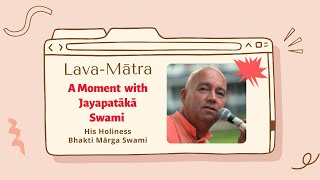
Bhakti Mārga Swami recounts his path from Dutch-Canadian childhood to Krishna consciousness in the 1970s, initiated by Srila Prabhupada in 1973. He spent ten years as Toronto temple president, made his first India pilgrimage in 1978, and credits Jayapatākā Swami's steady leadership and support for female gurus. He suggests Maharaj consider advisory roles given his health and age.
Questions this video answers
John Vis
1973 (via letter)
1978
10 years
187 Gerrard St (temple room in Toronto)
Hare Krishna. My name is Bhakti Marga Swami and I am from Canada. And I got the name Bhakti Marga from Srila Prabhupada back in 1973 through a letter. And my name was John before, and I come from a Dutch background. My parents came to Canada from Holland after the war, Second World War. And so I had a Dutch name. So John Vis V I s very short, but two syllables. We like it that way. So the letter came to which had my name on it, my Sanskrit name from Prabhupda and Bhakti Marga. And I like the name very much. In fact, even before the initiation dksha, everyone seemed the name got leaked out. Everyone got to know about it before it was announced in the temple room in Toronto at 187 Girard St. And at that time there was a trickle of devotees joining in Canada. And I was part of that trickle. I was wondering why I got that name because John Prabhupada's trend was to take the first name or the first syllable from your Judeo or Christian name and slap the Sanskrit onto it. Sanskrit name. And so I didn't get that. That didn't happen. And I was wondering what, why it was like that. So when I started my long walks across Canada, the marathon walking or Prekrma, I kind of figured it out on the first day of walking on Vancouver Island. I said, oh, all this while he knew I was going to be doing some devotion on the trail, on the road. And so I was quite an ecstasy for that epiphany. I was raised in southwestern Ontario near a very historical area, Uncle Tom's Cabin, if anybody knows about that. It's a famous book about an actual physical place where black slaves from the U.S. southern U.S. came into Canada for refuge. And a reverend who was born into slavery gave shelter to those people back in the 1800s. So I'm proudly part of that, you know, come from that area as well as just up the river called the Thames river in southern Ontario, where a famous chief, Tecumseh was killed by an American militia. So he was one of the great warriors amongst the first nations people in North America. And so he was my hero. I used to walk one mile to school, you know, on a snaky road along the Thames river to a one room schoolhouse. And I used to think about him, who's this chief? And I, you know, I heard he has done some marvelous things for his people. So basically it's a very rich historical area where I come from. And I was Raised on a farm. My dad worked at a factory, but I was, you know, he had a small sort of hobby farm. So I used to get up in the morning, 5:30am and milk the cow. And so when they first met devotees about Ka who herds the cows, they thought, oh, I can kind of relate to this lifestyle. I was just so pleased to hear that God is a person and there's details about God and God is not merely an older wise man, but rather is a wise but young energetic person, takes on that Persona. So I enjoyed Krishna consciousness so much in the beginning when I first, and I still do when I came to the temple on my first visit, which was in Montreal, I really liked the chanting, I liked the meditations, what was in the books. And of course the Beatles were big backers of Ka consciousness, especially George Harrison. And one of the first people I met was Bibi Govinda Swami Bhakti Bhringa Govinda Swami. And he was with four other devotees. And I spent some time with them. They encouraged me very much in my dietary changes and adjustments in my lifestyle. So I joined the temple in Toronto and it was a rented house where there were about 40 people living in a three story building. And we were all packed in like sardines in a can. And as soon as I stepped in that building, I felt like I was at home. Oh yeah, this is what I was looking for. I'm looking for a sense of community, a sense of belonging, like a family. You know, I was always close to my own family. My father was a super dad. My mother, she was very devoted to her family. And I had five siblings, still do. And, you know, I'm the oldest, so there's six of us and we always got along. But I really needed to be with a group of people that were kind of like philosophical, artistic and into a different kind alternative lifestyle, A little bit radical thinking. And so when I met the devotees and their age ranges from 18 to 25, I thought, this is where I belong. And I almost felt like I'd been in India before. I probably was an Indian in my previous life and I lived in an ashram. So I felt totally at home, totally. And I think it was just the first or second day that I was at the temple and they had me go on the street and to approach people for saying, here, Tom. I thought, well, that's not very much of a training program. There was no incremental, let's say, classes to get you to that point where you're trying to sell magazines of a religious nature. But anyways, I went along with it. I just had a lot of faith and trust. I thought this is the best place in the world for me to be. And so I been. That has been my base all these years. Almost 50 years. I've stayed in Toronto and of course, branching out. I've had a lot of responsibilities over the years, was even temple president for 10 years. I was very involved in cooking and cleaning, bhakta program training, sankirtan book distribution, selling carved candles that the devotees used to make. And I love Ka consciousness so much. The food was just great. Kitchri when it's good with lots of veggies in it and the chance to travel around, to move into the, you know, to travel around in the States. And it wasn't until five years after I joined that I had made my first trip to India. I was in 78. And of course, Parmapada passed away just a few months before. And when he did pass away, it was hurtful. But I also understood that his mercy is still with us. And I never spoke to him personally, although I met him first in Atlanta, Georgia. I didn't actually converse with him. I was too shy. I was a shy Brahmachari. And there were always these sannyasis around with the sticks, the Dundas. And they were senior to me. And Sai Pataka Swami, of course, is one of them. But we did have a chance to sit down and listen to Prabhupda. I always worked really hard. And that was our program. You get up early in the morning and you work super hard. You sell your soul out to the mission. And there was never enough rest, honestly. I remember in Detroit on Jefferson Avenue, where the devotees had a rented house, up on the top floor was the temple. And everything was quite makeshift in those days in North America, just like in South America where I am right now. Like, you buy an old school, you buy an old church, you get a big house, and you convert the biggest room into the temple room. Nothing was built from scratch. There was no Vedic, you know, let's say, approach formula for a building. So something. There were no blueprints for how to make a Vedic structure. So that's the way it was in those days. And I had a chance to travel to a number of places, went on morning walks with Prabhupada in Chicago, Detroit and Atlanta. And of course I had a chance to travel around all through Canada. And then India came on board as well. So I thought, wow, I joined a movement where you have lots of good people, lots of good peership. And a chance to go to exotic places. I thought this is the best situation for anybody to be in and your life is clean and so on. And, you know, throughout, there was always some little bit, you know, upheavals and some kind of disturbances, because that's human nature. But I never let it bother me. My father was an optimist, and I learned so much from Prabhupada, who's an optimist. Basically, there's only two ways to be in. To be upbeat or beat up. You have a choice, right? So I chose the upbeat position. And despite difficulties and challenges which come of their own accord, being amongst humans, you just always think positive, move ahead, go straightforward, and always remember and reflect on what Prabhupada had us do and his directions, his guidelines, and just following his. His trail, his track, which was to get up in the morning, of course, and attend the program and do some walking in the morning, come for darshan, and be very loyal to that program, the Bhagavatam class and so on like that. So over the years, I've maintained a steadfastness towards the sadhana in the morning and chanting Japa, which is so important. I'm not that proud of my approach. I should do a lot better. The best results you get from sadhana is when you apply your heart, and that's not always possible, but you keep trying. You never, ever give up. Never give up. So one thing about Jayapadaka Swami is he was coming to visit us in Canada. That was during the time that Vishwakarama Prabhu was the temple president. And Saipataka Swami came with a lot of enthusiasm. He always spoke very, you know, powerfully. And I was always impressed with the fact that he was very sharp with his memory. He had different languages down. He was, you know, he was prolific in English and Bengali and Spanish and maybe a few other languages as well. He's my big brother. He's senior to me, and he was there. He joined before, in fact, he was one of the first presidents or leaders in Toronto, Ontario, Canada. And if not the first president, he had been in Montreal prior, and he had come to Toronto as the president when our building was on Beverly Street. I'm just saying these things for historical purposes. Beverly street, which is a very nice area near the university, Canada's largest university, U of T, University of Toronto, near the art gallery, just near sort of a hip neighborhood. And that's where we were initially. So I really appreciated his. His memory, his power. And we know he's gone through physical challenges. He was once attacked at an airport with a guy with a knife. And he had suffered from other physical conditions. But he just keeps, you know, as a great leader, keeps moving on, keeps plowing ahead. And I really like his liberal sense. He's very, let's say, accepting of female diksha gurus, Vaishnavi gurus, and I appreciate that. In fact, it was in Toronto that Prabhupda spoke to Professor Joseph T. O'. Connell. And he was saying, yes, there are female gurus. That is part of our tradition, part of our history. And so Jayapata Goswami has been a support of that liberal sense because we need more gurus, we need more teachers, and we need them from people from different backgrounds. Prabhupada made it very clear in Toronto. He said, when he spoke to o', Connell, he said, not many, few, but, you know, so I feel that's a good formula. I really appreciate the fact that Maharaj is a supporter of that approach. There have been upheavals in our movement, and some leaders got led astray by different versions of the Gopi Baba Club and so on. But Sai Bhatta Goswami has stayed on the straight and narrow path of Ka Consciousness, the Gaudiya tradition, coming from Chaitanya Mahaprabhu. And in this way, he's a great leader. He's a great leader. And I'm hoping that, you know, I feel for him because I see his physical condition, and I hope that he'll feel the comfort to retire from, let's say, administrative tasks and function as an advisor and guide to the current gbc. It would really be nice for some of us to go in that direction. I'm certainly making my plans. I've got a succession plan, and I know he is as well. So that would be very good for the society to let the next generation come in with their wisdom and their experience and, you know, shape up and mold a. A movement, a culture for the 21st century. And so, you know, I know he was. He was coming regularly to Canada to visit. And, you know, he was also a supporter of the walks that I did. So that kind of, you know, let's say, encouraging buddy ism, if he will, is so necessary in our Ka Consciousness movement to make it a healthy and holistic organization. We need good leaders. And Maharaj has been a good leader like that for all these years. And being a good example, we do know that sometimes gurus, sannyasis, senior men and women, they sometimes find from grace. But, you know, he's been steady, and we appreciate that very much about him. And that's what you need. You need inspirational people all around you to be able to continue to move on and continue on with this super great mission. Thank you very much. Hare Krishna.
More from Jayapataka

20260205 Mayapur Academy Zoom Class at Śrī Māyāpur, India #JayapatakaSwamiArchives


Jayananda Prabhu is a Super Empowered Devotee as is Jayapataka Swami. Offering by Ramesvara Pr.

Jayapataka Swami Empowerment Is Beyond Human Comprehension. Offering by Ramesvara Pr ACBSP

Prabhupada Planted The Bhakti Lata Bhija in the West. JPS Vyasa Puja Offering by Ramesvara Pr ACBSP


Prabhupada Sent His Personal ISKCON Ambassador to India. JPS Vyasa Puja Offering by Ramesvara Prabhu


It Has Been My Great Honor & Privilage to Serve Jayapataka Swami by Ramesvara Prabhu. ACBSP

Prabhupada Planted Spiritual Energy into Jayapataka Swami. Vyasa Puja Offering by RamesvaraPr ACBSP

Вот русский перевод текста песни «Любовная песня матери Лорри своему сыну Джею»