Episode # 1 | Why Teens Must Embrace Entrepreneurship | Host - Dharamvir | Speaker - Jayesh Patel |
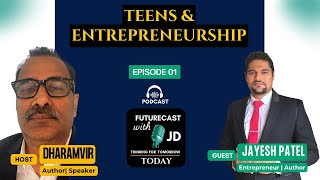
Jayesh Patel, founder of JK Globals, argues that Indian teens face high unemployment and should consider entrepreneurship over traditional jobs. He outlines three paths: working for a company, launching a solo venture, or partnering with peers. Using the Ikigai framework to align passion, skill, and market demand, Patel says teens should embrace failure as learning and start side projects early.
Chapters
Good morning. Welcome to a new episode of Future Cast where we will be discussing issues of tomorrow or the topics of tomorrow today so that we have a better future. And let me introduce myself, I'm the host today and I have three decades of corporate experience. I'm basically an engineer and my current passion is on teen education. That part of teen education where which is basically not covered in the schools and the coaching centers. And let me introduce our guest speaker today. He is J. Patel. He has two decades of professional experience in automotive. He's again an engineer and for two years now he is an entrepreneur. He has his own company. He is the founder and CEO of JK Globals. So welcome Jaish.
Thank you. Thank you. So I like the things that two engineers are talking about. A topic which is not engineering related. It is totally a different area of topic today.
Yeah, it is not related but it is very much related in terms of, you know, what we look for in life now, this topic. I think it is very, very relevant for today also and it will become more relevant in the future which is teens and entrepreneurship. Because as we see the environment today when government jobs come out, some government jobs come out, we see lacks of applications in the private jobs also we see that there are a lot of youngsters who remain unemployed even after doing engineering. It is high percentage of people who remain unemployed. Today also we see the job environment which is the dynamic today and it seems it will become even more dynamic in terms of the news we see of firings and all that every day. So I would start with, you know, what is the teen environment today in terms of earning a livelihood as you see it.
Okay, thank you for asking this basic question because I think that's the most important worry or the most top of the mind things which team have. So things have not changed at least in the last two decades which I have seen. But technology actually has opened up new doors of doing the things. And now once upon a time starting up a business required either you to be bootstrapped or to be a part of an investor community or to have your own cash that's actually reduced down. So as I see the environment today, I basically see that for the teens who are going to go into the space of livelihood they have three different options to do that. The option number one is start working for organizations who actually have a business idea and a business establishment and that's how they derive their value. Which I would not like to call this as a job but I would simply like to call this as like working for an Already established organization. Second opportunity which teens have right now is to go out with their own business idea and start a business of their own. It could be bootstrapped with their own money or with the own set of resources in the family, or find a venture capitalist. And the third one, which is something which has grown a past into a area, is that working with like minded peoples, like others who are almost of a similar age, or let's say of you can say a little decade apart, but it's like all experts coming together, collaborating and starting a business venture. More like a partnership. But here the partnership is more not related to like between an established and an unestablished one, but the people who are all trying to explore their own business idea and coming together for a common cause.
Yeah, so but still, you know, we see that most of the youngsters, they go for a job or basically working for a established company. So why that is so even now.
I am also a part of that cycle. And as I see my past years and decades, I was analyzing the point that why did I not think of entrepreneurship at the start time? And then it dawned upon me that one of the biggest reasons why entrepreneurship did not dawn to me at that point in time was that probably our education system has become so prolonged that by the time you actually pass out your graduation or where you learn your most important skill, which is like the most marketable skill or something which you are known for your rest of your life, the cycle time is almost like the age of 22 and if you are doing a post graduation, it's almost at the age of 25. So all this put together gives a pressure that once the person is out, he is more concerned about survival and instant monetization or instant livelihood. Because the time which is needed for an entrepreneurship takes at least two to three years to get it properly flourished. And most of the people in their youthful days are mainly after completing education, do not have the time to do it because they have lot of things on their mind, marriage, they have competition, the environment as such. And the job actually becomes the most easy fitting part of that thing. So I would say that comfort actually drives things towards it. And the span of the education.
Also I would say, I would add, maybe you can comment on that, that basically for quite some time it has been like that, especially earlier era, before 1990, there were very less opportunity or the market was very less open in terms of new entrepreneurs. So there were some established entrepreneurs which had a very good connection with the government and all that stuff and opportunity for new Entrepreneurs was very less, which probably has definitely changed after like opening up of the economy and now with the technology also. So but still most of the, most of the youngsters go for the old model, which is considered a safe model in, in terms of like if you get a job and then basically your basic survival is ensured for life. That is, that is the concept.
Yeah, that is true. So I first agree to your statement that yes, we have now a lot of opportunities where entrepreneurship has been made little simpler, but the competition has also grown. And during my time the entrepreneurship ability looked little bit smaller, but it was still there. So what I see right now is that you have to see entrepreneurship more like a concept that it is something like you're growing a plant. So plant will take minimum of some time to grow into from a seedling to a tree. And the tree may actually give you fruits. The tree may actually not survive and die. But the point is, out of all your ventures, if the tree actually one tree survives, let's say during your lifespan of 30, 40 years, you are planting multiple seeds and one seed actually grows into a full blown seed to a full blown tree. The wealth acquired from that one tree is so huge and big that it undermines the other things. It's something like you have an exponential opportunity to exponentially grow or you have an opportunity to linearly grow. So job is more like a linear. It's like it's always going to follow a straight line path. And though there may be some sort of ups and downs and peaks, but overall it will follow a linear path. But when you talk about entrepreneurship, it will be an exponential jump. But for an exponential jump you will always find the curve actually lags at the bottom. And then there is a hidden curve that some things which you don't see, which are beneath the curve, but the work is happening, but the results are not there. But once that footing becomes very strong, the jump happens. And since we are talking about the teens, I would like to highlight that one of the biggest lacuna which is there in our current society and education system is that people usually believe that it's only after college that you need to start the work, actual work of earning the money. But if you look in the west, where the startup movements have been stronger in the past, also the colleges have been the breeding ground of putting the seed inside. It's like if you look at the massive amount of time and effort and energy and the youthfulness which our teens carry right now, if somebody thought about an idea at the age of 10, which is around 16 years and nurtured that idea during his college days, during his graduation days. And by the time he decides to pass out, let's say at the age of 23 or 25, you can see that he has close to 7, 8 years to experiment on his ideas, get those things. And being as an adult individual after 18th, there is no legality in terms of how he can protect his interest, how we can look about the things. And that's what I feel is what is currently lagging right now that this entrepreneurship journey is not sought out. And then the easiest way is that okay, now every the party is over and as soon as you pass out, the most easiest thing which is promoted in the society and mainly by majority of the corporates is that please come and do a job. In fact, if the journey was started around five years back, I'm sure most of the people would have not opted for a job, but would have still continued with their ventures, grown it, properly done it. And it's only when they could not have found a light that okay, this is something not for me as a whole, they would have opted for a career which is working under a job. So if teens can be start looking at their future in a way that I have now crossed around 10th now let me start working on an idea and the society and thinkers like us create an environment and a mindset where whatever the tools are needed by them, they are given to them at the right moment so that they can cultivate the idea into something which is like a viable business solution. I think that's if it is done, the entrepreneurship can take very firm routing into teams and what numbers we are talking right now could be actually flipped.
I think basically this is also about giving them little exposure and guidance also, you know, showing them these paths also that they exist. I think as of now, teens are teens do see the path of the job, okay, they will do this course and after that they will get this job. So that path is quite clear to them and like masses are doing it. But in terms of like entrepreneurship, how it goes, how it starts, what is the pathway, what are the different steps for that there is no clarity, there is no exposure into the teens or even up to the college stage. Also I think quite lacking this knowledge I quite like. So that is big part of gap which is to be filled, right?
Correct. And that that's also one of the thing which is also kept a little secret because I can definitely relate that when I used to think about entrepreneurship, let's say in the final years of college, it was actually resented by the masses. Right from you would say the college environment, your professors and this topic is something not very thought about. In a way, people think that it is only a matter of skills. But as I've been into my entrepreneur journey after doing a job, I found that it is got more to do with how do you perceive at the things, how do you see some part of a thing. Like we have been all the time in the college and the education things have been taught about that. Okay, your ultimately your aim of let's say passing a subject is going into a mark sheet, going into a number. And if you're not at a certain number, probably you're not perform well. But if you look at the business side, I see it's more like a learning process. It's like you're learning any sports or you're learning any martial art. At the start of the martial art, let's say you are learning something like boxing. You know that you are never actually going to have the ability to put your first punch out, but as the time will be there, your punching speed and your ability to defend yourself will increase. And that's what it is more like an entrepreneurship where it's an idea you grow every day you add 2%, 2% and it grows into a way where the cumulation is so big that the idea becomes more like an explosion which is not seen by the people. And since it takes a little bit longer time and people don't start much early into the college days because that time the mind is pretty much occupied with academics about the future, about many other things including marriage, including lifestyle, including what type of future would be getting. And over and above that the pressure from the masses that okay, probably it's like rat race and if you don't actually step out, you're going to lose out. So that actually doesn't allow anybody to think on it. And it happens at a later stage of life when probably when people start comparing the journey of somebody who had initially invested his time into entrepreneurial journey and one who had invested his time into a job, they find that probably the end results are very, very drastically different. Not in terms of only the well generated, but in terms of the personality development, in terms of the freedom what person enjoys. And that's how this realization which comes at the last show, it should actually come at the first. So I believe that what a message you have taken today is a very strong message that if a foundation could be built today itself in a way where people have the most youthful energy, time and the plethora of resources available. Imagine a college steaming with thousand people you can understand where you have a daily ability to network them, meet them. It's impossible in a corporate type of a lifestyle or in later part of the journey that you get to meet thousand people every day with different ideas and all are aligned towards one single agenda of making their future mark. So this is the type of environment which is quite difficult to get in any part beyond your academics or your education. And if this could be leveraged and made into a thing, I think what sort of a dream, what our Prime Minister is also looking for and many other leaders that India would become the next hub of startups and new business ideas that can be realized in a very short period of time.
Yeah. And probably I can point it out here that you know, the whole of our education, whether it is school education, whether it is engineering, I have done engineering, you also done. And even Dr. Or, or I would say I would go even to the extent of, you know, our MB Master of Business Administrations. All these educations are designed towards, you know, making a employee of corporate rather than making an interit.
Yes, correct.
And this is something which probably needs correction and correction actually takes time in the. Because the system which is there. So I think auxiliary systems need to be there in terms of where, you know, somebody can plug in and give them that exposure. And maybe you will agree with me that, you know, entrepreneurship is. It could be little bit of theory exposure, but also it would be a little bit of doing that if you get a feel of it, if you do a little bit of it also, then maybe you will catch up the taste for it and make me enjoy.
It and, and it doesn't matter. So for example, if you work for four, five years on your project and you feel that probably the time is not right, I do not have the right skill and still I want to go for a livelihood. I would simply say that if you go and do a job also your outlook will be completely changed because there also you start looking like an entrepreneur and this is going to actually quadruple your journey. That somebody who has seen that mindset, has seen that result driven approach will definitely go out and work for a corporation with that approach and you will actually find that the two decades or three decades, what people usually take to learn those skills and reach up to that level, that could be compressed in a way. And it was a unfortunate part that we did not have this sort of attack going on during that time, which we would have seen and we would have got Inspired. And we would have trusted into that and said that okay, let's embrace entrepreneurship right from a stage and also embrace the failure. What I usually see is that what currently teens usually are conditioned by the society, by everybody, is that failures are something which should be avoided. In fact, the opposite of that is true that most of our ancient scriptures and the people who had already been successful, they will all admit that failures have been the most important part of their success journey. So in fact, Winston certain has said that success is a journey from one failure to another failure. And without failure you cannot actually achieve that part because when you fail you actually understand what did not go wrong. It has a seed to improve and to succeed much, much better. And there could hardly be any person which has not failed and then he has succeeded because that, that's how the universe has put up the law into that. And if teens can embrace the art of failure along with their parents, along with their community and come out very strong, I'm sure the entrepreneurship things will pick up a lot of momentum. And I have seen couple of things from your side Dharang where you have been talking about failures that embracing failures like they are nothing but more of like a learning tools to do that. And if that is embraced by that thing, this can add a multitude of mindset change into the teams and the entrepreneurship which currently looks like a little alien subject will become more of a familiar subject for them.
Yeah, I think this, this is a very relevant point which you have brought out that like outlook towards failure of our society, of our teens as a whole. It has to change drastically today like today if I see as a parent or as a society, failure is simply unacceptable. Failure is a word which is a stigma in our society. Nobody will admit even if I have failed, say if I get fired from a company, it's a failure on my part in some way. But I would like to hide it in today's environment, which is okay, it may be my failure, but if I don't accept it and if I don't learn from it, then my progress will be really limited. But that is the case as a, as a society today. So this is something which needs to, needs lot of work and which really needs to change for entrepreneurship to come in. Because in a job, when you are in a job you can show that you know you are not failing at.
All.
Because salary comes in every month and you can do enough to, you know, survive in a job. So it's, you can say it will seem like that you are not failing at all though. You may be failing at other friends, but in terms of your outlook you may not be feeling.
I was recently, yeah. Reading about Elon Musk and he was talking about the feeling of the rockets. He said that I'm not feeling rockets. He repeated the words of Thomas Edison. Very said that when somebody asked Thomas Edison 100 years back when the bulb was invented that your bulb failed thousand times and then it succeeded one time. He said that it's, it's not failed. It has actually showed me that how the bulk can actually go wrong, how my bulb design can go wrong for thousand ways. But that that's actually given me enough experience to build a very robust technology which we have. And practically we'll find that from the time it was invented till now, the basic bulk structure has not undergone many of a very significant change in terms of technology and everything. We still have the same design, we have the same type of curvature. There has been some improvements in the material and the manufacturing process but pretty much the bulb has been the same. And in fact when we have the LED lights we tend to also use the similar type of basic structure to do that. So that, that's the beauty of a failure, that it is something, you are using it to create something very long lasting. And if society can accept failures and if parents in particular can accept failures for the teens, I think they are basically casting a very different type of mindset into people and said that okay, you are failing, that means you're progressing. And once we have this sort of society, I think we are talking about entrepreneurship movement in a very smaller sense. It would actually go in a very big sense in every, each and every aspect of teens life.
Yeah, I think we have so much potential, so much youth, bubbling youth. If, if, and here I would mention they say, you know, where problems are there, more problems are there then there are more opportunities in terms of entrepreneurship. And I think in India we don't have lack of problem. We don't have so many problems. We have so many, so, so many opportunities we have which in which we can add value to the life of people. And if we can add value to the life of people then definitely it is basically entrepreneurship. If we are adding to, well, adding value to somebody else's life, of course that can give us a profitable business. It can gives us the, the type of life which we want, right?
Yes, correctly.
Okay, now I would ask you that, you know, from a general outlook which is there that you know, go for a, go for some studies, then you go for job and you know, you go For a safe sort of life. Then you tell me what is the, what is the most, you know, what is the most region which in, in your view that one should, one teen should think of going for a entrepreneurship along with its risks, which are there. So why should, why would somebody go for a entrepreneurship. Why should somebody go. Not for the society, I'm saying for the individual, for a, for a teenage going for a. Thinking in terms of, you know, he's in a 9th class or 10th class, why he should think of entrepreneurship at all.
So, so at the age of nine, probably the things what matter to most of the teens right now is that what's going to be our future? Are we going to have a stable life? Are we going to be sufficient enough to source our own funding, our own education and the life which is actually getting transformed into the environment. So when I was actually into my youth days, that's around two decades back, I used to think about that probably I'll have my own house, tk probably a car TK and a safe space to actually move out, see the world, meet new people and create a mark for myself. And pretty much when I meet some of the youth today, as a part of my engagement with my alma mater, I don't see much has actually changed. What has changed is the ramifications of each of this. So definitely it's a risky proposition, entrepreneurship. But I would still put it in a way that it's not about that you start out your own business for your livelihood. First you need to disconnect your livelihood with entrepreneurship. You have to simply think about entrepreneurship. In a very simple word is that I have a freedom to choose what I want to do, when I want to do, with whom I want to do and to what extent I want to do, which is some sort of a thing which probably working for others may not give you. And you will all agree to the fact that the biggest thing what teens resent right of the movement is getting controlled by either their parents, by their society, by their teachers. So this is a very natural urge. And this is, this even starts from the childhood days. So one is that you are actually getting aligned with some things and one is something you're getting controlled by. And as the years will progress, this controlling is going to definitely increase because your burdens will actually move up. You will be more, you can say knowledgeable and more conscious of the fact that you are not able to do what you want to do at one point in time. So entrepreneurship should be more like a natural urge that I want to Escape the control part. Now the idea is that why should you embrace this sort of an entrepreneurship is to avoid at a later stage a control which you don't want beyond a certain period of time. So it, it happens that people who have found the right jobs with the right motivation and with the right cultures continue doing that within any company like any other entrepreneur. But there is also a situation, what we have been seeing that, that it's been shared in one of the recent surveys, it was done around a year back, that 60% of the Indians feel that their work life balance is actually not up to the mark and the work has actually taken over their life. So this is some sort of a control. And the idea is you can jump the ship from one organization to another, but this is not going to solve your major problems because the things which you want to do and the things which somebody else is giving to you, there's always going to be a mismatch. And the idea here is that as we knew that two centuries back, we were never a country where people used to get employed. This is not our age old ancestral model. Our age old ancestral model has been about entrepreneurship only. And that's how India was once upon a time into his golden age, that every person provided a value and which was taken by somebody else. So the concept of entrepreneurship should not be seen in buildings, offices, factory. It should be simply said from the fact that I earn my livelihood or I do what I want to do through my own independence. And it has got nothing to do with I working with a team of 100 odd people or 200 odd people or in fact as a solo entrepreneur also. So if this concept is understood well by the teenagers, I don't see that they will see any risk into that because the risk is not getting into something like that and risking your control and freedom at a later stage. So you will have to choose and decide that which is the risk you want to take. Whether you want to get risk by getting yourself control at later point in your time and having a regret into that, or embracing the risk of doing something so that you can control your outcomes into that way. And in both cases you will actually find that initial part when usually teens and middle class actually start out. So I was also one of them. And it was always in my mind at the backside that this is more like a capacity building for me, more like an area where I'm actually getting into financial freedom. And there would be one fine day when this financial freedom I would like to use to control the outcome in my Career in the outcome, in the way I want to spend my time. And that was I was able to do after two decades of doing that. In fact, teens, if they start a little earlier, they can do it within a single decade.
Yeah. And with the additional guidance and I think when there is a clear pathway, then definitely they can do it. In fact, I conduct some workshop for teams and in which I suggest a mixed model sort of that every teen situation is different in terms of environment, financials and other stuff. So what I suggest to them is that they try to find, you know, something which is very close to their heart and they try to work on that. They should try to start work on that as early as possible and at the same time they can go for a job, no harm in that. And. But at the same time, what is close to their heart or what they want to do as an independent person in their life, that also they should devote some time to it, say half, half an hour every day, they must do it. And things are open now. The environment is very open. The knowledge is available to us free of cost from best of universities. So this is an opportunity so we can, we can, if we want to learn something, we can really learn and we can learn from the best. Just to give an example, I never cooked in my life, but from the past one year I'm learning from the master chefs video. Videos are available on the YouTube so you can simply learn. And this opportunity was not available in our time, 20 years back, 30 years back, it's not available at all. So they can learn whatever is their area of interest. At the same time they can do a job and build their like, if, if they like singing, then they should build up their singing talent. And at some point of time, and they do it side by side, they do it in the weekend, they, they do it. So it is, it will give them lot of satisfaction and fulfillment also along with the job, so it will give them a more fulfilling life. And if they think in, at some point in their life that this whatever their own thing itself can give them survival also, then they can switch it over. And obviously in that field they will have much more growth, much more fulfillment. There's no doubt about.
Yes, and in fact I would say that, I would conclude with your statement with one line that if they start trusting their instincts, distrusting their passions, I'm sure their minds are quite capable to find a way out that how this could be linked to their livelihood, this could be linked to their satisfaction and this can become their only job for future. So if you have read about a book called Ikigai, it talks about a convolution of three concentric circles where you have a demand, skill and something what you're passionate about. And if you are able to find that one sweet spot, this can become your profession for life. And then there is no such concept called as a retiring from life. It's like it's only retired when you actually on your deathbed. So if that's a concept which is normally promoted for people of my age and your age, but this, this can be applied if it can be applied at a teen level. Look at the amount of span which they have. I think a normal teen, if we take it from the age of 16 till the age of around the average age right now is around 80. Look at the time span which is close to around 64 years, which is there. And this sort of a timeline which is like almost like you can say in, in this entire lifespan actually the Pluto revolves three times around the Sun. That's the timeline which is there. The wonders can be made.
Yeah, I think it is a very good point to conclude Ikigai. So this is the, this is task, home task I would like to give to the teens. They should learn about what is ikigai. It is coming from Japan, it is practice there really. And, and it is very, very successful in terms of having a fulfilling life. So learn about it and try. I think it can do wonders in terms of our clarity on our lives.
Thank you.
Thank you. Jaish, it was very pleasant to have you. And discussion itself opens up a lot of our thinking cells which we I think don't think individually. So looking forward to having you many more times on this platform. Thank you. Thanks.
Thank you.
More from Jayesh

My Talk | Biggest Freedom Of Life ? | TM Club, Bilingual Club , Bangkok | April'25
My Story | Break Limits & Build Legacy | TM Club , Thailand| Apr 25 #strongereveryday #everydaygreat

What Type of W person are You? Are you Winner / Watchers / Wonderer / Wanderer