Geoffrey Quintero, a systems architect, argues that modern burnout stems from "ontological severance" – spending your most productive hours on work disconnected from who you are. He spent 25 years developing the Qualians framework, an 8-dimensional map of human virtues, and built Corealizeit.com to help people quantify their unique value in an AI-enhanced economy where machines handle repetitive tasks.
Chapters
There is a specific exhaustion known intimately by millennials and Gen Z at the end of a workday. It is a hollowing out that accumulates when you spend your most productive hours executing tasks entirely disconnected from your actual identity. This is a structural condition known as ontological severance. It occurs when an economic system requires your time and output but remains completely indifferent to your unique insights, virtues, and talents. We operate inside an economic engine built before the arrival of artificial intelligence. Without automated systems, human beings became the default substrate for mechanical labor. We were placed in an environment treating us as interchangeable parts, competing in a zero-sum landscape. Because this exhaustion stems from a structural design flaw, personal resilience cannot fix it. Dismantling a massively complex operational system and building a viable alternative requires the precise skills of a master systems architect.
Geoffrey Quintero brings exactly that discipline.
He is an innovator, builder, and technology visionary who spent decades inventing products and engineering technical architectures capable of scaling globally. In 1990, he designed and built the first interactive video drive-through for Burger King. He delivered the entire functional system for $50,000, outmaneuvering tech giants like IBM and Apple, who were attempting to secure the exact same contract. 9 years later, he designed the technical architecture and business models for massive industry web portals like Produ.com, establishing early scalable frameworks for digital communication. Through these successes, he recognized a key limitation: optimizing physical and digital systems only yields efficiency, but true progress requires engineering an infrastructure that supports qualitative human harmony and fulfillment. In 2003, Quintero experienced a profound disruption to his trajectory.
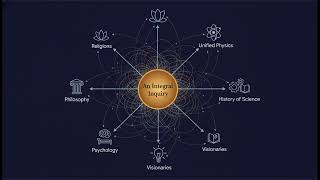
Waking in the middle of the night, he heard a distinct voice prompt him to seek out any idea conducive to the improvement of life order. He spent the next 25 years applying his engineering rigor to the deep structures of human meaning. He analyzed the precepts of major world religions, the texts of ancient wisdom, and the frameworks of modern psychology, to map out the spiritual and material spectrum of human cognition. His research relied on consilience, the principle of linking facts and theories across different disciplines to create a common groundwork of explanation. He integrated this with Ken Wilber's Integral Theory, which synthesizes multiple perspectives, from science to spirituality, into a single comprehensive understanding of reality. He took the quantitative, scaling mindset of a tech entrepreneur and redirected it toward mapping the exact architecture of human meaning.
To ground this philosophy in physics, Quintero integrated concepts from Nassim Haramein's Unified Field Theory. Unified Field Theory proposes the integration of gravity and quantum mechanics to create a cohesive, unified view of the cosmos. Haramein suggests existence starts at dimension zero, expanding outward into fields of qualitative existence, rather than a linear, chronological timeline. Quintero applied this logic to develop the Qualians framework, organizing traits like insights and virtues into an 8-dimensional periodic table of human value. This theoretical work drew direct validation from major intellectual figures, including authors like Deepak Chopra and Ken Wilber, who noted the extreme difficulty of mapping these ontological structures. This approach translates human meaning from an abstract feeling into a structured system architecture. By linking these qualities to the physics of emergent reality, Cantero built a framework that identifies and quantifies the unrepeatable value each person offers. The practical application of this blueprint is the systematic replacement of the old economy with AI-enhanced roles. An AI-enhanced role is a position within a collaborative ecosystem where artificial intelligence handles repetitive tasks, allowing the human to contribute their unique, unautomatable talents. While the current system uses artificial intelligence to make labor extraction more efficient, Cantero's framework treats AI as a liberation infrastructure. By letting algorithms absorb all the reductive, compressible dimensions of daily work, humans are finally free to operate at the level of their authentic capabilities. AI can optimize a skill, but it cannot originate a virtue or generate an insight born from lived human experience. To make this viable at scale, Quintero designed Corealizeit.com. It is the first user-owned infrastructure platform built specifically to capitalize on this unique creational value, allowing individuals to map their purpose and bring it into the world. Millennials and Gen Z are uniquely positioned to lead this shift in how we value ourselves and our work. You possess both the AI fluency to orient the technology correctly and the structural intuition to know the old system is broken. True relief from the burnout epidemic does not come from negotiating a better job title within a broken system. It comes from stepping into a new ecosystem built entirely to co-realize our unique human potential.