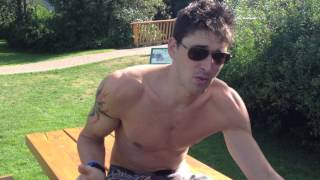
Ben Greenfield demonstrates five soft-tissue areas to mobilize during race week: calves, IT bands, glutes, thoracic spine, and shoulders. Spend five minutes daily with simple tools like tennis balls, a muscle stick, or foam roller. Thirty to fifty passes on your calves, twenty to thirty on the IT band, and twenty-second holds on glute trigger points reduce pain and improve performance.
Chapters
Foreign.
Hey, it's Ben Greenfield, and this is the week before Ironman for me. I'm out here at the beach before Ironman Canada. And one of the things that you wind up doing a lot of times during an Ironman race week is just kind of sitting around, right? And a lot of people leave a lot of money on the table when it comes to their bodies and having their bodies ready for the race because they don't realize that when you're not working out and when you're not beating up your body, this is a perfect time to mobilize all of the soft tissue that winds up getting tight, causing pain, and making you walk the last half marathon of an Ironman triathlon. Or have your bike, you know, your back get all locked up on the bike or have your shoulders feel like they're just not moving the right way during the swim. And the fact is that there are just a few tiny little things you can do every day in the last week leading up to the race that I personally do that can really help you out. So what I do when I'm hopping on a plane to go to race in Ironman, or in the case of this race, hopping in the car to drive up, I just toss a few things in my bag. I use a tennis ball or a lacrosse ball. I grab two lacrosse balls that I have taped to together, and I get some kind of a muscle stick, muscle track, tiger tail. This one's called emoji. Doesn't matter. Rolling pin. I mean, for crying out loud, just anything. And there are a few key areas that I work. I've identified five areas that if you hit these during race week, you're going to feel way better. On Ironman race day, it's just five key areas. Okay, so number one is your calf. Here's how I like to work my.
Calf with the stick.
Simply get down into this position, you hold the stick here, and I'll do about 30 passes or so, sometimes as many as 50, depending on how tight I am, all the way up and down the calf here, and then on the side here, and then finally up.
And down the shin on the front.
That only takes about two, three minutes tops per leg.
That's. Number one is the calf. Number two is your IT band. Now, if you happen to have a foam roller, that's honestly the best way to work your IT band. But you can also work with one of these sticks. You want to just pin your leg. You know, here I have it pinned against the table, and I'll put my.
Body Weight into this stick. You want to get to the point where it's a little bit teeth grittingly difficult. So really drive your body into it.
You want to find something you can pin your leg against as you do.
This, but do again about 20 to.
30 passes up and down your it. Band number three is your glutes, specifically the external rotators in your hips. This is the one area that really bites people during the run, that if you work this every day, your body's.
Really going to be thanking you.
On race day. You take your ball and you put it right underneath the outside of the hip.
Shift your body weight to the outside of the hip. This one actually really digs in there a little bit. You can roll circles clockwise or counterclockwise.
Or you can just hunt down those super tight areas, pin them, and just.
Hold for about 20 seconds until you.
Feel some of that pressure release. Okay, so that's a spot that can.
Be tempting to avoid because it's not comfortable.
But if you work it, your body's going to thank you on race day. Okay, I got two more. Number four is your thoracic spine. This area is going to be really important to have a lot of mobility on during the bike. This is exactly why I tape two of these lacrosse balls together.
I'll take these, and I'm going to.
Put them right under my mid spine.
Okay. So one ball is on one side of the vertebra, one side is on the other ball of the vertebra. I cross my arms like this, and then I go side to side. This is one that I picked up from Kelly Starrett in his Becoming a Supple Leopard book and also his mobility wad website.
But this one, you get to like.
Mile 90 on the bike and you're.
Hunched over those arrow bars. It's.
If your thoracic spine is mobilized again, your body's really going to thank you, and you'll feel way better than if you've got all these adhesions going up and down your thoracic spine. So you just kind of go up your spine, twisting side to side like that.
Now the last one.
This is an area that, especially when.
People put on a wetsuit, they tend.
To complain that their shoulders feel really tight.
A lot of times it's because the internal rotators of the shoulder are locked up. So you grab your tennis ball, put.
It right underneath your armpit, you'll roll around so you find that tight spot. You're going to find it. So mine's right there. Okay. Then I'm going to take my arm in this internally rotated position and just basically go from external rotation to internal rotation. You'll catch that spot if you have that internal rotator pinned properly. And you'll do about 10 repeats or so external so internal rotation and then flip and do the same thing on the other side. So if you hit those five areas.
Your calf, your IT band, your thoracic spine, your internal rotator, and then the outside of your hips here, those are the five key areas.
And you can just hit them for.
Like five minutes a day during Ironman race week. You'll have a much better race, I guarantee. So hopefully that helps you out. I'm Ben from BenGreenfieldFitness.com have a great race.