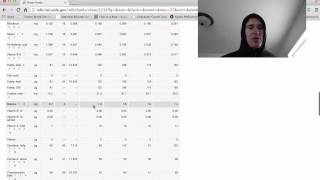
Ben Greenfield walks through the USDA food database, which tracks 8,463 foods with complete nutrient breakdowns. Using an avocado, he shows how to find serving-size specifics: about 1 gram of sugar per cup, 10 grams of fiber, 728 milligrams of potassium, and detailed amino acids and antioxidants.
Questions this video answers
8,463 foods.
About 1 gram of sugar (per cup).
About 10 grams of fiber (per cup).
Approximately 728 milligrams of potassium (per cup).
About 31.5 micrograms of vitamin K (per avocado cup).
Chapters
Foreign.
Hey, folks, what's up? It's Ben Greenfield here, your health and nutrition ninja. Wearing my special ninja hood today, about to show you how to be a ninja with your food. Now, I'm holding in my hand something I eat quite a bit of, an avocado. And this particular avocado, as you might notice, has probably had better days. It sat out on the kitchen counter all night last night, but I probably will still throw it in my smoothie. Now, let's say you want to find out what's in your food. You want to find out exactly what's in your food. Well, a lot of people don't know that the USDA has a database of over 8,000 foods. And many apps and websites draw upon that database to get their nutrition information that they feed to you, like My Daily Plate or mynetdiary or any other type of nutrition website or app you might use to log. But the fact is, a lot of these websites are kind of shallow and surface in terms of the amount of data they actually give you about a particular food. Now, what you're looking at right now is the USDA Agricultural Research Services database of over 8,000 foods. 8463 foods, to be exact. Now, I'm going to show you how you can delve into the nitty gritty details of any food. Fat composition, protein breakdown, everything. But if you don't want to type in that full URL to your browser, I actually made it easy for you. Just go to BenGreenfieldFitness.com FoodSearch and it'll automatically redirect you to this URL. That's BenGreenfieldFitness.com foodsearch so I'm going to put down my avocado now, and I'm actually going to type Avocado here in the search engine. And we're just going to go for Avocados Raw, all commercial varieties, and do a, do a search. Okay, so here it brought up the avocado. Now you can see here as I go down through.
Actually, back up just a little bit here to show you one quick thing. I'm going to type in, rather than have it fill it in for me, I'm just going to type in avocado and then go, okay, and then it shows me Avocado Oil, California Avocado, Florida Avocado. I honestly don't know the big difference between Florida and California, but I'm just going to click on Avocados Raw, all commercial varieties. Okay, so then it brings me to this screen Where I can, for example, change the amount of avocado that I'm looking at like one cup, one cup parade, one cup sliced, one cup avocado, and see the actual amount of nutrients, minerals, vitamins, water, etc. In the actual food. Now, what's really cool is that if you go to full report all nutrients, you click on that, you can get way, way detailed. It'll give you the scientific name, It'll give you what's called a carb, the fat and protein factor, as well as the nitrogen to protein conversion factor. So you can actually figure out how much of the usable nitrogen in this food actually is used as protein. You can go down and look at total lipids. You can look at the ash produced by the food. You can look at. This is kind of cool. I like this. Fructose, lactose, maltose, galactose and starch content of the food. And let's say we're looking at. Let's go ahead with one cup of avocados and follow this column here. I can see, for example, the exact amount of fructose, galactose, starch, etc. In the avocado. Interestingly, an avocado, in terms of the sugars in it is kind of a mix of glucose and fructose without very much sugar at all. This is in grams, so it's only got a gram of sugar in it. An avocado with about 10 grams of actual fiber. So there's a lot of kind of fiber, fiber in there, but not a lot of it is sugar. You can see all the minerals in the avocado. See, it's actually relatively high here in potassium, 728 milligrams of potassium. We can jump down to the vitamin breakdown. Okay. Way more detail than you normally get from just like a food database in an app. When you're typing this stuff into an app, this is the type of data that like, professional nutritionists rely upon. By the way, we can see the amount of vitamin E, everything. Okay, now here's something kind of cool. And by the way, avocado has 31.5 micrograms of vitamin K in it. That's actually pretty decent. Here's what I like. You can actually look at saturated fat, monounsaturated fat, and polyunsaturated fat content, which is really interesting. If you actually want to really get geeked out on this, go read the Perfect Health Diet by Paul Geminet where he talks about kind of like what the ideal total monounsaturated and polyunsaturated fatty acid breakdown should be in foods. And you can actually kind of see if you really want to geek out how you're doing with that. If I click plus on lipids, check this out. It'll actually show me the actual amount of chains and where the fats are saturated. You know, like this one's saturated at the 16 mark in terms of the carbon chain. Like, it'll really delve into a ton of data here. Like, you can totally geek out on this. Showing the amount of alcohol. There's no alcohol in an avocado, by the way. If I click plus here on amino acids, I can see the complete amino acid breakdown of my avocado. All of the essential amino acids and non essential amino acids. Exactly how much is in the avocado down here. All the antioxidants, isoflavones, flavanols, flavones, flavanones, flavanthriols, and anthocyanidins. I can click plus on any of these. Like, let's say flavanols. Could see exactly which flavanols, like, there's no quercetin. Or any of the other flavanols, incidentally, in an avocado. As a matter of fact, flavanthriols, very little bit of epicatechin, which you'd actually find in green tea. Interestingly, you can see an avocado is not chock full of antioxidants, but this isn't taking into account the avocado seed, which actually does have a lot of antioxidants in it, incidentally. So pretty cool stuff, huh? The geek in me loves this. So if you ever just want to go and type in some of the staple foods in your diet and see what they're made up of, this is a really cool way to do it. So I hope that was helpful for you. And I'm Ben from Ben Greenfield Fitness, signing out. Remember, you can go to BenGreenfieldFitness.com FoodSearch and it'll automatically direct you to this URL. And remember, you do want to make sure that you click on the full nutrient report when you click on your food. And once again, that is this part right here. Let me click on my avocado again.
Right.
Where'd it go?
Oh, okay. So it automatically pulled up the detailed report. But you don't want the basic report, you want the detailed report. So we learned a lot about the little avocado today, and I hope that was helpful for you.