Dubai's Cutting-Edge Biohacking Scene, The Right Way To Combine Cold, Hot, PEMF, HBOT, & Red Light
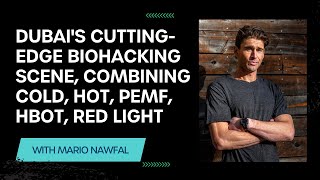
Mario Nawfal, a Dubai-based Twitter Spaces host, walks through his daily biohacking routine with Ben Greenfield: cryotherapy at minus 140 degrees, cold plunges, HBOT, red light, and PEMF therapy. Ben advises on stacking order, recommending PEMF before exercise, sauna after workouts, and cold plunges once weekly for 6 to 10 minutes. Mario tests his biological age every three months with Dunedin Pace.
Questions this video answers
About 4°C for ~3 minutes (performed twice during a sauna session; once-weekly longer cold plunge recommended).
Cryotherapy at 140°C for 3 minutes (transcript states this equals ~284°F).
Hyperbaric chamber: 1 hour, seven days per week.
PEMF: ~30 minutes; red light therapy: ~30 minutes (red light performed after cryo/sauna/PEMF in his routine).
Typically an 18-hour fast (used to fast daily).
Chapters
You should know that cold water immersion, particularly when the head goes under the water, is far, far more advantageous compared to cryotherapy. The reason for that is it activates the, what's called the mammalian dive reflex and tones the vagus nerve. So all the nervous system benefits that you get from cold only happen if you're in cold water with the head underneath. The other thing is that the cold water, you might notice it feels a little bit less comfortable than the cryotherapy chamber because of what's called that hydrostatic pressure of the water against the skin. The cold water is also more effective at eliciting, like the fat burn, the shivering response, the, you know, the shift of white fat to brown fat. So if you had to chew something, I'd say water. But since you have the cryotherapy chamber, I'd say keep doing it. But then consider at least once a week, kind of going a little bit longer with the cold water and making sure your head is going under a few times.
Well, folks, my guest on today's podcast is actually a guy who pretty much started with nothing, launched a $10 million company over the course of a couple years, launched another company called IBC Group and took that to nine figures. Took another group called NFT Tech public, and now manages and hosts one of the largest Twitter spaces that's ever existed. Millions of listeners per week with guests like Elon Musk and Hunter Biden and Mark Andreasen and Charles Hoskinson and Michael Cohen, a bunch of other top crypto exchange folks, entrepreneurs, and a plethora of other high profile names. He's talked on TedX, he's speaking to me today from Dubai. He's heavily in demand when it comes to speaking at tech spaces, but also behind the scenes, he's a pretty prolific biohacker and loves all these cutting edge.
Tech knowledges, health technologies, as a matter.
Of fact, so much that he even has someone who manages a lot of this for him as far as putting together all the cool things that he does to optimize his body. So, folks, my guest on today's show is Mario Nafal.
Mario Nifal. All of the show notes are going.
To be@BenGreenfieldLife.com.
And that being said, Mario, it's actually, it's. It's pretty special that I interview somebody and they actually have an assistant with them to help them keep track of all their biohacks.
That, that's, that's pretty impressive, man.
Yeah, man. So, so two things. Number one, it, it's Pretty impressive that the interviewer is also on a walking treadmill while interviewing. While I kind of point that out. And second, my assistant became my girlfriend and now manages my biohacking as well. So, like, I've got a full package next to me. She makes sure I live forever and make sure I've got a companion in life.
Dude, if my wife managed my biohacking, I'd probably be dead. Yeah, she doesn't track jack squat.
I'd be there yet, bro.
Like, that's why. One of the reasons. I have a list of the reasons why I don't want to get married. One of them is, I've heard that when you get married, things change at times. I've seen enough movies to say, you know, we used to watch Everybody Loves Raymond. Yeah, I want the person making sure I live forever. It doesn't change the pills or the drips.
Exactly. My wife is amazing. I don't think she'd ever take advantage of my health insurance or anything like you've just alluded to. But she's not an organizer or a manager. I'd probably be having lettuce and ketchup for breakfast, and my fitness routine would be something like cleaning the garage. So, anyways. Okay. And what's your assistant's name again? Mario. It's just to make sure I get this right.
Jennifer.
Jennifer. I called her assistant your girlfriend. Biohacking manager, assistant, whatever. Jennifer. So, Marv, for people, a lot of my listeners and viewers, they're familiar with many people in the health and biohacking spaces, but possibly not so familiar with some of these big folks like you who are doing things like hosting massive events on Twitter spaces. And so just as a background, what exactly is it that you do? I don't even quite fully understand it. I've just come across you a few times, seen some of the stuff that you're doing. That would be cool to have you on the show.
Yeah, man. So I still don't know what I do, to be honest. So I started. I used to love building businesses, and I've always been. I don't like the concept of death. It just doesn't make sense to me. Like, one second you're here operating in this world, and then suddenly you're just gone. It just doesn't click in my head. So I don't like the concept of death. That's why I'm obsessed with biohacking. But what I do is I started hosting a Twitter space, an online show. I used to be on Clubhouse before, about a year ago. Used to be the biggest crypto show, but then now became the biggest show, period. So we've had a lot of big names from Mark Cuban, Bill Ackman, bunch of senators and you know, we reach millions of people a week.
So.
And I'm. So we have a finance show in the morning, we have a politics show at night, we have a crypto show in the afternoon. Seven days a week, or five or seven days depending on the show. And in the works right now we have an AI show launching in a week or two. And the second one is a biohacking show. I'm partnering with one of the biggest names in the industry and we're in late stage discussions to finalize it. And I'm also partnering with Dr. Drew to do a medical show unrelated to biohacking general medicine. Covid this type of stuff.
Which, which bio. Are you allowed to say which biohacker you're gonna have on for your.
I haven't asked for his permission yet and we haven't signed. So do you want me to say it and you bleep it out or just say afterwards.
That's all right, that's all right. I'm sure that I'll stumble across it at some point. So when you say Twitter show, like what's a Twitter show, is that the same as like a spaces?
Yeah, it's a space.
Yeah. Okay. All right. And you were doing Clubhouse and then you do this and how does it work? Do you actually just get a person on and then you have a whole bunch of people show up and ask questions or what's the show actually comprise of?
Yeah, man. So we do. It's pretty insane. Like you remember FTX that collapsed? Yes, that exchange, the crypto exchange. So when that collapsed, we were covering it live. Like I was doing my normal crypto show and we were covering it live. We ended up doing a 20 hour show, then a 15 hour show with like a barely a few hour break to sleep a bit. And when we covered that live, the world was watching. So kind of showed the value of Twitter spaces where you cover things live. The media was watching, everything was happening. The whole collapse was being covered live in one place.
And.
And then the media will take all the information from that place. Elon jumped on a couple of times. And then since then we just cover a lot of. We used to cover a lot of live events. Silicon Valley banks collapse, the missile in Poland and now we cover everything from. From LGBTQ rights to the war in Ukraine to US politics. Today we're doing the debt ceiling. And whenever we cover something, it's always unbiased and in the middle. So we get both sides coming together and debating, which is pretty interesting because CNN is like, you know, biased one way, Fox News is biased another. So there's no one doing it. We're bringing both sides together and we're doing that. And it's been. It's been an incredible, unexpected, ongoing journey.
Well, look, I know we're going to talk about it because you do all these cool biohacks and life extension technologies, and I know you've worked with David Sinclair, who's a pretty prolific guy in the health optimization space himself, but it kind of raises the question for me, like, how do you actually monetize a Twitter space to be able to do something, you know, like afford your daily hyperbaric chamber or whatever?
Yes. So I have initially, initially the spaces weren't making money, at least the non crypto spaces. And to this day, the biggest one I do every day, the politics and news ones, I've never made a cent out of it. It's just been costing me money. That's because the business funds it, at least for now, the other shows. So the most obvious way to fund it is just advertisers, but it's pretty lame and not that exciting. So we have an entire business model behind it. So my company is as an incubator, it's an AI and crypto incubator now expanding to just any startup, including tech startups. So what we do is we promote the incubator, we promote the business on the spaces. So that kind of a machine in the background, like you do your podcast, you've got a whole machine behind it that allows you to monetize it beyond just advertisers, whether you're getting clients or you're selling products. So it's a similar, similar machine behind it, just scaled very heavily. And then the news and politics ones, we haven't, we still haven't. There's many ways to monetize it, and it's fascinating how the multiples are really interesting. But we haven't started monetizing it yet. We are working to take the company public later this year. We're working towards that, which means that, you know, liquidity will not be an issue. So we don't really need to make immediate money. It's more reaching, a bigger audience and leveraging it later for. For financial gain.
Yeah, that makes sense. Where'd you grow up, man? That's obviously not in America.
Australia.
Melbourne. Melbourne. Okay. All right, gotcha. And when. When did you migrate out of Melbourne and come out this way or out to Dubai and. Tell me about that, Jennifer?
Yeah, Eight years ago, before I met Jennifer, I traveled the world. Jennifer stumbled upon me and got stuck in this. In this loop of what I call life, what many people call craziness. But, yeah, I was traveling for eight years, man. Didn't have a home. I was literally homeless for eight years. Spent most of my time in Miami, Europe, Marina del Rey, and more recently, Dubai.
Okay, got it. And what got you into all this? Like. Like getting into health, biohacking, etc. Look, it's just.
It's just I get surprised when people ask me this. Now, I know you're asking me for an interview, but when people genuinely ask me, I'm like, how can you not like, yeah, how. How can you live knowing it's like someone gets. And so I'm using an extreme example just to make a point. But imagine someone getting cancer. It's like, hey, why are you getting treatment for this? Like, what convinced you to get treatment? I have freaking cancer. And you ask me why I'm getting chemotherapy. It's the same thing here. Like, I have a disease called death, and you ask me why I'm trying to delay or prevent it.
Yeah. Yeah, that makes sense. So do you think that it's capable for humans to achieve some type of immortality through transhumanistic efforts or at least significantly extend life or slow the rate of aging above and beyond where we're at right now?
I'll give you a stupid answer, and Jen will give you a better answer. My stupid answer is I want to try to delay aging for as long as I can until hopefully we get a technology that can reverse it or just halt it. That's my goal. And then eventually reverse it. That's my goal. I know it sounds very naive, but I'm hopeful. And, Jen, you talked about a study recently that actually shows it's not going to take that long for us. It's not going to take as long as many people make it out to be for us to actually potentially reverse aging. So when he told me this, I got pretty excited.
Oh, tell me about it, Jennifer.
Yeah, so Odaj Sinclair worked with mice, and he was able to actually reverse the age of mice, which was really impressive for me. That's why I believe, like, we're not that long from reversing biological age. Another study mentioned that we're actually maybe like, 12 years away from finding a way to reverse it in humans.
Yeah. And that study Got me excited, man. Like, when I heard that, I'm like, shit, I have a chance.
Yeah. Yeah. Have you, have you seen the, the Rejuvenation Olympics website? Are you familiar with that at all?
Is that the one by Brian Johnson?
Yeah, yeah. So they're using what's called the Dunedin Age Pace Measurement to determine for any given, you know, let's, for simplicity, say 24 hour period, how many hours of a 24 hour period or how many days of a week or how many weeks of a year you actually are aging compared to the general population. And so obviously a figure that is lower than one would indicate a slowed rate of aging that, you know, theoretically, and these are what guys like, you know, Brian Johnson, et cetera, are trying to achieve, could result in almost like reverse aging. The closer and closer that number gets to zero. So on this website.
Below zero is reversed. Yeah, below zero would be like literally like Benjamin Buttoning. But the idea is there's a lot of people, and I think a lot of like, prolific entrepreneurs, people in the tech space like you, et cetera, who have perhaps a little bit more energy or resources to devote to this, who are getting down. You know, I don't think anybody's below 0.7 right now, but I mean, folks are in like the low 0.7, which, if you do the math, that would mean, you know, for a 365 day year, you might only be aging for 260, 270 days out of that year. And so that'd be interesting for you to start to track some of the stuff you're doing. It's called the Dunedin Pace Measurement. And companies like True Age Diagnostics, they're probably one of the more popular companies that will literally have a blood spot test sent to your house. And you just do the test and then you track on a regular basis what your efforts are actually resulting in when it comes to age reversal.
Yeah, Jen just wrote the name, so I'm going to look into it. I heard about it in a, as a podcast, I like all my first million. And they interviewed Brian Johnson once. They mentioned in a podcast a couple of days ago, the calendar you're talking about. And they have like the Olympics thing and they have Brian Johnson's apparently first. Are you on there or no?
Yeah, well, I interviewed Brian about four weeks ago. Fascinating guy. I mean, you know, we talk about those of us who are, who are kind of focused on age reversal. I mean, he, he is on the cutting edge, like 120 different supplements each day. And I mean, he's spending like it sounds like five to six hours a day on this, which to me can become paradoxical, you know, if you're living a long time, but spending all those years spent cold and hungry and libido less, you know, hunched up inside some kind of a cryotherapy chamber or hyperbaric chamber. But, you know, Brian's a nice guy. His approach seems reasonable, but he definitely spends a lot of time on it. And yeah, I believe he is at the top of the list there with a low 0.7 number. I think I'm about 0.76 or something like that. He and I have very different approaches, though. You know, I have a background as kind of a masochistic endurance and strength athlete who did a lot of damage to my body for like 20 years. And I use a lot more of the biohacking technologies. His approach seems to be more based on fasting sane amounts of exercise, a very large number of supplements, probably about four times what what I take, and a lot of tracking and testing and not doing anything unless it's steeped in science. I tend to have a little bit more of like a. Like a guinea pig approach myself.
All right, so when you say 120 different supplements, is that different types of supplements or different pills total, including ones he takes 3, 4 of pills, based.
On my rough calculation. Looking on his website, it is actually 120 different compounds. You know, C60, spermidine, urolithin, a NAD, you know, all the way down to like extra virgin olive oil and dark chocolate, which I think it counts as a food, not a supplement. But it's a fascinating approach and it actually led me to wanting to ask you, before we jump into some of your strategies, you or Jennifer, are you doing anything from a testing or tracking standpoint to kind of see how what you're doing is working?
Yeah, we constantly. We do blood tests every three months. That's the first thing we do. And you mentioned true age. We also do that to check if he's actually reversing his biological age or not. And as opposite, if everything's working.
Yeah.
That includes the Sinclair tests.
Now.
You'Re working with Sinclair. I think you mentioned to me a couple days ago as we were throwing around some ideas for today's show, that you've been working with David Sinclair.
Yeah.
And what's that actually look like?
He's really good, actually. He monitors everything, like from Mario's glucose levels constantly, the way he sleeps.
His exercise. So whenever he exercises, we have everything graphed out. We also Send him, like, literally everything. Everything. His supplements.
Like, everything. Blood tests. So he tracks everything, gives us. Gives us his feedback, and then we implement whatever he sends.
Research, of course, he follows up with a soothing voice. Like, it's like.
So you have.
Based on your blood test, your biological age is 20% more than your chronological or whatever actual age, which is bad. But don't worry, we can solve it. You know what? You just gave me the worst news, but the way you speak seems like it's incredible news, so thank you very much.
That's how I would describe Sinclair impersonation. Yeah, I'm trying my best. This is bad. So. So in terms of what you've actually learned from him or what he's teaching you or what you're implementing, and I realize this is kind of a loaded question, but we got time. I would love to hear what you're actually doing. Like what a typical day in the life of Mario or week in the life of Mario looks like when it comes to biohacking, age reversal, and just general health optimization. All right.
Can you do me a favor, though?
Yeah.
Be direct. Tell me from scale 1 to 10, how extreme is it? Like, how good is it? The higher, the happier I'll be. But you have to be honest. Okay.
Like. Like I wanted to give you feedback on. On how good your protocol is.
Yeah, yeah, yeah.
All right, well. Well, I will, but let. But do me a favor. Let's make sure David Sinclair doesn't listen in, because if he does, you know, and I. And I. I differ with him on a certain approach. You know, I've only just started working with Sinclair.
I've only just started a lot of.
A lot of his protocol. You won't hear right here.
Yeah.
Okay, so if I speak too much, let me know because I'm pretty geeky about this. And then Jen will fill the voids where I'm too stupid to explain. So I'll start with diet. Diet is. I used to be vegan. Now I'm pescatarian. But really wanting to focus more on vegan. I don't know what Sinclair recommends. Sinclair recommends meat and stuff. I sneaked in lamb and grass fed beef, like randomly a week ago. But generally vegan. Pescatarian. I have eggs a lot. That's what I eat. I used to have a private chef. No longer do. Technically, she stole our money, disappeared. That's the truth. But we're looking for a new chef, so that's in terms of what I eat. I try to sleep eight hours a day.
Okay.
Okay. So I'M gonna interrupt you. Let's get in, let's get into details, dude, because, you know, we're long form. We, we can, we can geek out on this stuff. What, what are you doing as far as like a typical breakfast, lunch, dinner, pescatarian type of approach?
18 hour fast. I used to fast every day. Been a bit shaky recently. Since the show. Especially since the show. But generally speaking, you know, I eat. I'm not as strict as I was before. I monitor my calories, my weight is steady. But, you know, I do eat a lot of eggs, don't eat much bread, you know, sweet potatoes, vegetables. I really stopped caring enough about what I eat and that's not right. I'm keeping it healthy, though. I'm sticking to healthy, but I'm not really watching all the macros and stuff.
Stuff.
I've really fallen back with this. I really got to catch on there, Jen.
Check you have a team that does it for you.
So.
Yeah, but they don't warn me. So they calculate my macros, but they don't tell me, Mario, you're eating too much of this, too little of that. So that's probably something I need to fix.
Well, well, in Dubai. In Dubai too, it can be a little bit tough. Like, like last time I was in Dubai, you know, I went to a place that had served. They were, they were serving like burgers and steaks and they were bragging about how the cows were grain fed, when of course in the US is the total opposite. You know, they were looking out for the grass fed. Grass, finished meat, but of course the grain.
I don't eat beef, I don't eat.
Beef, taste better, et cetera. But then when it comes to things like, you know, eggs, vegetable, are you able to get things like pastured eggs, organic produce, things of that nature in Dubai?
Yeah. The place I eat from, it doesn't say organic and stuff. I probably should start calling them. So you give me notes to take. I already appreciate this. I should check these. These are basics. When I had a private chef, everything was organic, grass fed, blah, blah, blah. Everything but me. Losing the chef has been a hit. But I'm going to start working with the chef again shortly.
I'm going to.
I think we have one coming to the house. So I have a private chef again and I'm very strict on all these things and macros and have a set menu, et cetera.
Yeah, yeah, okay. So you're doing more. More of a vegan, pescetarian approach, it sounds like. Also pretty rich on the Egg front. You know, of course, one of the issues, Mario, and you may have heard this concern raised before, is of course, you know, this idea of muscle centric medicine and muscle being a sink for things like blood glucose and muscle being a highly advantageous longevity strategy, especially things like, you know, grip strength, how much you can deadlift, you know, your overall fast twitch, muscle fiber capacity. And of course, many vegans face an uphill battle when it comes to adequate amount of amino acids and protein for things like the, the anabolic approach or enough MTOR activation, things like that. So it sounds like you're getting nature's perfect package protein, in my opinion, in the form of eggs. But are you doing anything else to ensure that you're getting adequate protein, whether from a supplement or a food strategy standpoint?
You did he actually, he just today decided to go back to vegan. I was telling him constantly to go plant based. Okay. And he used to eat like once a week, maybe lamb or maybe add a little bit of chicken, but very rarely. So it wasn't that common. It was mostly plant based. That was his diet because I was worried about his protein intake. But he just decided to change.
Like literally I'm eating pescatarian though. Seafood. Seafood. I eat a lot of seafood as protein and omega. Whatever.
Yeah, yeah, that, that's fantastic. And that's, that's what I tell a lot of, a lot of people who are choosing plant based to at least try to work in some eggs and fish where you can. And then the other thing that's super important, I don't know if you guys have, have given this much thought. Thought is the idea of deactivating a lot of plant defense mechanisms. That means like fermentation, soaking, sprouting. It would be like the idea of, for example, instead of having, you know, a salad with, with quinoa, you're, you're soaking quinoa overnight or sprouting the quinoa or instead of doing lots of raw greens, or instead of doing lots of shoots and sprouts, or with nuts, for example, soaked in sprouted nuts instead of regular seeds and nuts. I find that a lot of people doing the plant based diet, they'll sometimes have digestive issues, you know, bloating, gas, you know, sometimes constipation, things like that. Because the plant defense mechanisms haven't been deactivated. Is that something you guys think about or you've talked with David much about or anything along those lines?
She's so, she just took notes. If you see me or her look down or look Away. We're taking notes, so we don't look at that yet.
Well, by the way, if people watch the video version of this podcast, they'll often see me with a pen and a green pad. That's what I do while I'm talking. I'm pretty old school. I'll take notes as I'm talking to the people I'm interviewing to remind me of things I might forget to ask or little things you say that I want to note down. So I'm the same way. I'm constantly taking notes during the whole show. So anyways, go ahead. Are you guys kind of like doing something special with the plants?
No, we don't do anything special with the plants, but I can. So we're gonna start that. Jimmy, go back to the routine.
Yeah, but there's one other thing I'll throw in there, and this is a total like, fox guarding the hen house type of tip for you, because I actually own a supplements company and our most popular supplement, particularly for people who eat plant based, is called Essential Amino Acids. They're a vegan source of amino acids. A couple of scoops of them is like the equivalent of eating an entire steak's worth of protein. But they're our most popular product by far. Like 10x. If you WhatsApp me or email me or whatever after the show, I want to send a couple bottles out your way just so you can kind of assess the difference in how you feel. Because I haven't had a single plant based person not start on to like 20, 30 grams of essential amino acids per day and report like amazing sleep recovery performance, et cetera. So later on I'll get you a couple bottles. But anyways, go ahead and go back into your routine.
I'm in, man. I mean, we're gonna geek out like crazy on the biohacking show. I swear you're gonna love the co host as well that we're gonna have. All right, so another thing is I sleep. Sleep is extremely important to me. I've got my whoop here. I used to have an OURA ring, but I lost it every week.
So I used to never have an alarm. Like, I don't do meetings. And I used to always sleep. No one wakes me up. But now I have a freaking show. So now my sleeping is all over the place. But I still try to get at least an average of 8 hours of sleep a day. I know that's extremely important and try to make sure it's deep sleep. I sleep in a cold room, have a comfortable mattress, Tempur mattress, comfortable pillow, and I have an eye mask, sleep mask. Now, sleeping from the right time, like 7pm till 3am, whatever it is 4am the ideal time to sleep? I don't, because my show is US hours and I'm not in the US So that makes it difficult.
You also wear glasses, the true dark glasses, to regulate for the circadian rhythm.
That's a really good idea, especially if you've kind of got these shifts in circadian rhythmicity that might not be ideal based on the time of your show and the US Time zones. The light mitigation is a huge piece. So you're doing the blue light blocking glasses and the sleep mask. Are you doing anything else in the cold or the. Or the light or even like the EMF mitigation department when it comes to sleep?
Yeah. So he has also a cooling mattress.
I do, yeah. Oh, you're sleeping on a cooling mattress and you don't even know it.
But I have a cooling mattress as well.
Good thing somebody's in charge. What are you. What are you doing as far as the cooling mattress goes?
The bed.
Oh, the bedjet. Yeah. So it's like a. It's like a fan goes under the covers, you know the bedjet? Yeah, under the COVID Yeah.
That's a different technology than the. Because there's the one that circulates the cold water, which apparently they're going out of business. I just found out. I think it's sleep, me. And so I think eight sleep is the other solution for running cold water under your body while you sleep. But a lot of people don't realize you could do the same thing with air, which is what the bedjet does. And the reason I know this is because I now sleep in a Faraday canopy, you guys, which is like. It's a silver line fabric. I got it from this company called Shielded Healing. So at night, the last thing I do when my wife and I climb into bed is I press a little button on the remote control and around the entire big princess poster bed, the entire bed becomes enveloped in this silver lined cage. I can't send a text message. I can't make a phone call. There's zero signal whatsoever. It's like you're inside this old, ancient primal cave. But of course, the problem with that is it gets warm. And even though I now sleep on one of these cooling mattresses, initially, the research that I did into it was on the bedjet. To be able to use air to kind of like blow some cool air up into that faraday cage. Now I just use the. The cooling water with a little oscillating fan that blows in. But that bedjet's actually pretty cool technology, especially for people who don't want to mess around with the cold water version.
Yeah. So what's that thing you use?
Oh, so, okay, so it's called a Faraday canopy, and we actually had. So Brian Hoyer is a guy who travels all over the country, and I think sometimes he'll go to other areas of the world. He shows up at your house with all these different crazy meters. He walks through your whole house, and he measures things like cell phone radiation and cell tower exposure, WI FI radiation, dirty electricity, what your dishwasher is doing or your refrigerator. The areas that are best in terms of, like, where to set the beds in your house and what direction they should face based on electricity. And then, amongst other things, including things like dirty electricity filters in each room of the house or kill switches in the bedroom that will kill all electricity. He has Faraday painting, where you can paint a certain area of the house that will block all electricity from coming into that area of the house. And then he also has this fabric that is a shielding fabric. It's like a Faraday fabric. Many people, for example, guys who are concerned about sperm quality, will put their phone inside, like, a protective case. This is a similar idea, except you're literally putting your entire bed into a protective case. My sleep when I'm at home, because I use the aura instead of the whoop. I just find the aura to be easier for me is, like, up in the mid-90s as far as my sleep quality. And I think a big part of it is that during the third of my life where I'm arguably wanting the most nervous system repair and recovery, I'm completely shut off from any form of ionizing radiation, which is actually. It's a pretty cool little sleep hack. And obviously, there's other things you can do. Like you mentioned, you get rid of the light and you adjust the temperature. But I think that one of the most underrated aspects of improving your sleep score, especially for guys like you and I who are, like, blogging, podcasting, Twitter spaces around technology all day, is to basically completely nuke all technology from the bedroom and just surround yourself in this, like, protective canopy during the entire night of sleep.
That's so cool. Yeah, I'm gonna get that canopy thing.
Would you do it? You can stay without your phone.
No, I'll be on my phone when I want to sleep. Put the phone away, press the button that's amazing.
You just put the phone in airplane mode. And by the way, not that I want to dominate the conversation here, but I just love talking about this kind of stuff. When I travel. I obviously don't have that cage. Mario and Jennifer. But there's another company called no Choice. And no Choice makes, like, a track suit and a jogging suit that's entirely lined with this same silver fabric that blocks all electricity. So, for example, if I'm on an airplane, what I do is in my bag, I pack one of these jogging suits, and as soon as I go through security. Because if you go through the security screeners, you'll look like a ghost. They'll freak out because they can't see it with the X ray scanners or anything. And then you got to get padded down, take it to the special room and everything. But as soon as I go through security, I pull this suit on, and I can go onto an airplane and not get exposed to all the WI fi. Everybody's cell phones, because half the people don't put their phone in airplane mode anyway. So you're getting bombarded by all these cell phones trying to seek a signal. But then the cool thing is that same suit, if you do get to a hotel room and you feel like you want to protect yourself a little bit while you sleep, you can actually just put that suit on top of your. On top of your bedspread or on top of your top sheet and kind of have your own, like, go with you shielded healing type of environment.
That's so cool. I'm gonna get that for sure. Yeah, I wrote it down. That's so cool.
Yeah. Yeah. So anyways, back. Back to sleep. Are you. Are you taking any, like, supplements or nutritional strategies for sleep at all?
Yeah, Jen's getting it now. There's one I started taking recently. I'm out of it.
This is actually. Sinclair gave you this?
Yeah, so Sinclair gave me this one. It's called Sweet Dreams by Serena Loves.
Okay.
It's got.
It's got.
What does it have? We've got kilotol, mannitol, cellulose, vegetable starch, and less is natural flavor, citric acid.
Okay, so it's like. It sounds like maybe like a prebiotic fiber type of approach to sleep optimization. Yeah, like, for. For the gut. Are there. Do you. Do you take anything that would be like, you know, like CBD or, like, inhibitory neurotransmitters or the type of things that would make your body relax or fall asleep faster?
I tend to be. Okay, like, how long how long should I. How long should it take me to fall asleep? I fall asleep. I watch videos, shorts, like YouTube shorts, like, which is like TikTok. I watch shorts for about, you know, 30, 45 minutes. That, which she relaxes my brain and then I fall asleep pretty well. I used to have insomnia a couple of years ago, but I just watch those and I fall asleep. I could probably sleep even earlier if I stop watching earlier.
Yeah.
But yeah, that's what I watch. And in terms of taking cbd, don't bring CBD to Dubai.
Yeah, yeah.
Oh, that.
Actually I've heard that you don't want anything on the bottom of your shoe if you don't get thrown in. Thrown in prison. That's a good point. You know, even if you can't use cbd, I'm a huge fan, especially for guys like you and I who travel a lot of melatonin. There's one guy in Sarasota, Florida who literally makes these super duper high doses melatonin bottles and melatonin suppositories, meaning you literally like put them up your butt and it's like 300 milligrams of slow release melatonin. When I travel or when I've been traveling extensively, like if I were to come over to Dubai and do this interview with you guys, I do high dose melatonin for the first couple of days. And they say that for every hour that you cross when traveling, it takes a full day for your body circadian rhythm to realign and normalize. And I find that when I use this melatonin, like I'll be flying to London in a week, I can feel fantastic, as though I'm in my normal time zone within just a couple days, even If I'm crossing 8, 9, 10 time zones. So melatonin is a, is a fantastic strategy. But to reply to your question, Mario, about sleep latency, ideally in a proper sleep environment, it should be two to five minutes from the time that you climb into bed and close your eyes to the time that you actually fall asleep. And that's totally achievable. Unfortunately, it does require rather than things like videos and things like that in the bed usually sounds. And there are like wraparound sleep headphones. Like there's one company called SleepPhones.
I do. I have a speaker, man.
I have a speaker.
I have a speaker and I put a fan sound.
Oh, that's perfect. That's perfect. Yeah, yeah. But I think honestly, boring books on the bedside, you know, like self improvement books or like you Know, essay books or even fiction is way better than videos. If you do want to decrease your sleep latency, you know, just. Just because of technology is like as soon as your hand picks up that phone, it's thinking, even subconsciously about work, about, you know, communication, et cetera. And that's another reason I like that, that Faraday cage around the bed because you just can't even turn the phone on if you wanted to. Or you could, but it doesn't have a signal, so. Anyways, though, I'm glad that you're prioritizing sleep.
Yeah, yeah. I'm going to start using my phone less because I think I can fall asleep easier. I just enjoy, like, for me, it's just not going to sleep directly. I enjoy watching better videos. It's kind of my chillaxing time after because I don't take breaks during the day. So it's like a bit of a break. Chillaxing, having fun and then sleeping. It's a bit of both. What do you think?
Yeah, yeah, I like that. If you. Have you heard of the Muse headband or the Muse app? It's like a. Yeah, yeah, yeah. My mind. Yeah, yeah. They'll do neurofeedback and track your brain waves and then sometimes play different sounds or breath work. But they have, you know, related back to this idea, Mario, of like, what you look at or listen to helping you to fall asleep. They have the most boring stories on the freaking face of the planet built into the Muse app. And you put on your. Your headphones and you play a story and literally it's like some dude walking along the beach for 20 miles, stopping off and like, having a nice cup of chamomile tea on the. As he stares out over the veranda and the waves crash and he hears. Dude like you. You can't listen to one of those stories for longer than 10 minutes without literally, like waking up the next morning and not knowing how the story ended or what happened. So that's also kind of a strategy. Somebody or aura has the same thing. Aura has built in super boring sleep stories. And it sounds like the worst thing to listen to as you fall asleep, but you actually do fall asleep very quickly, especially if you tend to have racing thoughts and somebody else's voice kind of lulls you to sleep. Because there are these stories that you're kind of sort of interested in, but not really. And then you just fall asleep.
I'm going to try it out. I'm going to get the Muse. I'm actually going to introduce you to someone I live with, a good friend of mine, very, very close friend who also runs the biggest incubator in web 3. Like a big business guy, invests like crazy. And he has a company called Brain Alive, which is a competitor, as far as I understand. It's a competitor to Muse. I think you like chatting to him. So I'll just tell him to come up to my room after this interview.
Oh yeah, that'd be super cool. I love stuff like that. I always take a nap every day after lunch and my post lunch nap because I personally only sleep about six, six and a half hours a night. But I always do a nap after lunch to catch up. And napping is my time to experiment with all the relaxation devices like the Braintap or the Muse or some haptic device or supplement or whatever. So I literally use post lunch to guinea pig that kind of stuff. So that'd be super interesting.
Yeah, I'll connect you with him.
Obviously, when people think biohacking, Mario and Jennifer, they think technologies like hyperbaric chambers and cryotherapy or vibration platforms or, you know, different light sound stimulation machines or whatever. I think it'd be cool to hear a little bit about what type of technologies that you're using or that, that Sinclair is coaching you with or anything else. Like what are some of the cool biohacking technologies that you're using right now?
Yes, so. So as a clinic I go to here in Dubai every day. So I go seven days a week. I spend about four hours there. And what I do is I do sauna for an hour, infrared sauna, four hours.
Wow.
Now four hours total? Not just a sauna, sauna is one hour.
Are you like working during this time or is this just like four hours? Just shut off to the world. Just working, man.
No way. I cannot not work, man. I'll just get depressed. So I work during the sauna. I jump on calls all the time. Sometimes I eat inside as well. Jenny will tell you a funny story. Once she walked in on me in the sauna.
He was completely naked and he got delivered shrimps and seafood inside the sauna. So I see him naked with all of this foot and I was like, it was stinky as.
Okay, I didn't know it was stinky. So I was just chilling.
We're going to rabbit hole again here real quick because I have to tell you, the sauna can be great, especially if it's like a low EMF sauna or an infrared sauna. But the fact that your tissues are being heated in A sauna means any form of technology, including a phone in the sauna, can be way worse for you in terms of the radiation from the phone and than when you're at room temperature and not in that heated environment. So I would actually heavily advise against having your phone in the sauna. And then the other thing is one of the benefits for longevity from an infrared sauna and I'm fully self conscious that I feel like I'm lecturing at you right now, but that's.
No, I love it, bro.
I love it. So, so one of, one of the things that happens in the sauna is mitophagy, right? Cleanup of the mitochondria and autophagy, which is cellular cleanup. When you have elevated triglycerides, elevated blood sugar, calories coming in, or the production of so called incretin hormones, which are the hormones responsible for digestion, cellular autophagy and cellular mitophagy gets completely shut off. So all of the longevity and detoxification benefits of a sauna are negated by either A, emf, B, consuming calories in the sauna, or both. So the best thing to do before a sauna would be to figure out a way to get the body temperature up without calories. So when I'm going into a sauna, I'll do like black pepper, tea, coffee, caffeine, you know, sometimes like a nicotine loss.
No, no calories because bulletproof coffee is good, but there's like 200, 300 calories in that. So just no calories. My sauna is always fasted, but with some type of central nervous system stimulant like caffeine, green tea, nicotine, you know, bitter melon extract, anything that will increase the body temperature without you needing to consume calories. Because then you get the most best of both worlds. You get the cellular cleanup because the metabolism is elevated. But the metabolism isn't elevated because you're digesting food and consuming calories. It's elevated because you put some things into it that enhance the effects of sauna. I should send you an article and a podcast I have on my website about all the supplements and things that you can do before cold to enhance the effects of cold and all the things you can do before heat to enhance the effects of heat. But definitely technology and food are not two of them. But nonetheless, I want to hear more about these four hour forays into the biohacking facility and what else you're doing while you're there.
All right, so the other thing I do is once a week I do A cold plunge as well. Sauna, cold plunge. Today I did it. So on our cold plunge. Okay.
Okay.
Once a week is enough for the cold plunge.
Oh, you know, it's, it's tricky because how.
It depends, by the way.
Yeah, I do.
How long and how cold? 140.
Okay, that. That's pretty good. So you're getting brief forays into the cold and then is this other session that you're doing, the water session longer?
No, I do the water session once a week. I go in those, the cold water, the cold plunge. It's about 4 degrees Celsius.
Okay.
For about three minutes. Twice during the sauna. Two to three times.
Yeah, I don't go all the way.
And look, I do enough, but I got up to about here.
Yeah, yeah, that, that, that's not bad. I mean, hot cold contrast is different than the cryotherapy because you're getting the shift in the lymph flow and the blood fluid and kind of this natural cleanup for the body. The, the thing is, a couple of things to realize is that most of the like, like the autophagy and longevity enhancing benefits of cold kick in when you're cold for a longer period of time. Like anywhere from six up to. Usually you cut things off around 18, 19 minutes because that's when hypothermia risks set in. No way.
Listen, man. Yeah, I'm barely, I'm barely surviving three minutes.
I can see on the video you're a lean guy. So I get it. I'm lean too, and I struggle with the cold. But I think the best strategy for cold is once a week, once a week, a longer session. Mine was actually this morning. So I was in the cold plunge. Mine is at about 37 degrees Fahrenheit. I forget what that comes out to, Celsius. But I was in there for 10 minutes. And I'll only do that length, a period of time where I'm actually shivering when I get out once per week. And then shorter, more frequent cold sessions, like you're doing with the cryotherapy, sprinkled throughout the rest of the week is adequate. But you should know that cold water immersion, particularly when the head goes under the water, is far, far more advantageous compared to cryotherapy. The reason for that is it activates the. What's called the mammalian dive reflex and tones the vagus nerve. So all the nervous system benefits that you get from cold only happen if you're in cold water with the head underneath. The other thing is that the cold water you might Notice it feels a little bit less comfortable than the cryotherapy chamber because of what's called that hydrostatic pressure of the water against the skin. The cold water is also more effective at eliciting, like the fat burn, the shivering response, the, you know, the shift of white fat to brown fat. So if you had to choose something, I'd say water. But since you have the cryotherapy chamber, I'd say keep doing it. But then consider at least once a week, kind of going a little bit longer with the cold water and making sure your head is going under a few times.
All right, so, so, so first, thanks for ruining my night. So I do. So I need. So it's 4 degrees Celsius. Yours is 2 minus double. And like, I'm skinny, man. So I'm really skinny. I'm working on gym. We'll get to that in a bit. But.
Based on what you're saying, I need to do it once a week for longer. So you're saying what, four minutes?
Oh, if you do once a week, you want it to be a shivering induced thermogenesis. For most people who are pretty lean, it's a little longer than that. You know, for me it's around eight to ten minutes. For you it might be six to eight minutes. But I push yourself, you know, and there are. What I like is there are really cool apps now that actually have breath work sessions in them designed to do while you're in the cold. I think one of the best ones out there is called other ship. Instead of mother ship, it's called other shit. And there's like 10 sessions in there that range from two minutes up to, I think, eight to 10 minutes in length. And they literally coach you through breath work while you're in the cold. And dude, it makes it go by way faster and eases the transition quite a bit for the longer cold sessions.
And I'm too busy screaming, man. And I'm not over exaggerating my joke.
I scream, no, don't. Stay calm. Use it for stress resilience training. Just, just stay calm. I. I know if, if you can manage a Twitter space with celebrities and millions of people, you can totally breathe your way through it. Through. Through an ice tub. You just got to practice.
All right, as you say. But for me, it's survival. I genuinely think I'm getting frostbites every time.
All right, so we do cryotherapy. I do cryotherapy. 140 degrees Celsius every day. That one for three minutes. I've been doing it every day for a long time.
Let me tell you how much in the Fahrenheit. In Fahrenheit this is 284 degrees Fahrenheit.
Yeah. That's a pretty good temperature. So that's like a dry sauna, not an infrared sauna, right? Yeah, yeah. Are you doing, are you doing red, red light therapy at a different time?
Yep.
I do thread light therapy afterwards for 30 minutes. I do pimf. P e m f p e m f pimp.
Yeah.
For 30 minutes?
Yeah. What's that look like, the pemf. Are you using like a mat or a pad or a coil or something like that?
Bed. I sit on a bed that's mainly from the waist up and I sometimes put a pad behind my lower back just to kind of put a bit of focus there. So I have a bit of pain there sometimes.
Yeah, that's fantastic. Just in case that went over our listeners head is pulse electromagnetic field therapy. It basically opens and closes cell membranes so it flushes waste out of cells. It'll cause less calcium to be in the cells. So things like low back pain or other spasms will tend to disappear. I'm a huge fan, Mario. I do it every morning. You know, every morning I get up and I'll do like 10, 15 minutes of foam rolling and deep tissue work and stretching. I do a lot of that while I'm on the pemf, Matt. And then two times a month I get a three hour massage and I do it on top of a massage table that's plugged into the PMF mat. So I get full body pemf for like 6 hours a month just laying there. Which is fantastic. I mean you feel like a, like a new human being if you ever use PMF for like two, three hours.
All right, so I do hyperbaric chamber for an hour seven days a week.
Okay, got it, got it.
Now and then I do AI. Go ahead.
Oh, I was going to ask you both the, both the hyperbaric and the pmf, they respond really well. Kind of like a central nervous system stimulant is good before the sauna to increase the body heat. Anything that increases blood flow is really great to pair with hyperbaric or pemf. That could be anything from like taking a nitric oxide capsule to popping a Viagra to using arginine or citrulline. Anything that kind of flushes the, the, the, the cardiovascular system. Niacin would be another example. Those are kind of like turkey and cranberries. When it comes to combining them with HBOT and or pemf. So that's another thing you could stack in there.
Yeah, I've just. Jen is writing it down. Niacin, what else?
There's a few options. The top ones would be niacin, like high dose niacin, arginine, citrulline. A lot of these things you'd also find in pre workout boosters because they increase blood flow. Viagra, you know, or anything that has silbenafil or tadalafil, Cialis, Viagra, things like that. Or literally. There are companies that make nitric oxide lozenges and nitric oxide capsules like Conroy or Dr. Nathan Bryan has a real good suite of nitric oxide products. Some of them are even transdermal. You can smear them on the body. But anything like that, it's kind of like a, like a vasodilator for the entire body and it'll enhance the effects of the PEMF or the hyperbaric.
All right, I wrote that down. So I do the hyperbaric after the, after the pimp and the. I'm sorry, I do the sauna after the hyperbaric and pimp.
Yeah, okay.
He usually takes instead of niacin and the man.
Yeah, NMN isn't bad. You don't get quite as much of a flush from nmn. And if you're looking, I mean, I love NAD as an age reversal and mitochondrial and DNA protectant as well. But I think the best form out there right now is a form of NAD that's called NAD3. Tony Robbins talked about it in his book Life Force. And I talked with Tony and Peter Diamantis about it on a podcast. And later a company called Biostack Labs came out with a really, really good form of NAD3. So that's what I use for oral supplementation. And then in the same way that I travel with those high dose melatonin suppositories, I also travel with NAD patches. There's a company called Ion Layer. And I slap one of those on right before I head to the airport to hop on any long haul flights or on any day that I'm sleep deprived, because NAD is great for sleep deprivation. And so what I'll do is a few times a month, like a higher dose patch, occasionally an iv, and then the oral supplementation. But for the oral form. Jennifer, you asked about NMN. I think NAD3 is better than NR, NMN or NAD, unless you have a nudge, nudge, wink, wink relationship with David and he can get you the nad. I don't think it's nad powder. I think it's technically NR powder. His powder is really good, but I don't think it's available commercially.
All right, so the hyperbaric chamber we discussed. And then what I do after that, there's the.
The gym. So I do AI gym. I started doing it every day, which there's three, four different machines. You probably don't remember them.
Yes, you do. Yeah.
There's the bike called the Bike.
Yeah, the bike that you go faster, like quick sprints with a. With an oxygen restraining thing. You put an oxygen mask and the cooling pads. Oh, this is, this, is this one. Yeah, yeah. There's another one where you do, like. It's like a. It's like a vest. It's called a Vesper. So you sit like this. Yeah, you go like this.
I know. I have. I have one at my gym. I love that thing. I use it three times a week. Yeah.
With cold compressing here and here.
Yeah.
And on the feet.
Yeah.
And under my bum.
Yeah. And you, you do the, you do the exercise with oxygen therapy. Like the oxygen while you're doing the Vasper.
I do the oxygen with the bike.
Okay, got it. Got. Either one works. That's fine. I do mine with the Vasper. I have the one called the live O2 that sits right next to the Vasper. And so you have a switch and you can do pure oxygen or hypoxia. And so you kind of like switch back and forth throughout the workout. It's fantastic.
I do both.
Okay, got it. Amazing.
And. And then I do the. The resistance. Resistance training with like, AI powered. So it's like it knows your strength and it. That goes against your strength. It's not manual.
Is it the. Is it the arx?
I think so, yeah. Yeah, I think so, yeah.
Oh, that's. It's great. It's like one single set to failure. And the harder you push against it, the harder it kind of pushes back against you. It's got like a 2 horsepower engine in it. Yeah, that's that. So when I'm. When I travel, I do a lot of body weight blocks, blood flow restriction training, calisthenics, walking, et cetera. But at home, my two primary exercise modalities are very similar to yours, the Vasper and the ARX Fit, which is like an AI powered device similar to what you just described. So those are fantastic for strength and cardiovascular.
Yeah, Pulling, pulling, pushing legs, upper body ropes, everything. All of it AI powered.
Yeah, yeah. It's probably a very similar device. You just do a few exercises, you're just doing one set as hard as you can to failure.
Yeah, yeah, exactly, exactly.
Yeah, I do that every day, man.
Seven days a week. I started doing it a couple of months ago.
No, the gym. You don't do that every day.
Yeah, every day.
Now.
Why did this happen?
I usually. I meant to take a day off. No, I meant to take, according to James, one day off.
It depends how old you are. Like if you're over 42 or three days of these, you know, I'm 41 now, and so I find that I have now three days a week. And all those three days are sauna, you know, cold walking, stretching, foam rolling and maybe a little bit of pickleball or tennis. And then the other four days are Vasper ARX strength training. So, yeah, you could probably get by with a day of really smartly programmed recovery and still hit weights and cardio most days. As long as it's not excessive. I actually think that consistency and frequency, especially for busy guys like you, kind of trumps, you know, massive, huge, long, two hour weight training workouts, you know.
Oh, yeah, I do pressure therapy, detox compression. I do it a couple of times a week.
What do you think?
Is that enough for upper body and lower body?
What's detox compression therapy?
Pressotherapy. Oh, drainage.
Is that like the, like the boots and the arm sleeves that compress air and then release? Oh, yeah, those are wonderful. Yeah, I have one of those actually set up next to my PEMF unit and if I'm reading a book or something, we'll pull on those beats. Yeah, that or those.
I do it every day.
Oh yeah, you can totally do that every day. I mean, you could kind of, you know, kill two birds with one stone and, and work while you're in those things, you know, And I'll sometimes do that with a book or a laptop. So yeah, those are fantastic. The company over here in the US that's the leading company for that is called what was called normatech. They were just purchased by a company called Hyperice, but it's the same thing. They have arm sleeves and leg sleeves that. I think a lot of my listeners have probably heard of these before. They compress your limbs from the distal to the proximal joint and kind of move blood back towards the heart. Your legs just feel light as a feather after you get out of those things.
Yeah, I just wrote it down to make sure I do it every day.
The meditation chair, you do yoga, Stretching.
Yeah, I don't. I do the theragon. I don't do the meditation chair, which I should. And I do stretching, assisted stretching a couple of times a week. Two, three times a week.
What's the meditation chair?
So because he never gets a break, they have like a chair, he puts headphones. It vibrates a bit.
Oh.
And he listens like to some nice story, et cetera.
Just like walking on the river or something like that.
Oh, okay, cool. Yeah, yeah, that's fantastic. I think there's actually one of those over here. Thinking about getting on the podcast because I was at a medical facility down in Florida. You know, I actually did a ketamine therapy session on it, which was pretty, pretty game changing to combine ketamine with meditation and this chair. But it, but it. You've probably been in those chairs, like at the airport, and you sit in them and they give you a massage. This does full chair vibration, extremely intense. Like your entire body is shaking and trembling, but it does it in cue to the music. And then you're wearing a pair of headphones that tells you when to breathe in and when to breathe out. It's called a shift.
That's the one he does.
Oh, my gosh. Yeah. Is it, Is it, Is it the shift wave chair? Do you know?
I think so. Yeah. Yeah, I think so. I remember the logo on the. On the master face.
Yeah, those. You know, I haven't even done a podcast on it yet and haven't talked about that thing much on the podcast yet because I was actually hoping to establish some kind of a relationship with them first. But. Yeah, that thing is. It's crazy. It's like a massage chair on steroids with breath work and meditation and music all combined. Should I do this? Oh, I think as far like, if you're a busy guy and it sounds like you are with a tendency towards like racing thoughts, ruminating, having a hard time shutting the brain off. There's something about introducing that haptic vibratory sensation to the breath work and the meditation you're already doing that eases the transition into just kind of shutting the brain off. Obviously, like I mentioned, the first time I did it, I also had an intramuscular injection of ketamine, so that was. My brain was definitely turned off. But I'm actually. I'm actually in the process of learning a lot more about that vibration chair. So that's fantastic. You have access to one?
Yeah, done.
All right.
Yeah, I have access to that place. Has it.
You also do nac drips yeah.
And I do NAC drips.
Yeah. N acetylcysteine. Okay, that's fantastic.
Yep. Anything.
Do you ever do much in the realm of, like, stem cell injections or exosomes or anything like that?
No, we really want to do stem cell injections. We don't start yet, but we're really keen on those.
Yeah, there's one doctor over there. You got to be careful. You want to make sure that, you know, somebody has access to clean stem cells and is often combining them with exosomes and they're injected in those joints. You want to make sure they're using, like, ultrasound to make sure that the digital imaging is there. But there's one guy over there, his last name is Khan, I think K h a n a deal Khan, and I think he has a clinic in Dubai, and he's the guy, I believe, that treats a lot of the royal family and a lot of the celebs over there with stem cells. So a deal Khan would be a guy to look into for the stem cell piece because obviously you want to be careful. I think it's a deal. I've got him in WhatsApp here. I think it's a D E E L.
Let me double check to make sure. But, yeah, he would be the guy in Dubai particularly for stem. So, yeah. Diokhan A D E E L K H A N. Are you in the.
Bio Institute clinic in Dubai?
No, no, but I haven't been in Dubai for, like, three years. What is it?
Okay. No, because we were really interested in pursuing stem cells there, and I know, as far as I know, it's the only clinic in Dubai that does this.
Okay. That might be his place. I look it up. But, you know, some of these places fly under the radar, so you might just want to look up his name or you guys can always. I can connect you guys on WhatsApp later on if you want, because, yeah, I mean, obviously, stem cells are a pretty significant part of an age reversal protocol if you've got access to the right ones. And a lot of the things you're doing, like the pemf, the red light therapy, et cetera, is perfect to pair with stem cell treatments because it helps those young cells survive. I did want to tell you guys one thing that's interesting. I learned this from a biologist over here in the states named Dr. Gary Brecke. Or he's actually not doctor. He's biologist Gary Breca, and he has a protocol called the Superhuman Protocol. It's kind of similar to what you're already doing. It starts with pemf, which, like I mentioned, opens and closes the cell membranes. It kind of activates the cells. Step two out of three is exercise with oxygen therapy like you're already doing, but then you save the red light until after you've done the PEMF and the oxygen therapy, because at that point, these cells are in a high metabolically active state, full of oxygen. And when the photons of light hit the cell, it produces a lot more ATP than it would normally. So as far as the arrangement or the order, if you were going to go, or if one of our listeners was going to go do a session similar to what you guys are describing, you could actually, in priority of order, do first PEMF and then second, your exercise with oxygen therapy, and then third, the red light. And what I tell people who can't afford or don't have access to a lot of that stuff, the. The primal equivalent is go outside for a walk, barefoot grounding, and then do a breathwork session and then go out and lay in the sunlight for, like, 20 minutes. So you can kind of. You can do the. The primal ancestral version or the modern biohacking version, but you actually feel like a million bucks after doing that.
So do I do the oxygen chamber before the red light?
Yeah, you do. You do the pemf, then the oxygen, then the red light.
And exercise.
So oxygen exercise after oxygen.
Yeah, or with oxygen.
Okay, now, I mean, talking about the oxygen chamber.
The hyperbaric.
Hyperbaric.
Oh, the hyperbaric. No, that's different, because hyper. Yeah, hyperbaric. You could do it as a part of this. So you'd either do pemf, hyperbaric, red light in that order, or PMF exercise with oxygen and. Or hyperbaric and then red light in that order.
And then when do I do the cryo?
Preferably the cryo would be either at the very beginning of everything to induce that adrenaline norepinephrine response, or at the end to cool the body's temperature, but not too much, or both. You know, start and end with the cold. I should throw the caveat in there, though, for that longer cold session. A lot of people kind of have the impression that you're not supposed to do cold after workout at all because it excessively blunts the body's inflammatory response and limits the type of gains that you get, such as satellite cell proliferation or mitochondrial biogenesis. But. But you have to be cold for a long time for that to happen. So the only time you wouldn't Want to do cold right after workout? Mario, would be that longer cold water immersion session I recommended to you. That's the one that you wouldn't want to do after workout. All the rest of these shorter cryotherapy sessions, ideally at the beginning to wake up the body and charge it up, and then if you can, also at the end to cool the body's temperature.
And how about the sauna? Do I do this in the middle somewhere or.
Most of the research on the performance and red blood cell production capabilities of a sauna treatment involve doing the sauna after you've exercised. So in an ideal scenario, you'd kind of like rehydrate after your exercise session and go in the sauna after that.
So red light or sauna after exercise?
Yep. Yeah, yeah, exactly.
Nice.
Go ahead.
No, no, I was going to ask you, like, based on what I've told you so far and be brutally honest. How, how, how good is it?
It's pretty, it's pretty good. There's a few little mild variations in the order of exercises that we talked about and possibly the need for a little bit of recovery thrown in there. Like a day that's just focused on like sauna, ice cold walking, foam rolling, massage, things like that. Just because as you age you'll probably find six days a week or it's just very difficult to pull off. But ultimately it's a pretty good protocol, I would say. Honestly, the main red flag for me of everything that you've just described is I think your sleep habits and sleep environment might be able to be optimized a little bit better based on some of the stuff we talked about. But I mean, you're pretty privileged in that you have access to this facility. What's the name of it? Is this just all your own stuff or is this like a private facility that you go to?
That's a private facility that I go to.
It's called By Formation.
By Formation, they have a place two places in Dubai.
Okay.
And one, a new one in New York.
Okay. Yeah. I have a lot of listeners who are, who are in many of those locations might be interested in this place. But yeah, you have access to that place and you're using a lot of the things that you, that you should be using for it. So the other thing I would definitely bear in mind on this pescatarian route that you're going to, like I mentioned, is just fermentation, soaking and sprouting. And you can tell your chef this as well, to deactivate a lot of those plant defense Mechanisms combined with a pretty, pretty good use of something like either a vegan protein powder or essential amino acids or both. So you're really maintaining adequate levels of protein. A lot of people think that's just for muscle, but again, for a guy like you, you know, the neurotransmitters in the brain are a big part of that too. And even though we're, you know, we're coming up on time here in a little bit, I did want to ask you that, speaking of neurotransmitters, because a lot of guys in like the tech space, you know, entrepreneurs, et cetera, they're into things like nootropics and smart drugs. You know, like maybe Modafinil or, you know, microdosing with psilocybin, which I would imagine probably isn't a thing in Dubai or, you know, some kind of like, done for you, you know, nootropic or brain enhancing blend. Are you into any of that type of stuff? Like things that you would take to enhance your mental output?
Lion's mane, Jen just told me, but that's it.
Oh yeah. Well, Lion's mane is fantastic. That's, that's a good one.
But I'm pretty, I'm pretty productive as this. I just need to be better at focusing. But do you think I should look into nootropics? I don't know what's legal or not in Dubai to see what I'm able.
To do, but oh man, I mean there are literally hundreds of.
Forget about legality. Forget about legality because most of your audience is not in Dubai.
I would say as far as legality and efficacy, if I were going to talk about things that aren't generally known by the public, as far a lot of people talk about on its Alpha brain or Qualia Mind or all these done for you brain supplements you can get off Amazon. There are more fringe companies like Nootropics Depot or Limitless Life. Nootropics. And I'll link to these in the show notes. If people want to dig into them, just go to BenGreenfieldLife.com Mario but of, of the ones out there that I think more people who are really pushing themselves on a daily basis should know about, there's a relatively new one called Cognance C O G N A N C E. It puts you into a hyper productive, focused and creative mode for a solid 1012 hours without a lot of the side effects like the sleep side effects or the lack of personality side effects of something like Modafinil. Right. Which was the drug that the movie Limitless was based off of, that one's called cognance. The way it works is actually very similar to psilocybin, but without the psychedelic effects. It triggers some of the similar receptors. So cognance is one, if you were to get that, definitely take slightly higher dose fish oil. When you take it, because your brain starts working so fast, you actually burn through what's called your choline levels pretty quickly. But that thing combined with about 4 to 6 grams of fish oil is one of my new favorites. And then the other one is a peptide. And I know that Limitless Life Nootropics has this and I like it because even though most peptides you need to inject, this one is a nasal spray. It's called cmax C lank S E M A X slash S E L A N K. About two to three sprays of that is not only something that a lot of people use for like depression and anxiety and mood, but it has a really profound cognitive enhancing effect that lasts about four to six hours. And technically it could be combined with the cognates, but those two would probably be two that aren't really that popular out there, but that I've been recommending to a few of my kind of like higher end entrepreneurs and execs to use during their busier days. And they're, they're definite game changers.
All right, man, I wrote them all down. Look at the notes. Look at this. This is just mine.
You might have more notes than me. Mine is too bright. Hey, I did want to ask you guys because Mario, you're pretty connected and you talk with a lot of smart people, like on Twitter, spaces, et cetera. And from what I understand, you even do a little bit of investing, I think. Is there anything that you're looking at in the health, fitness, biohacking space coming down the pipeline that you think is super interesting or is gonna be popular or that a lot of people don't know about, but you've kind of got your eyes on anything specific.
Like for me, I'm a more business person, so I'm looking at media. So I think the media side of this is fast. Like one thing, it's going to be interesting for you. I've talked to a lot of people about this, you know, investors and people that are, that are wealthy and.
The. I'm just going to use the word conversion rate. The conversion rate. And I'm not selling anything. The conversion rate is ridiculous. They all want to learn more without me even trying to sell I just tell them I do this, this and that. Please bring me in like my, my friend and business partner that I'll introduce you to in a bit. They're the brain alive one that competes with that thing for the head you talked about earlier.
What was it called?
The one for sleep.
Muse.
Yeah.
So he came with me to buy hacking today and he's more into meditation and that side of things, the spiritual side of life. So yeah, that. This is one observation that doesn't answer your question directly in terms of particular products. I think the whole AI gym, because it's such a gym, is something that everyone relates to. It's not getting going down that know, extreme end that we were talking about. I think it's, it's, it's a very relatable and a very low hanging fruit for any business minded person. And then what Formation is doing. Look, I want to, I want to get equity in them because I love what they're doing. I think the concept is great and I think like there's three industries in the world that I'm really fascinated by and I'm really bullish on web3 crypto, number one. Number two is AI and number three is biohacking anti aging, which I think it hasn't reached its hype phase yet, whereas AI and crypto have.
So that's.
I hope that answers your question. If there's anything specific you can think.
It does, it does. That gives attention to.
No, I'm just.
Go ahead, Jennifer.
Treat aging as a disease.
Yeah, that's Sinclair's whole idea, right.
In my opinion, I think people should look more at aging as a disease.
Yeah, yeah, some. Something that is actually manageable and preventable. Look, I don't think death is preventable and actually I'm a Christian so I kind of want to die so I can go to heaven. But at the same time my goal is to maximize my lifespan and my health span as much as possible during whatever time I'm blessed with here on this planet. So I can help as many people as possible. And it's actually interesting what you described, Mario. Web3AI and biohacking. I don't think those three have fully merged to the capability that.
They'Re capable of. Not to overuse the word like capable, but basically Web3 and the ability to be able to interact virtually with a trainer or in some type of a virtual environment AI to be able to very precisely do things like measure and quantify what you're doing and then deliver you customized nutrition and fitness programs based on that. And then of course biohacking to use things like you're using at this bioformation labs like the minimal effective dose of exercise using the best technologies. I could see folks getting to a point where they could step into a facility like you've just described and let's say maybe they don't have four hours, maybe they've got one hour. You could have, well, I could put it this way, a far, far more effective workout than most people are getting right now in their average hour long workout at the typical gym with a personal trainer. And you know, don't get me wrong, I'm all about like going outside and swinging a tennis racket and picking up heavy rocks and you know, running through the trees and doing some pull ups from tree branches. But the technology side of things is pretty interesting too, especially when it comes to folks who are busy, who want the minimal effective dose of exercise and who want to use every technology tool at their disposal to achieve that. You know.
Yeah, man, I'm with you 100% and I would. I'm going to introduce you, I have to introduce you to Gorav. I think you guys will click. The one that has the copy is Brain Alive. It's a, it's like AI with Web3. It's got a token, it's an AI product and it's, it's a competitor to a lot of these muses and other, other competitors. So I think you'd love it. Do you want me to bring him up now, see if he's available for a quick two minute chat? I think you guys will click.
Don't bring him up now because I have a hard stop in like five and we gotta close out the podcast. But let's let.
Tell you what, I'll connect you on WhatsApp, I'll connect you on WhatsApp, do.
A WhatsApp or an email intro. And then, you know, what you said about conversion rates is also super interesting because I'm shocked at the number. I mean, I had three conversations this week with guys who are paying like physicians or biohackers up to $30,000 a month to oversee their programs. And I've seen the programs they're getting and they're not that great. But nonetheless, it's shocking to me the number of wealthy entrepreneurs who are spending a lot of time and money on this stuff and getting taken advantage of. So I want to make sure I put that out there to folks just because somebody says they're a world famous biohacker doctor or something. Always get a second Opinion if you can, because I've seen people with super messed up programs who are literally emptying out their wallet every month. Somebody who just knows that they whatever, you know, made a bunch of money in Bitcoin or something. So proceed with caution.
Yeah, absolutely.
Absolutely.
I haven't had. I haven't experienced those because luckily I have Jen, and she obsesses with. With your contents and Claire's contact content and others. Peter Diamandis, I think.
Yeah, yeah, Peter's great too.
She's like obsessed with you guys. When I said to have you on jump on a call with Ben Greenfield, she's like, I can't do it. No, no. So that's how geeked out she is.
You did great, Jennifer. You guys are like Batman and Robin. So I love it. It looks like you make a good team. You know, like I mentioned, we're running short on time. But you know, Mario, I would imagine a lot of people might want to check out some of these spaces that you do. Particularly, you know, for my listening audience. I know a lot of them are probably into some of the economic and political type of discussions that you're having. I know they'll be interested in some of these biohacking discussions.
Well, we'll be doing biohacking ones.
Yeah, that's what I was gonna say, that they'll definitely be interested in that. So tell me the best way for people to find out more about those or see a schedule or whatever.
Yeah, just Google my name. Mario Norfolk. N A W, F, A L. And follow me on Twitter, because whenever I start a space, you'll get notified. So Mario Norfolk. And yeah, like, we'll be doing these live shows for biohacking, even though it's not a mass audience like politics or finance or even crypto. AI. It's one that I think is too important and one I want to. From a business side, I want to dominate the media early on like we did in all the other industries.
Yeah, yeah. And I think I'm already following you on Twitter. And definitely, folks, give Mario a follow. I'll link to it in the show notes@bengreenfieldlife.com Mario. All of his accounts, Instagram, Twitter, et cetera. But I'll definitely be hopping in and joining on for a session once you launch one of those biohacking spaces. Cause it's something I love to see. I used to pop randomly into a few of them when they used to be on Clubhouse, but I haven't gotten that involved on Twitter spaces. So you've motivated me now. I'll jump into one at some point.
Yeah, I've just subscribed to you on Twitter as well. I can see you've got subscriptions. I'm a subscriber of yours.
Cool. Awesome. Well, you guys, this has been a fascinating discussion. I really enjoyed it. It was just fun to geek out. And obviously we all love this stuff. And hopefully if you're listening in right now to this podcast, you got a few tips. But if you want to leave your own comments, questions, feedback, et cetera from me or for Mario or for Jennifer, go to BenGreenfieldLife.com Mario and that's where you'll find all the goodies in the show notes. So, Mario and Jennifer, thank you so much for doing this and taking the time and stopping your busy day in Dubai to join me.
Appreciate it, man. Thank you, Ben.
Awesome. Awesome. All right, folks, well, I'm Ben Greenfield, sign out with Mario Nefal and Jennifer, I don't even know your last name. Jennifer. I don't know. Ask Mario. Maybe he'll be in the fall pretty soon. But anyways, what's your last name? Or are you allowed to say it?
Zahram.
Z A H M. Z A Z.
A H M. Okay, cool. And next time I'm over there in Dubai, I'll look you guys up. We'll connect at some point. So in the meantime, folks, BenGreenfieldLife.com Mario for the show notes. Thanks for joining.
More from Jeffrey





The Solution to Aging Might Be Closer Than Anyone Realizes - With Ben Goertzel


