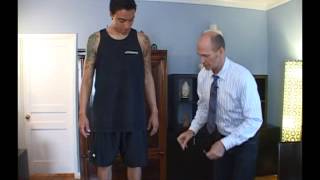
Dr. Ken Best demonstrates muscle testing with an encoder device. Ring-finger weakness shows at 5-7 pounds; after holding the encoder, tolerance jumps to 15-20 pounds. Flexibility improves about an inch just from holding it.
Questions this video answers
About 5–7 pounds of pressure.
Less than half a pound (the tester said "I haven't even got a half a pound on him and he's going weak already").
About 7 pounds on that side.
About 15–20 pounds.
About one inch.
Chapters
Sa.
Providing you with directions for each test is Dr. Kenneth Best, owner of Best Sports and Holistic Chiropractic in Los Angeles. For those of you who are not familiar with Dr. Kenneth Best, he is one of the country's most celebrated sports and holistic chiropractors. Dr. Kenneth Best is author of two books, Facing Life's Challenges and Rewriting youg Life. He's a former competitive rower and an on site chiropractor with the national cycling team for the US Olympic trials. Dr. Best is known as the celebrity chiropractor because he's much in demand by the cast and crews of television and film shows. And he's appeared on news shows such as the doctors Extra, KTLA 5 Fox 11, KCAL 9. So you're in very good hands here. Now let's meet Dr. Ken Best.
Hi, I'm Dr. Ken Best and what we're going to do is test a simple muscle strength today using his hand and ring finger. Because previously we tried his middle finger and he's so strong that I can't get the muscle to fail. In other words, if I keep applying pressure, at some point the muscle should weaken. He's really strong and I can't break that. Let's go ahead and try that. We're going to hold these two fingers together. I'm at the folds of the knuckle. I'm going to pull apart. One, two, three, resist. And I can't get him to break. So he's very strong. So what we're going to go for is the ring finger. Now, a couple things you need to be careful of are just having the same direction every time you do the test and, and applying the same amount of pressure evenly as you start the test. And.
Hold these together, I'm going to pull them apart. So now I'm going to try the ring finger because he was too strong with the middle finger. One, two, three, resist. Hold strong.
And it took about five to seven pounds of pressure before he went weak. Let's just check it one more time. Hold strong. Hold strong. One, two, three, resist.
Okay, so you have a good sense of how strong you were with that. I'm going to grab the encoder and you're going to hold that in your hand so we can just put that in your magnetic field. I'm going to go back to the ring finger. I want to do exactly the same test. I'm going to be back on the fold of the finger and the fold on the thumb. Hold these together as strong as you can and 1, 2, 3, resist.
Wow. I think I got a muscle cramp out of that, so you're a lot stronger with that. I could not even break them on that, so that's pretty impressive. Hold strong. One, two, three, resist. Okay, we're going to take the encoder. We're going to have you just hold that in that hand so we get the energy of that and see how it changes the weakness of that test. Hold strong. One, two, three, resist. Oh, my. That's amazing. That's good.
Hi, I'm Dr. Ken Best, and we're going to show you how to test balance on the encoder. So first, what we're going to do is we're going to have him stand on one leg. So let's stand on your right leg, bring this arm out to the side. I'm going to do. I'm going to make sure that he can balance first on his own, which he can. I'm going to apply very slowly pressure at the wrist. I haven't even got a half a pound on him and he's going weak already, so that's not too good for an athlete. Let's try the other side. See how you do there. Stand on that leg, Bring this arm out. I'm going to apply pressure very slowly. And this side, I've got 3, 4, 5, 6, about 7 pounds of pressure before he goes weak on that side. So let's try the encoder with him, see how that helps. Let's just hold that in that hand for now. Go ahead and step on that right leg. This was the really weak side. Bring this up here. I'm going to hold. And so he still goes weak on this side, so I suspect a neurologic weakness on that side. Do that again. Hold strong.
Okay, now, just out of curiosity.
Okay, step on that leg. Hold there.
So.
What I did is I just tapped on the encoder just to activate it for a second, because the encoder reacts to the body because of the type of technology that's put into it. And go ahead and step on the right leg. And so when I tapped it, then I got a really good response where I can put, you know, a good 15, 20 pounds on him and he doesn't go weak. Now, that's just because I suspected a neurologic pathway that was inhibited on that side because we tested him earlier and that muscle is weak. But if we take this away.
And retest him, hold strong so he goes back weak. So I know it was this muscle here. Bring your leg out to the side. Hold here. I'm going to push. And that muscle goes weak. So just in the clear, that muscle was weak, which is why he can't stand on that leg. Now, when we go back to the other side. So we're going to put the encoder on this side, step up on your left leg. So we knew he could balance on this side, and we knew it could take about 7 pounds of force. Hold strong.
And I can do at least two to three times the amount of force before he can go over on that side. So that's pretty impressive.
So, hi, I'm Dr. Ken Best, and what we're going to do is we're going to test your flexibility. And we're going to do that by having you just do a simple forward bend. And one of the things we want to do is just have you do it a few times so we can find your max range. So go ahead and touch your toes for me.
Bring them down even. Okay, so you already get down to your toes. Let's have you go a little bit further. Go as far as you can.
And come back up so we can already reach past your toes. So if you have the ability to be on a stair step or maybe the curb outside, what I'm going to do is introduce a box for you to stand on for right now, just so we can, for this test, see how much more range of motion he actually gets.
So let's go ahead and have you stand up on that.
And so bending forward, not twisting your body, so you want to make sure you're coming down even both times. So go as far as you can. Go forward, touching in front of the box.
Okay. Come back up and do it again one more time.
And. Okay, good. Come back up.
And let's have you hold the encoder in your hand and come and reach forward.
And so we. We gained about an inch because now we're at the bottom of that. And come back up and try it one more time, see if you get any more.
Okay, and the same thing. So as far as your range of motion, it gives you the width of one of these, which is about an inch.
Good. Okay, fantastic. Here you go. Put this on the same wrist with the encoder. Now.
Quite a substantial difference.
So, ladies and gentlemen, grab a partner, follow Dr. Best's directions, and put your new encoder through its paces. Then register for your lifetime guarantee, checking the boxes where you experienced gains over the coming weeks. You'll no doubt experience an increase in stamina, coordination, focus, and energy. But that's all we can show you today. Also remember, the daily use of the Entramner drops works in synergy with the encoder to amplify the gains you've just experienced by an additional 10 to 25%. So again, congratulations and enjoy. And now that you know how to conduct these tests, why not have some fun practicing them with your family, friends and co athletes? Or at least the athletes with whom you're not competing with. This is Alta Laina saying goodbye for now.