Ben Greenfield breaks down why generic shoe insoles don't work for most athletes and walks through your options: off-the-shelf brands like Superfeet, adjustable inserts with removable shims, oven-molded versions, and fully custom orthotics from a podiatrist. More customization costs more but fits your foot better for running and cycling.
Chapters
Hey, I'm Ben Greenfield, and the reason I'm holding a shoe is because I want to talk to you about what's inside the shoe, the orthotic. And I think, you know, a lot of times you'll buy a shoe and it can be a 100 or 150 dollar shoe, and you'll assume that because, you know, the outside of the shoe is so nice and expensive and works so well, that the inside of the shoe is just going to automatically be optimized for your foot. And whether we're talking about a running shoe or a cycling shoe, that's often not the case. Everybody's foot is incredibly unique and we can't assume that a shoe that's designed to fit.
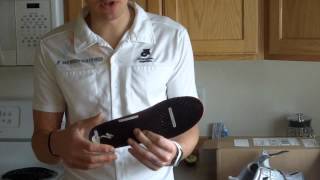
A portion of the population is going to fit you, especially when you're out pounding as many miles as you're probably going to pound in those shoes. So when we take an orthotic out of a shoe, typically you'll see something that's shaped like this. And I'm not saying that this pattern isn't bad. This is a pattern that again, fits kind of a subset of the human population kind of decently and doesn't really fit that many people for going out and pounding the pavement for mile after mile after mile. Don't get me wrong, if you were standing around in this orthotic at your job, it probably wouldn't be that big of a deal. But what you generally see is you've essentially got a heel to toe with a little bit of build up right in here to support your arch. And most shoes these days keep you from pronating too much. So what I mean by pronating is typically when you strike the ground, you'll be slightly on your big toe with your heel slightly down, and you tend to kind of roll towards the, towards the little toe, towards the outside of the foot after your foot strikes the ground. And an orthotic like this supports that to some extent. But the problem is that so many people get injured with these type of orthotics because they just don't fit your foot the way that your foot is supposed to be fit. So that's where custom orthotics come in. One option is that you can simply get an orthotic, and this is an example of a cycling orthotic that's not custom in that you pay a lot of money to get your foot molded or anything like that. But it's a step above the average orthotic that you're going to find in a cycling shoe or running shoe. And this is called a specialized body geometry orthotic. And if you close up on it, you'll see what's called a metatarsal button right in the middle there that spreads the actual metatarsal bones in your foot. And by spreading those bones in your foot, it causes the nerves that run down the middle of your foot to be less compressed. So you don't get things like numb foot, numb toes, things of that nature. It's also more built up and a little bit stiffer, just higher quality material than you get in the average orthotic that you pull out of a cycling shoe. And it's built with. The other thing I should point out here is a longitudinal arch. This arch extends down the foot a little bit longer than a normal orthotic would. And so something like this you can buy off the shelf. If you bought something like a specialized shoe, this is what most of them come with. But you can also just buy these off the shelf and put them in any cycling shoe. A version of this that would be the equivalent for running shoe would be like, for example, if you've heard of Superfeet, Superfeet is an orthotic that's very similar. It's designed to be kind of a cut above the average orthotic you're to going to find in a shoe. Now another option, kind of the halfway point to customizing a shoe is to get something like this. This is an E sole and this is a cycling orthotic. But it's got this plastic piece on the bottom of it that you can actually take off.
And you can customize your footbed by choosing a color that fits your foot best. The reason that I have this beige color is I just went and at the bike shop riding the bike, just tried every orthotic that they hear that they had at the store and ended up finding that this one fit the foot best and made my foot feel most comfortable. And you will find that there's many of these easels will come with all of these. Like you buy it and it'll come with all these. And you can try that at home. I just wanted one from the cycling shop. So this is kind of like halfway to customizing your foot. Another example of going halfway would be to get a regular shoe, but to get a shoe that's called an oven molded shoe. Shimano used to make one like this. You can get oven molded orthotics. I don't have an oven molded here to demonstrate to you, but this would be another example of something similar where it's not quite customized to the foot, but it's very, very close. And then the last option, if you want to go with the Cadillac version, would be to just get your foot molded. And I went to my physical therapist. Many physical therapists will do this. Many podiatrists will do it. So see one that works with athletes, if you go see a physical therapist or podiatrist. But I got a casting of my foot, and based off of this casting of my foot I had, and you just pay for one time casting, you can use it over and over again. But I had a custom orthotic created for my running shoe, and then also a custom orthotic that's a little bit stiffer, shaped a little bit differently created for my cycling shoe. This is what a custom orthotic looks like. You can see it. You know, it's kind of stiff through here. It's got different buildup through here. This is molded exactly to my foot. It's the most comfortable thing I can put in my shoe other than just walking around in bare feet. So in terms of completely customizing your orthotic experience, you can get your foot casted as a physical therapist or a podiatrist and go with that method. But, you know, compared to the first orthotic here that I showed you, the first insert here that I showed you, big difference between something like this, which is very, very generic, and something like this, which is completely customized to you, and even something like this or this, which is kind of right in the middle. So as you can see, there's a multitude of solutions. The more customized it is, the more you're going to pay. So there is a financial.
There'S a financial aspect to this, but hopefully that gives you a little bit better idea of what you're working with when it comes to orthotics. So I'm Ben Greenfield, and I hope that was helpful.