Full-Body Biohacking Workout in 20 Minutes, No External Loads or Joint Impact - Bjoern Woltermann
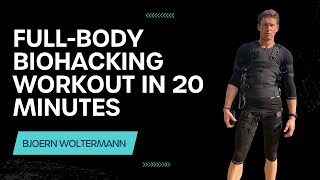
Podcast interview with Bjorn Woltermann (founder of Catalyst) discussing the Catalyst full‑body EMS suit: how it works (modular vest/shorts/arm straps + Impulse Pack controlled by an iPad app), distinct electrical protocols for strength versus cardio, and practical usage (20‑minute sessions, typical frequency ~1–2x/week). The conversation covers emerging clinical and longevity applications (sarcopenia, bone mineral density, congestive heart failure, pelvic‑floor rehabilitation), safety notes (pacemaker contraindication; company claims FDA home‑use clearance), and purchase/shipping details (price and financing).
Questions this video answers
$2,385
$500 deposit; financing via Affirm example ≈ $66/month over 3 years
Catalyst is described as the only FDA‑cleared device for home use (per the speaker)
Average observed use ≈ 1.8 sessions per week (company figure)
Approximately 10% of muscle mass loss per decade (statement from guest)
Chapters
My name is Ben Greenfield, and on this episode of the Ben Greenfield Life.
Podcast, we normally use about 10% of our muscle mass every decade. At the age of, like, 85, we're left as men with, like, 60% or something like this. That has impact to our hormonal balances, to our activity levels. It has an impact, like how we burn calories. It has an impact on how we recover. If we're tripping, are we falling? Are we not? Are we breaking bones? Are we not? We can solve this. It's a bold statement, but I have a lot of customers in their 70s and even some in their 80s. They say, like, it's rejuvenating and they're becoming more active. And females in their 60s say, I can play with my kids again. It's beautiful.
Faith, family, fitness, health, performance, nutrition, longevity, ancestral living, biohacking, and a whole lot more. Welcome to the show.
I'm gonna tell you a quick story. One of my friends took this fringe weight and blood sugar control supplement called Semaglutide. It's a peptide. This was, like, three days after he took it, and I was sitting with him at dinner, and he couldn't eat. He literally just, like, couldn't eat. He was staring at the food, no appetite. And obviously that's why Semaglutide is used for things like diabetes and obesity and significant appetite. I'm personally a foodie, so I probably wouldn't go near the stuff because I like to eat. What my friend was doing this whole time was he was tracking his blood glucose. He was holding his phone up by his armpit and then take his phone away, and he could see his blood glucose just dropping over three days in real time at any point. One of my other friends was at dinner. He's like, what are you doing? Why do you keep holding your phone up to your armpit? He's like, because, look, I can see my blood glucose whenever I want. Well, he was using a blood glucose monitor rather than those annoying things that you test your blood with on your fingertip from the drugstore. And he was using this monitor, supported by this company called Levels. Devils is basically a company that has partnered with these blood glucose monitors where they send it out to your house, you put it on, and then you track your blood glucose in real time, anywhere you are like, how do green beans affect my blood sugar? How does steak affect my blood sugar? How does sledding in the snow affect my blood sugar? How does a stressful email affect my blood sugar? What lifestyle changes, diet changes, exercise changes. Can I make for better blood glucose? Because that's highly correlated to health and overall longevity. So levels is at the cutting edge of this stuff. And if you want to get in on levels and better understand how food affects your health and try a continuous blood glucose monitor for yourself, you can go to Levels Link Ben. That's levels L, I, N K. Ben. Levels Link Ben. They got a bunch of all the information you need over there about how to get started with blood glucose monitoring. Levels link Ben. One of my favorite ways these days to strengthen my immune system and optimize my recovery is by getting in my Clearlight Sauna. It's a clearlight infrared sauna, helps you create heat shock proteins that stimulate cell repair and help to rebuild muscles faster and protect against degenerative diseases like Alzheimer's and Parkinson's. And most people aren't aware of the essential role that these heat shock proteins play. An immune function too, which is really nice this time of year when their sickness is going around. It allows your immune system to react more quickly and efficiently to viruses and pathogens. It helps to inhibit viral replication and decrease levels of inflammatory cytokines, while at the same time, the heat increases nitric oxide production in the body, which also has antiviral effects. Now, what I have at my house is a Clearlight sanctuary sauna because I can get a whole bunch of my friends in there. We can sit around, we can chat, we can burn incense and sprinkle essential oils like little hippies all over the place. But we're also guilt free because all the Clearlight saunas, unlike many of the saunas out there that basically microwave you while you're inside of them, these ones have EMF and ELF shielding so you're not exposing your body to harmful dirty electricity. And they come with a lifetime warranty, which is the ultimate guarantee of a quality product. And these things are high quality. So you get their complete line that you can check out at Clearlight Saunas when you go to healwithheat.com healwithheat.com, mention code Ben for extra discount and free shipping. That's healwithheat.com, mention my name Ben for a smoking hot deal and free shipping. One of my favorite, not carbohydrate, not fat, not protein. Little known secret macronutrients is now back in stock. It's called ketones. The ones I use are made by hvmn. They're called Ketone iq. They're perfect for staving your appetite for hours on end, running from Meeting to meeting when you can't get food. Any type of endurance activity because ketones are a great fuel for the heart, for the liver, for the diaphragm anytime you want. A great amount of portability, convenience on an airplane, it's amazing because you're not even tempted at all by any food the whole time you're sitting on the airplane. Ketones are 28% more efficient at generating energy than sugar alone. That means you could do a lot more with a lot less, especially when your body gets pushed to the limits. Because ketones help you convert stored fat into energy. And then with ketone iq, you can actually get that without having to fast and excessively restrict carbohydrates. They created this stuff through a $6 million contract from the U.S. department of Defense. Deep partnerships with some of the top researchers in ketone science. It's a truly cutting edge drink. It avoids the insulin spikes, the caffeine jitters, the mid afternoon energy crashes. So super simple. You just throw this stuff back, I'll toss back a shot straight out of the bottle. Some people like to mix it with a little water, stevia, stuff like that. But either way, HVMN stands by their products 100%.
All right?
If you're not satisfied, your order is free. That's how much they believe and I believe in the power of ketones been using for years and years. Here's how to get 20% off of any purchase of Ketone IQ. You go to HVMN me BENG. H, V M N me BENGAL. Use code BENG. That gets you 20% off of any purchase of ketone IQ. You can also find them at any California Earth bar locations, which are usually within an equinox, so check them out. Hvmn me beng. So a few months ago, I released a podcast episode about what I titled as the world's most efficient biohacked workout. It was a whole episode where me and my guest went deep into the science behind what's called full body electro muscle stimulation. And we talked about this suit. You may have seen it before. It's kind of become this big thing amongst celebrities and biohackers and fitness enthusiasts. It's a suit that you actually pull on that's an electrical muscle stimulation suit. And unlike many of the former EMS suits that have existed up until that point, there are no long cables and wires and things sticking out of it. So it's just like all wireless. You pull it on and then you basically link it to an iPad. And a trainer is right There walking you through an entire workout with moves like squats and lunges and presses. It'll literally simulate you feeling as though you've lifted hundreds of pounds. But it's just this suit that you pull on. So I kind of predicted when we recorded that episode that this technology was going to take the fitness world by storm. And it has. I mean, pro athletes are using this to build muscles that they've. They've never been able to build before, to train muscles they've never used before to retrain injured muscles. And people all over the world now are using this thing as a way to basically get all the benefits of heavy lifting, rehab, injury recovery, cardio, blood flow, et cetera, simply by pulling on a pair of shorts and a shirt that are lined with electrical muscle stimulation and then just basically going to town with a very, very small footprint and an easy to use device that'll travel everywhere. I interviewed the guy who founded this company and actually brought full body EMS to the United States, and his name is Bjorn Wolterman. And there's been a lot going on in terms of electrical muscle stimulation technology. Some of the news, some of the science on it, even things like bone density and sarcopenia and congestive heart failure. And I thought it'd be cool to get Bjorn back on to revis this whole idea behind EMS and how it works. For those of you who didn't get a chance to listen to the first episode, and also to delve into some of the burning questions that I've gotten from my audience about this Catalyst EMS suit, and also some of the questions that I have. So if you're listening in and you want a link to the previous podcast for an even more thorough explanation of what the technology is and how it works, then you can go to BenGreenfieldLife.com or Catalyst2. That's BenGreenfieldLife.com catalyst the number two. And I'll link to my original podcast with Bjorn, some other articles that I've written about electrical muscle stimulation, and then of course, all the shownotes for what we're about to talk about today. So, Bjorn, welcome back to the show, man.
Thank you for having me, Ben.
I appreciate you doing this. From a hotel down in Mexico, we've been trying to make this episode work just to give folks the full update. So. So here we go. And what part of Mexico are you in again?
We're in Playa del Carmen. It's my wife's birthday. And this is our fixed week a year where, hey, we're Going to take a week off, but it works. The Internet is. Okay, good enough for this. So here we go.
Yeah, you're coming through. Okay. I was just telling you before we started recording, my wife and I just got back from San Miguel de Allende, which is a fantastic little city in Mexico. It's not in the water, so you don't have a lot of the annoying tourists walking around in swimsuits, but it's just all cobblestone streets and art galleries and amazing kind of like mom and pop shops. And we were celebrating the Day of the Dead, the Dia de los Muertes down there. It literally feels like you're almost like in Europe or northern Spain and not in Mexico. So if you ever get a chance, you'll have to visit that spot, too.
I definitely want to. I mean, the Day of the Dead is very high on the list for my wife and me and. Yeah, maybe next year.
Yeah, we got all dressed up for it and painted up and actually the conference that I was speaking at or private group that I was speaking with, the entire thing was based around pondering your own death, working on your tombstone, writing your obituary, learning about deathbed moments, and essentially how you live your life in terms of purpose and motivation and adventure and bucket list items. So it was actually pretty powerful event, of course, surrounded by a bunch of kids out in the streets celebrating the Day of the Dead festival. So it's an interesting experience, very interesting setting.
Yes.
But of course we're not going to talk about dying today. Hopefully we're going to talk about living with electrical muscle stimulation. So I think before we delve into some of the questions I've gotten about this whole Catalyst device, and some of the things have been changing in terms of the research and the science that you wanted to hop on and talk with me about. Can you give people the basic overview of the Catalyst, what it is and what it does?
The Catalyst training system is, as you said, full body electro muscle stimulation device. It comes in the form of a suit. And the suit is modular. It has three components. It has a vest, a shorts piece, and then two arm straps. And with this format, we are capable of serving basically individuals of any shape or size and form and level of activity and fitness and age, gender, all the dimensions. Because what we wanted to build is we wanted to build a training system that can literally help people get in shape or achieve their fitness goals, whoever they are and wherever they are on their fitness journey. It's controlled by an iPad. It's all the smarts and all the Softwares within an iPad app which takes training content like Think Netflix training content out of the cloud. And it communicates with what we call the Impulse Pack. It's like a small device, it's a little bit like an iPhone size, a little bit thicker than this and it gets attached to the suit and there's a Bluetooth connection between the Impulse Pack and the the iPad. The Impulse pack sits on your hip or like a little bit more on your technically on your hamstrings where it doesn't get in the way. Basically that device then sends small electrical currents through your body to each muscle group that is targeted in a very specific form. So each impulse for each muscle group is different. And what it does is it simulates or basically superimposes the same signal that you would send from your brain to your muscle to tell the muscle to contract. I mean tell. Right. You know what I mean? So basically there's a nervous signal that gets through your motor nerves to motor neurons and basically elicits a contraction within fibers within the muscle. And this signal we know exactly how it looks like and what to do and we can go into different ways of how to do it. Like there's when you wanted to have like fast twitch muscle development with type 2 muscle fibers fibers, there's a different signal as if you want to have a general strength training which more elicits power growth.
On slow twitch muscle fibers. Or if you want a cardiovascular just increase and load from a taxation of your cardiovascular system or if you just want a pumping sensation which helps with nutrient distribution and flush out of lactic acid. So basically we can exactly tell each muscle in your body what to do, how much to do it. And the muscle cannot differentiate between the signal that comes from your brain and the signal that comes from the training system. What that allows us to do is it allows us to help individuals that either already have maxed out their capabilities because they're athletes and they're on a plateau to give the muscle even more to do and a different stimulus. And I mean you have used it now for quite some time. And every time you use it it's like you did a totally different set of training as if you would normally lift because it actually activates the muscle in a very, very complete way.
Well, it activates the muscle in a very complete way or activates little tiny stabilizing muscles that have been detrained or that you haven't been using because again it's bypassing your brain. So your brain doesn't get to select which muscles it's going to use because that's what it's comfortable grabbing.
Yeah, you cannot cheat. Exactly. That's really what it is. And for example, for me, when I first found it, I had a very weak lower back, 6 foot 4 tall, skinny guy, and I had massive back problems and didn't know how to literally train my lower back. And a lot of machines that you also find in the gym, these rotation machines are actually not good for you. But with EMS training, you can literally trigger and target each muscle in exact way how you want it to achieve the goals that you intend to do.
Yeah. One thing you mentioned there was how it could be used for recovery. This is probably one way I haven't been using it. But for example, when I interviewed the folks who designed this automated blood flow restriction cuff system called the Katsu, which is kind of a popular training system in Japan, and by the way, I feel like I get a little bit of a Katsu like training effect wearing the catalyst just because. Because there's a little bit of blood flow restriction to the arms and the legs just by having the suit on. But nonetheless, these guys said, well, you could get a lot of the pumping effect from the Katsu, the benefits of it from a recovery and a blood flow standpoint by simply wearing it while you are, say, at the office, while you're at your workstation, preferably your standing workstation, and just have it running passively. They also recommended that you could do the same if you were just say, out on a long walk. The catalyst, is that something that you've had users just literally just pull on and have on during a day of work, say underneath their normal work clothes to occasionally do a little bit of electro muscle simulation.
We haven't had that yet. At least I'm not aware of it. I mean, there's many users out there and they tell us stories like what they achieved with their Catalyst suit, I mean, months after. So I don't know if anybody used it during regular days or in combination with a Kaatsu. What I can tell you is because we have a very complete muscle activation, which means there's a very high use of adp, glycogen or whatsoever in the muscle in relation to the normal use. There could be an effect where just the general replenishing of nutrients is not fast enough to basically replenish the nutrients within the muscle. Where in a Kaatsu that's exactly what you're doing, you're reducing the supply of nutrients and oxygen and that it could be that because the Increase in the Catalyst training, the increase of basically usage and depletion of nutrients and ADP could be a similar effect. Basically where supply and demand gets out of whack. Right. So in Katsu you restrict the supply and with Catalyst you increase the demand. So yes, that could be. What if you would just strap on your arms even more than it should be. You probably also have a blood flow restriction. We don't recommend that.
Yeah, you don't recommend combining blood flow restriction with electrical muscle stimulation.
I just don't know. Right. So it's something that we haven't really tested yet. And before I recommend something like we have thoroughly tested everything, so maybe I should get one and we should run a small study. But I haven't tested it yet.
Yeah, the other thing that someone recommended to me was I do some training on this super slow resistance training device called the arx. I forget who it was, but they said they'd actually worn the EMS suit while doing super slow training and that it was just an absolute game changer in terms of the demand. Now obviously the Catalyst is designed originally to use no weights or occasionally very light weights. And that's kind of the idea is you don't need weights when you use it. But have you ever combined it with something like a super slow training protocol or some type of very slow and controlled lifting protocol that would allow you to do electrical muscle stimulation and lifting simultaneously?
Yeah, what I've done is I just sometimes use very small weights in my hands just as additional resistance, or these egg weights or small weights. Something like this, definitely. I know that there are pro sports protocols, like with soccer players and so on and so forth, where they basically combine it with like squat jumps or box jumps and so on and so forth. But I would definitely do this in a very controlled environment because under the stimulation, you know that you don't have 100% control over your motions, like as much as you're used to. So as a beginner, I wouldn't do it as a pro. Yeah, there's something, I combine it with a trx, something like this, just to mix it up a little bit. We don't have content for that yet, but maybe one day.
Yeah, I mean, there's obviously a lot of uses that I'm sure people are experimenting with the Catalyst on. But the one that I think is probably in addition to just your full body strength routine that you have in there is the cardio component on something like an Airdyne bike. That's kind of my go to modality is most of your strength training workouts last about 20 minutes. So that's, that's more than enough in terms of anybody who has not used this device that might not seem like a long workout, but you're not really begging for more. The 20 minute mark.
Yeah, we're joking. It's a time machine. When it says after 10 minutes it's half time, you're like, no way.
Yeah, exactly. I think the workouts go by pretty fast because you're switching from exercise to exercise at a pretty rapid pace. But yeah, I mean, I wouldn't want to go much more than 20 minutes with the strength training. But then what I do, because I like to just get my strength and my cardio done with all at once if I have the option. Just as a time hack is you keep the suit on and after the iPad finishes the strength training session, you can then select a cardio session and you can set your cardio for I think 10, 20, 30, or I believe there's even a 40 minute option on there. But it's kind of like a lower intensity stimulation that is again, more cardio based. But I'll just walk over to the Airdyne bike and do the cardio while on the Aerodyne. It is probably one of the more physically demanding cardio workouts that I ever do when I use that 1:2 modality of cardio mode plus the full body bike. Now obviously on the iPad, it'll show you how you can just run in place, two jumping jacks, et cetera. But man, oh man, getting on a bike with that thing is nuts. And I actually wanted to ask you, I don't recall if we covered this in detail in the last podcast, but what is the difference in terms of the electrical modality used for the cardio versus strength? Because it feels remarkably different.
Yeah, it does. So first of all, I also use that, what I recommend there is a cardio interval training, which is just basically just see the logo, but it has timers where you basically do 30 seconds of you go full on and then 30 seconds of just recover. And I do this on the edine bike or on the assault bikes and you literally for 30 seconds you go all out and then again like for 30 seconds or a minute, you just recover a little bit. And combined assault bike with catalyst cardio is just. It's wrecking. It's absolutely wrecking. So after like 10, 15 minutes of this, I'm literally like sitting there and just catch my breath. But yeah, it's a wonderful workout. Okay, coming back to the Difference in what we do with the muscle. So I don't know if we covered this last time, but each muscle group in the body has a characteristic about how much of a trigger or how long of a trigger it needs to react, which is the pulse width of an individual pulse. In EMS training or in strength training, you basically send between 1 to roughly 100 impulses per second. So 1 impulse per second is what you feel in the. Let's start on the other side, the most common one. So in the power one, you send 100 impulses a second and what you do is you need to have that many impulses, because the fast twitch muscle fibers, when they fire, they also deactivate quickly. They don't just fire quickly, they also deactivate quickly. So to basically build them up to a full tetanus, what we want in power and strength, strength, you need a lot of small nudges to the muscle to keep them in a full tetanus. So in a contraction, that's actually what you want to achieve. If you go below that, what happens is the fast twitch muscle fibers fall off, they don't develop a full tetanus. And your main strength development comes from the slow twitch muscle fibers. That's roughly 75 hertz that we're using. Not it's 75 we're using, but that's roughly the area. If you now go further down, what's happening is you have individual twitches and the muscle fibers actually don't develop a full tetanus, so they don't come to a full contraction. So they basically activate and then fall off again. And activate and fall off again. So you have a use of adp, you have a use of glycogen. If you have anything left, you should generally do strength first, cardio second. Because during strength training, you need your glycogen in the muscle. And if you already did 20 minutes of catalyst strength and want to go into cardio, you want to go also into fat burning and these aspects. So do this second. So if you have anything left, it will then use more of the nutrients that are in your muscle, but will not create a full tetanus. So you feel these small twitches. So basically what we're doing, we're nudging the muscle to work, but you still have enough control over your body that you can do complex movements like running or cycling or jumping jacks and so on and so forth.
Yeah, because with the strength, it sometimes feels as though the muscle's almost in a state of pure tetanus to where when you're doing an overhead press, you almost have to go inch by inch, which obviously isn't conducive to walking or running or being on a bike.
Exactly. So the training goal that we have is we want to text the cardiovascular system so you need to deliver more oxygen, because we want to get our VO2 max up. You have to deliver more nutrients. The blood has to be pumped through the body so the heart rate goes up. These are the goals in the cardio training. So what we're doing is we are taxing the cardiovascular system all over the body by activating muscle fibers, but just partially. So your body basically does the running or does the assault bike. And then we put an additional tax on it, which is this incredible trait, because now your cardiovascular system really, really has to work, and that even work with individuals that, for example, have issues like knee replacements or hip replacements. So we have customers that literally just walk on a treadmill. They don't run, they just walk on a treadmill. But then they increase the load from the Catalyst system and can get their heart rate exactly where they want it to be. Maybe they want it at 120, maybe they want it at 130. But you can do this without running. You can do this without the impact on your bones and joints and so on and so forth. Forth. Or you are, let's say, an MMA fighter, and you already do these interval sessions, cardio interval sessions, on assault bikes, because you are simulating real exhaustion, very, very strong exhaustions, over 30 seconds or a minute. And then you need to learn how to get your heart rate down again, and so on and so forth. If we now put the Catalyst system on top of it, you literally get wrecked in this one minute, which is a very realistic training, because we tax your system on top of what you're doing from the traditional workout.
Yeah, well, there's something about it that's just absolutely crazy when it comes to the cardiovascular component. I mean, you can literally. And this is kind of like my thing with the Catalyst is I don't use it any more often. You may not want to hear this as the owner of the company, but any more often than about once per week. Just because, honestly, when I do a workout, I do the workout up pretty seriously and go all in. And for me, there's enough little muscles that get recruited and enough of an impetus that I don't get from other strength training workouts that I'm sore enough from using that to where I don't really want to come back for a good week. And I actually have a lot of clients now who own the Catalyst. And we program in either one cardio and one strength workout per week, or one strength cardio combo per week. And then on the other days they're doing a little bit of kettlebell, they're lifting weights. Now when people travel, I have them using it more frequently. The other thing that I do in addition to using it on an average of once per week is if I know I'm not going to be able to work out for a few days, or if I have a long haul flight, or if I just know that I'm not going to be able to move much, I'll do a pretty tough catalyst workout. Because honestly I just don't feel like working out or I feel as though I'm sorrento from that thing to where I don't need to. So if I've got a big long haul flight or something coming up, I'll do a big workout. Just because you literally feel as though you only have to work out like once a week when you wear this thing. Maybe I've got the intensity turned up too high though because I do really, really like to feel as though I'm pushing against the thing.
Everyone is different. So you, for example, you already have your training regimen and if you want to supplement it with a catalyst and you do this and it gives you the results you want, perfect. My wife is the same, she's working out all the time and she uses it for especially lower body training like glutes activation, lower back activation, abs. Like these are really areas that are sometimes hard to train and absolutely loves it. And the same as you said, like when we are traveling, she always has her suit with her. That's absolutely the way to do it. I see this with quite some people that are very, very regular gym goers or like, you know, doing other types of trainings. It's a perfect supplement. And then if you are not working out at all and starting with just once a week, that already has life changing effects. So as long as you use it and you regularly use it, I don't care how much you use it. I want it to fit into your life and I want it to be something that you can consistent with because if you can't be consistent with it, you're not going to be successful. You know that, right? If people overdo with something and you say you have to do this three times a week and then after six weeks they fall off the regimen, that doesn't help anybody use this as much as you want and as you like it, and then supplement it with other things. We see roughly an average use of like 1.8 a week. That's what we see amongst our customers. Some use it more, some use it less. Do it how it fits into your life. That's how we designed it. You shouldn't be scheduling your trainer because the trainer only has time at 6:30 or 7 in the morning or whatsoever. You should take on your suit, do it whenever it fits into your life and then do it as often as you like. By the way, I also do it before I'm traveling. It's the best thing because then I also don't cramp up that much when I'm sitting on a plane for long periods of time. And I did Catalyst before. The muscles are just so exhausted, they just really relax. I love it.
Yeah, it's perfect for a long haul flight where you want to sleep and your body's just. All right, I'm ready for recovery now. We could go on to. We're blue in the face about the science behind the Catalyst, but we covered a lot of that in our initial episode. And again, I'll link to that and the Catalyst and everything else we talk about@bengreenfieldlife.com Catalyst 2 and Catalyst is called a K. So Catalyst, the number two. The reason that we kind of originally decided to pop on and do this episode in the first place, this follow up episode, Bjorn, was there's been a lot that you guys have been finding in terms of research and science for other indications for this that go beyond just fitness or getting ready for a long plane flight. Can you go into some of the things that you guys have been finding as far as the latest science and news on this form of electrical muscle stimulation?
Some of this is very nascent. But what we are seeing is there's more and more studies coming up that indicate that the full body muscle stimulation does not only benefit your muscle mass, but also your bone calcification. So bone density in general, the traditional science headed to a point or like wisdom headed to a point that if you don't lift heavy weights, you don't have any positive impact on your bones. Catalyst is becoming more and more besides the young, healthy, fit people who supplement it like you. It's becoming more and more a longevity topic. And in longevity, we have two big problems. We have sarcopenia and we have osteoporosis. Like on a physical perspective, sarcopenia, which is the loss of muscle mass as we age, is basically solved at this point in time, I know it's a big word, but if you do catalyst once a week, you're basically maintaining your muscle mass if not gaining as long as you want. We normally use about 10% of our muscle mass every decade. So at the age of 85, we're left as men with 60% or something like this. And that has impact to our hormonal balances, to our activity levels. It has an impact to how we burn calories, it has an impact on how we recover. If we're tripping, are we falling? Are we not? Are we breaking bones? Are we not? Yeah, we can solve this. It's a bold statement, but, you know, people that really use this and have a lot of customers in their 70s and even some in their 80s, they say like, you know, it's rejuvenating and they're becoming more active. And females in their 60s say, I can play with my kids again. It's beautiful.
Now, have you guys actually run any actual studies on the sarcopenia component?
So we are currently starting one. We are working with several universities on different specific topics. One is Sarcopenia and Neurology in Aging. And they want to run it with a group of subjects in their 60s and see how we can basically either stop it or even reverse it. We are having another initiative with a subsection of the Mayo Clinic. It is a group called We Build Hearts. They work with individuals that have congestive heart failure. We were not cleared for this yet. We're very clear, like, you know, we're starting the research round, but they approached us and said like, hey, we think that full body Ms. Training is a regimen that is easy to be compliant with and that individuals that have heart issues can easily do they feel safe with it. It is safe. We can see basically life extension. We have to still run this and prove this, but this is the suggestion that's basically coming out of this.
Okay, and by the way, quick interruption there about the safety of using it with the heart. Is there any concern if there are fibrillation issues or electrical abnormalities in the heart? Because this obviously is an electrical signal.
So two things, like if you have a pacemaker, you must not use it because the pacemaker basically will interpret the EMS signal as, oh, something is wrong and which is misfire. That's basically what's happening. We don't kill the pacemaker, but it will basically misfire. So first of all, Catalyst is the only FDA cleared device for home use. Literally, we're the only device that you can use without supervision. And in order to get that, what we had to prove is that it is safe and does not affect the heart. If you have afib or really a strong heart disease, you should definitely check in with your physician. But for a healthy heart it is not an issue. So we had to basically prove that. And how we did this is we worked with a pacemaker company. So we basically said, hey, how does a signal have to look like to actually reach the heart? And they said, hey, show me your parameters. And we showed them their parameters and they said, your device will be a very shitty pacemaker. That was literally on the phone.
Are you going to put that on the front page of your website? A very shitty pacemaker?
Yes. No. This was literally the comment that the physician from this pacemaker company gave us when I gave him the parameters. It's basically like the heart is very well protected, there's a sack with water. It's basically a Faraday cage. And like the human body is phenomenal, like, you know how it protects itself. So we cannot reach the heart, otherwise we also wouldn't have been cleared. On top of that, our device is physically built in a way. And you see this when you open the suit, for example, there are two electrodes on the right pectoral muscle and two electrodes on the left pectoral muscle and two on the right biceps and triceps and so on and so forth. So we have made sure that there's never a current going across the body. So for example, if you have a defibrillator or like an AED device, you have to basically put one on the left side of your chest and one on top of your right pack. This is basically how you have to put it because the current has to flow from one electrode to the other and basically has to penetrate the heart. So our device is designed that it stays within the muscle and just superficial. On top of that, we are only sending 1% of the energy that you would have needed it to reach the heart. So that's absolutely not an issue.
Remember last time you were at a gas station and you saw those over the counter sexual performance enhancing pills? They're tempting, I know, but if you ever actually looked at the ingredients, it's a bunch of central nervous system over stimulants that give you four hour erection and nasty side effects and heart problems. A possible trip to the hospital. There are certain pharmaceuticals out there that you could take for enhanced sexual performance. But why not go au natural? There's this company called Joy Mode. My wife and I have been using this stuff, what it is, is it's a powder you pour into water. It's got L, citrulline, arginine, yohimbine and vitamin C. The arginine and the yohimbine increase nitric oxide production and relaxation in your genitalia and increased sex drive. And the antioxidant action of the vitamin C protects the nitric oxide from what's called oxidative degradation, which further enhances the blood flow, promoting activity of the nitric oxide. So put all together, you get enhanced sex drive and blood flow for both ladies and gentlemen to their nether regions. And it doesn't have all the sorts of side effects that prescription medications or over the counter gas station pills come with you just tear open the sachet, you mix it with some water, I dump it straight into my mouth because I'm weird like that. And they take about 45 minutes to four hours prior to sexual activity. It'll last about five hours or so. You get better blood flow, better erection quality and firmness, screaming, better orgasms, better sexual energy, better sex drive. So if you want to spice things up in the bedroom naturally and boost your sex performance naturally, and do it without nasty prescription drugs or pharmaceuticals or prescriptions, then here's my offer for you. Go to usejoymode.com greenfield that's usejoymode J-O-Y mode.com greenfield or you can just enter the code greenfield at usejoymode.com, they'll get you 20% off your first order. Have fun with that one. I'm pretty stoked because this is now something I can do and I'm on the go. And it's based on this idea that the human body being mostly water, but what you probably don't know is everything else in your body is 50% amino acids. That means basically water and amino acids are two of the most important things that you can have in your body. And some amino acids are essential. You have to get them from food, from breaking down steak and chicken and eggs and everything else. But this stuff called kion aminos is a plant based full essential amino acids profile backed by over 20 years of clinical research with the highest quality ingredients, no fillers, no junk. Rigorous quality testing tastes amazing with all natural flavors. I got on the amino acids bandwagon way back when I was racing Ironman triathlon. Started with branched chain amino acids, realized those were a waste of time, switched over to essential amino acids and it has been a game changer ever since. Now, what did I mean when I said Travel well. These Kion aminos, which are the essential amino acids that I take, they have for the watermelon flavor, the lemon lime flavor, the berry flavor and the mango flavor. They got stick packs now so you can take them on the go anywhere. I honestly have a couple packs in my fanny pack now. I can dump them in water when I'm at a restaurant, have that instead of a bread, a basket that comes out or a cocktail. They satiate the appetite, they accelerate recovery, delivery. They're amazing pre workout or during a workout. The list goes on and on. Fact is, if you haven't tried essential amino acids, you're missing out. And you can save 20% now on any monthly deliveries and 10% on any one time purchases. If you go to getkion.comBen that's getkion.comBen to get my fundamental supplement for fitness Kion Aminos. GetK-I-O-N.com Bean.
This is it.
This is a big announcement. I'm thinking you're going to really dig this. It's something I've been working on for.
The past three years.
Probably one of the biggest and most exhausting projects I've ever done in my life. I've been asked for a long time to write a book on family and parenting and legacy and raising healthy and resilient and free thinking and impactful children. I've never felt very qualified to be able to write that kind of book because my sons are are just 14 and who's to say they're not going to wind up in prison. But I know a lot of parents with incredibly impactful children. Entrepreneurs, billionaires, single moms and dads, divorced parents, pastors, my parents, education experts, legacy builders, wealth management experts. Just people who have really decoded life, legacy, discipline, education, everything that goes into kind of like the blueprint for raising a tiny little superhuman. So what I did was kind of in the style of like Tools of Titans or Tribe of Mentors by Tim Ferriss, if you're familiar with that. I basically interviewed over 30 sets of amazing, amazing parents and I gathered all their knowledge, all their wisdom, all their little tips and tricks and insider strategies and tools and resources. And I put them all together in a book. I don't know if you read my book Boundless, but this is like what Boundless was for biohacking, this is that for parenting. It's actually called Boundless Parenting. It is well over 650 pages long. It is a tome. It is everything a new parent or existing parent or teacher or grandparent or anyone else who interacts with children would ever need to know. With interviews and tips from the best of the best parents on the face of the planet. It's called Boundless Tools, Tactics and Habits of Great Parents. Boundless Parenting Tools, Tactics and Habits of Great Parents. It's available now for pre orders. It's all@boundlessparentingbook.com I guess there's not a.
Whole lot for me to say other.
Than that if you go to BoundlessParentingBook.com you can sign up there, you can get on the pre order list. We're giving away a bunch of bonuses to the first handful of people who get on that pre order list, so.
So pre orders are open.
Yeah.
Now if you're hearing this BoundlessParentingBook.com I am so blessed and I'm so grateful and I'm so freaking excited about this project.
You have no idea.
I'm just like beaming from ear to ear right now.
So if you can help me share the word about this book, gosh, I would be super grateful.
If you want to pick one up for yourself or copies for friends, again, I'd be super grateful. I think that we can change a.
Lot of people's lives, a lot of.
Children'S lives, develop legacies that will last for generations to come after we've left this planet with a book like this. So BoundlessParentingBook.com check it out. And thank you so much for being a part of this.
In addition to what you found on sarcopenia and this idea that it might actually be something useful for congestive heart failure, I think another thing you had mentioned to me was an impact on bone density, which was actually surprising to me because this is something, and I think I even commented on this in the past. I've told people, well, you could do electrical muscle stimulation or blood flow restriction or tattoo training, but at some point you have to load the bone along the long axis of the bone to actually increase bone density. But it seems that you're indicating that might not be the case with something like ems.
It has to be the case still. However, the way you design the EMS training might have that side effect as well. So we have first studies in that basically suggest if you are not doing passive ems. So, for example, if you recover from a knee surgery and you're lying on the couch and you put a TENS unit on it that has no bone.
Density impact at all, you should clarify and Sorry to interrupt. Just real quick, you said a TENS unit. This confuses a lot of people. Because TENS is simply the transcutaneous electrical nerve stimulation where you aren't actually recruiting muscles.
Right, right, exactly. So a TENS unit does not have this impact. Even a local EMS unit, like, for example, a Compax that you would use just sitting, would not have that impact. However, when you are moving, when you are lunging, when you are doing biceps curls and so on and so forth, and you're moving your body against the weight, what's happening is two things. First of all, there is some impact from your body, but there is a stress because your quads and your hamstrings, to use this as an example, are contracting at the same time. The muscles are basically the straight line. They're basically pulling in a straight line. And the bones generally have a little bit of an arch to it. So, for example, your femur has an arch to it towards the hip and so on and so forth. And there is some stress. And this is currently where science is getting deeper into. They're saying we. We're seeing measurable DEXA scan, measurable bone increases. If individuals are training for a year, it's not something that changes within weeks as the muscles do. The muscles adapt much sooner. But we are seeing increases in bone minerality in elderly people after a year of training, which is twice interesting. It stopped the decrease and. And it had even increases. So there are initial signals. There's more science now currently conducted, or more studies conducted, but there are initial signals that. So if you have active protocols, like what Catalyst does. We don't put people on a chair or on a couch or something like this. If you have active protocols with intense muscle work, like part muscle stimulation, you actually see results also in bone minerality. It's not the same as if you lift 400 pounds, of course, but for people who cannot lift 400 pounds, this is a good solution.
Okay, got it. So congestive heart failure, sarcopenia, bone density, it all seems to be indicated for that. Anything else that you found out from a research or a science standpoint that surprises you or that is kind of new on the EMS front, all these.
Aspects are aspects that we didn't design the product for. That's quite interesting. So people tell us. For example, I had one individual, he's an MD himself, he had prostate cancer. And when you have prostate cancer and get basically your prostate removed, your quality of life is basically shit. And to recover from that, it takes roughly six months. That's what he basically told us. And he is an mde and he can take things in a way that we as normal individuals wouldn't do that and treat himself. And he said he used Catalyst because a friend recommended to him and his quality of life was back after two months instead of six because the pelvic floor activation was so significant, it helped him to redevelop his pelvic floor in two months rather than six. And these are things where I'm like, whoa. And people just reached out after they achieved that. They literally like, you know, MDs just use it themselves and basically, like, decided to do that. So there are all these different areas that we are now starting with partners from the medical community to establish the foundation for this so that at one day this could actually be an additional non invasive treatment for a lot of different aspects that we hadn't had before. Another individual that reached out to me and this is what I meant when I said, I get these random LinkedIn messages. I literally have individuals who seek me out on LinkedIn and just tell me like, hey, this is what I did. This is how long I have your Catalyst suit. This is what I achieved. Thank you for building this. And this is just the most beautiful piece of my job. So this one individual said he's a dentist, and I went on his podcast and he said, you basically fixed my occupational pain. And I'm like, what do you mean? As dentists, we are in this very weird position that we constantly have to work in and our career basically ends when we cannot tolerate the pain anymore. And it was interesting. I didn't know that. And he said, I've been using Catalyst for six weeks and my back pain is gone and my mobility is back. And he said, please come on my podcast because he has a podcast that talks about how to be better dentists. And we just talked about occupational pain as a dentist. And he basically said, hey, every dentist should have one. It increases your career or extends your career. And the ROI of this device is two days or something like that. And he said, it's just increasing your quality of life quite a bit. So very, very interesting use cases. Frozen shoulder problems of individuals that couldn't finish their golf swings, which people say, like frozen shoulders, really hard to treat, or general back problems like back pain. Yeah. So very interesting use cases.
And by the way, that's interesting that you say that about the prostate and the pelvic floor, because we briefly mentioned this the first time I interviewed you. But there are devices out there, like a company called Inovo, they make a pelvic floor trainer that they advertise as, like, pull on shorts that act as a Kegel exerciser for things like incontinence or prolapse or even just an inability to, let's say, maintain blood flow or erectile quality because of pelvic floor detraining. There are also devices that I know have, have become increasingly popular at physical therapy clinics. For example, there's one called an emsculpt device that you sit on that's like electrical muscle stimulation for the pelvic floor and almost like a chair that you sit on. And I'd run this by you briefly in our last episode. You can basically, by turning up the leg stimulation component of the Catalyst suit, get that same thing if you're just looking for some of the sexual health, pelvic floor training, staving off, incontinence, prolapse, et cetera. Again, because you're using all these little muscles that, you know, in the average barbell squat, you might not actually be consciously activating those pelvic floor muscles. But this, this is another perfect example to where you're, you're using these muscles you haven't used before and up training in this case, some, some very important, often neglected muscles in the pelvis. It's a full body suit, but a big part of it is these shorts that pull on that have electrodes very close to those areas. Nothing over the genitals. Don't worry, folks, but it's close enough to the pelvic floor to where you can get some pretty significant benefits from a sexual health pelvic floor standpoint.
Spot on. The nice thing for me is you're generally getting healthier because it's a full body workout. That's why I originally built it. And then you have this million of positive side use cases, which is literally sexual health, which is incontinence, especially for women post nadl, postpartum, have sometimes urinary problems. And I went to a hotel room, to a hotel the other day and there was an ad and I was like, this is the solution. It was basically not a catheter, but an inlay for the bed for women who have incontinence problems. And I was like, this is an awful situation. If this is your solution so we can solve this literally. I mean, my wife had small incontinence problem when she was jumping like plios, very heavy, just that, just a drop here and there, very small. She said since she's doing Catalyst, it's gone. My sister had this problem gone. It's literally postpartum incontinence and all these aspects literally gone. And yeah, I can tell you, it works. It absolutely works. And as your husband, I can also tell you it works. I don't know if this fits into this podcast, but I can literally tell you the self esteem and the amount of joy that comes from a good health and a good core is just absolutely amazing. And you don't even have to do anything extra and you don't need a device extra. It's like you're already doing this. And as you said, if you have very deep squats or Russian squats or so on and so forth with all these electrodes, it literally activates it. Interestingly for me, women have more awareness of their pelvic floor than men do because I think they are more accustomed to dealing with it. I sometimes have men telling me, oh, it really tickles down here. And I'm like, yeah, this is what you should also have awareness of, by the way. So it's a way of training, but it's also an awareness builder. So very interesting side effects.
The other thing related to the idea of, let's say, grabbing little muscles that you normally wouldn't use or training areas that have been detrained like the pelvic floor, it's kind of this interesting concept that there is, say, via the use of cold thermogenesis, like cold bath soaks or cold water immersion, or even cryotherapy chambers, this phenomenon where people report elimination of strange pains and fibromyalgia that they've been trying to fight for years, or this full body effect that they're unable to get if they were to just consciously engage in some type of, of training protocol. And it's almost as though by outsourcing to a device or to cold water or to heat activities that your brain is no longer doing, you affect this interesting change in health that I think dictates the idea of using ancestral mechanisms like cold and heat, or modern mechanisms like electrical muscle stimulation allow you to actually kind of like have your own medicine cabinet at your disposal when it comes to getting the body to shift in a way that you're just unable to get it to shift consciously because you're outsourcing the work to the brain of cold or the brain of heat or the brain of electricity.
Yeah, I think you're spot on here. I think this whole area of exercise as medicine where we have now multiple partners that we're working with and we're doing like small studies or small projects to really, really find out what we can do with this new tool of electromassor stimulation, it is almost like an unlock where people have not been successful with what they try to do to improve their physical health. But this is so easy to do and your body starts to feel different very, very quickly. It is almost like you could say an entry drug to a healthier lifestyle. So I, for example, was plagued with stress headaches my whole life. They basically came from my neck, I later found out, which was almost cramping. I'm hypermobile around my neck, so that didn't help. So a lot of spinal problems that I generally have, like neck and then lower back. But the use of EMS training, especially around crampy muscles, like muscles that are basically in pain and trying not to move because they can get in a constant state of, of being tight, gets basically broken as a vicious cycle because they get so exhausted they literally have to relax. And that breaks a vicious cycle. So I haven't had these kind of migraines or headaches for 10 years now since I've been using full body EMS starting in 2012. And then on top of that, you asked me the other day why I get so sore. There's first of all, I'm activating muscles that were basically underdeveloped, but all. But also like I think, and this is something that we have to get deeper into. When I'm not using muscle fibers or certain aspects of the body. I don't know what the state of that is. I mean, we have cells in the body that are just in a very bad state and basically toxic for the environment. So with powered muscle stimulators or electro muscle stimulation, when I'm just activating muscles that basically are dormant or broken or not really working and all these get broken up, I basically just flush out bad cellular neighbors. So to say Dr. Kaufman always calls this, if you have a grumpy neighbor, they make everybody else's life miserable and just generally clean up your muscle mass and get rid of your cramps. And this is why we see customers that report my frozen shoulder is gone, or my headaches are gone, or my mobility increased. One very, very interesting case we had is an individual heavily overweight was up for a hip replacement surgery. And his doctor said, hey, you have to increase your strength pre surgery so that your rehabilitation gets better. So you need a good prehab. So reached out because he heard from a friend that there's catalyst. He got a catalyst suit. He did katalyst for six weeks.
Weeks.
And his physician said, hey, keep doing what you're doing. You're doing well. He did another six weeks. And after six weeks they held on and said, hey, let's pause your schedule for your hip replacement surgery. Lost weight, got stronger, pain went down, mobility went up. Nine months later, they called off the surgery. They said, we don't need it anymore. Your muscles are not strong enough to keep your joint in place and to carry your body. Body lost weight, increased muscle mass, and just massively increased quality of life. So now his surgeon reached out like, hey, I want to work with you guys how we can use this. It's so much better before surgery and for people where we can't even fix it, it will definitely accelerate recovery. Yeah. So there's a lot new stuff coming up by people using our product and other products in the rest of the world. I think this is a very nascent field where we can improve people's quality of life quite a bit. And we're learning every day. And as we learn, we will work then again with the FDA to get clearance for new indications for use. We'll come up with new protocols. We're very excited.
Yeah. The list of benefits goes on and on, but then the delivery mechanism via these small bite size workouts works really, really well. And that's actually something I wanted to ask you as far as the workouts that are on there and the frequency with which they're updated or kind of like. Another popular training device is the Tonall, which is a wall mounted exercise device that allows you to choose from different trainers to different full body workouts, to isolated muscle part workouts. Now, what are you guys doing as far as updates to the app, new workouts, new modalities, anything like that that has occurred since the last time that, that we spoke?
Yeah. So we onboarded, I think, four new trainers since last time that we spoke. For example, one who I really like a lot is, for me, for my own trainings is Matt. He's a MMA coach and he has very good or serious of training. So, for example, you can learn how to box, but he really not only does a workout with you, but he also teaches you technique. And it's almost like the buildup of like, hey, here's this one, here's this one. Take care of this. So you almost forget that you're working out because you're also getting coached on boxing. And then he has like a series of like 1, 2, 3, 4 different workouts and they all built on top of each other. I really like that we added a first few set of workouts that are injury prevention specific. So for example, ACL stabilization. So all the exercises within this workout really go around stabilizing your knee joint and all the adjacent muscles around that. We're getting into golf very soon, so we are building specific workouts for golfers. There's a huge community out there and a lot of Catalyst customers are golfing and said, hey, do you have something that's specific for this? We want to get into seasonal things. How do you prepare for skiing, these kind of things. We're onboarding more trainers. We're massively increasing the team at the moment. With the initial success that we had, we were able to raise a nice series, a round, and that allows us to grow the supply chain, grow the team, get more trainers, get more content. We're insourcing our software team at the moment, hiring additional members on the tech side. Yeah, just like amazing stuff to come. What we're also going to build is we're going to recommend. Recommend more to you. What to do next. So based on what you have been doing, we might build in other data sources like your whoop or your aura or your Apple watch. And we understand where you are today when you work out. This is a little bit further out, but we're getting there. To really basically become your personal trainer that really says, hey, you did this. Okay. Today you should be doing this.
We started with yoga content. I don't know if you tried some of those yet. There's definitely more to come. Yes.
I just updated the app a few days ago. Now I haven't delved into any of the yoga or anything. What are some of your favorite workouts that you just have as your go tos?
Yeah. So literally at the moment, it's Matt's boxing series. I like that a lot. Matt has this. Then Max has a few dynamic strength training workouts that are high intensity, high motion. I really like those. There's a lower back strength which I use for my lower back. And then like I said, I combine the cardio interval workout with an Airdyne bike. And. Yeah, just wrecking.
If somebody's listening in and they want to try this thing, obviously it's not a one size fits all. People come in a variety of shapes and sizes. You can't just pull on the suit. How's the sizing actually work? Is it kind of like when you get a wetsuit and you submit your. Your arm, your shoulder size, your chest width, et cetera? Or how exactly do you figure out what size you're supposed to get?
Yeah. So similar to that, the one other company in our field that I can think of that has a similar personalization is aura. So you Buy basically a ring. You buy a voucher for a ring and then you get a ring kit set. And then after a while you say, I want size 10 or something like, this is what I wear, for example. So the way we do it is so you buy your suit and we send you a form. And in this form we're asking you about five, six different sizes. So circumference, chest, waist. We want your height, your weight and gender. And with this we are then basically this all goes into an algorithm and it basically picks the right combination of sizes for your base layer, for your, your vest, for your shorts, and for your arm straps.
Okay. And the last time that we talked, there was an issue with just like a massive wait list. Like people have to wait months and months to get one. What's the status of the waitlist component right now?
So it is still long and there are still people on this wait list. However, we are able now to ship in much shorter periods of time. So like six weeks, something like this should be. Definitely be possible. We had some events where we then once of a sudden had a lot of inventory where we were able to ship in two weeks. But six weeks is something that's probably more realistic. I'm just back from a trip in Asia. We found some amazing, very, very scalable production partners in Taiwan. Yeah, it's going to be much better. It's down from six months to weeks. That definitely is coming back. The waitlist is still very, very long. But we are shipping. And yeah, it's also dependent on sizes, so you can be lucky. So sometimes one size was out. So for example, this summer small shorts were out, which means generally females, a lot of females we weren't able to ship, but males got their shipping. So we've overcome this and now it's in the six weeks area.
Okay, gotcha now. We last time had a deal where people could get moved up towards the front of the wait if they were to get one. As one of my podcast listeners following the link that we have in the show notes, if somebody goes through something like that, I believe. Are you guys still doing the expedited delivery and a personal. I think it was that. And people also get a personal onboarding via Zoom, right?
Exactly. So what we do with your like, with key partners like you, what we do is we prioritize delivery. So people who come through your link, that's probably more like two weeks. But only two weeks after you gave us your. As a customer, you have to give us sizing information after you purchase because only then we can put it together, ship it out, and so on and so forth. So if you do the purchase, get your sizing in as soon as possible, two weeks is very reasonable for your customers. We're still moving you guys in front of the line. And yes, you get a personal zoom onboarding if you wish to.
Okay, got it. And yeah, I mean, this thing can literally replace an entire gym if you really had to, especially if you live a small condo or apartment or something like that. Like I mentioned, I'll still use kettlebells, I still use the arx. But as far as throwing this in a few times a month to just grab all these new muscles and train stuff you've never trained before, I think it's well worth the investment. And you guys also have some kind of like a payment plan, because I think if someone were to just lay down cash and buy this all at once, how much is it? I Forget.
It's like $2,385. But we probably have to raise the price as soon as everything else in the economy has to go up. But at the moment it's2385. So basically how it works is you do a $500 deposit. And I think on your. It's like direct checkout. And if you do affirm, it's 66 bucks a month.
Okay, that's 66 bucks a month. You got like zero interest for. Was it like three years, something like that?
Three years, exactly that, yes.
Okay, so 60. That's less than a health club membership. So it's not a bad deal. And while I see a lot of exercise trends come and go and people send me all sorts of crazy stuff to try, this is definitely one that has stuck. I mean, if people hear me talk about my own workouts, it's like the kettlebells are. Hell, yes. Blood flow restriction bands. Absolutely. Some form of super slow training. Yes. And then cold heat. But this idea of throwing in some technology and using electrical muscle stimulation, I mean, it's a no brainer in this case, literally and figuratively, because it just allows you to train in an incredibly unique fashion. So if you're a fitness enthusiast or if you're somebody who wants to stave off sarcopenia or work on bone density or boxing skills, I guess, long story short is there's a significant cardiovascular health effect from this. It's not just strength.
Absolutely. So we have studies from Europe, and this is again, when you said, hey, this stuck. So in Europe, it's now a thing for 15 years.
More from Jeffrey





The Solution to Aging Might Be Closer Than Anyone Realizes - With Ben Goertzel


