How Many Calories Can You Burn With Cold?
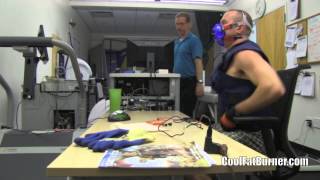
YouTube video (Jeffrey/’Eric’) demonstrating a controlled lab test of the “Cool Fat Burner” (and a companion “Cool Gut Buster”) at the Exercise and Physical Activity Resource Center (EPARC), UC San Diego. Using indirect calorimetry (masked breath measurement) Eric and lab manager David Wing compare resting metabolic rate (lying and sitting) to metabolic responses during cold thermogenesis with the device, ice water ingestion, and a ‘‘shiver‑surfing’’ protocol. Key measured facts in the video: resting metabolic rate lying ≈1944 kcal/day, sitting ≈2100 kcal/day; light shivering while wearing the devices produced >2× resting calorie burn, ice‑water + device produced ≈3× resting burn (Eric states an instantaneous extrapolated daily rate ≈5,860 kcal/day); the lab session had a technical glitch that lost ~16 minutes of data and the full session was about 1 hr 45 min. Eric also discusses prior N=1 experiments (glucose/insulin sensitivity and ketosis) and practical tips (keep fingers/toes/ears/nose warm, ‘shiver surfing’ interval approach).
Questions this video answers
About 1,944 calories per 24‑hour period (lying RMR).
About 2,100 calories per 24‑hour equivalent (sitting in lab; ~8% higher than lying RMR).
Slightly over 71 °F (Eric states ~71 degrees).
Over twice the resting calorie burn (reported as >2× resting rate).
Approximately three times the resting metabolic rate (≈3×).
Chapters
Hi, everyone, it's Eric and I'm here at the Exercise and Physical Activity Resource center at the University of California, San Diego. And today we're going to put the Cool Fat burner to the test. I'm here with David Wing, lab manager at eparc. David, why don't you fill us in on what we're getting into here?
Eric, we're really happy to have you here. Today we're going to use a process called indirect calorimetry. Basically what we're going to do is put a mask on you that measures how much air you're breathing and how much of that air is oxygen. Based on that, we can determine how much oxygen you're using. Because oxygen is used in the metabolic process, we can very precisely and accurately figure out how many calories you're burning through a series of calculations and algorithms.
So what we're going to do today.
Is we're going to measure you just regular sitting, natural if you will, how much your resting metabolism is. But then we're going to measure you again under a variety of circumstances, wearing the Cool Fat burner to see how that changes both how many calories you're burning and where those calories are coming from.
Awesome. Sounds good. A note to our viewers. For the first time ever, you're going to be seeing the Cool Gut Buster. We are in a laboratory setting, so obviously we can't be cranking AC and doing all that sort of thing. So I'm going to wear the Cool Gut buster simultaneously with the Cool Fat burner and hopefully that will crank the intensity up a little bit and let's see what kind of results we can get. Sounds good. Let's do it. Okay, I'm going to narrate this so we can fast forward through most of the footage. Let me quickly catch everyone up.
This is the third study. The first two individual studies I did months ago, completely independent of EPARC and the university. Those two studies I did on myself. One was the glucose insulin sensitivity experiment and the other was the ketosis experiment. Last winter, I did the test regarding insulin glucose sensitivity, nutrient partitioning, where basically I took my cold adapted lean self and intentionally fattened up, stopped all cold thermogenesis, basically most exercise, most healthy eating, ate a bunch of junk food, got fat, fattened up 2, 3 inches around the waistline, put on fat and then added exercise and cool fat burning, used cold thermogenesis and went through over 150 glucose strips over that month and a half and basically showed that I could lower blood glucose Levels about the same amount from cold thermogenesis, using cool fat burner as what I could running jogging basically for an hour or so. And of course that's not just about insulin sensitivity. It's also about nutrient partitioning. You don't want your fat to be insulin sensitive. If you're sensitive to insulin, that means when you eat stuff, especially carbs, all nutrients, that insulin is released and it pulls those nutrients from your bloodstream into your tissues. Well, you want that those nutrients pulled into your muscle tissue, not your fat tissue. So that's nutrient partitioning. And this probably also explains, as mentioned in the old how I eat junk food and still lose weight video. Whenever you work out, then have your junk food or high carb meal, then do cold thermogenesis, a lot of times you'll feel pumped afterwards. That's because of the increased insulin glucose sensitivity. And it's basically pushing.
All those nutrients into your muscles. Hence why you often feel pumped afterwards. And that pump sometimes is as big or significant, almost as big as the pump you actually feel from lifting. So that is nutrient partitioning taking place there, the nutrients being pushed into your muscles and not your fat cells. So that was the first experiment. Then I did an experiment that I didn't even mention, actually. They haven't even put up on the site or anything yet. Basically I wanted to if the cool fat burner could speed up ketosis, if I could enter ketosis faster from.
Using the cool fat burner, entering cold thermogenesis, etc. Than without. And of course the results showed that I did enter ketosis faster, but I had to use keto sticks. And they're very imprecise and not the most reliable tool. And since on top of just being an N1 experiment, just me, and not under really very controlled circumstances, I really didn't do much about that particular experiment. That was more of a personal curiosity as much as it was anything else. Well, now here we are at the University of San Diego or California San Diego, and this is about as scientific as it gets. We're doing indirect calorimetry. This is the gold standard for measuring calorie burning metabolic rates, so forth. And here at the EPARC lab, they, I mean, they design and run experiments, you know, for folks all over the country in the world. This, this is top notch scientific controlled settings here. As you can see, here I am, we're doing the resting metabolic rate. Technically this is, I'm sitting here, so I'm using slightly more like 8% more calories simply from sitting than from Lying down. Yesterday we did a true resting metabolic rate test where I was lying down and breathing into the mask and you know, they did what they did and got their measurements. My resting metabolic rate for the day is about 1944 calories. So in a single day, a 24 hour period, doing absolutely literally no physical activity, no cold exposure, no eating, nothing that can affect my metabolic rate. I'd be burning about 1944 calories. Now here sitting, it's about 2100 calories. It's about something like an 8% increase sitting. This also kind of ties into NEAT, the non exercise activity calories that you can burn just from moving around in the day, standing as opposed to sitting as opposed to lying down, having a job while you're active, so forth. You can burn hundreds and hundreds of calories every day just from that sort of activity. And of course, if we look at the chart, the calorie burn as it's charted over time, you can see that the numbers, the line graph here, it's more or less the same. The sitting is almost exactly the same as the lying resting metabolic rates, they're pretty comparable, not a real huge difference. Let me briefly go over how this experiment is going to be set up. We're going to do it in 30 minute blocks. Yesterday we did the lying down resting metabolic rate. Now we're starting with the sitting resting metabolic rate. We're going to do half an hour of cool down where I'm going to throw in a cool fat burner and cool gut buster and kind of let it take over. But I'm not going to drink any ice water and the room temperature is slightly over 71 degrees, so we can't count on that for any metabolic changes or calorie burn. So it's all coming from the cool fat burner and the cool gut buster. And that will be the cool down section which will be roughly 30 minutes. Then I'm going to drink some ice water to start off the 30 second or 30 minute time block after that and I'm going to try to push it up into the higher intensity levels. And then finally I'll take off cool fat burner, cool gut buster and see how my body recovers in a thermo neutral 71 degree room. See what that does to the calorie burning. Okay, so now we're moving into the next portion of the experiment, the cool down and I'm going to. Well, I'm going to put on the cool fat burner and cool gut buster. Normally I would stand up to do This, I wouldn't stay seated. And since I do stay seated, it's a bit clumsy for me to get it on a little cumbersome while putting it on while staying seated. But as part of this experiment, we want to eliminate the confounding variables as much as possible. What that means is I don't want anything else to take credit for the calorie burn. So if I stand up, move around, heave around the cool fat burner, this and that, that's going to increase my calorie burn at least for a few minutes or whatever. And we're trying to eliminate that. So that's why I stayed seated.
You'll notice throughout the experiment, I do very little movement. I stay more or less in the same posture, hands, arms, more or less in the same position. And I'm basically just watching a video on the phone. And again, this is, this is the cool down portion of the test. This is basically just relaxing, easing into the experience and so on. There will be no intensity level I experience in this experiment that I haven't already experienced many times with just the Cool Fat Burner. But because there's no air conditioning here, it's actually slightly warmer than what it should be. I'd prefer it to be 67 or 68. It's actually 71. And because I can drink very little ice water due to the mask, because of those limited, because of being limited on those supporting factors, that's why I kind of pulled out the Cool Gut Buster and using that to add to the intensity. I do know also that, you know, for many users of the Cool Fat Burner, maybe they want to use it at night and they can't drink a lot of ice water. And because they don't want to be up, you know, having to use the bathroom all night when they should be sleeping. So that's another reason I'm coming out with the Cool Fat Buster, just to make it a lot easier, so you don't have to drink so much ice water, you don't have to crank the, the AC quite as high and so forth. Okay, so let's look at the chart and let's see what's starting to happen here. We see, of course, already the resting rates, which are very comparable. And now as we're seeing the cool down, it doesn't go up a whole lot overall, but we're starting to see some small jumps. And then something interesting happens about 15 minutes in. Bam. All of a sudden I start, I shoot up straight from casual beginner casual, all the way up into low level hardcore intensity, which basically means really light shivering. Now, there's actually seven levels of shivering supposedly. And you know, the real, real subtle level is where you just barely feel twitch, maybe, you know, in some of the small muscles, your lower back or whatever. And of course the highest levels where your, you know, your whole body's twitching around due to uncontrollable shivering. So I'm at the lower levels here and already you can see the calorie burn shoots up really high. It doubles the calorie burn. Dave was actually the guy running the experiment, the EPARC lab manager, Dave, he was in the next room getting the ice water ready for the next segment. When he came in, he thought there was a mistake because the readings had jumped so high and he actually.
Stopped the experiment. We do have the data in here, but it's kind of amusing that that kind of jump was so ridiculously high that even he thought there was something wrong.
I'm getting some really weird readings. I'm going to do a full recalibration.
And we're going to start this second one over.
I'm just getting some really weird readings.
I'm sitting shivering. That's what I want.
Oh, you are?
Yeah.
That is definitely why you kicked in.
All of a sudden.
Okay, well, I'm still going to recalibrate the. Just because I'm getting a lot of CO2 off you. I just want to confirm that what we're seeing is you, not this.
It's definitely like hitting it all of a sudden.
Okay, cool.
So as you can see, you know, from our resting rate up to the cool down, we had a very slow creeping increase. And then bam. When it hit me all at once, even though it was real light shivering over twice as high, over twice the calorie burn. And as a quick aside, there's a neat little bio hack here, especially for those of you who are maybe thinking that shivering is such a terrible sensation or experience. First of all, keep in mind there are various levels and one can stay at the lowest levels of intensity. Also, keep in mind you don't need to shiver at all in order to see the benefits of cold thermogenesis. This is just sort of a way to speed it up and go all out. Go to the highest levels of intensity. Just like some days, you may work out harder than others or you may diet more stringently than other days. On some days, you may want to use the cool fat burner at the highest intensities and go up into at least light level shivering. It's up to the, you know, up to the user's discretion. But anyhow, one way to kind of negate the supposed negative experience. And this is partial theory, this is partial personal experience, and this is used in the cold thermogenesis community. This is not something we're testing here in the lab today. And that is using the covering the fingers, toes, ears and nose, double socks, gloves, usually I'd be wearing a snow cap, thick shorts, etc. Basically, whenever you feel cold, it typically starts in your fingers, toes, ears and or nose. So if you keep those areas warm, your perception is you're warmer than what you really are. So you feel warmer than what you would think. Certainly I feel warmer here than what many of you viewers probably think I feel simply because I'm keeping my fingers, toes, ears and nose warm. So that's largely a perceptual, subjective experience. Then there's the theoretical physiological change that happens. Again, this is still conjectural, not something we're testing here. But basically by keeping your fingers, toes and ears, ears and nose warm, you're telling your brain that all as well if it were out in nature, and your fingers, toes, ears and nose get cold, your brain thinks it's danger, you know, maybe you're in for some cold exposure, etc. So it's going to conserve heat and pull it in to the core. Well, by keeping your fingers, toes, ears and nose warm, you're telling your brain all is well. So it lets the heat flow, so to speak, and that allows the cool fat burner to pull more heat out, thus creating a greater thermal load and a deeper thermogenesis experience. Now add to that, if you just occupy your mind, whether you're watching tv, reading a book, I like to mess around on the computer. While you're doing your sessions on top of the fingers, toes, ears and nose, I mean, you're almost hardly even cognizant of even shiver level intensity. It's kind of amusing. You look down and see maybe your hand twitching. And obviously you're conscious that your trunk is cold and you feel the cool fat burner. But it's not the experience you typically associate with shivering. And then of course, it comes as little surprise that schools of mysticism around the world, some of their meditational practices involve maybe meditating in the snow or meditating under cold waterfalls and so on. So it all kinds of ties together. So to conclude all that going to the highest level intensities is not required, but if you decide to do it every so often, you can kind of do this biohack trick out on your system to feel much warmer than you are, cover the fingers, toes, ears and nose, occupy your mind, let go, relax, and.
There you go. Okay, so I drank the ice water and we can see the number shooting really high. We now go to triple calorie burn, three times the normal rate.
Wow. Here's the thing too. There's a, there's a phrase I kind of coined a technique I came up with called shiver surfing. Think of it as interval training for cold thermogenesis. First of all, I'm not even going full all out shivering here. I'm only going to going to low level shivering. And even then I'm only spending half the time shivering. I'm cycling in and out of shiver goosebumps. Shiver goosebumps. Now, there's numerous advantages to this. One, you don't have to go as intense for your peaks during the shiver. Two, you're only shivering half the time. Three, whenever you cycle back down into the mere goosebumps. This is almost certainly what's like tricking and forcing your brown adipose tissue, your brown fat into kicking on or at least really going into overdrive. See, think about it. Just like interval training with exercise, I'm only spending half my time at the higher intensity, yet I'm still getting this huge, huge caloric burn, this huge metabolic boost. Again, triple the normal rate. Now think about this. The magic number you always hear is 500 calories a day for weight loss. The safe amount you should be trying to lose is a pound of fat a week. Because if you go more than that, you're probably going to cause metabolic damage, you're probably going to lose muscle tissue, and then when you do regain the fat, you're going to regain it all, plus more. So you shouldn't try to lose more than a pound a week. And that comes out on average to 500 calories a day. Well, I'm doing this right now. At this rate, I'm going to have 500 calories in no time flat over the course of a day. This is over 5860 calories. Now, of course I'm not going to do this for 24 hours, but think about that. That number is approaching the generic 6,000 calories a day that the scientists on Antarctica burn, the ones who are required to eat 6,000 calories a day in order to maintain their body weight. I'm burning that many calories, or just about at this rate right now, 5,860 calories. And I'm only shiver Surfing. I'm not going all out shivering, and I'm not even spending the whole time shivering. Only half the time, as you can see on the chart with the ups and downs, up and downs, but they're all still around that triple metabolic rate level. And I stay like this for what, the whole 15 minutes to 30 minutes now when I do this at home, a lot of times when I have the cold, cold room ice water, I'll stay like that for an hour. I'm staying at that rate for an hour. So do the math. I'm getting my hundreds and hundreds of calories burned right then and there, you know, and then for the last half of the session, I'll slowly taper off, go more towards the goosebumps and try to recruit more of the brown fat, which will last for, you know, far beyond the session. During this section we actually had a technical glitch and we lost actually 16 minutes of, of data and recording. So the session is actually even longer. The whole experiment is even longer than what's indicated by the graph. I believe Dave said the whole thing was something like an hour and 45 minutes. Typically when I personally do a session, I never go less than an hour, pretty much ever. And I'll frequently go up to an hour and a half or two hours. Again, roughly half the session shivering, or at the very least, shiver surfing. And then the last half just goosebumps. You obviously don't have to go that high to get the benefit. But you know, I'm going for broke and I'm going to burn massive amounts of calories. I'm going to do it quick, you know, get the biggest, quickest effect possible. Okay, so for the, for the last part of the hardcore session after we had the glitch, I remember, I don't know if this is purely subjective or if it was the case, but I remember the ice water wasn't quite as cold and we had between the lost time and so forth, you can see the numbers start tapering down somewhat, probably due to, in my opinion, due to just a lack of stimulus. And it's longer, there's more there than what we're actually seeing due to the lost time. So winding down the hardcore session again, we had the triple calorie burn. Massive calorie burn. Just ridiculous.
Now let's move into the post session recovery stage. So I take off the cool fat burner, cool gut buster. And we can still see that for that first 15 minutes, I'm over 230% of my resting metabolic rate, calorie Burn. So even though we don't have a cold room, which is at home, how you should be doing it, after you take off your, your cool fat burner, you should be relaxing or lounging in a cold room. And even though I'm not drinking any more ice water, I'm still getting well over double my calorie burn for the first 15 minutes. And then for the last 15 minutes I eat of this last 30 minute segment, my calorie burns around 170%. So on average for that whole half hour, I had a 200% calorie burn for the whole last half hour after removing the device. So to kind of summarize the whole thing, my resting metabolic rate was tripled during the hardcore section of the experiment here I was doing something that's very easy, shiver, surfing, shoot into very slight shivering, then cool back down into goose pumps and then just repeat that over and over. The amount of calorie burn I have here in this session would easily count for that 500 calories a day magical number that people recommend for a pound of fat a week of safe weight loss. Even if you don't get all 500 calories from cold thermogenesis, get some of it from there, some of it from exercise, some of it from diet. Now you don't have to just rely on diet. Why put all your eggs in one basket? What if you screw up that day or have a binge day or you know, fall off the wagon, then what? You're screwed. But what if you could throw in a little bit of exercise or some cool fat burner use? Now you still get your 500 calories burned for the day despite not eating, you know, sticking to your diet that particular day. And I think this experiment, even though it is just on me, it pretty much shows without, you know, without a doubt under the highest scientific standards, that there's a huge potential for a massive calorie burn with cold thermogenesis. Here I am sitting in a, you know, 71 degree room, didn't drink hardly any ice water, threw in a cool fat burner, cool gut buster, and I'm burning calories at a daily rate that approaches being in Antarctica. So there is definitely something here. So if you're interested in cold thermogenesis, all the benefits, the weight loss, the hormonal rebalancing, insulin, adiponectin, reduced systemic inflammation, a better restful sleep post exercise recovery, just all the benefits that come with it. Here you go, good luck, until next time.
More from Jeffrey





The Solution to Aging Might Be Closer Than Anyone Realizes - With Ben Goertzel


