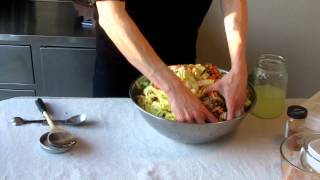
Jessie Greenfield walks through making kimchi at home using whey and salt for lacto-fermentation. Mix vegetables, let them release liquid for 45 to 60 minutes, pack into jars, ferment at room temperature for three days, then refrigerate. A half-gallon batch is ready to eat after three days.
Questions this video answers
Two shredded napa cabbages.
Six shredded carrots.
1 cup of daikon radishes.
Two bunches of green onions.
Two tablespoons of grated ginger.
Chapters
Hi, I'm Jessie Greenfield with the Inner Circle, and I'm going to show you how to make kimchi. It's an excellent snack and one of the most nutrient rich foods you can possibly eat. So that being said, I'm going to show you how easy it is to make. What I have here is I have two shredded napa cabbages.
Here. I have six shredded carrots. You'll throw those in there with that.
A cup of daikon radishes.
Two bunches of green onions, and you're probably thinking to yourself, wow, that's getting kind of full. It's okay. It's going to shrink down.
We have six.
Minced garlic.
Two tablespoons of grated ginger.
Okay. Then I'm gonna put in some of the seasoning. This is chili powder. You can do chili flakes, whatever you prefer. I like to do two teaspoons of it in mine. It's however hot you like it. It is a spicy dish.
But you can determine on how spicy you like that.
So we got two teaspoons of chili powder.
And then I got eight tablespoons of whey. And you're probably like, well, we don't have whey just laying around the house. A couple places where you can get whey is by buying fresh mozzarella. The stuff that's in the liquid. That liquid it's in is whey. You can find whey in yogurt. It's generally that slimy stuff that is right on top of the yogurt is the whey. I make yogurt cheese, and so I have an abundance of whey. And someday I will show you how to make yogurt cheese. So here is eight tablespoons of whey.
And then you're gonna do 2 tablespoons of salt, which I need to go grab. Sorry.
Cooking dinner at the same time, simultaneous. Yes. I am a woman. I'm a good multitasker.
So there's one tablespoon and this, the salt and the whey is what's going to preserve this dish. That's what is used, what people used to use back in the day, probably during great grandparents time, to preserve their food. So two tablespoons.
Of that.
Then we're going to carefully toss this doesn't need. I'm actually going to use my hands. Make sure your hands are clean when you do this, because it's lacto fermentation that we're doing here is what the term is called. And it's basically growing good bacteria. This is. I'm going to really Help you in your stomach and the digestion and the assimilation of all of your nutrients. One of the reasons why this is such a good food for you. This is excellent. Now, it doesn't need to be tossed like to perfection, but just get it going.
Yes. See, I'm making a mess. It's okay. Everything can be cleaned.
So next there's a couple of options. You can either take a mallet and pound this down. And what will happen is the salt is going to draw the moisture out of the vegetables because there's a lot of moisture in here. Or what I like to do is I just like to let it sit and let thyme do that for me, because I have lots of other things I can be doing while this is sitting. And the water will draw out itself. So it takes about, I would say an hour, maybe 45 minutes for that to happen. And then when you come back, you're gonna lick in the very bottom and there's gonna be a lot of liquid at the bottom. And then I like to stir it all up. And then that's when I put it in my jar. And what I do is I get a. This makes a half gallon of kimchi. That seems like a lot of kimchi. If you want less than that, you can half this recipe. No big deal.
So I have a half gallon jar. I'm going to put this all in my gallon jar. When it's in my half gallon jar, I'm going to press this stuff down to the bottom. You want the liquid to cover this. That's important. Otherwise you're going to get some ugly brown kimchi. So you want the liquid to be about to be an inch of liquid covering this. Then after that, you're going to let it sit out on your counter for three days. Sounds like a long time. But remember, we got all this salt in here and that's what preserving. That's what's preserving it and that's what's causing it not to rot. So after three days it goes to cold storage, which goes into your fridge. Or like us, you could probably put it in your garage right now. It's cold enough outside, so that's how you make kimchi. And it's ready to eat after three days. Really little amount of labor that goes into this. And you've got a very healthy food product here. If you buy this stuff in the store, it's probably pasteurized and it no longer has the health benefits that this would have. So I hope you try this out. It's a really great recipe. If you have questions on it, leave them on the forum. I'll be happy to answer any questions or concerns you have about making this stuff. Enjoy the recipe. Delicious. A half gallon is normally gone in a week at our house, so enjoy.